Viajá con Gus
HomeSouth AmericaVenezuela
Venezuela
🇻🇪 South America

Venezuela

White-sand Caribbean beaches, the mysterious tepuis of La Gran Sabana, the towering Angel Falls and the Andean cable cars of Mérida: a country of extreme contrasts where the sea and the mountains almost touch.

Jump to what you need

🧭 Essential facts

Currency
Venezuelan bolívar (VES). In practice, US dollars in cash circulate widely and are used for most everyday purchases.
Language
Spanish. Numerous recognized indigenous languages are also spoken.
Capital
Caracas
Plug
120 V, 60 Hz — types A and B (US-style plug)
Best time to visit
Dry season, December to April. To see Angel Falls at full flow, aim for the rainy season (June to November) instead.
Time zone
VET, UTC-4 (no daylight saving time)
Entry / visa
Requirements depend heavily on your passport: UK and Australian citizens can currently enter visa-free for up to 90 days, while US and Canadian citizens must apply for a visa in advance (visas are not issued on arrival). Check your own government's current advice before booking, as conditions change quickly.

🌍 About Venezuela

Venezuela is a country of extraordinary nature: Angel Falls, the world's tallest uninterrupted waterfall; the prehistoric tepuis of La Gran Sabana; the turquoise waters of the Los Roques archipelago; the Mérida Andes; and Caribbean beaches. Sea and mountain, rainforest and savanna all sit within a short distance of one another. On potential alone, it is one of the most spectacular destinations in South America.

The country breaks down into very distinct regions: the center and the capital (Caracas); the coast and the Caribbean (Margarita Island, Los Roques, Morrocoy, Choroní); the Andes and the west (Mérida, Maracaibo); and, above all for nature-focused travelers, Guayana and La Gran Sabana in the southeast, with Canaima, Angel Falls and Mount Roraima. Because distances are so large, many legs are covered by domestic flights, and several iconic destinations (Canaima, Los Roques) are visited almost exclusively through organized packages.

It's worth being upfront about this: Venezuela has been going through a deep economic, social and political crisis for years, and in 2026 it is also navigating a government transition that keeps it an unstable destination, one that a number of foreign ministries advise against or restrict travel to. It is not a country for improvising or traveling independently without a plan. Those who go typically do so with trusted local operators, stay well informed about the current situation, and accept that conditions can change fast.

Advertisements

💱 Currency and exchange rate

Traveler's tip: bring US dollars in cash, in small, clean, undamaged bills, because they are used daily for almost everything. Foreign cards and ATMs work only sporadically, even if your home bank is American, so don't plan around them. Check the day's exchange rate before paying in bolívares, and keep your cash split between a few different places.

💱 What your currency is worth in VESLIVE WIDGET
Loading live rates…
Full converter for VES →

✈️ Getting there and around

There are no direct commercial flights between Venezuela and the United States, Canada, the United Kingdom or Australia, so getting there always means connecting through a third country. The main gateway is Simón Bolívar International Airport in Maiquetía (CCS), serving Caracas from the coast near La Guaira, about 45 minutes from downtown. From North America, the standard route is via Panama City on Copa Airlines, or via Bogotá; from the UK and elsewhere in Europe, Madrid on Iberia is the usual hub, with occasional connections through Istanbul on Turkish Airlines. From Australia, expect a long routing through the US or Europe and then one of these hubs — there is no realistic one-stop option. Once in the region, Venezuelan carriers such as Conviasa (the flag carrier), Laser Airlines, Avior and Estelar cover the final leg into Caracas and other cities; routes and frequencies change often, so confirm details close to your travel dates. Other airports worth knowing are Maracaibo (MAR), Valencia (VLN) and Porlamar on Margarita Island (PMV). For long distances inside the country, domestic flights save serious time: the most useful routes link Caracas with Porlamar (Margarita), Maracaibo, Puerto Ordaz and Canaima (the base for Angel Falls). On the ground, intercity buses cover the whole country from terminals such as La Bandera in Caracas, with reclining overnight services on the longer routes. Within cities, taxis are the practical option: agree the fare before you get in, or use a car arranged by your accommodation, since ride-hailing apps have only limited coverage.

🎒 What to do and see

Angel Falls (Kerepakupai Merú)
The world's tallest uninterrupted waterfall, dropping nearly 1,000 m (3,280 ft) from the Auyantepui tepui inside Canaima National Park. You reach it by light aircraft to the village of Canaima and then by curiara (dugout canoe) along jungle rivers. It is the country's single natural showpiece and one of the most striking sights in all of South America.
Canaima Lagoon
The heart of the park: a lake of tannin-reddened water ringed by waterfalls — including the Sapo Falls, which you can walk behind — with tepuis on the horizon. It is the base camp for excursions to Angel Falls and a remarkable landscape in its own right. Visited on packages from Ciudad Bolívar or Puerto Ordaz.
Los Roques
An archipelago of more than 300 islands and cays of white sand and clear turquoise water, one of the most pristine marine parks in the Caribbean. Ideal for snorkeling, diving, kitesurfing and simply unplugging. You fly in on a light aircraft from Caracas and stay at a guesthouse on Gran Roque. A genuine paradise, though not a cheap one.
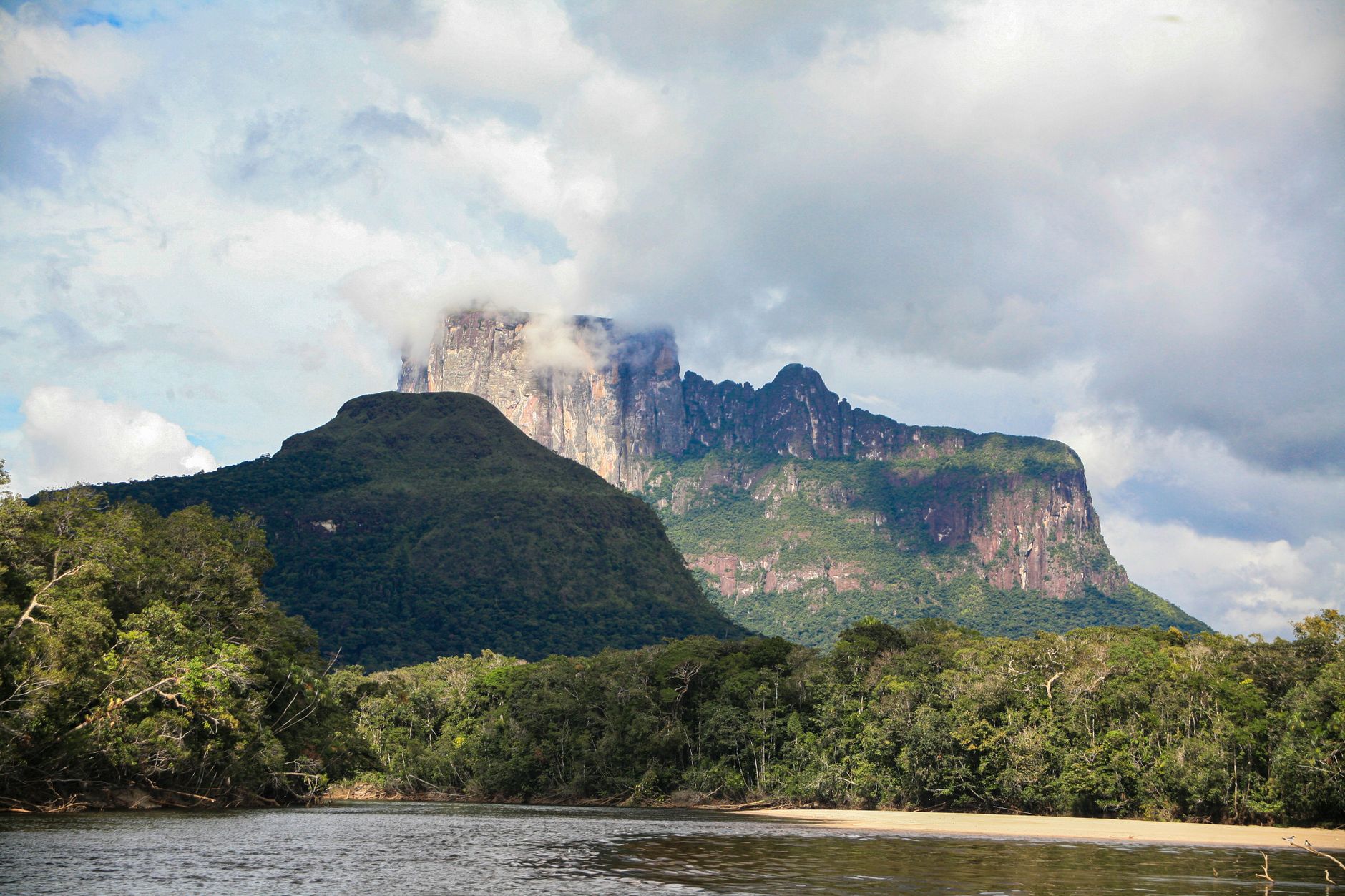
Mount Roraima
The most famous tepui, the 'lost world' that inspired Arthur Conan Doyle: an ancient rock plateau where Venezuela, Brazil and Guyana meet. The multi-day trek to its summit, with its lunar landscapes and endemic species, is one of the great adventure treks on the continent. It requires a licensed guide and a solid level of fitness.
La Gran Sabana
A vast high plateau of savanna, rivers, waterfalls (such as Kamá Falls and Aponwao Falls) and tepuis breaking the horizon, home to the Pemón people. You drive the highway that runs down toward the Brazilian border. Wide-open, silent, otherworldly scenery.
Mérida and the Andes
The university city of the Venezuelan Andes and the base for the mountains: the Mérida cable car (Mukumbarí) is one of the highest and longest in the world, climbing above 4,700 m (15,400 ft). Around it are Andean villages, high moorland, lagoons and hearty mountain cooking — a cool contrast to the Caribbean coast.
Margarita Island
The 'Pearl of the Caribbean', the country's largest and most popular island, with beaches for every taste, colonial history in La Asunción and Pampatar, and a relaxed atmosphere. For decades it was Venezuelans' favorite sun-and-sand escape, with direct flights from Caracas and other cities.
Morrocoy National Park
On the central coast, a park of cays, mangroves and calm, shallow-water beaches (Cayo Sombrero, Playa Mero), hugely popular for a day trip by boat with snorkeling. An accessible slice of Caribbean reachable from the mainland, near the towns of Tucacas and Chichiriviche.
Choroní and Henri Pittier National Park
Crossing the cloud forest of the country's oldest national park brings you to Choroní and Puerto Colombia, a colonial village of brightly painted houses beside Caribbean beaches with strong Afro-Venezuelan heritage, drums included. A nature-and-culture escape from the country's center.
The Catatumbo Lightning
Over Lake Maracaibo, where the Catatumbo River meets the lake, a unique phenomenon occurs: electrical storms on nearly every night of the year, one of the most lightning-dense spots on the planet. It can be watched on excursions from the southern end of the lake — an unmatched natural spectacle for curious travelers.

📅 When to go: climate and best time

The best overall time to visit Venezuela is the dry season, December to April, with sunnier, more stable weather — ideal for the Caribbean beaches (Los Roques, Margarita, Morrocoy), the Mérida Andes and treks such as Roraima, which is far more enjoyable without constant mud. It is also the local high season, especially around year-end holidays, Carnival and Easter week.

There's one important exception: to see Angel Falls at full flow, you want the rainy season, June to November, when the rivers swell enough for light aircraft and dugout canoes to reach the base comfortably; in the height of the dry season, the flow drops sharply and river access can become difficult. In short — if Angel Falls and Canaima are the priority, aim for the rainy months; for everything else, go dry. Either way, check the country's current situation and flight connectivity before locking in dates, since services keep changing in 2026.

Advertisements

🍽️ What to eat

The national emblem is the arepa: a round cornmeal flatbread that's split open and filled a thousand different ways (the chicken-and-avocado 'reina pepiada' is a classic), eaten at any hour. Add empanadas, tequeños (cheese-filled dough sticks), pabellón criollo (the national dish: shredded beef, black beans, rice and fried plantain), Christmas hallacas, and cachapa made from fresh corn. Tropical fruit and Venezuelan cacao — among the best in the world — are a treat on their own.

In practice, Venezuela runs on cash US dollars today, and tourist-facing prices are high. Street food is the most affordable option: a filled arepa or empanada runs 2 to 5 USD, while a restaurant meal in a city costs about 10 to 20 USD per person (verified July 2026). In destinations like Los Roques or Canaima, where nearly everything moves through packages, meals are usually included at your guesthouse. To drink, try fresh fruit juices, coffee and Venezuelan rum, which is highly regarded.

🛟 Safety and health

Venezuela is, right now, a higher-risk destination, and it's worth saying that plainly, without either exaggerating or downplaying it. The country carries a deep economic and social crisis, with high crime levels (Caracas in particular records elevated insecurity), and in 2026 a political transition following the January capture of Nicolás Maduro keeps the situation unsettled. As of 2026, the US State Department rates Venezuela Level 3 (Reconsider Travel) — an improvement from the previous Level 4 (Do Not Travel) — with specific Do Not Travel zones for the Colombia border area, Amazonas state and Apure state; the UK Foreign Office advises against all but essential travel to many parts of the country; and Canada's government advises against all travel, a rating it has kept since its embassy closed in 2019. This doesn't mean the country is off-limits (Venezuela received more than 3 million international visitors in 2025), but it does mean it isn't a destination to improvise. Visitors typically travel with trusted local operators, avoid moving around independently, don't display valuables or cash, use taxis arranged through their accommodation (especially from Maiquetía airport), and stay current on the situation. Nature destinations run through agencies (Los Roques, Canaima, La Gran Sabana) operate in a more controlled way than the big cities do.

On health, the public system is badly deteriorated and quality care is private and expensive, so travel insurance with solid medical coverage and evacuation is essential — and worth double-checking works given the unusual diplomatic situation. Bring your own medications, since shortages happen. No vaccine is mandatory, but yellow fever is recommended for La Gran Sabana and the Amazon, along with precautions against dengue and malaria in jungle areas. Tap water isn't safe to drink — stick to bottled water. Power and water cuts are common. The general emergency number is 911 (verified July 2026), though response capacity is limited, and remember that consular support for foreigners in trouble is itself limited or complicated right now depending on your nationality — check what your own embassy or nearest mission can actually do before you go.

💰 How much it costs

Venezuela is something of a paradox for budgeting: even though the country is in crisis, it isn't cheap for visitors, because the economy runs on the dollar and tourist services are priced accordingly. Outside the premium destinations, about 40 to 70 USD a day covers local food and basic transport, but the marquee attractions push the budget well past that (verified July 2026). Carrying US dollars in cash — small, clean bills — is essential, since foreign cards and ATMs work only sporadically.

As a reference for the star destinations (July 2026): a round-trip flight from Caracas to Los Roques runs around 120 USD, plus a roughly 50 USD park fee for foreigners, and all-inclusive guesthouses run 135 to 285 USD per person per night. Canaima packages typically cost 1,000 to 1,500 USD per person (including internal flights, lodging and the Angel Falls excursion), and a one-day excursion to the falls runs roughly 250 to 350 USD. Day-to-day life, by contrast, is far cheaper: an arepa costs 2 to 5 USD and a restaurant meal 10 to 20 USD. The short version: the iconic nature experiences demand a real budget; everyday life doesn't.

🤝 Culture and practical tips

The language is Spanish, spoken with a fast, expressive Caribbean accent full of local slang ('chévere' for cool, 'pana' for buddy, 'chamo' for guy or kid); any Spanish speaker gets by easily, but English carries you only so far outside hotels and agencies. Numerous indigenous languages are also spoken, especially in La Gran Sabana (the Pemón people) and the Amazon. Venezuelans are warm, talkative and deeply hospitable, proud of their music (gaita, joropo), their baseball and their food. Despite the hardships, a strong sense of humor and solidarity runs through daily life.

The plug is 120 V and 60 Hz with type A and B sockets — the same as in the US and Canada, so North American devices need no adapter, while UK, European and Australian travelers do. Because power cuts are frequent, pack a power bank and a flashlight. Connectivity is uneven: prepaid SIM cards are available (Movistar, Digitel), but internet can be slow and unreliable, and an eSIM won't always solve that. One piece of advice from people who know the ground: arrange everything in advance with your accommodation or agency (transfers, payments, routes), carry enough cash because you won't be able to withdraw money easily, and check the country's situation shortly before you travel, since it changes fast.

📜 History of Venezuela

The history of Venezuela is the history of a land of extraordinary contrasts — from the Caribbean to the snow-capped Andes, from the endless Llanos to the Amazon and the tepuis of Guayana, the oldest lands on the planet — inhabited for millennia by Carib, Arawak, Timoto-Cuica and Warao peoples. It was one of the first places where Christopher Columbus set foot on the American mainland, on 3 August 1498, when he reached the Paria Peninsula and named it 'Tierra de Gracia' (Land of Grace). A year later, the expedition of Alonso de Ojeda, Amerigo Vespucci and Juan de la Cosa saw indigenous stilt houses over Lake Maracaibo and named the region 'Venezziola' — little Venice — the origin of the country's name.

Here was born the first Spanish province on the continent, with its capital in Coro from 1527, and three centuries later, South American independence itself: from this land came Francisco de Miranda, the Precursor, and Simón Bolívar, the Liberator, who freed half of South America. Venezuela was the first Spanish American nation to declare absolute independence, on 5 July 1811.

Read the full history of Venezuela →

❓ FAQs about Venezuela

Is it safe to travel to Venezuela in 2026?
It's a higher-risk destination. The country is in a prolonged crisis and, in 2026, a political transition that keeps things unsettled, with elevated crime especially in Caracas. As of 2026, the US rates it Level 3 (Reconsider Travel, up from Level 4), the UK advises against all but essential travel to many areas, and Canada advises against all travel. It isn't impossible to visit (it draws millions of tourists), but it isn't for improvising: those who go use trusted local operators, avoid moving around independently, and stay well informed. Check your own government's current advisory before deciding (verified July 2026).
Do I need a visa, and does it depend on where I'm from?
Yes, sharply so. UK and Australian passport holders can currently enter visa-free for stays of up to 90 days. US and Canadian citizens need to apply for a visa in advance — visas are not issued on arrival, and processing can take a couple of weeks. Bring a passport valid for at least 6 months beyond your entry date regardless of nationality, and double-check current requirements close to your travel dates, since they've been changing through 2026.
What currency is used, and can I pay by card in Venezuela?
The official currency is the bolívar (VES), but in practice US dollars in cash circulate widely and are what you should plan to bring, in small, clean bills. Foreign cards and ATMs work only sporadically — even US-issued cards aren't reliable here — so don't count on them: travel with enough cash and keep it split between a few places.
Is Venezuela expensive to visit?
For visitors, yes — more than most expect, since the economy runs on the dollar and tourist services are priced in it. The marquee destinations push the budget hard: a night at a Los Roques guesthouse runs 135 to 285 USD, and a Canaima package costs 1,000 to 1,500 USD. Everyday local food, by contrast, is cheap (an arepa costs 2 to 5 USD) (verified July 2026).
How do I get to Angel Falls?
Angel Falls sits inside Canaima National Park, with no road access. You fly by light aircraft to the village of Canaima (from Ciudad Bolívar or Puerto Ordaz) and then travel by curiara (dugout canoe) along jungle rivers to the base of the falls. This is almost always done through an organized package. For the falls at full flow, aim for the rainy season (June to November).
Do I need travel insurance and vaccinations for Venezuela?
Travel insurance with solid medical coverage and evacuation is essential, since quality healthcare is private and expensive. Bring your own medications in case of shortages. No vaccine is mandatory, but yellow fever is recommended for La Gran Sabana and the Amazon, along with precautions against dengue and malaria. Given the unusual diplomatic situation for some nationalities, it's also worth checking what consular help would actually be available to you before you go. Don't drink tap water.
What's the best time of year to visit Venezuela?
The dry season (December to April) is best overall, ideal for the Caribbean beaches, the Mérida Andes and the Roraima trek. The exception is Angel Falls: for full flow, aim for the rainy season (June to November). Always check the country's current situation and flight connections before fixing your dates.
Advertisements
Cities and destinations

Explore Venezuela by region

Pick a region and open each destination to see what to do, prices and how to get there.

📍

Central Venezuela and the Capital

9 destinations
Caracas
Caracas
See guide →
Maracay
Maracay
See guide →
Valencia
Valencia
See guide →
Waraira Repano National Park (El Ávila)
See guide →
Colonia Tovar
Colonia Tovar
See guide →
Galipán
Galipán
See guide →
Henri Pittier National Park
See guide →
Choroní
Choroní
See guide →
Cata and Cuyagua
Cata and Cuyagua
See guide →
🏔️

The Andes

11 destinations
Mérida
Mérida
See guide →
Mérida Cable Car System (Mukumbarí)
See guide →
Pico Bolívar
Pico Bolívar
See guide →
Sierra Nevada National Park
See guide →
Sierra de La Culata National Park
See guide →
Jají
Jají
See guide →
Los Nevados
Los Nevados
See guide →
Mucubají Lagoon
Mucubají Lagoon
See guide →
Pico El Águila
Pico El Águila
See guide →
San Cristóbal
San Cristóbal
See guide →
Trujillo (Monument to the Virgin of Peace)
See guide →
📍

The West and Zulia

5 destinations
Maracaibo
Maracaibo
See guide →
Catatumbo Lightning
Catatumbo Lightning
See guide →
Sinamaica Lagoon
Sinamaica Lagoon
See guide →
Santa Ana de Coro and the Médanos Dunes
See guide →
Adícora
Adícora
See guide →
📍

The East, Caribbean and Islands

11 destinations
Margarita Island
Margarita Island
See guide →
Los Roques Archipelago
See guide →
Morrocoy National Park
See guide →
Chichiriviche
Chichiriviche
See guide →
Puerto La Cruz
Puerto La Cruz
See guide →
Mochima National Park
See guide →
Cumaná
Cumaná
See guide →
Paria Peninsula
Paria Peninsula
See guide →
Río Caribe
Río Caribe
See guide →
Coche Island
Coche Island
See guide →
La Tortuga Island
La Tortuga Island
See guide →
📍

Guayana and La Gran Sabana

11 destinations
Canaima (Canaima National Park)
See guide →
Angel Falls (Kerepakupai Vená)
See guide →
Mount Roraima
Mount Roraima
See guide →
Ciudad Bolívar
Ciudad Bolívar
See guide →
Ciudad Guayana (Puerto Ordaz)
See guide →
La Gran Sabana
La Gran Sabana
See guide →
Santa Elena de Uairén
See guide →
Quebrada de Jaspe (Kako Parú)
See guide →
Kamá Falls (Kamá Merú)
See guide →
Kavac
Kavac
See guide →
Auyantepui
Auyantepui
See guide →
🌿

The Llanos and Amazonas

6 destinations
The Llanos
The Llanos
See guide →
Apure Cattle Ranches (Hatos)
See guide →
San Fernando de Apure
See guide →
Barinas
Barinas
See guide →
Puerto Ayacucho
Puerto Ayacucho
See guide →
Cerro Autana
Cerro Autana
See guide →

💡 Fun facts

Angel Falls (Kerepakupai Merú) is the world's tallest uninterrupted waterfall, dropping nearly 1,000 m (3,280 ft) from the Auyantepui tepui.
The Catatumbo Lightning, over Lake Maracaibo, produces electrical storms on almost every night of the year and is one of the most lightning-dense spots on the planet.
The tepuis of La Gran Sabana are among the oldest rock formations on Earth and shelter species found nowhere else.
The arepa is the national culinary emblem: a cornmeal flatbread split and filled a thousand different ways, eaten at any hour of the day.
Venezuela has a Caribbean coastline and an Andean mountain range within the same country, plus the Los Roques archipelago, one of the most pristine marine parks in the Caribbean.
Sources

Where the data on Venezuela comes from

These are the sources we cite most across this country's guides, with how many times each appears. Hard data —tickets, opening hours, requirements, transport— comes from the official source and carries the date we checked it. Restaurant and hotel picks come from guides and reviews, and we say so on each page.

Image credits
Photos from Wikimedia Commons, each under its own licence (CC BY, CC BY-SA or public domain). Open each file to see its author and licence.
Maracay cerro (cropped) · Vista de la ciudad desde las urbanizacion la trigaleña · Altamira, La Castellana en Caracas, Venezuela · Colonia Tovar 2 · Poblado de Galipán · ISLA LARGA CARABOBO · Colores de Pueblo · ColoniaTovarMountains · Plaza Bolívar de la Ciudad de Mérida · Teleferico Arribando Estacion barinitas · Pico Bolívar desde el Pico el Toro · Bolívar usgs · Sierra La Culata, Mérida, Venezuela · Jaji merida · Los Nevados, Merida, Venezuela · Laguna de Mucubají, Merida, Venezuela · PICO EL AGUILA10, MERIDA · CollageSCB · Plaza Cristobal Mendoza · Puente de Maracaibo · Catedral de Nuestra Señora del Rosario de Cabimas. · Laguna de Sinamaica - Palafitos Escuela · Monumento a la Federación Venezolana I · Playa Punto Fijo · PlayaElAgua (Margarita-VEN) · Village Gran Roque · Cocotero en Cayo Sombrero · Chichiriviche de Noche · Parque Nacional Mochima Puerto La cruz, Edo Anzoategui. · Parque Nacional mochima · Cumana sucre · Playa Medina Peninsula Paria · Río Caribe · Atardecer en la Isla de Coche · Playa caldera la tortuga venezuela B · Salto del Angel-Canaima-Venezuela18 · Monte Roraima derivado 2013 000 · Ciudad Bolivar, Venezuela (12455501955) · SaltoAngel5 · Santa Elena de Uairen, Bolívar, Venezuela - panoramio (6) · +9