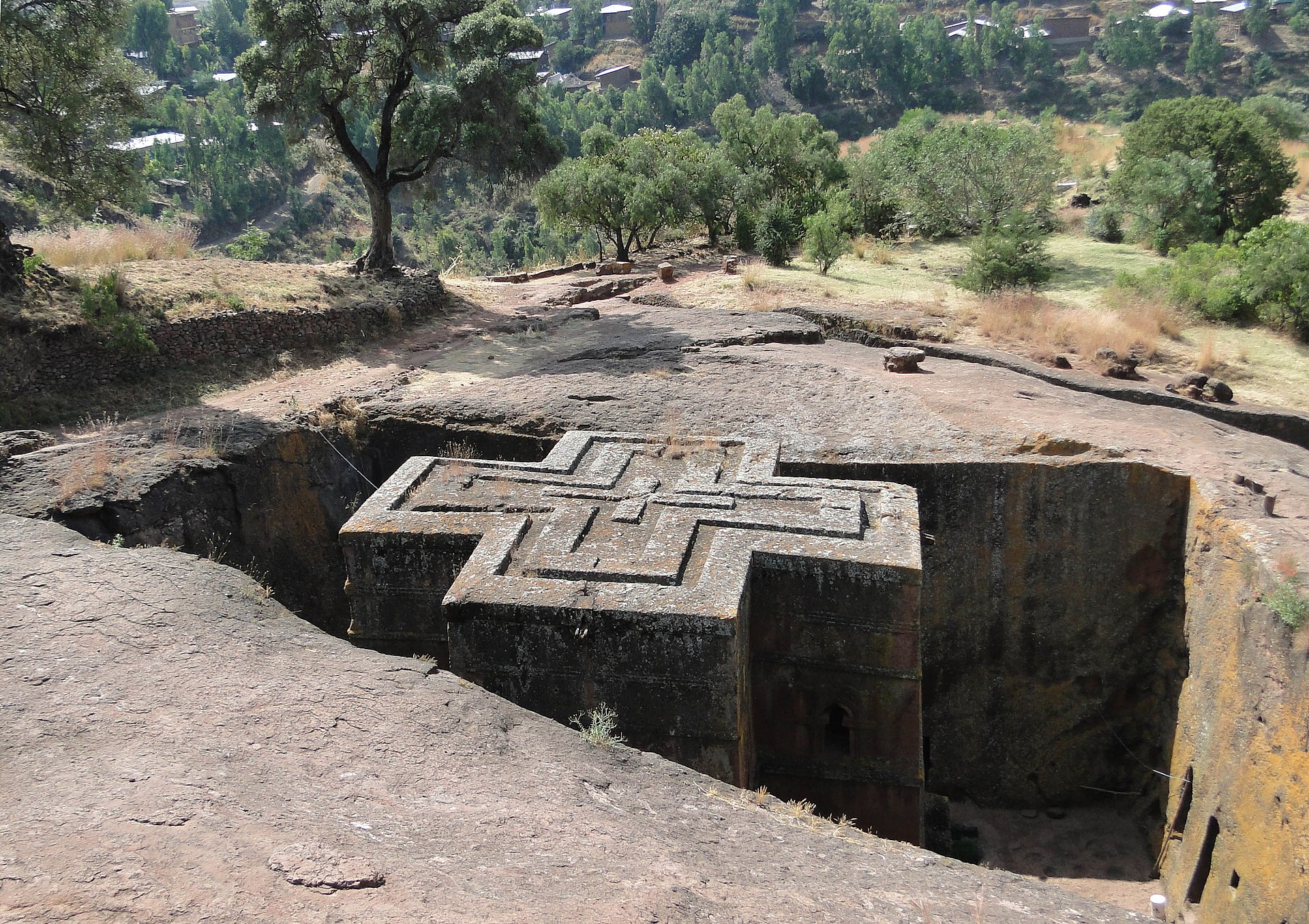
The rock-hewn churches of Lalibela, one-of-a-kind landscapes and an ancient culture: Ethiopia is one of Africa's least-known gems.
🌍 About Ethiopia
Ethiopia is different from everything else in Africa, and that's not a cliché. It's the only country on the continent that was never colonised —it held off Italy at Adwa in 1896—, it has its own alphabet, its own thirteen-month calendar and its own Orthodox Christian church, one of the oldest in the world and older than most of Europe's. All of that adds up to a trip that feels like it's on another frequency.
The historic northern circuit is the heart of the country: Lalibela, with eleven churches carved downwards into the living rock in the 12th century; Gondar and its stone castles, which look medieval European in the middle of Africa; Axum, capital of an empire that minted its own coins while Rome still existed; and Lake Tana with its island monasteries. This is living heritage, not ruins: in Lalibela, mass is still celebrated as it was eight hundred years ago.
Nature is just as impressive and among the most unusual on the planet: the Simien Mountains, with maned gelada baboons that exist only here, and the Danakil Depression, one of the hottest and lowest places on Earth, with lakes of yellow acid and volcanoes with permanent lava. Now, to be frank: Ethiopia is a demanding trip. Infrastructure is patchy, you feel the altitude, and the security situation varies a lot from region to region, so you need to check up-to-date official sources before putting your itinerary together.
💱 Currency and exchange rate
The local currency is the birr (ETB). It's worth carrying some cash, letting your bank know before you travel and checking the day's exchange rate.
💱 What your currency is worth in ETBLIVE WIDGET
Loading live rates…
✈️ Getting there and around
Addis Ababa (ADD) is the hub of Ethiopian Airlines, Africa's largest airline, with direct flights to São Paulo and connections across the region. That brings a concrete advantage: anyone arriving in the country on Ethiopian gets much cheaper domestic fares, which makes it reasonable to fly the historic northern circuit —Bahir Dar, Gondar, Lalibela and Axum—, which by land means days on mountain roads. Long-distance buses exist and are very cheap, but slow and exhausting. Addis Ababa has an urban light rail and minibuses. For the Omo Valley and the Danakil you hire transport with a driver: this is not an area to drive on your own.
🎒 What to do and see
The churches of Lalibela→
Eleven 12th-century churches dug downwards into volcanic rock, not built but carved from above, with their roofs at ground level and tunnels and trenches connecting them. The Church of St George, shaped like a perfect Greek cross when seen from above, is the most famous. It's a World Heritage Site and still an active place of worship: there are priests, pilgrims wrapped in white cloth and masses that start before dawn. For many people it's the most impressive thing in Africa.
The Simien Mountains→
A World Heritage national park, with thousand-metre cliffs and plateaus above four thousand. It's home to gelada baboons, which exist nowhere else in the world, eat grass and let you get within a few metres while they graze in herds of hundreds. There's also the walia ibex and the Ethiopian wolf, the most endangered canid on the planet. You explore it on foot, from one day to a week, with a guide and a scout, both mandatory.
The Danakil Depression→
One of the most extreme inhabited places on Earth: more than a hundred metres below sea level and with the highest average annual temperatures ever recorded. It has Dallol, a geothermal field of acid yellows, greens and oranges that looks like another planet, and the Erta Ale volcano with one of the world's few permanent lava lakes. You can only visit on an organised expedition with vehicles and an escort, and access conditions change, so you need to confirm close to your travel date.
Gondar→
The 17th-century imperial capital, with a walled compound holding several stone castles built by successive emperors, a World Heritage Site. It's called the Camelot of Africa, and it surprises because it looks nothing like what you expect from the continent. Nearby is the church of Debre Berhan Selassie, whose ceiling covered in painted angel faces is one of the most reproduced images in the country.
Axum→
The capital of the Aksumite Empire, which between the 1st and 7th centuries was one of the great powers of the ancient world, trading as far as India and minting its own coins. Its monolithic granite stelae remain, the tallest still standing at twenty-four metres, each carved from a single piece. It's a World Heritage Site. According to Ethiopian tradition, a chapel in Axum holds the Ark of the Covenant, which no one but a guardian monk may see.
Lake Tana and Bahir Dar→
The country's largest lake and the source of the Blue Nile, with more than twenty Orthodox monasteries on its islands and peninsulas, some from the 14th century, with murals covering the walls entirely. You visit them by boat from Bahir Dar; some don't admit women, which is worth knowing when planning. Nearby are the Blue Nile Falls, whose flow depends quite a bit on the season and the dam.
Harar→
A walled city in the east, a World Heritage Site and considered the fourth holy city of Islam, with more than eighty mosques inside a maze of colourful alleyways. Its most famous custom is the men who hand-feed wild hyenas every night just outside the city walls, a practice that goes back generations. Rimbaud lived here, and the city has a completely different feel from the Christian north.
The Omo Valley→
In the south, a valley where several peoples with very different cultures live side by side, among them the Mursi, known for their lip plates. It's one of the most debated visits in African tourism: the dynamic of paying to photograph people creates a problematic relationship, and some operators handle it much better than others. If you go, choose agencies with a community focus, give it time and don't treat it like a photo gallery.
Addis Ababa→
The capital sits at more than two thousand three hundred metres, is the third-highest capital in the world and is home to the African Union. The National Museum holds Lucy, the three-million-year-old hominid fossil that changed what we knew about human origins. Merkato market is one of the largest in Africa. And there's a remarkable café scene, which makes sense in the country where coffee was born.
The Bale Mountains→
Less visited than the Simien and with different landscapes: the Sanetti Plateau, above four thousand metres, is the best place in the world to see the Ethiopian wolf, of which only a few hundred remain. Below, the Harenna Forest is a humid high-altitude forest where wild coffee grows. It's an excellent area for birdwatching, with many endemic species.
The Rift lakes and Awash
The Rift Valley runs through the country and leaves a chain of lakes —Chamo, Abaya, Langano— with hippos, huge crocodiles and abundant birdlife. Awash park has savannah, a canyon, hot springs and wildlife adapted to dry conditions. These are the places where Ethiopia looks most like the rest of East Africa, and they work well as a break between the historic north and the south.
The coffee ceremony
Coffee was born in Ethiopia, and here drinking it is a social ritual that lasts a good hour: the beans are roasted in front of the guests, ground by hand, brewed in a clay pot called a jebena and served in three rounds, and you're expected to stay for all three. It comes with incense burning and sometimes popcorn. If you're invited, accepting is the right thing to do: it's one of the best ways into the country's everyday life.
📅 When to go: climate and best time
October to March is the best time, by a wide margin: it's the dry season in most of the country, with clear skies, passable roads and pleasant temperatures in the highlands. October and November, just after the rains, have the greenest landscapes and are ideal for the Simien. January brings two extraordinary celebrations: Orthodox Christmas on 7 January, which draws tens of thousands of pilgrims to Lalibela, and Timkat on the 19th, with processions and mass baptisms that are among the most impressive religious spectacles in the world.
The main rains run from June to September and make things quite difficult: impassable dirt roads, delayed domestic flights and muddy mountain trails. For the Danakil Depression the logic is reversed: it can only be visited in the coolest months, roughly November to February, because the rest of the year temperatures are downright dangerous. And keep Ethiopia's own calendar in mind when booking, because festival dates don't match those of the Gregorian calendar.
🍽️ What to eat
Ethiopian cuisine is one of the continent's great cuisines and is like no other. The base is injera, a flat, spongy fermented bread made from teff —a grain that grows almost only here—, with a slightly sour taste, which serves as plate, cutlery and food all at once: a large platter covered in injera comes with different stews on top, and you eat with your right hand, tearing off pieces to scoop up each stew. Sharing the same platter is normal, and feeding someone else by hand —gursha— is a gesture of affection.
The stews, called wat, range from doro wat, chicken with hard-boiled egg and berbere —the spicy blend that defines the country— to shiro made from chickpeas and tibs, sautéed meat. There's something very useful for vegetarians: the Orthodox church prescribes fasts without animal products for much of the year, so there's a huge tradition of vegetarian dishes, and ordering the fasting platter is one of the best meals in the country. To drink, coffee of course, tej —a homemade mead— and local beer. Always bottled water.
🛟 Safety and health
Let's be direct about this: the security situation in Ethiopia varies a lot from region to region and has changed considerably in recent years, with areas that have had or still have conflict and others that function normally. Any definitive statement goes out of date quickly, so the responsible thing is to check your country's foreign ministry's current official advice before putting together your itinerary and check it again close to your travel date, as well as consulting local operators working on the ground. In cities, the usual precautions apply: don't show off valuables, watch out for pickpockets in markets and don't walk through empty areas at night.
On health, there are three things. Yellow fever: if you arrive from a country with risk of transmission —several in South America are— you'll be asked for the international certificate, which has to be given in advance. Malaria: there's a risk in the lowlands, but Addis Ababa and the highlands above two thousand metres are not risk areas, so it depends a lot on your route and a specialist doctor should decide. And altitude, which people underestimate: Addis is at more than two thousand three hundred metres and much of the historic circuit goes even higher, with the Simien and Bale above three thousand. Take it easy the first few days, drink plenty of water and don't go straight from a flight into a high-altitude hike.
💰 How much it costs
Ethiopia is cheap day to day —eating, getting around on local transport and staying in simple hotels costs very little— but the trip gets more expensive in two ways: domestic flights, which are practically essential for the historic circuit because overland distances are huge and slow, and organised expeditions like the one to the Danakil, which require heavy logistics. There's a very concrete trick that almost nobody knows and that saves a lot: anyone arriving in the country on the national airline gets domestic fares considerably lower than those who arrived with another carrier.
Admission to historic sites and parks is paid separately, and in Lalibela the ticket covers several days. Local guides are mandatory in several places —parks, some churches— and generally add a lot, because without context much of Ethiopia's heritage is hard to understand. The currency is the birr and it's worth carrying cash: cards are rarely accepted outside Addis and ATMs can fail, so plan your cash in advance and in small notes.
🤝 Culture and practical tips
Ethiopia has its own alphabet, Ge'ez, and its own calendar: thirteen months —twelve of thirty days and one of five or six— and a gap of about seven or eight years compared with the Gregorian calendar, so the year is different there. The clock is counted differently too: the day starts at dawn, so seven in the morning is one o'clock for them. This isn't a tourist curiosity: it can cause real confusion with transport times and bookings, so always confirm whether a time is 'Ethiopian' or 'European'.
The Ethiopian Orthodox church shapes much of everyday life, with frequent fasts, huge festivals and very visible devotion. To enter churches and monasteries you have to take off your shoes and dress modestly, and some Lake Tana monasteries don't admit women. Socially, greetings are long and involve contact —a handshake with a shoulder bump between acquaintances—, you eat with your right hand from the shared platter, and you don't photograph people without permission, something especially sensitive in the Omo Valley, where paying for photos creates problematic dynamics.
📜 History of Ethiopia
Few countries in the world can tell a story as long as Ethiopia's: here, in the Awash and Omo valleys, some of our most distant ancestors walked, and from here came Lucy, the skeleton that rewrote the history of humankind. Three thousand years later, in the same highlands, Aksum flourished, an empire that minted its own coins, raised thirty-metre obelisks and became one of the first states on the planet to embrace Christianity.
Ethiopia is the only African country that was never colonised for any lasting period: it defeated a European army at Adwa in 1896 and resisted, even under the Italian occupation of 1936-1941, until it regained its sovereignty. Its history weaves together the legend of the Queen of Sheba, the Ethiopian Orthodox Tewahedo Church, the rock-hewn churches of Lalibela, the Muslim sultanates of Harar, the Solomonic dynasty, Emperor Haile Selassie, the Derg's Marxist revolution and today's difficult federal republic. This is the full arc, told with verified names, dates and figures.
Read the full history of Ethiopia →❓ FAQs about Ethiopia
Do I need a visa for Ethiopia?
Yes, and you apply for it as an e-visa on the Ethiopian government's official website before travelling. It's a relatively simple process, but it's best to do it several weeks in advance and to be wary of intermediary websites that overcharge. There's also a visa on arrival at Addis Ababa airport for some nationalities, although relying on it is risky. Check the current requirements for your citizenship before buying flights (verified July 2026).
Is it safe to travel to Ethiopia?
It depends a lot on the region and the moment: the situation has changed considerably in recent years, with areas that have had conflict and others that function normally. That's why the responsible answer isn't a definitive one that may go out of date, but to tell you to check your country's foreign ministry's current official advice when planning and again close to your travel date, and to consult operators working on the ground. In cities, the precautions are the usual ones for any trip.
What vaccines and prophylaxis do I need?
Yellow fever is the entry requirement: if you arrive from a country with risk of transmission, and several in South America are, you'll be asked for the international certificate, which has to be given in advance. On malaria, there's an important distinction: the lowlands are a risk area, but Addis Ababa and the highlands above two thousand metres are not, so it depends on your specific route and a doctor specialising in travel medicine should decide. Also ask about hepatitis A, typhoid and meningitis.
Will I feel the altitude?
Yes, and people underestimate it a lot. Addis Ababa is at more than two thousand three hundred metres —the third-highest capital in the world— and much of the historic circuit is even higher, with the Simien and Bale Mountains above three thousand. For the first few days, take it easy, drink plenty of water, avoid alcohol and don't follow your arrival flight with a high-altitude hike the next day.
Is it true they have a different calendar?
Yes, and it affects practical things. The Ethiopian calendar has thirteen months —twelve of thirty days and one short one— and runs about seven or eight years behind the Gregorian. On top of that, the clock is counted from dawn, so seven in the morning is 'one o'clock' in Ethiopian time. When booking transport or excursions, always confirm whether the time you're given is Ethiopian or European, because that confusion makes people miss flights and buses.
When is the best time to go?
October to March, the dry season, with October and November especially beautiful because the landscape is green after the rains. January has two extraordinary festivals: Orthodox Christmas on the 7th and Timkat on the 19th, with huge processions that are a unique spectacle in Lalibela and Gondar. From June to September it rains heavily and many roads become impassable. The Danakil Depression can only be visited in the coolest months, roughly November to February.
How do I get around the country?
For the historic northern circuit, by plane: overland distances are huge and slow, and domestic flights with the national airline are frequent. A tip that saves quite a bit of money: if you flew into the country with that same airline, you get much lower domestic fares. Overland there are long-distance buses that are cheap but slow and exhausting. For the Danakil and the Omo you book an expedition with vehicles, which is the only way.
How many days do I need?
With ten days you can do the historic northern circuit —Lalibela, Gondar, the Simien and Lake Tana— flying between stops. Two weeks let you add Axum or head south to the Rift lakes and the Bale Mountains. The Danakil requires a separate three- or four-day expedition, and the Omo Valley another four or five. It's a country where it's better to choose one region and do it well than to try to cover everything.
Explore Ethiopia by region
Pick a region and open each destination to see what to do, prices and how to get there.
📍
Addis Ababa and the centre
2 destinations📍
The northern historic route (Lalibela, Gondar, Axum)
3 destinations📍
The far north and the lakes (Simien, Danakil, Tana)
4 destinations⛰️
The south and the east (Omo Valley, Harar, Bale)
4 destinationsWhere the data on Ethiopia comes from
These are the sources we cite most across this country's guides, with how many times each appears. Hard data —tickets, opening hours, requirements, transport— comes from the official source and carries the date we checked it. Restaurant and hotel picks come from guides and reviews, and we say so on each page.