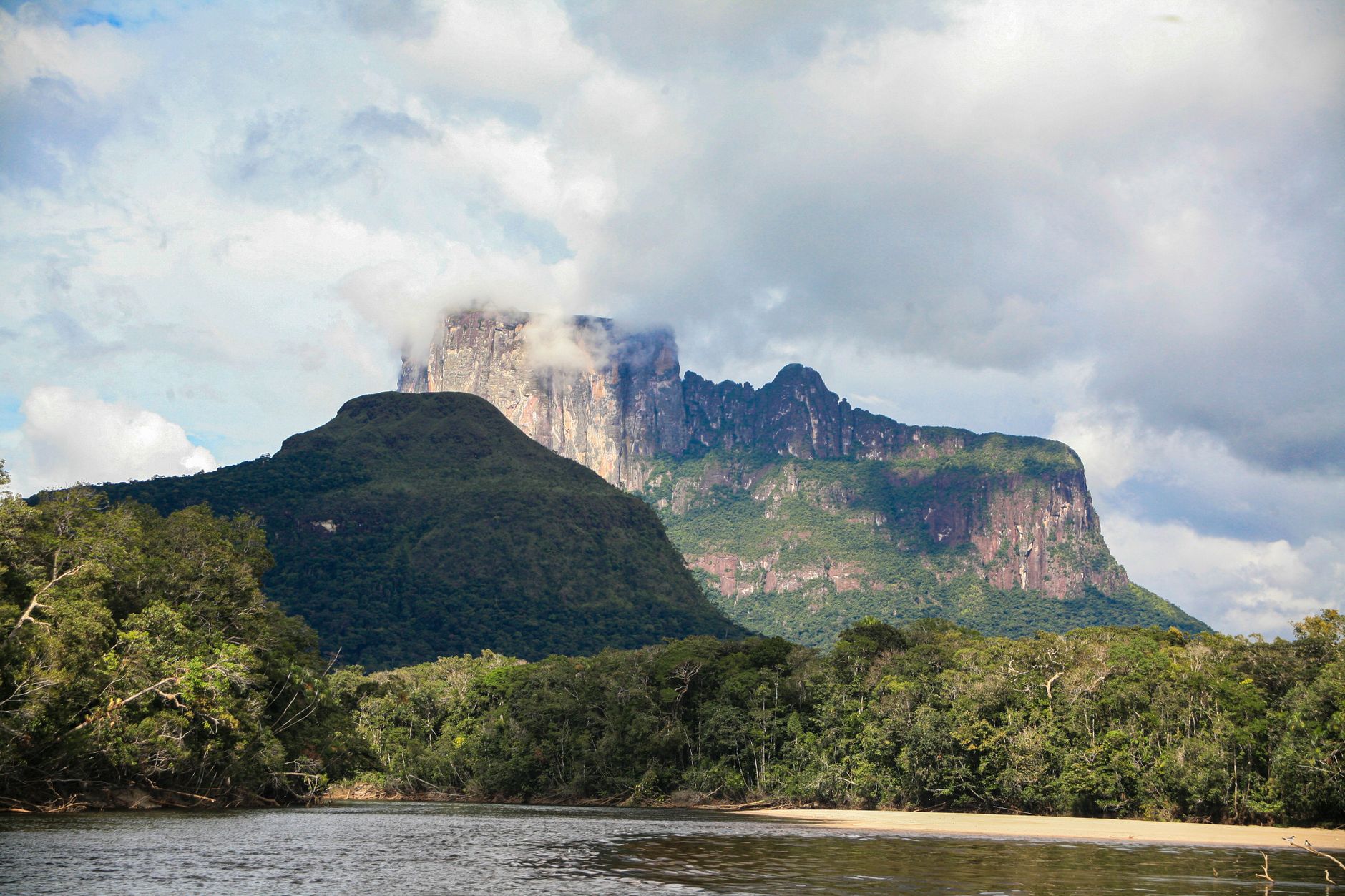
Auyantepui (or Auyán Tepui) is the largest tepui in Canaima National Park and one of the most imposing in the whole Gran Sabana: a colossal flat-topped mountain with sheer walls rising above the jungle and savanna of southeastern Venezuela. Its name, in the Pemón language, is usually translated as 'devil's mountain' or 'house of the devil'.
It is world-famous because Angel Falls (Kerepakupai Vená), the tallest waterfall on Earth, plunges from its summit with a drop of almost a kilometer. Auyantepui lies within Canaima National Park, a UNESCO World Heritage Site, and is the heart of the 'lost world' of the tepuis, with the Canaima lagoon, the falls, the village of Kavac and the landscapes that fired the imagination of explorers and writers.
This guide covers the essentials of Auyantepui: what it is and why it's unique, its relationship with Angel Falls, how it's visited (Canaima, scenic flights, river trips, Kavac), what to keep in mind, and how to organize an expedition to this Venezuelan natural icon.
Auyantepui is the largest tepui in Canaima National Park, and Angel Falls, the tallest waterfall in the world, drops from it. It is a formation of the ancient Guiana Shield, sacred territory of the Pemón people, and it was made known to the wider world by the flights of aviator Jimmie Angel. The full story is on our history page.
Read the full history ↓Venezuela's largest state: home of the tepuis and Angel Falls — the world's tallest waterfall — of La Gran Sabana and the Pemón people, of Bolívar's Angostura Address, of Orinoco gold, of the Guri dam and the heavy industry of Ciudad Guayana.
Read the history of Bolívar →No exact prices: a scale from $ (budget) to $$$$$ (luxury), with 2-3 options per category.
Origins, formation and what the sources say.
Auyantepui is the largest of the tepuis in Canaima National Park and one of the most imposing in the whole Gran Sabana. Like the rest of these mountains, it is a remnant of an ancient sandstone cover laid over the Guiana Shield, one of the oldest geological formations on the planet, with rocks more than 1.5 billion years old. Over millions of years erosion wore that cover away, leaving standing these flat-topped plateaus with sheer walls that rise hundreds of meters above the savanna and the jungle.
Its summit, covering some 667 km² —one of the largest in the Gran Sabana— and reaching a maximum altitude of close to 2,450 meters, holds a singular ecosystem, cut off from its surroundings, with endemic plants and animals that evolved separately, adapted to the harsh conditions of altitude, constant rain and nutrient-poor soils. That biological isolation, comparable to an island in the middle of the jungle, is one of the most fascinating features of the tepuis and has drawn naturalists from all over the world.
The name Auyantepui (or Auyán Tepui) comes from the language of the Pemón people and is usually translated as 'devil's mountain' or 'house of the devil', reflecting the sacred, mysterious character these mountains hold in Indigenous cosmology. For the Pemón, the tepuis are the dwelling places of spirits called mawari, places of respect and of mythical accounts that explain the origin of the world.
Although Angel Falls and Auyantepui had always been known to the Pemón people, their international fame is tied to the American aviator and gold prospector Jimmie Angel. During the 1930s Angel flew over the Gran Sabana several times looking for gold deposits, and on one of those flights, in 1933, he sighted the waterfall that now bears his name, though the Pemón and some earlier explorers already knew it as Kerepakupai Vená.
The episode that sealed the legend came on 9 October 1937, when Angel tried to land his plane, a Flamingo named 'El Río Caroní', on the boggy summit of Auyantepui itself. The undercarriage stuck in the soft ground and he, his wife Marie and two companions had to walk out over eleven days through the jungle to the nearest community. The adventure, widely covered by the press of the day, gave Angel Falls worldwide exposure.
Angel's plane sat stranded on the summit of the tepui for 33 years, until it was recovered and restored in 1970; today it is displayed outside Ciudad Bolívar airport as a monument to the feat. His name stuck for good to the tallest waterfall in the world, with a total drop of almost 979 meters, although Venezuela also promotes the use of its original Pemón name, Kerepakupai Vená, in recognition of Indigenous culture.
Auyantepui's worldwide fame is owed above all to Angel Falls, which pours from the top of its walls. With a total drop of almost a kilometer (around 979 meters, of which some 807 are a single uninterrupted free fall), it is the tallest waterfall in the world, a column of water that largely turns to spray on its long descent toward the jungle, forming permanent mist at its base.
The water feeding the falls comes from rain that gathers on the vast summit of Auyantepui and drains through a cleft in the tepui wall known as Devil's Canyon. That's why its flow varies enormously with the season: in the rainy months (June to November) the falls are an imposing torrent, while in the dry season they can shrink to a thread of water that disperses before reaching the ground.
The scale of Angel Falls and its setting —dropping from the summit of a colossal tepui in the heart of the jungle— make it one of the planet's great natural icons and the main goal of trips to Canaima. Seeing it, from the air or by boat to its base, is an experience that sums up the grandeur of the world of the tepuis.
Auyantepui and Angel Falls lie within Canaima National Park, one of the largest in Venezuela at some 30,000 km², created in 1962 and declared a UNESCO World Heritage Site in 1994 for its exceptional natural and geological value. The park protects a vast complex of tepuis, savannas, rivers and waterfalls, in one of the most extraordinary landscapes on Earth, and is one of the ten largest national parks on the planet.
All of this territory is the ancestral home of the Pemón people, who have lived in it and cared for it since pre-Columbian times, and for whom the tepuis are sacred mountains, dwellings of spirits and central figures in founding myths. The community of Kavac, at the foot of Auyantepui, and other communities in the region take an active part in tourism, providing guides, churuata accommodation and boat services, in a community tourism model that combines environmental conservation with local livelihoods.
The landscapes of Auyantepui and the Gran Sabana also fed the wider imagination: they are believed to have inspired Arthur Conan Doyle's 'The Lost World' (1912), and they have since appeared in stories, documentaries and productions such as Pixar's animated film 'Up' (2009), which further popularized the image of these mountains floating among the clouds for audiences all over the world.
Beyond Jimmie Angel's feat, Auyantepui and the other tepuis of the Gran Sabana have been the object of numerous scientific expeditions since the mid-20th century, all keen to document their unique biodiversity. Botanists, entomologists and biologists have identified on their summits hundreds of plant and animal species that exist nowhere else on Earth, genuine 'islands in the sky' that evolved in isolation over millions of years.
The first documented ascent of Auyantepui's summit by a land route was a formidable challenge, given walls hundreds of meters high and the dense jungle around its base. Mountaineering expeditions, many of them with Pemón guides taking part, managed to open routes to the top over the decades, though access remains extremely demanding and reserved for specialized teams with heavy logistics, often supported by helicopter.
These expeditions continue today, for scientific as much as sporting reasons, and they are part of Auyantepui's international standing as one of South America's great geographical challenges, comparable in difficulty and singularity to the great Andean massifs, but with the added draw of a biology found nowhere else.