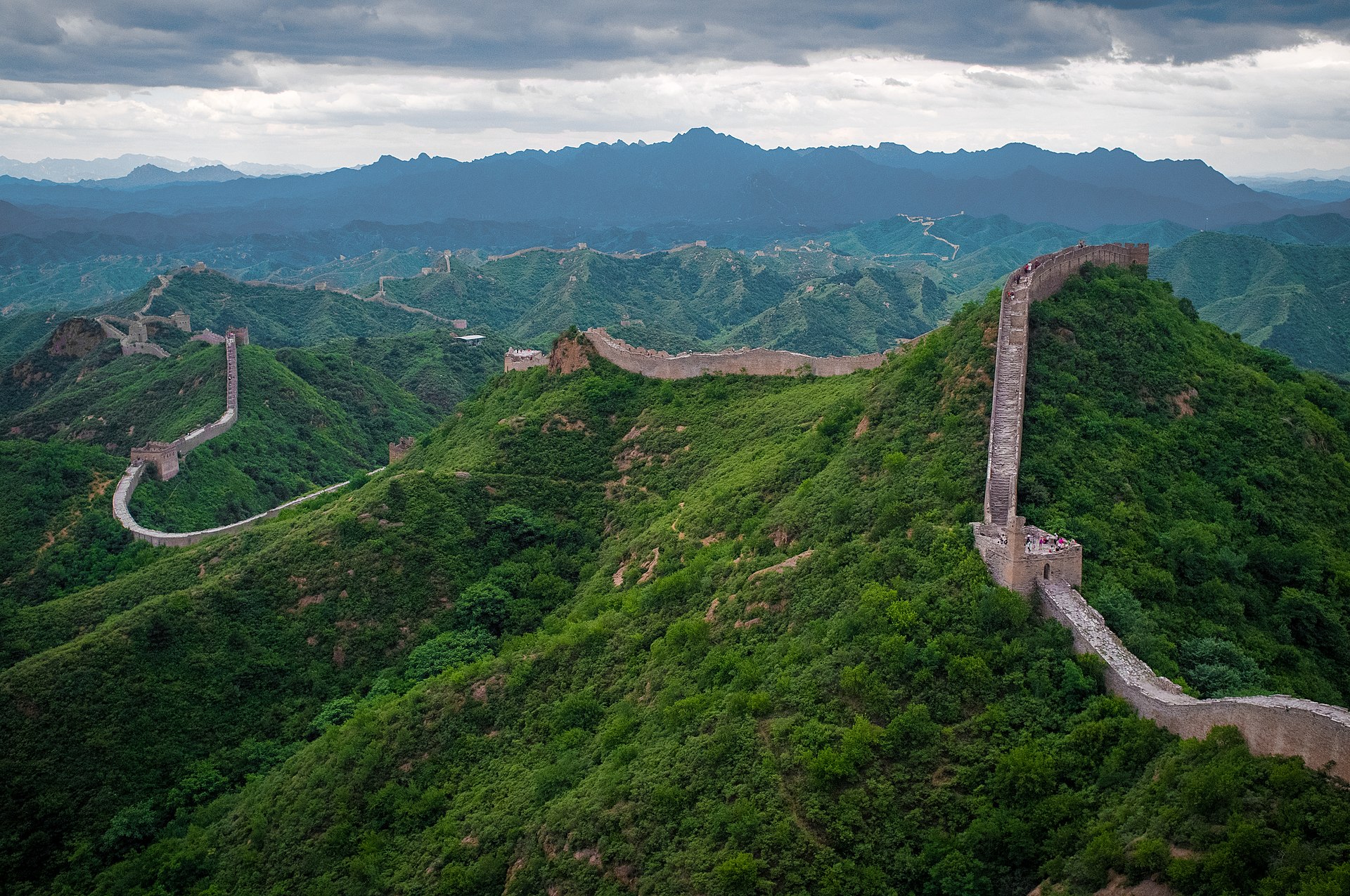
The Great Wall, the warriors of Xi'an, megacities and ancient landscapes: China blends imperial history with modernity.
China is a country the size of a continent that overwhelms with its scale: megacities of twenty million people bristling with skyscrapers, five thousand years of imperial history, deserts, sacred mountains and terraced rice fields. For Latin American travellers it is probably the most foreign destination of all —a different script, different food, censored internet— and that is exactly why it's one of the most fascinating. It is technologically way ahead (you pay for everything with your phone, the trains fly) while still keeping corners of untouched tradition.
The classic itinerary links Beijing (the Great Wall, the Forbidden City), Xi'an (the terracotta warriors) and Shanghai (the futuristic megalopolis), three cities connected by bullet train in just a few hours. With more time you can add the karst mountain landscapes of Guilin and Yangshuo, the water towns near Shanghai, the pandas of Chengdu and its spicy Sichuan cooking, or more adventurous routes to Tibet, Yunnan or the Silk Road.
What surprises most is how easy the logistics are once you get past the initial barrier: high-speed trains are punctual and cheap, everything is safe, and since 2025 several South American countries can enter without a visa. The real challenge is the language and the closed digital ecosystem; with your apps set up in advance, the trip becomes surprisingly smooth.
The local currency is the yuan or renminbi (CNY, symbol ¥). China is an almost cashless society: you pay by QR code on your phone for practically everything, from a taxi to a street stall. The two big wallets are Alipay and WeChat Pay, and for the past couple of years tourists have been able to link their foreign Visa or Mastercard to them without needing a Chinese bank account (there are fees on larger payments and some limits). It's a good idea to install and verify both apps before you travel, because when one fails at a shop the other usually works. Foreign cards on their own are accepted only at large hotels and the odd tourist spot, so don't rely on them. Bring some cash in yuan as a backup, even though fewer and fewer shops prefer it, and check the day's exchange rate before changing money.
Full converter for CNY →From Latin America and Europe, China is reached on long-haul flights, almost always with a stopover at a hub in the Gulf (Doha, Dubai, Istanbul, Abu Dhabi) or in Asia. The main gateways are the international airports of Beijing (Capital and Daxing) and Shanghai (Pudong), followed by Guangzhou, Chengdu, Shenzhen and Hong Kong, which works as a convenient connection to the south of the country. Once inside, the best way to get around is the high-speed train: the China Railway network (the CR/Fuxing trains, which run at up to 350 km/h) is the most extensive in the world and links almost every provincial capital, so routes like Beijing–Xi'an, Beijing–Shanghai or Shanghai–Hangzhou take just a few hours, city centre to city centre. Book tickets in advance in high season and carry your passport, which serves as your ticket. For huge distances or destinations without high-speed rail —Tibet, for example— there are domestic flights and the odd night train. A key practical detail: many services common in the West (Google, WhatsApp, Instagram, Gmail) are blocked inside China, so if you want to keep using them you need to buy and set up a reliable VPN before entering the country, because once inside it's hard to download one.
The best seasons are spring (April-May) and autumn (September-October): pleasant temperatures, little rain and good visibility. Being such a huge country, the climate varies enormously by region: the north (Beijing, Xi'an) has very cold, dry winters and hot summers; the south and the coast (Shanghai, Guilin, Guangzhou) are subtropical, humid and get heavy rain in summer; and the high-altitude west (Tibet, Yunnan) follows its own mountain logic.
Avoid at all costs two holidays when the whole country travels at the same time: Chinese New Year (between late January and mid-February, depending on the year) and the October Golden Week (the first seven days of the month). On those dates trains sell out weeks in advance, tourist sites are overwhelmed and prices go up. Summer brings stifling heat and humidity to the east and south, plus the risk of typhoons on the coast.
Real Chinese food looks almost nothing like what you find in Chinatown: it's a huge regional universe. In Beijing, Peking duck; in Sichuan and Chongqing, hot pot and spicy dishes that numb your tongue; in Guangzhou, dim sum and milder flavours; in Xi'an, hand-pulled noodles and lamb sandwiches. Dumplings (jiaozi and baozi), noodles and fried rice are the everyday staples, and the street food at night markets is cheap and spectacular.
Eating is one of the cheapest parts of the trip: a plate of noodles or a handful of dumplings at a local spot costs between 20 and 40 yuan (about 3 to 6 dollars), and street food even less (verified July 2026). Tipping is not customary. A tip: learn to use the delivery apps and picture menus, and don't be afraid to point at what the people at the next table are eating.
China is a very safe country for tourists: violent crime is extremely rare and you can walk around the cities at night without worry. The precautions are more about the classic pickpocketing in very crowded tourist areas and, above all, some scams aimed at foreigners: the best known is the 'tea ceremony' or the 'art students' who approach you in areas like Wangfujing or the Bund and end up leaving you with an outrageous bill. Be wary of overly friendly strangers inviting you to a particular place.
Tap water is not drinkable: drink bottled or boiled water (hotels and trains offer hot water everywhere). No vaccinations are required to enter from Latin America, although it's a good idea to have your routine shots up to date. Good travel insurance is highly recommended because care at international hospitals is expensive. The emergency numbers are 110 police, 120 ambulance and 119 fire (verified July 2026). Remember that you need a VPN set up in advance to use Google, WhatsApp or Instagram.
China is a surprisingly accessible destination for backpackers. A tight day (hostel bed, street food and local eateries, city transport) can be done on about 40 to 60 dollars; a mid-range trip, with hotels and the odd bullet train, comes to around 70 to 110 a day (verified July 2026). The big variable is the city: Chengdu or Xi'an are much cheaper than Shanghai.
Concrete references (July 2026): a hostel dorm bed costs between 9 and 15 dollars (60-100 yuan); a plate of noodles or dumplings, 3 to 6 dollars; the city metro, just 0.30 to 1.50 dollars per ride (2-10 yuan); and bullet trains between cities, between 30 and 90 dollars per leg depending on distance (200-600 yuan). Admission to the major sites (Great Wall, terracotta warriors, Forbidden City) is around 8 to 20 dollars. Almost everything is paid by QR code with Alipay or WeChat Pay, so it's best to have them linked to your card before you travel.
Language is the biggest barrier: very little English is spoken outside large hotels and no Spanish at all, and Mandarin uses characters, not an alphabet. Translation apps with a camera feature (downloaded in advance, because Google Translate doesn't work well inside the country) are essential for reading menus and signs. Socially, Chinese people are direct and practical; tipping is not customary, queuing can be more chaotic than in the West, and public toilets are often squat toilets, so it's best to carry your own paper.
The plug is usually type A (flat pins, as in the United States) or type I (as in Argentina and Australia), and the voltage is 220V, the same as in most of Latin America, so devices work without a transformer. The most important thing for the trip is the digital ecosystem: Google, WhatsApp, Instagram, Gmail and Facebook are blocked, so you need to buy and set up a VPN before entering (once inside it's hard to download one). And get Alipay or WeChat Pay linked to your foreign card: without them, in almost-cashless China, even paying for a taxi is a struggle. An eSIM with data helps you stay connected.
No other civilisation on Earth can tell a story as long and as continuous as China's. While Egypt, Mesopotamia, Greece and Rome faded and were replaced by different peoples and languages, in the basins of the Yellow River and the Yangtze one cultural tradition reinvented itself again and again without ever fully breaking the thread: the same script that Shang dynasty diviners carved more than three thousand years ago is, with changes, the one read today on a phone in Shanghai. In between came unifications and break-ups, nomadic invasions that ended up becoming Chinese, the Great Wall, the Silk Road, the compass, paper, printing and gunpowder, and dynasties that lasted centuries and collapsed in an afternoon.
This is the story of a country that, for much of human history, was the largest economy in the world, that then lived through a 'century of humiliation' of wars, forced treaties and imperial collapse, and that in just a few decades became one of the great powers on the planet again. We tell it with real names, dates and figures, and with restraint in the hardest chapters: the famines of the 20th century, the Cultural Revolution, Tiananmen and Tibet. Because understanding China means understanding how a quarter of humanity got here.
Read the full history of China →Pick a region and open each destination to see what to do, prices and how to get there.
These are the sources we cite most across this country's guides, with how many times each appears. Hard data —tickets, opening hours, requirements, transport— comes from the official source and carries the date we checked it. Restaurant and hotel picks come from guides and reviews, and we say so on each page.