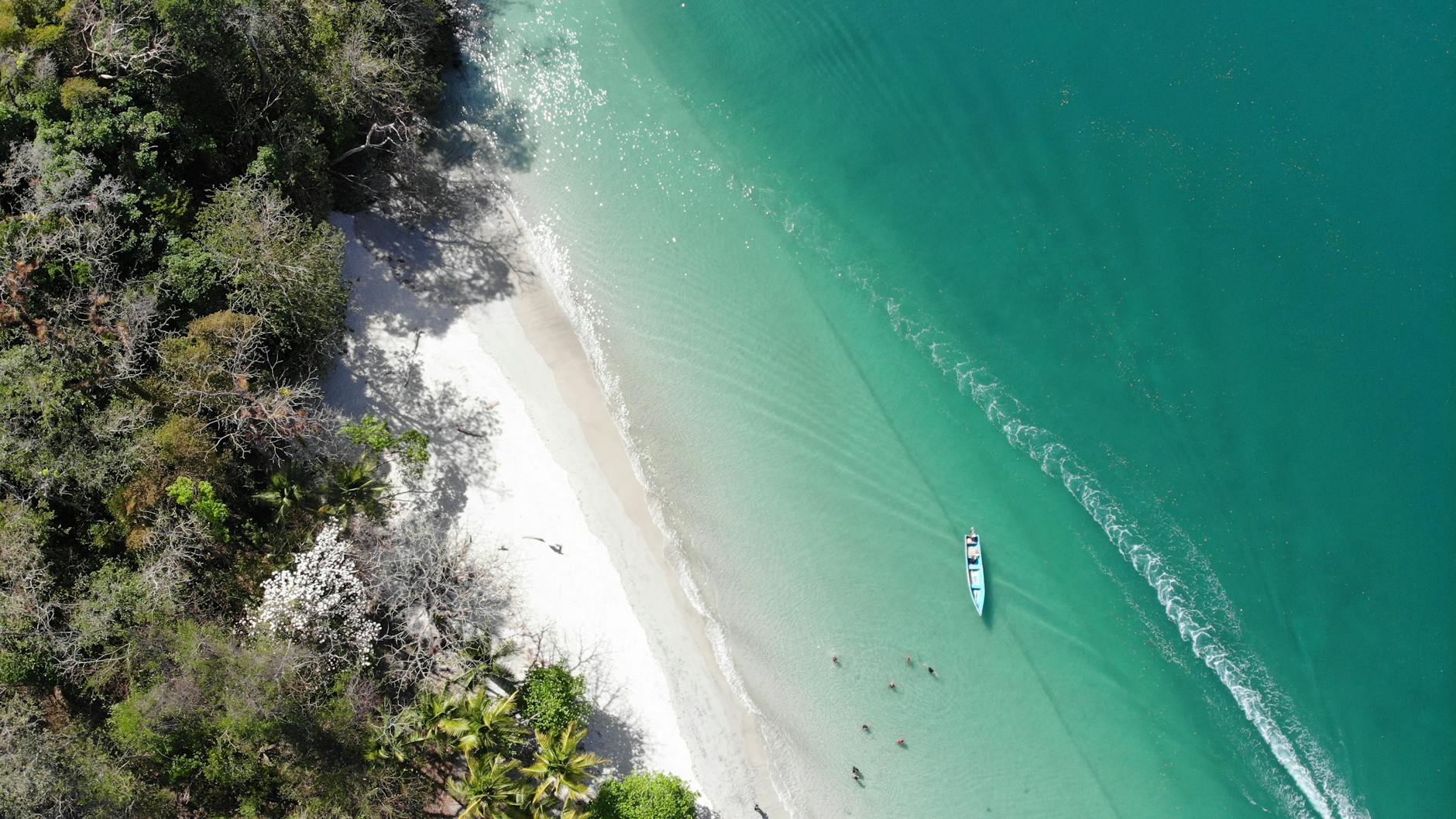
The country where two oceans almost touch: the immense Canal, the turquoise waters of the San Blas islands, the coffee mountains of Boquete and a capital whose skyline faces the Pacific. A bridge between two continents and two seas.
Panama is the country where two oceans almost touch: a narrow isthmus cut by the most famous canal on earth, with a skyscraper capital facing the Pacific, turquoise Caribbean islands in Guna Yala (San Blas), coffee mountains around Boquete, and extraordinary biodiversity because the country is the land bridge between two continents. For anyone coming from the United States or Canada it is an unusually frictionless destination: the official currency is the balboa, but it is pegged one to one with the US dollar and American banknotes are what actually circulate, so there is nothing to exchange and no conversion to think about. Sockets are the same flat-pin type A and B at 120 V, the clock stays on Eastern Standard Time all year with no daylight saving, and traffic drives on the right.
The country divides neatly into zones. Panama City holds the Canal, the colonial Casco Viejo and the skyline; the Caribbean side has the islands of Bocas del Toro, the San Blas archipelago and colonial Portobelo; the Chiriquí highlands have Boquete and its coffee farms; and the Azuero Peninsula and the Pacific have Pedasí, Santa Catalina (surf and diving) and Coiba Island. Everything is linked by cheap intercity buses, short domestic flights from Albrook airport in the capital, or a rental car for the interior. Distances are small: you can land in the morning and be in the mountains or on a Caribbean island the same day.
The real draw is that combination of cosmopolitan city, near-empty islands and cool highlands packed into a small, easy country — and how much less visited it still is than Costa Rica next door, with beaches and islands that remain close to undeveloped. Tocumen airport is worth knowing about in its own right: it is the main connecting hub between North and South America, and a great many travelers pass through it on the way somewhere else without realizing they could break the trip and see the Canal for a couple of days at no extra airfare.
Traveler's tip: the balboa exists mostly on paper — in practice you pay for everything in US dollars. The local coins (centésimos) are the same size and value as US cents and circulate mixed in with them. Carry small bills: taxis, markets and rural areas often struggle to break large notes.
Full converter for PAB →The main gateway is Tocumen International Airport (PTY), on the edge of Panama City and one of the most important air hubs in Latin America. It is the base of Copa Airlines, the national carrier, with connections to dozens of cities across the Americas; international airlines also fly in from North America and Europe. For domestic flights, Marcos A. Gelabert Airport (Albrook), inside the city, serves destinations such as Bocas del Toro, David and more remote areas — ideal when the overland trip is long. The intercity bus network is cheap and reaches the whole country from the Albrook Grand Terminal; for long routes it is worth booking ahead. In the capital, the Panama Metro is fast and cheap for getting around and is backed up by city buses. For taxis, agree the fare before getting in, or use ride-hailing apps such as Uber, which are widely used in the city. Renting a car makes sense for exploring the interior (Chiriquí, Azuero), although traffic in the capital can be heavy.
The best window is the dry season, from mid-December to mid-April (what Panamanians call summer), with clear skies, far less rain and the best conditions for the islands and beaches. It is also high season: more people and higher prices, especially over Christmas and New Year and during Holy Week. It lines up conveniently with the northern winter, which is precisely why it is the busiest stretch. Carnival, in February or March depending on the year, is the largest event in the country and Las Tablas is where it is celebrated most intensely — book accommodation months ahead if you want to be there, and expect much of the country to shut down for those four days.
The rainy season runs from May to November. In most of the country it means clear mornings and a short, heavy downpour in the afternoon rather than all-day rain, so it is far more travelable than it sounds; the Caribbean side (Bocas del Toro, San Blas) gets rain spread more evenly through the year. In exchange you get fewer tourists, a much greener landscape and better prices. Two useful details: humpback whales are in Pacific waters (Azuero, Coiba) from July to October, and Boquete stays cool and pleasant all year regardless of season. Worth noting for anyone comparing Caribbean destinations — Panama sits south of the main Atlantic hurricane track and is very rarely affected, so there is no hurricane season to plan around here.
Panamanian cooking mixes Indigenous, Afro-Caribbean and Spanish roots and is more about comfort than fireworks. The essentials: sancocho de gallina, a slow-simmered chicken and root-vegetable soup flavored with culantro that counts as the national dish; arroz con pollo; carimañolas, fried yuca (cassava) fritters stuffed with seasoned meat; patacones, green plantain slices flattened and fried twice; and above all ceviche — raw fish cured in lime — which at the Mercado de Mariscos, the seafood market in the capital, is as fresh and as cheap as it gets anywhere. On the Caribbean coast, look for fish with coconut rice. For breakfast, thick fried corn tortillas (nothing like the Mexican kind) and hojaldras, a fried dough.
To drink: coffee from Chiriquí, including the sought-after geisha; Ron Abuelo rum; the local lagers Balboa and Atlas; and a raspao, shaved ice with syrup, for the heat. A ceviche at the Mercado de Mariscos costs around US$2.50, and a meal at a fonda, a simple neighborhood eatery, US$4 to US$8; at a tourist restaurant in Casco Viejo it climbs to US$15 to US$30 per person (verified July 2026). The customary tip is around 10%, noticeably less than the 15% to 20% expected in the United States, and a service charge is sometimes already on the bill, so check before adding on top. Since everything is priced in dollars, there is no mental currency conversion to do.
Panama is a relatively safe destination for visitors, particularly in the tourist areas of the capital, the islands and the interior. In Panama City the usual big-city caution applies, and it is worth avoiding neighborhoods such as El Chorrillo and Curundú, and parts of Colón, after dark — the transition between a safe street and a much rougher one can happen within a couple of blocks. Take taxis with the fare agreed in advance, or use an app; Uber works well in the city. One warning that matters more than any other: do not attempt to cross overland into Colombia through the Darién Gap. It is a lawless stretch of jungle with no road, controlled by armed groups, and it is genuinely dangerous rather than merely difficult. Before booking, check the current official travel advisory issued by your own government, which is updated as conditions change and covers specific provinces separately.
Yellow fever vaccination is no longer required for entry, though it is recommended if you plan to go into the jungle areas of Darién — check your own case with a travel clinic. Use insect repellent because of dengue, and strong sunscreen: this is nine degrees from the equator and the sun is harsher than it feels. Tap water is drinkable in most of the country, including the capital, though in remote spots such as some islands in Bocas del Toro or San Blas it is safer to stick to bottled. Hospitals in the capital are good by regional standards, and several are used to treating foreign patients. Take out travel insurance with medical cover and evacuation: US health plans, and Medicare in particular, generally do not cover treatment abroad, and getting off a San Blas island in an emergency is slow and expensive. The emergency number is 911, the same as in the United States and Canada (verified July 2026).
Panama covers a wide price range, with the convenience of everything being handled in dollars. A backpacker gets by on roughly US$45 to US$60 a day, a mid-range budget runs about US$70 to US$130, and the capital plus tours to San Blas or Coiba can push the total up considerably (verified July 2026). By Central American standards it is mid-priced — cheaper than Costa Rica, more expensive than Nicaragua or Guatemala — and by US standards food and transport are inexpensive while imported goods and beach resorts are not. Urban public transport is among the cheapest on the continent, which helps a lot.
For reference (July 2026): a hostel dorm bed costs between US$12 and US$25; a meal at a local fonda, US$4 to US$8; the Panama City Metro just US$0.35 a ride and city buses around US$0.25; a day tour to San Blas, between US$40 and US$100 depending on what is included. You save by eating at the Mercado de Mariscos and at fondas, using the metro and buses instead of taxis, and traveling in the green season. Two practical notes on money: ATMs dispense US dollars, so there is no exchange step and no currency spread to lose, but a card with no foreign transaction fee is still worth bringing, since that fee depends on where the merchant is rather than on the currency. And carry small bills — taxis, boatmen and rural shops rarely have change for a fifty.
The official language is Spanish, spoken with a Caribbean accent and plenty of local slang. English goes further here than in most of Latin America: it is widely spoken in the capital, in tourism and in business, a legacy of the decades of American presence around the Canal Zone, and in Bocas del Toro you will hear an English-based Caribbean creole spoken as a first language. Panamanians are easygoing and proud of how mixed the country is: Afro-Caribbean communities descended from Canal-era workers, Indigenous peoples (Guna, Emberá, Ngäbe) with their own self-governing territories, and a mestizo majority. It is a cosmopolitan, outward-facing society, and Panama City feels far more like a small international financial capital than what most visitors expect from Central America.
Practical details: the currency is the balboa, at par with and in practice replaced by the US dollar, which circulates as ordinary cash — carry small notes, because taxis and markets struggle to break large ones. Power is 120 V, 60 Hz with type A and B sockets, exactly as in the United States and Canada, so North American devices need no adapter and no converter (European and Australian ones do). Connectivity is good: buy a prepaid SIM from +Móvil or Digicel with your passport, or arrange an eSIM before you fly. Panama is also one of the easiest countries in the region for a long stay — the pensionado program grants residency to foreigners who can show a qualifying lifetime pension, along with a long list of legally mandated discounts, which is why there are sizeable North American retiree communities in Boquete, Coronado and Bocas del Toro. One tip from experience: book San Blas trips well in advance and with a reputable operator, because it is autonomous Guna territory and the logistics are rougher than the photos suggest.
The history of Panama is, above all, the history of an isthmus: a narrow strip of land barely eighty kilometers wide at its slimmest point that, for five centuries, obsessed empires and great powers because it joined — and separated — two oceans. Inhabited for millennia by Indigenous peoples such as the Guna, the Ngäbe, the Buglé, the Emberá and the Wounaan, heirs to chiefdoms that mastered goldwork and polychrome pottery, the isthmus was in 1513 the setting for the first European sighting of the Pacific Ocean, by Vasco Núñez de Balboa. From then on it became the hinge of colonial trade: along the Camino Real, along the Camino de Cruces and through the fairs of Nombre de Dios and Portobelo passed much of the silver of Peru on its way to Spain, drawing the pirates and privateers who turned the Panamanian Caribbean into a chessboard of war.
A Spanish province attached first to Peru and later to the Viceroyalty of New Granada, then part of Gran Colombia after the peaceful independence of 1821, and finally an independent republic from November 3, 1903, Panama built its identity around the Canal — the work that Ferdinand de Lesseps and the French failed to complete and that the United States opened in 1914, keeping it under American control in the Canal Zone for almost a century. The struggle for sovereignty, from the Martyrs' Day of 1964 to the Torrijos-Carter Treaties of 1977, culminated on December 31, 1999, when Panamanians recovered the interoceanic waterway in full.
Read the full history of Panama →Pick a region and open each destination to see what to do, prices and how to get there.
These are the sources we cite most across this country's guides, with how many times each appears. Hard data —tickets, opening hours, requirements, transport— comes from the official source and carries the date we checked it. Restaurant and hotel picks come from guides and reviews, and we say so on each page.