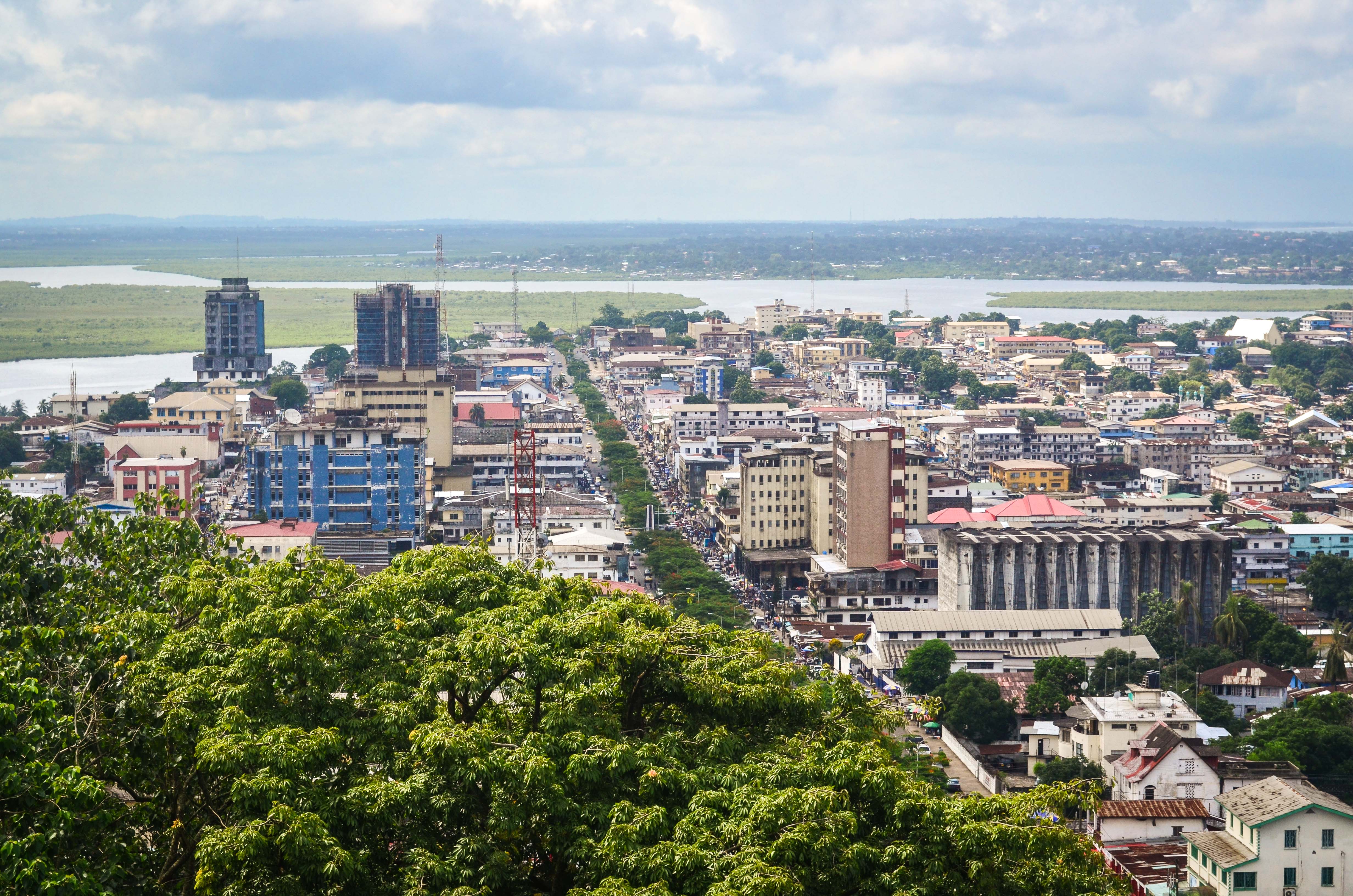
The only country in Africa founded by African Americans freed from slavery: Southern-style houses facing the Atlantic, the continent's best surf point breaks in Robertsport and the primary rainforest of Sapo, home to pygmy hippos and chimpanzees. One of the most authentic and least visited frontiers in world tourism.
Liberia is one of the most unusual and least-visited destinations in West Africa, and its history explains why: it is the only country on the continent founded by African Americans freed from slavery, who in the 1820s and 1830s crossed the Atlantic back to build a nation modelled on the American South. That's why in towns like Harper you can still see wooden houses with verandas in the style of Mississippi plantations, Baptist and Methodist churches, and an Americo-Liberian identity that coexists with more than twenty indigenous peoples and their languages.
The country isn't a classic safari destination but one of raw nature, wild coastline and adventure travel for curious travellers. Its great natural jewel is Sapo National Park, one of the last large blocks of Upper Guinean primary rainforest, a refuge for the elusive pygmy hippo, the forest elephant and chimpanzees. On the Atlantic, Robertsport draws surfers from all over the world with its long waves and empty beaches, and dozens of kilometres of golden coast lie almost untouched by infrastructure. Inland, waterfalls like Kpatawee and the Nimba mountains, a World Heritage Site, complete the map.
Liberia has recovered from a devastating civil war (1989-2003) and the 2014-2016 Ebola outbreak, and today it is a country at peace, though poor and with basic infrastructure. Travelling here calls for flexibility, patience and, generally, relying on local operators and guides: roads are tough, cash is king and comforts are scarce outside Monrovia. In return, it offers an authenticity that hardly exists any more, genuine hospitality and the feeling of being somewhere very few travellers know.
Liberia has an unusual dual-currency system: the official currency is the Liberian dollar (LRD), but the US dollar (USD) is also legal tender and has circulated alongside it for more than a century. In July 2026 one US dollar is worth about 185 Liberian dollars (verified July 2026), though it's worth checking the day's rate because the LRD moves. In practice, USD is used for hotels, tours, good restaurants and big purchases, while LRD is essential for shared taxis, markets, street food, admission fees and small towns. Bring US dollars in cash, in good-condition, low-denomination notes (torn or old ones are sometimes refused), and change some into LRD at banks or exchange bureaus in Monrovia. ATMs are scarce and unreliable outside the capital, and many dispense only LRD with low limits, so withdraw cash in Monrovia before heading inland. Cards are hardly used except at a handful of top hotels; assume this is a cash destination. Tipping isn't mandatory but is appreciated: some small change for guides, drivers and lodge staff, and 10% in formal restaurants.
Full converter for LRD →There are no direct flights from Latin America and the journey is long: almost every route goes through Addis Ababa with Ethiopian Airlines (which connects Buenos Aires and São Paulo with Monrovia, often with an extra stop in Lomé or Accra), or through Europe (Brussels with Brussels Airlines, which has the most direct flight to Liberia) and Casablanca with Royal Air Maroc. Allow between 24 and 34 hours of total travel depending on connections. The only air gateway is Roberts International Airport (ROB), about 50 km east of Monrovia (a good hour by road). On visas: Latin Americans need a visa to enter Liberia. The country has an e-visa portal (evisa.liser.gov.lr) where you upload your passport, yellow fever certificate and return ticket, although you can also apply at a consulate; check the system's status and requirements before travelling (verified July 2026). You must present the international certificate of vaccination against yellow fever to enter. Inside the country, getting around is the most challenging part of the trip: there is no rail network or comfortable long-distance buses, and roads to the interior are dirt and become impassable in the rainy season. The usual options are hiring a 4x4 with a driver, using shared 'taxis' and minibuses between towns, or flying charter light aircraft to remote destinations. For the southeast (Sapo, Harper) it's almost always best to go with a local operator.
The best time to visit Liberia is the dry season, roughly from November to April. In those months it hardly rains, the dirt roads inland are passable and parks like Sapo can be explored on foot without getting stuck in the mud; it's also the best window for nature, and the waterfalls still have a good flow early in the season. Something to bear in mind between December and February is the Harmattan, a dry wind that carries dust from the Sahara, lowers night-time temperatures a little and hazes the sky.
The rainy season, from May to October, is one of the most intense in Africa: Liberia is among the wettest countries on the continent, with brutal peaks between June and September that can leave roads impassable and make access to the interior and the southeast difficult. Not everything shuts down — Monrovia and the coast can still be visited — but expect heavy rain and tricky logistics. A note for surfers: the best waves in Robertsport usually come precisely in the wet season (May to October), when the swell is more consistent, so if you're going for the surf it's worth accepting some rain. Heat and humidity are high all year, with temperatures around 26–32 °C.
Liberian cuisine is tasty, spicy and hearty, always revolving around rice, the sacred ingredient of the table. The most emblematic dish is cassava leaf (a stew of chopped cassava leaves with meat or fish, palm oil and sometimes peanuts), served over rice. Other staples are palm butter or palava (a thick palm fruit sauce with meat and smoked fish), jollof rice (spiced rice with tomato, which Liberia shares with all of West Africa), pepper soup (a very spicy broth with meat) and country chop, a mix of meat, fish and vegetables cooked in palm oil. As thick accompaniments there are fufu and dumboy, cassava doughs that you dip by hand into soups and sauces.
Eating is cheap if you go to street stalls and local 'cook shops': a generous plate of rice with cassava leaf or palm butter costs around 2–5 USD, and lunch at a tourist restaurant in Monrovia 6–12 USD. At the capital's few international restaurants (Lebanese, Indian, Western) you can spend 12–25 USD. For snacks, try grilled street fish and chicken, fried plantains and the tropical fruit, which is excellent. Watch out for the heat: Liberian cooking uses a lot of scotch bonnet chilli and is among the fiercest on the continent, so ask for it mild if you're not used to it. To drink, the local Club Beer is good and cheap, and in rural areas people drink palm wine; be careful with water (bottled is best) and ice.
Liberia emerged from a long civil war (1989-2003) and the 2014-2016 Ebola outbreak, and today it is a country at peace, but it remains poor with fragile institutions, so you need to travel informed and use common sense. The main risk for tourists is petty crime: theft, pickpockets and opportunistic robbery, especially in Monrovia (city beaches at night, markets, crowded areas). Avoid showing valuables, don't walk alone at night, use known taxis or ones arranged by your accommodation rather than walking in the small hours, and keep digital copies of your documents. Political demonstrations can get tense: best avoided. Emergency services are limited and unreliable; the emergency number is 911, but it doesn't always answer, so keep the contacts of your hotel, your operator and your insurer handy.
On health, two points are key. First, yellow fever: the vaccine is MANDATORY to enter Liberia and you may be asked for the international certificate (yellow card) at the airport, so getting it at least 10 days in advance is not optional. Second, malaria: the risk is high throughout the ENTIRE country all year round; see a travel doctor about the right prophylaxis (atovaquone-proguanil/Malarone is commonly prescribed) and add repellent, long sleeves at dusk and a mosquito net. Vaccines for hepatitis A and B, typhoid, meningitis and rabies (depending on your itinerary) are also recommended, as is being up to date with routine ones. Medical infrastructure is very basic outside Monrovia, so good travel insurance with international medical evacuation cover is absolutely essential. Don't drink tap water (use bottled or purified) and be careful with street food: best piping hot and freshly made.
Liberia isn't as cheap a destination as you might expect given its level of development, because almost everything imported is expensive and tourist services are scarce. On a backpacker budget, sleeping in simple guesthouses and hostels (10–30 USD a night), eating at local cook shops and getting around by shared transport, you can manage on about 35–60 USD a day. Mid-range, with mid-range hotels in Monrovia (50–100 USD), the odd tour and more comfortable transport, allow 90–160 USD a day. And in comfort, with the capital's best hotels and a 4x4 with driver, it easily reaches 180–250 USD a day or more. The biggest expense isn't accommodation but logistics: reaching the interior and the southeast requires 4x4 vehicles, drivers and sometimes light aircraft, which push costs up considerably.
To size up a typical 10- to 14-day trip combining Monrovia, the Robertsport surf coast, an inland waterfall and an expedition to Sapo National Park: mid-range it comes to around 1.200–2.500 USD per person on the ground, not counting international flights (which from South America usually cost 1.400–2.400 USD return depending on the season and connections). The big savings are in local food and shared transport; the biggest cost is hiring an operator or a 4x4 with driver to reach the remote corners, which is almost unavoidable if you want to see Sapo or Harper. A tip: travelling in a group greatly reduces the per-person cost of vehicle hire and guides, which is the heaviest item in a Liberian budget.
English is the official language and is understood almost everywhere, so with basic English you'll get by fine in hotels, transport and paperwork; Spanish isn't used. Note that on the street people mostly speak Liberian English ('Liberian English' or 'Kolokwa'), a creole with its own accent and expressions that can be hard to follow at first. More than twenty indigenous languages are also spoken (Kpelle, Bassa, Gio, Kru, Vai, among others). The country is deeply religious, with a Christian majority and a Muslim minority, and very sociable: greetings matter, courtesy is valued and it's wise to dress fairly modestly away from the beach. A typical gesture is the Liberian 'snap handshake', a handshake that ends with a finger snap. Ask permission before photographing people, especially at ceremonies or in sensitive areas such as government buildings.
On the practical side: plugs are type A and B (flat pins, US style) plus some European types, and the voltage is 120V in many places as an American legacy, though it's best to bring a universal adapter; the power grid is very unstable and much of the country relies on generators, so a power bank and a torch are almost essential. For connectivity, buy a local SIM from Orange or Lonestar Cell MTN as soon as you arrive (cheap, with decent data in cities but patchy coverage inland); you need your passport to register it, and hotel wifi tends to be weak. Driving is on the right. And the golden rule for Liberia: travel with flexibility and a good attitude, because plans change, roads get complicated and the best way to enjoy this country is to rely on local people, who usually respond with genuine hospitality and a real eagerness to show off their land.
Liberia is a country that was founded twice. First by the peoples who have lived there for centuries —the Kru, Bassa, Kpelle, Vai, Grebo, Gola and some twenty more—, farmers, fishers and traders of the Upper Guinean forest who built kingdoms, secret societies such as the Poro and the Sande, and even their own writing system, the Vai syllabary, one of the very few indigenous scripts invented in Africa. And founded a second time, in 1822, when a handful of African Americans, born into slavery and later freed, landed on an island in the Mesurado River, sent by the American Colonization Society of the United States with the idea of "returning" free Black people to Africa. From that encounter —often unequal and at times violent— between native Africans and Americo-Liberian settlers was born, in 1847, the Republic of Liberia: the first republic in Africa.
This is the full story of Liberia: the country whose name comes from the Latin liber, "free", and whose capital, Monrovia, honours a US president; the story of an Americo-Liberian elite that ruled for more than a century under the True Whig Party while the native majority was left on the sidelines; of Firestone rubber and the largest plantation in the world; of Samuel Doe's coup in 1980, the atrocious civil wars from 1989 to 2003 and the name of Charles Taylor; and also of Ellen Johnson Sirleaf, the first woman elected head of state in Africa and a Nobel Peace Prize laureate, of Ebola, and of a country that, after so much tragedy, is still rebuilding. A small nation of Atlantic beaches, primary rainforest and a history unlike any other on the continent.
Read the full history of Liberia →Pick a region and open each destination to see what to do, prices and how to get there.
These are the sources we cite most across this country's guides, with how many times each appears. Hard data —tickets, opening hours, requirements, transport— comes from the official source and carries the date we checked it. Restaurant and hotel picks come from guides and reviews, and we say so on each page.