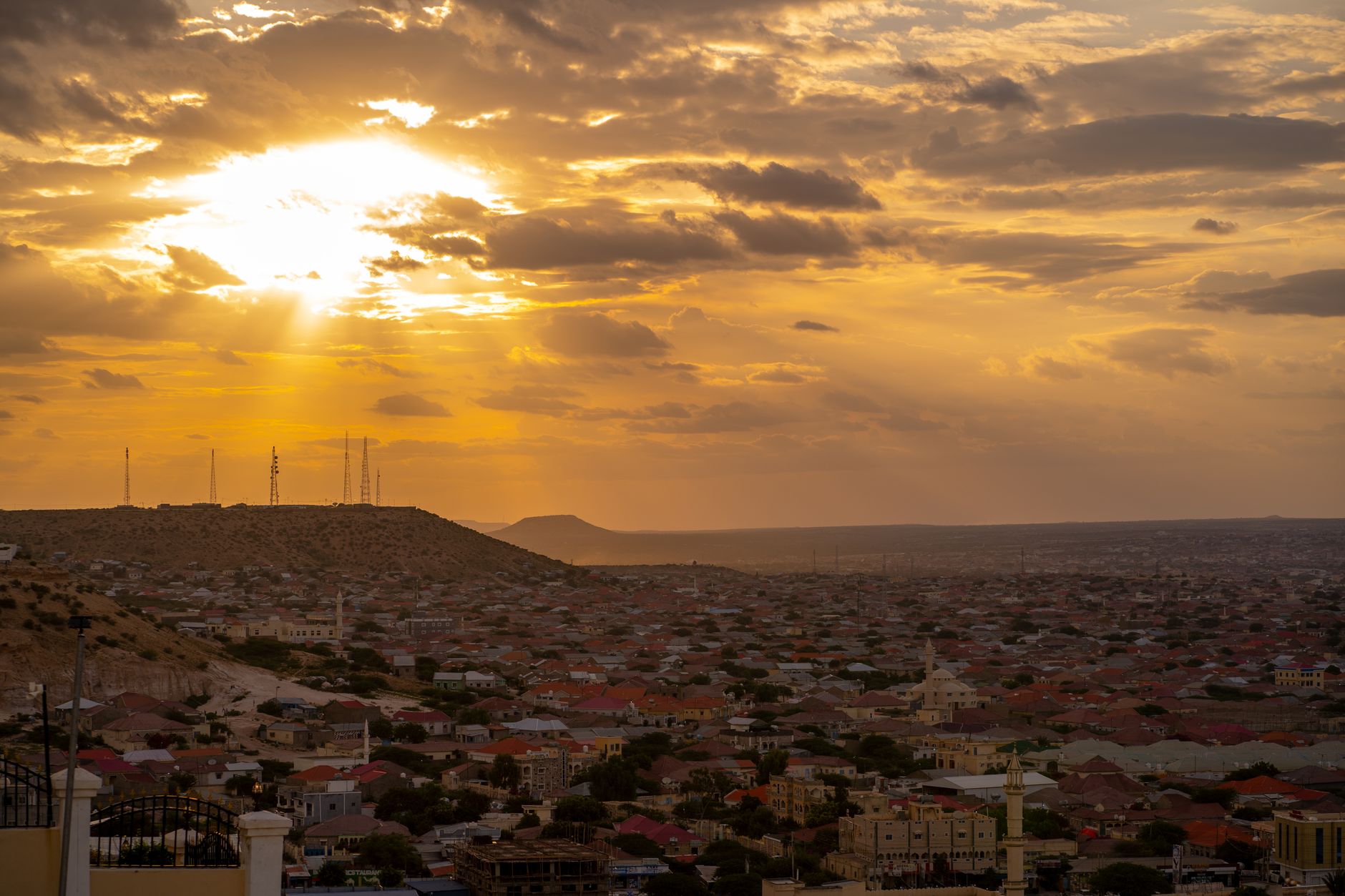
The longest coastline in mainland Africa, an Italian and Arab old town wrecked by decades of war in Mogadishu, and the rock paintings of Laas Geel: Somalia is one of the most dangerous and least visited countries in the world. Almost every foreign ministry advises AGAINST travel; this guide is for information, not an invitation.
Somalia is a country in the Horn of Africa, looking out over the Gulf of Aden and the Indian Ocean, with the longest coastline on the continent and a centuries-old history of trading ports linking Arabs, Persians and Indians with the African interior. On paper it's a fascinating destination —Mogadishu with its Italian and Arab old town, Indian Ocean beaches, green mountains in the north, 5.000-year-old rock paintings— but in reality it's one of the most dangerous and inaccessible places on the planet.
Since the collapse of the state in 1991, the country has endured decades of civil war, famines and the still-active conflict with Al-Shabaab, a jihadist group that controls rural areas and frequently attacks Mogadishu and other cities. That's why almost every foreign ministry (the United States, the European Union, the United Kingdom and several Latin American countries) keeps its highest 'do not travel' warning for Somalia, because of terrorism, kidnapping, crime, landmines and piracy. Any visit is made with a local operator and an armed escort, accepting a high and very real risk.
The important nuance is the north: Somaliland, an autonomous region that declared independence in 1991 (although no country recognises it), is considerably more stable and has a small adventure-tourism scene around Hargeisa, Laas Geel and Berbera, almost always with a mandatory escort outside the capital. This guide gathers honest information to help you understand the country, its regions and its risks; it isn't a travel recommendation, but a guide for anyone who wants to get to know it with their eyes wide open.
The official currency is the Somali shilling (SOS), at around 571 SOS to the dollar (verified July 2026), but in practice the country is deeply dollarised: prices are quoted, paid and thought of in US dollars, and the shilling survives almost only as small change, in huge wads of very low-value notes. Bring US dollars in cash, in new, low-denomination notes, because there are no reliable international ATMs and foreign cards aren't accepted anywhere. What does work perfectly is mobile money (Hormuud's EVC Plus, Zaad): much of the population pays for everything by phone, although for visitors the realistic option is cash in USD. Somaliland, the northern region, issues its own Somaliland shilling, which isn't valid in the rest of the country. Tipping isn't mandatory, but rounding up is appreciated by guides, drivers and escorts.
Full converter for SOS →There are no direct flights from Latin America: you arrive with at least two stopovers at Mogadishu's Aden Adde International Airport (MGQ), typically via Istanbul (Turkish Airlines), Nairobi, Addis Ababa or Dubai. Since September 2025 there has been a national eVisa (around 60 USD, single-entry), best applied for on the official portal before you fly; some nationalities still get a visa on arrival in Mogadishu. WATCH OUT for Somaliland: it's an autonomous region with its own immigration control, the Somali eVisa is NOT valid for entering via Hargeisa and you need a separate visa (on arrival at Egal airport or from a representative office), and vice versa. Travelling overland between cities is extremely dangerous because of Al-Shabaab and the checkpoints: in practice you fly between Mogadishu, Hargeisa, Garowe, Bosaso and Kismayo with local airlines, and every movement around Mogadishu and the south is done with a local operator, a vehicle and an armed escort. Without that logistics, this isn't a destination you can explore on your own.
Somalia's climate is organised into two dry seasons and two rainy ones. The best window to visit, generally speaking, is the cool dry season of Jilaal, roughly December to February, when temperatures drop a little and conditions are more stable. The other dry season, Hagaa (June to August), is very hot and windy on the coast, although in the northern mountains (Cal Madow, Daallo) it brings mists and some humidity that keep the forests green.
Where possible, avoid the two rainy seasons: Gu (April to June), the main one, and Deyr (October to December), because they make dirt roads difficult, cut off rural areas and can bring flooding. All this climate planning, in any case, comes second to security: for almost every foreign ministry, the ideal date to 'go' to Somalia is never.
Somali cuisine is one of the richest and least known in the Horn of Africa: a crossroads of African, Arab, Persian, Indian and Italian flavours. The everyday dish is bariis, rice flavoured with cumin, cardamom and cloves, served with goat, lamb or camel, and often accompanied —a curious tradition— by a ripe banana on the side. Breakfast belongs to canjeero (or laxoox), a spongy, slightly sour bread, a cousin of Ethiopian injera, dipped in stews or eaten with honey and butter. Sambusa (fried pastries filled with spiced meat) are the snack you'll find everywhere.
The Italian colonial era left a taste for pasta: 'baasto' with meat sauce is eaten as a matter of course, sometimes even with canjeero on the side. Everything is washed down with shaah, a strong black tea loaded with spices and sugar, or with coffee; as a Muslim country, there's no alcohol. Hospitality is sacred: turning down a dish or a tea can be taken as a slight, and eating is usually a shared, generous act. Eating locally is cheap, around a few dollars per meal (verified July 2026).
Security is THE issue in Somalia and there's no sugar-coating it: almost every foreign ministry in the world —the United States, the European Union, the United Kingdom, Australia and several in Latin America— keeps its highest level, 'do not travel', because of terrorism, kidnapping, violent crime, armed conflict, landmines and piracy. The jihadist group Al-Shabaab controls rural areas and carries out frequent, deadly attacks in Mogadishu and other cities (car bombs, attacks on hotels, airports and markets), and kidnapping foreigners for ransom is a real and extreme risk. US diplomatic staff, for example, aren't allowed to leave the Mogadishu airport compound. Those who travel anyway do so with a specialised local operator, an armed escort, low-profile vehicles, varied routes and insurance covering war zones and medical evacuation. It isn't a destination for improvising or travelling alone, and no precaution removes the underlying risk.
The north softens this warning but doesn't cancel it: Somaliland (Hargeisa, Berbera, Laas Geel) is considerably more stable and has a budding adventure-tourism scene, although outside Hargeisa you're usually required to travel with an armed police escort (SPU), and the border areas with the rest of Somalia and with Puntland are still marked as no-go. On health, there's no formal yellow fever vaccination requirement unless you arrive from a country with risk (several in Latin America are: bring the certificate), but it's recommended to be up to date on hepatitis A and B, typhoid, tetanus, polio, MMR and, depending on the trip, rabies and cholera. Malaria is present throughout the country, so antimalarial prophylaxis and repellent are essential. Always drink bottled water, bring your medicines from home and assume medical infrastructure is very limited: insurance with evacuation isn't optional. There's no reliable nationwide emergency number; your real point of reference is your operator and your escort.
Somalia is an expensive destination to organise, not because of the cost of living —which is low— but because of security. Local food costs a few dollars, a simple hotel in Hargeisa runs about 30-80 USD a night and urban transport is cheap (verified July 2026). But the expense that defines the trip is logistics: in Mogadishu and the south you almost always book a package with a local operator that includes accommodation in protected compounds, armoured transfers and an armed escort, and that can cost around 150-300 USD or more per day per person, depending on the group and the level of protection.
In Somaliland the budget is somewhat more manageable: on top of accommodation and meals, you need to add the guide, the 4x4 vehicle to get out of Hargeisa (Laas Geel, Berbera) and the mandatory police escort (SPU), which is paid by the day. A multi-day trip through the north usually comes to around 80-150 USD a day per person in a small group. Throughout the country you pay in cash and in dollars: arrive with plenty of margin, in new, low-denomination notes, because there are no international ATMs and no way to get money once you're inside.
Somalia is an almost homogeneous country ethnically and religiously: the vast majority are ethnic Somali and Sunni Muslim, with a strong clan structure that shapes much of social and political life. The languages are Somali (written in the Latin alphabet since 1972) and Arabic; English is understood in tourist and official settings, especially in Somaliland, and a few Italian words still survive in the south. Spanish isn't spoken. Society is deeply hospitable and chatty, but also conservative: modest dress is expected —for women it's essential to cover arms, legs and head with a scarf— and you should respect prayer times and the month of Ramadan.
It's a Muslim country with no alcohol, where you should always ask permission before photographing people and never photograph checkpoints, soldiers, escorts or official buildings. Khat (a stimulant leaf chewed in the afternoons) is part of the male social landscape, although visitors are better off staying out of it. Sockets are a mix of European (C) and British (G) plugs at 220V, so bring a universal adapter. You can get a local SIM with data (Hormuud and other operators offer good mobile coverage and mobile money), but connectivity and electricity can be patchy outside the cities. Above all, the cultural rule that matters most is security: always follow your guide's and your escort's instructions.
In a granite rock shelter 50 kilometres from Hargeisa there are cows painted in red and white, with ceremonial collars around their necks, that have been gazing at the same horizon for some five thousand years. The site is called Laas Geel, and a French archaeological mission only brought it to the world's attention in 2002. That one of the best-preserved rock art ensembles in Africa is still not on the World Heritage List says, in a single sentence, almost everything you need to understand about this country: here history is ancient, and political recognition is an open question.
This is the full history of Somalia: the land of Punt that sold incense and myrrh to the pharaohs, the Indian Ocean city-states that traded with China, the sultanates of Adal and Ajuran, the colonial carve-up between the British and the Italians, the Dervish resistance, the 1960 union, the dictatorship of Siad Barre, the collapse of the state in 1991 and the long road back. And also the history of Somaliland, which declared independence in 1991 and functions in practice as a separate country, with its own government, currency and visa, in a diplomatic limbo that only began to shift in December 2025.
Read the full history of Somalia →Pick a region and open each destination to see what to do, prices and how to get there.
These are the sources we cite most across this country's guides, with how many times each appears. Hard data —tickets, opening hours, requirements, transport— comes from the official source and carries the date we checked it. Restaurant and hotel picks come from guides and reviews, and we say so on each page.