GO! Assistance has 50% off in October and, with our link, you get an extra 20%.
Pick origin, destination, dates and ages and see the price of your travel assistance in a minute.
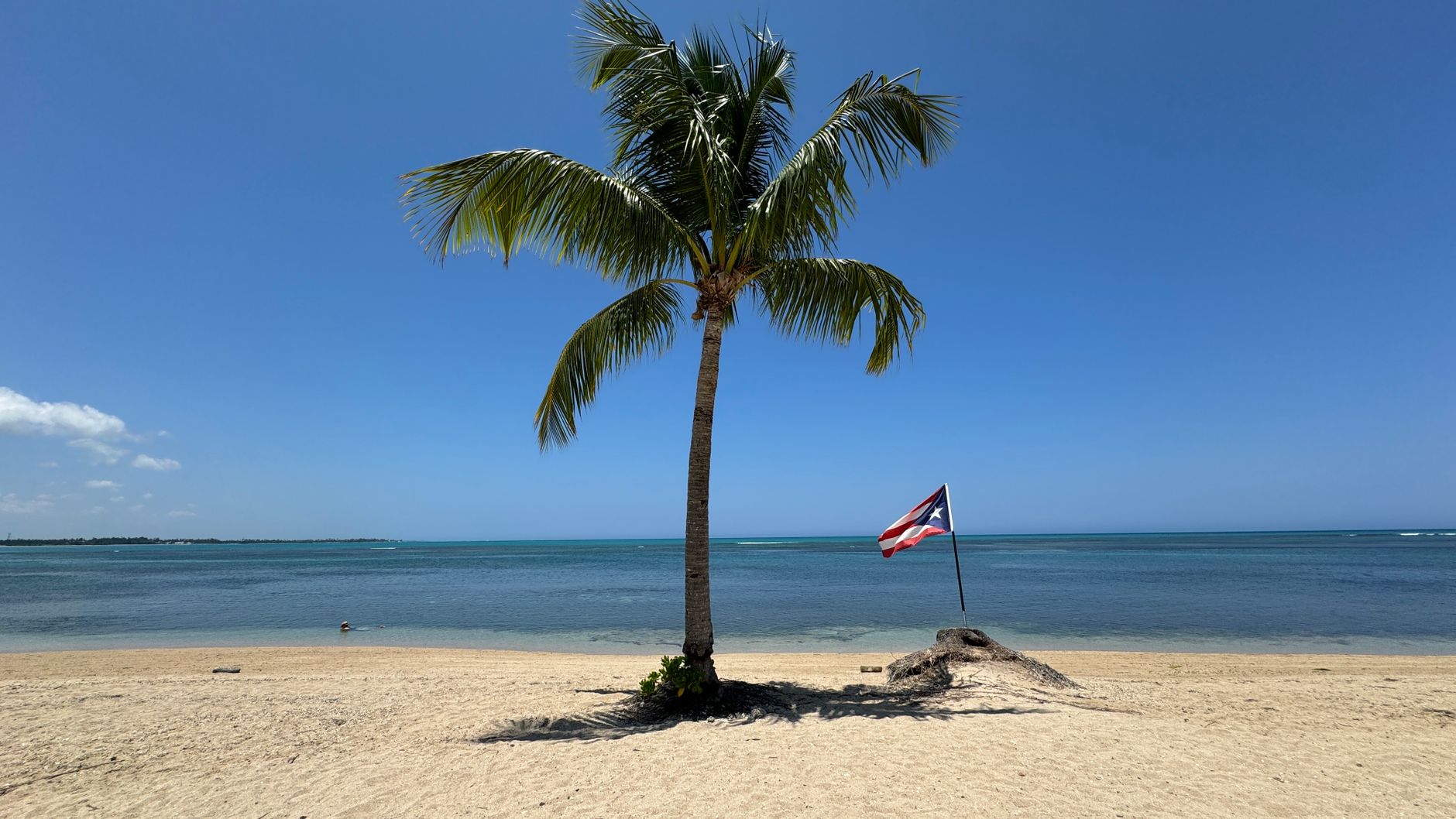
The Island of Enchantment awaits with the blue cobblestones of Old San Juan, glowing bioluminescent bays, the tropical rainforest of El Yunque and postcard Caribbean beaches. Boricua warmth, salsa and reggaeton on every corner.
Puerto Rico is the Caribbean without the paperwork. It is a US territory, so for American travellers there is no passport, no customs and no currency exchange — it is a domestic flight that lands somewhere that feels emphatically foreign. Spanish is the language of the street, salsa and reggaetón set the rhythm (reggaetón was born here), and Old San Juan is one of the oldest colonial quarters in the Americas, with blue cobblestones and two enormous Spanish fortresses.
The island is small enough to drive across in a few hours. San Juan holds the history and the nightlife; to the east are El Yunque — the only tropical rainforest in the US National Forest system — and the island municipalities of Vieques and Culebra, with world-class beaches and bioluminescent bays; the west coast is surf country around Rincón; and the drier south has stately Ponce and the Guánica dry forest.
What you get is a genuinely Caribbean island with US infrastructure: reliable roads, familiar phone service, ATMs everywhere and hospitals that meet American standards. What you should budget for is that it is priced accordingly — this is not a cheap Caribbean destination.
Traveler's tip: Puerto Rico uses the US dollar, so if you're coming from the US you won't need to exchange any money. Cards are accepted almost everywhere, but it's worth carrying some cash for food kiosks, tips and rural areas. Keep in mind that the usual tip at restaurants is around 15–20%.
The main gateway is Luis Muñoz Marín International Airport (SJU) in San Juan, the largest and best-connected in the Caribbean. It receives direct flights from many US cities, along with connections from Latin America and Europe. On the west side of the island, Rafael Hernández Airport (BQN) in Aguadilla works as a second option with a few international routes. Among the airlines with the most operations are the big US carriers such as American, JetBlue, United, Delta and Southwest, plus Frontier and Spirit on budget routes. To get between the main island and the island municipalities of Vieques and Culebra, there are short domestic flights with regional operators such as Cape Air, as well as the ferry that leaves from Ceiba. Within San Juan there's a public bus system (AMA) and the Tren Urbano, but outside the metro area public transport is limited. To explore the island freely, the most practical option is to rent a car: distances are short and the roads are in good shape. In the cities there are taxis, and Uber also operates in and around San Juan, a comfortable and affordable option for city trips.
The dry season, December to April, is the best window: sunny, less rain and calm seas. It is also high season, with the highest prices and the biggest crowds between Christmas and Easter. The climate is warm and tropical year-round with remarkably stable temperatures thanks to the sea breeze, so there is no genuinely cold month.
Hurricane season runs June to November, with the greatest risk between August and October — worth factoring into travel insurance and flexible bookings. May and November are good shoulder months, with fewer people and better prices. For surfing in the west, the best swells are in winter, November to March. And one local detail: Puerto Rican Christmas is among the longest and most festive in the world, with parrandas — roving house-to-house celebrations — continuing well into January, past the Three Kings festivities.
Puerto Rican cooking, cocina criolla, is bold and filling. The essential dish is mofongo: green plantain fried, then mashed with garlic and crackling, usually stuffed with meat or seafood. Alongside it, arroz con gandules (rice with pigeon peas), slow-roasted lechón, and the fritters sold at beachside kiosks — alcapurrias and bacalaítos. The piña colada was invented in San Juan, and the local rums, Bacardí and Don Q, are everywhere. Coffee grown in the island's mountains is excellent and underrated abroad.
Reference prices (verified July 2026): eating out costs roughly what it does in the mainland US. Kiosk fritters run a few dollars, a plate of mofongo in a restaurant US$12–18, and dinner with a drink US$25–40 per person. Eating at the Piñones or Guavate kiosks costs far less and is often better than a restaurant meal. Tap water is safe to drink. Tipping follows the US convention at 15–20%, and it is sometimes already added to the bill, so check before doubling up.
Puerto Rico is generally safe for visitors, and the tourist areas — Old San Juan, Condado, El Yunque, Vieques, Culebra and Rincón — are calm. As in any large city, San Juan has neighbourhoods worth avoiding and opportunistic theft happens: never leave anything visible in a parked car, as break-ins at beach car parks are a known problem. Most travellers have no trouble at all. One practical note: since Hurricane María in 2017 and subsequent earthquakes, the electrical grid remains fragile and occasional outages happen, so a torch and a power bank are genuinely useful.
For health: tap water is drinkable, no vaccinations are required, and dengue is present, so use repellent, especially in forested areas. The medical system meets US standards, which also means US prices. This matters more than visitors expect: if you are travelling from outside the United States, your regular health insurance almost certainly does not cover you here, and an emergency without cover can be financially serious. Even US travellers should check whether their plan covers out-of-network care on the island. Emergency number: 911, with Spanish- and English-speaking operators (verified July 2026).
Puerto Rico is expensive by Caribbean standards, with prices close to those of the mainland United States and the US dollar as currency. A tight backpacker budget starts around US$70–100 per day; mid-range travel runs US$150–250; comfortable travel considerably more. Concrete figures (verified July 2026): a hostel dorm bed US$25–40, a budget hotel room from US$80–120, a plate of mofongo US$12–18, a coffee US$3–4.
After accommodation, the biggest cost is usually the rental car: around US$40–70 per day, and effectively essential if you want to leave San Juan, because public transport is limited outside the metro area. The cheap parts: the ferries to Vieques and Culebra from Ceiba cost only a few dollars, kiosk food is inexpensive, most beaches are free and Old San Juan costs nothing to wander. El Yunque charges a modest entry fee with a required advance reservation. These are reference values, not fixed prices.
Spanish and English are both official, but Spanish dominates in daily life and you will hear it everywhere, spoken with a distinctive Puerto Rican accent that drops final consonants and moves fast. English is widely understood in tourist areas, hotels and San Juan, so you can travel without Spanish — but learning a few phrases changes how people respond to you, particularly in the mountains and small towns. The culture blends Taíno, African and Spanish roots into an identity that is strongly and proudly Puerto Rican, distinct from the mainland US despite the political relationship.
Practical details: plugs are US type A and B, 120 V, 60 Hz, so American devices work without adapters. If you have a US mobile plan it works here as domestic, with no roaming charges — one of the real conveniences of the destination. A few tips from experience: rent a car to make the most of the island, book El Yunque and the bioluminescent bay tours well in advance because they fill up, and keep a torch or power bank handy for the occasional power cut. Tipping is 15–20%, US-style rather than Caribbean.
The history of Puerto Rico is that of a Caribbean island inhabited for millennia by Amerindian peoples and, at the moment of European contact, by the Taíno, who called it Borikén, 'land of the proud lord'. Christopher Columbus sighted it on November 19, 1493, during his second voyage, and Juan Ponce de León began its colonization in 1508 with the founding of Caparra. For four centuries the island was one of the great military keys of the Spanish Empire in the Americas: San Juan, protected by its walls and by the castles of El Morro and San Cristóbal, withstood the attacks of Francis Drake, of the Earl of Cumberland, of the Dutch and of the British, earning a reputation as an almost impregnable bastion at the entrance to the Caribbean. Outside the walled capital, the island lived poor and half-abandoned, between cattle raising, smuggling and, later, the sugar and coffee plantations sustained by slave labor and by the jíbaros of the mountains.
The nineteenth century brought the awakening of a creole consciousness: the Grito de Lares of 1868, the abolition of slavery in 1873 and the Autonomic Charter of 1897, which barely had time to be applied. In 1898, after the Spanish-American War, United States troops landed at Guánica and, by the Treaty of Paris, Spain ceded the island to the power of the north, opening a unique chapter: that of a Caribbean territory of Spanish language and culture under North American sovereignty. Its inhabitants have been United States citizens since the Jones Act of 1917, and since 1952 the island has been an Estado Libre Asociado (Commonwealth), with a political status still debated among statehood, independence and keeping the Commonwealth.
Read the full history of Puerto Rico →Pick a region and open each destination to see what to do, prices and how to get there.
These are the sources we cite most across this country's guides, with how many times each appears. Hard data —tickets, opening hours, requirements, transport— comes from the official source and carries the date we checked it. Restaurant and hotel picks come from guides and reviews, and we say so on each page.
I have never been left without internet on a trip. I land and my phone connects to the strongest network in the country I am visiting: I can let people know I arrived, sort out transport, book tours and keep posting content at a super affordable price (really cheap!). I always use the Maya Mobile eSIM, check out its plans by clicking the banner. See Maya Mobile plans →
Affiliate link: we earn a commission.