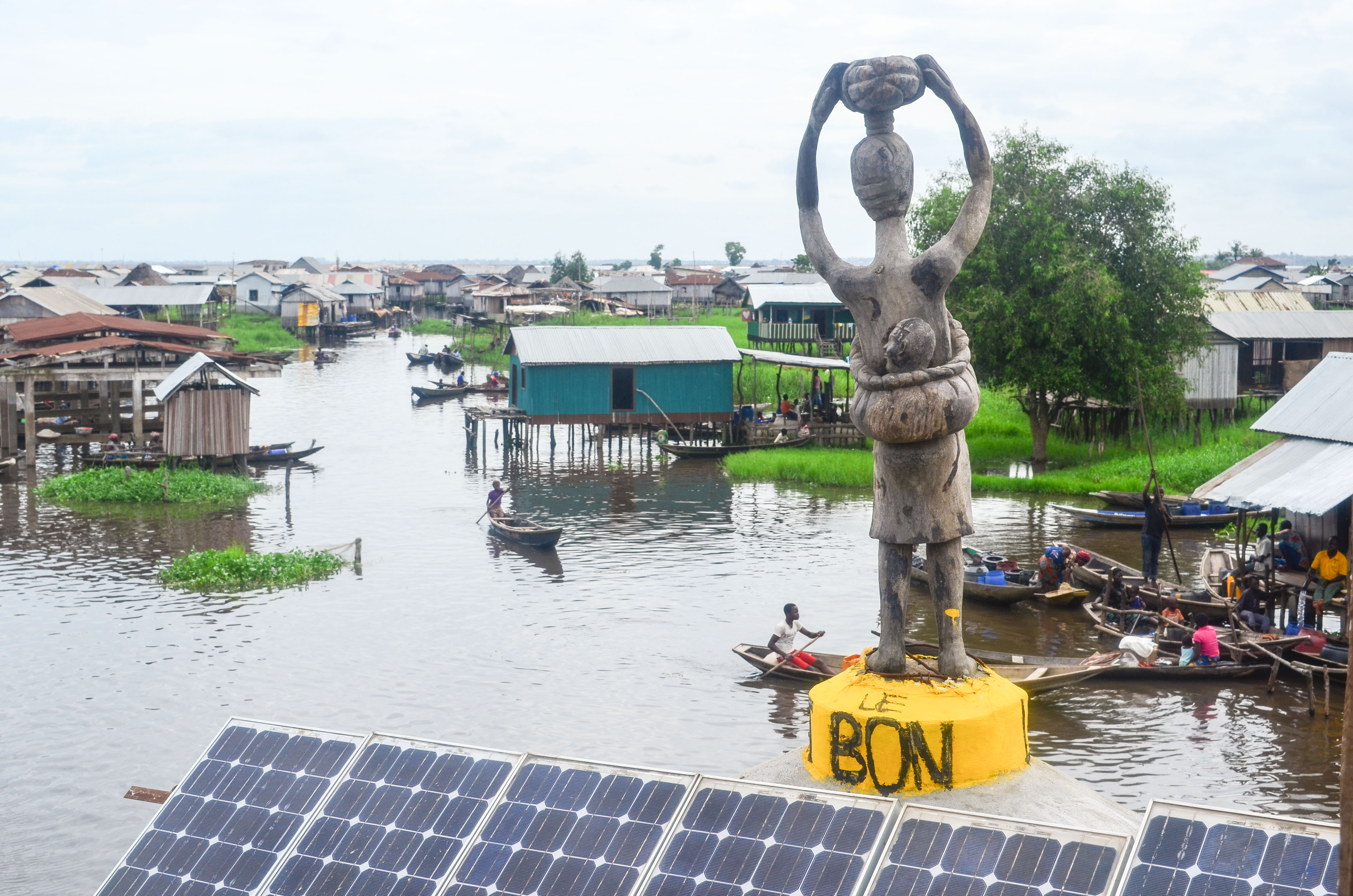
The cradle of voodoo and of the mighty Kingdom of Dahomey: the royal palaces of Abomey, the lake village of Ganvié, the Door of No Return in Ouidah and the safaris of the Pendjari make this small West African country one of the most intense and authentic cultural trips on the continent.
Benin is a small, elongated country on the Gulf of Guinea that packs in a cultural and historical density hard to match in West Africa. It is, above all, the cradle of voodoo: a living religion that permeates daily life, with temples, fetish markets, ceremonies and a pantheon of hundreds of deities. And it is the land of the Kingdom of Dahomey, one of the most powerful pre-colonial states on the continent, whose royal palaces in Abomey are now a World Heritage Site. For the curious traveller, Benin is an open history book: here you come to understand, in a raw and direct way, the tragedy of the slave trade that bound Africa to the Americas.
The south, tropical and humid, holds the big icons: Cotonou, the chaotic and vibrant economic capital; Ouidah, the port of slave-trade memory and spiritual capital of voodoo, with its Slave Route, the Door of No Return and the python temple; and Ganvié, the astonishing 'Venice of Africa' built on stilts in a lagoon. Towards the centre come Abomey and its royal palaces, and the sacred hills of Dassa. In the north, drier and more Sahelian, the landscape changes completely: the Somba fortress-houses of the Atacora region, the town of Natitingou and Pendjari National Park, one of the last great wildlife sanctuaries in West Africa.
It's a destination for travellers with an explorer's spirit, driven more by culture, history and human contact than by luxury comfort. Tourist infrastructure is basic, distances call for patience and the heat is intense, but Benin pays you back with an authenticity that's hard to find these days: few tourists, warm and curious people, and experiences (a voodoo ceremony, a pirogue ride among stilts, a mud palace) that stay with you. That said, the far-north border area requires you to read up carefully on the security situation before travelling.
The currency is the West African CFA franc (XOF), shared with seven other countries in the region (Senegal, Côte d'Ivoire, Togo, Niger, Mali, Burkina Faso and Guinea-Bissau). It has one big advantage: it is pegged to the euro at a fixed rate of 1 EUR = 655,957 XOF (verified July 2026), so its value is stable and predictable; against the dollar it trades at around 575 XOF per USD (it varies with the euro). That's why it's worth bringing EUROS in cash to exchange (they get a better rate than dollars) at banks and bureaux de change in Cotonou. Benin is very much a cash economy: cards (Visa, Mastercard somewhat less) are only accepted at large hotels, the odd supermarket and agencies in Cotonou, while for zémidjans (motorbike taxis), markets, admission fees, street food and anywhere inland you absolutely need CFA notes. There are ATMs from Ecobank, UBA, Bank of Africa and others in Cotonou, Porto-Novo, Parakou and mid-sized towns, but they become scarce in the far north, so withdraw cash before heading into the interior. Tipping isn't compulsory but it's appreciated: round up at restaurants, and some small change for guides and drivers.
Full converter for XOF →There are no direct flights from Latin America to Benin: every route involves a stopover. The most convenient connections are via Paris (Air France flies direct from Charles de Gaulle to Cotonou), Brussels (Brussels Airlines) or Addis Ababa with Ethiopian Airlines, which links Buenos Aires (EZE) and São Paulo (GRU) with Cotonou; Casablanca with Royal Air Maroc or Istanbul with Turkish also work. The only international airport is Cardinal Bernardin Gantin in Cotonou (COO), on the coast. Allow between 22 and 32 hours of total travel depending on the stopovers. As for visas, the good news is that Benin has a 100% online e-visa system: Latin Americans apply for the electronic visa before travelling on the official portal (you upload your documents, pay, and approval arrives by email within a few days), without setting foot in a consulate; there are 30- and 90-day options. An international yellow fever vaccination certificate is required to enter. Within the country, the cheapest way to get between towns is by taxi-brousse (shared cars and minibuses) and buses from companies such as Baobab Express or ATT; within towns, zémidjans, the yellow motorbike taxis, rule. To reach the north and the parks comfortably, the most practical option is to hire a car with driver or book a tour, because distances are deceptive and signage is scarce.
The best time to visit Benin is the dry season, from November to February, when it hardly rains, roads are in better shape, the heat is a bit more bearable and the Pendjari's animals gather at waterholes (the best safari months run from December to April, as far as security allows). It's also when the great Ouidah Voodoo Festival takes place, every 10 January, drawing tens of thousands of people: if you're interested, book accommodation well in advance. Between December and February the Harmattan may blow, a dry wind that carries dust from the Sahara and hazes the sky, especially in the north.
The climate is tropical and varies by area. The south, on the coast, has two rainy seasons: a long one (April to July) and a shorter one (September to October), with high humidity and heavy downpours. The north, more Sahelian, has a single rainy season (June to September) and is drier the rest of the year. Temperatures hover around 27–34 °C almost all year, with somewhat cooler nights in the north during the Harmattan. If your priority is the culture of the south, you can travel almost any time while dodging the rainy peaks; if you're after safari and dry roads, aim for the November–April window.
Beninese cuisine is tasty, spicy and largely built on hearty sauces eaten with a dough. The everyday dish par excellence is 'pâte' (akassa or telibo): a maize, millet or cassava porridge dipped in sauces of tomato and pepper, gombo (okra), peanut or leaves. It comes with chicken, fresh lagoon fish or meat. Other stars are 'amiwo' (a red maize pâte cooked with tomato sauce, typical of the south), local-style rice, 'atassi' (rice and beans) and, as an unmissable street snack, 'akara' (fried bean fritters) and fried plantains ('aloko'). A very Beninese product is 'wagasi', a fresh cheese made by the Peul people that's fried and served golden, delicious.
Eating is cheap if you go to 'maquis' (popular eateries) and street stalls: a plate of pâte with sauce and fish costs around 1.500–3.000 CFA (about 3–5 USD), and a generous lunch at a tourist restaurant, 6–12 USD. At the few restaurants in Cotonou with international menus (Lebanese, French) you can spend 15–30 USD. As for drinks, the local beer (La Béninoise) is good and cheap; in rural areas and at ceremonies palm wine flows, and above all sodabi, the potent craft palm spirit that is practically the national drink. Watch out for the chilli, which tends to be fierce: ask for it on the side if you're not used to it, and with food and water, better safe than sorry (see the health section).
Benin, in its southern and central half, is a calm and hospitable country where tourists are rarely targets of violence; the main risk there is petty crime (pickpockets and theft in markets like Dantokpa, bus stations and busy areas of Cotonou) and the occasional traffic accident, which are very common with zémidjans. The usual city precautions apply: don't flash valuables, keep an eye on your phone, avoid walking at night in dark areas and agree on prices in advance. The situation changes in the northern BORDER area: the departments of Alibori and Atacora, on the border with Burkina Faso and Niger (exactly where the Pendjari and W parks are), have since 2021 suffered activity by jihadist groups (JNIM), with attacks on security forces. Many governments advise against travel to that border strip; before planning the Pendjari or the far north, check your country's official travel advisories and ask reputable local operators what is open and safe. The police emergency number is 117 (fire brigade 118).
On health, there are two non-negotiable points. First, yellow fever: the vaccine is MANDATORY to enter Benin and you may be asked for the international certificate (yellow card) at the airport; you need to get it at least 10 days before travelling. Second, malaria: there is a risk throughout the ENTIRE country and all year round, with a chloroquine-resistant strain, so see a travel doctor about the right prophylaxis (atovaquone-proguanil is usually prescribed) and back it up with repellent, long sleeves at dusk and a mosquito net. Vaccines against hepatitis A and B, typhoid and meningitis (especially in the north, in the 'meningitis belt') are also recommended, as is being up to date with routine shots. Don't drink tap water: use bottled or purified water, be careful with street food (better hot and freshly made) and take out good travel insurance that covers medical evacuation, because healthcare infrastructure outside Cotonou is limited.
Benin is an affordable destination by international standards, though not 'dirt cheap': scarce tourist infrastructure and long distances mean transport and guides weigh on your wallet. Backpacker-style, getting around by taxi-brousse and zémidjan, sleeping in simple lodgings (10–25 USD a night) and eating at maquis, you can get by on about 30–50 USD a day. Mid-range, with mid-range hotels (35–70 USD), the odd tour, a driver for long stretches and restaurants, count on 70–130 USD a day. And in comfort mode, with good hotels, a car with driver and private guides, it goes up to 150 USD a day or more. Admission to the star sites is affordable: the Abomey palaces and the museums cost around 2.500–5.000 CFA (5–10 USD), and the pirogue to Ganvié costs a similar amount per person.
The big expense of a trip to Benin is usually a safari in the Pendjari (when it's operating): between park admission, 4x4, driver-guide and lodge accommodation, a couple of days can easily run to 150–300 USD per person. To give you an idea, a classic 8- to 12-day circuit through the south and centre (Cotonou, Ouidah, Ganvié, Abomey, Porto-Novo, Grand-Popo) at mid-range comes to around 700–1.400 USD per person on the ground, not counting international flights (which from South America usually cost 1.300–2.100 USD return depending on the season and stopovers). The biggest savings come from shared transport and maquis; the biggest expense is hiring a driver and guide, almost essential to make the most of the interior and the north. A tip: travel in a group and share the car with driver (about 50–90 USD a day), which works out far better value.
The official language is French, spoken throughout the administration, hotels, tourism and the cities: with basic French you'll get around fine, and Spanish is practically never used, so it's worth brushing up on some French before you go. Dozens of local languages are also spoken, above all Fon (the most widespread in the south) and Yoruba in the south-east; learning 'kudo' (hello in Fon) or a simple 'bonjour' with a smile opens many doors. Beninese culture is warm, community-minded and deeply religious: voodoo, Christianity and Islam coexist, often within the same family. Voodoo is taken seriously, it's not a show: always ask permission before photographing people, ceremonies, temples or fetishes, and if you're invited to a ritual, follow the guide's instructions and show respect.
On the practical side: plugs are type C and E (round pins, European/French style), the voltage is 220V, and power cuts can happen, so a power bank comes in handy. For connectivity, buy a local SIM as soon as you arrive (MTN and Moov Africa are the main operators, with good coverage in the south and cheap data; you need your passport to register it); in the north the signal becomes patchy. Hotel wifi is unreliable, so mobile data is your best ally. Traffic drives on the right. Dress somewhat modestly, especially in the Muslim north and at religious sites. And the golden rule for Benin: travel with patience, flexibility and curiosity, because the pace is slow, plans change and the best way to enjoy it is to let yourself be carried along by its people and its cultural intensity.
Few countries so small on the map carry a history as dense as Benin's. This narrow strip of West Africa, squeezed between Togo and Nigeria and looking out over the Gulf of Guinea, was for centuries the stage of one of the most powerful and feared kingdoms on the continent: the Kingdom of Dahomey, with its capital at Abomey, its warrior kings, its corps of women soldiers whom Europe dubbed "Amazons" and its religion, Vodun, which was born here and crossed the Atlantic from here. Its coastline was also the infamous Slave Coast: from the port of Ouidah and its Door of No Return, hundreds of thousands of Africans were shipped in chains to the Americas, in one of the most brutal chapters of human history.
This is the full history of Benin. It begins with the Fon, Yoruba and Bariba peoples who settled its territory, moves through the splendour of Dahomey and the Yoruba kingdoms, the Atlantic slave trade, the bloody French conquest and the resistance of King Béhanzin, and continues to the colony of Dahomey, independence in 1960, the years of coups, Major Kérékou's Marxist experiment and the exemplary democratic transition of 1990. Today the country proudly claims to be the birthplace of Vodun, and in 2021 it saw the royal treasures that a French general had seized from its kings more than a century earlier return from France.
Read the full history of Benin →Pick a region and open each destination to see what to do, prices and how to get there.
These are the sources we cite most across this country's guides, with how many times each appears. Hard data —tickets, opening hours, requirements, transport— comes from the official source and carries the date we checked it. Restaurant and hotel picks come from guides and reviews, and we say so on each page.