GO! Assistance has 50% off in October and, with our link, you get an extra 20%.
Pick origin, destination, dates and ages and see the price of your travel assistance in a minute.
Belize: The only English-speaking country in Central America: the Belize Barrier Reef, the Caribbean cayes, Maya ruins hidden in the jungle and the legendary Great Blue Hole are waiting for you.
Belize is the odd one out in Central America, and for an English speaker that is the point: it is the only country on the isthmus where English is the official language. Signs, menus, dive briefings and the immigration desk are all in English, so the usual friction of a Central American trip is absent. Add a currency pegged at a fixed 2 BZD to 1 USD, US dollars accepted everywhere, American flat-pin sockets and a time zone that matches US Central Time, and it is one of the least complicated foreign countries an English speaker can reach.
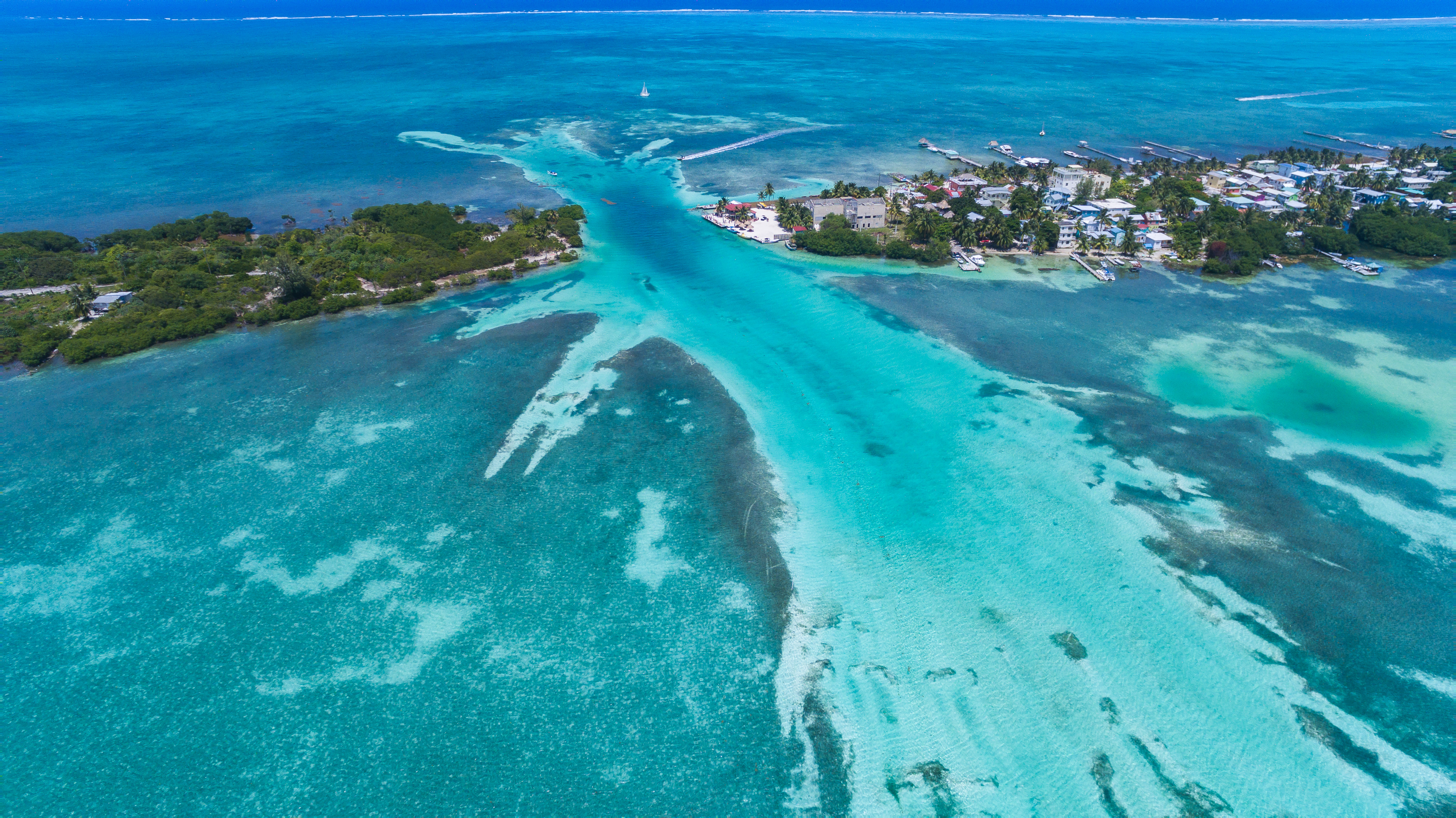
The trip splits into two worlds. Offshore are the cayes and the reef: Caye Caulker, barefoot and backpacker-friendly with sand streets and a 'go slow' motto, and Ambergris Caye with the town of San Pedro, larger and more developed. Both sit beside the Mesoamerican Reef, the second-largest on the planet after Australia's, and both launch trips to the Great Blue Hole, a circular underwater sinkhole more than 300 metres across. Inland, the Cayo district is jungle country, with San Ignacio as the base for Maya cities such as Xunantunich and Caracol, rivers, waterfalls and the extraordinary ATM cave. The southern coast around Hopkins, Dangriga and Placencia is Garifuna territory.
The country is tiny — fewer than half a million people — so you can combine reef and jungle in one trip without long transfers. Independent since 1981, when it stopped being British Honduras, it kept the English language and the British legal system but drives on the right like its neighbours. What catches people out is the cost: Belize is the most expensive country in Central America and prices behave more like a Caribbean island than like Guatemala next door.
Traveler's tip: the Belize dollar is pegged to the US dollar at a fixed rate (roughly 2 BZD = 1 USD), so carrying US dollars is very handy and they're accepted at most businesses. Pay for bigger things by card when you can, and keep cash in small bills for the cayes, food stalls and boat transfers, where card machines aren't always available.
Full converter for BZD →The main gateway is Philip S. W. Goldson International Airport (BZE), about 16 km from Belize City. It receives direct flights from several US hubs (Miami, Houston, Dallas, Atlanta) and some connections from other parts of Central America. If you're coming from South America, the most common route is a layover in the United States, Panama or Mexico City. For domestic flights, the airlines Tropic Air and Maya Island Air link the most popular destinations on small planes: San Pedro (Ambergris Caye), Caye Caulker, Placencia, Dangriga and Punta Gorda, among others. They're short, scenic flights and very useful for saving hours of travel by land and sea. Overland, buses run along the spine of the country via the four main highways (Northern, Western, Hummingbird and Southern). They're cheap, though slow and without many comforts. To reach the cayes you use ferries and speedboats that leave Belize City for Caye Caulker and San Pedro. In the towns there are taxis (no meter: agree on the price before getting in) and car rentals to explore the interior and the jungle at your own pace.
The dry season, from late November to mid-April, is the best window: clear skies, calm seas and the best underwater visibility of the year. It is also high season, so prices climb and the cayes fill up, especially around Christmas, New Year and Easter. The rainy season runs roughly June to November and brings humid heat, afternoon downpours and Caribbean hurricane season, with the highest risk between August and October — if you travel then, choose flexible bookings and check what your insurance covers. May and late November often give good weather at lower prices.
The climate is tropical and warm all year; the jungle interior is muggier, while the cayes get a sea breeze that makes the heat manageable. Water temperatures stay comfortable in any month, so diving and snorkelling work year-round — the dry season simply gives clearer water. Two things worth planning around: whale sharks historically appear off Placencia around the full moons from March to June, and Belize keeps UTC-6 all year with no daylight saving, so it matches US Central Time in winter and sits an hour behind in summer. Flying from Houston or Dallas, there is effectively no jet lag.
Belizean food sits where Caribbean, Creole, Garifuna and Maya cooking meet. The everyday plate is rice and beans — cooked together in coconut milk, which is what makes it Belizean rather than generic — with stewed chicken, pork or fish and fried plantain. On the cayes the emphasis shifts to seafood: lobster in season, shrimp, snapper and conch ceviche, made from the large sea snail whose shells you see piled outside kitchens. From the Garifuna kitchen, try hudut, mashed plantain with fish stewed in coconut broth. Breakfast often means fry jacks, puffed fried dough with beans and eggs. To drink: fruit juices, local rum and Belikin, the national beer.
Reference prices (verified July 2026): Belize is more expensive than its neighbours. A plate at a local stall or family-run diner runs about US$6-10, a meal at a tourist restaurant on the cayes US$12-20, and a Belikin US$2-3. On Caye Caulker, lobster grilled on street barbecues in season is genuinely good value. Tap water is not reliably safe, so stick to bottled or filtered — one of the few places Belize is less convenient than home. Tipping runs 10-15%, lower than the US norm. Prices are often quoted just as 'dollars', so ask which one: at the fixed 2-to-1 rate the difference is double.
The tourist areas — the cayes, San Ignacio, Placencia, Hopkins — are calm and the mood is relaxed. The place to be careful is Belize City, which has neighbourhoods with real crime: do not wander it on foot, especially after dark, and take taxis instead; most travellers only pass through between the airport and the ferry terminal. Standard precautions cover the rest: keep valuables out of sight, agree the taxi fare before getting in because there are no meters, and drive the interior in daylight. If you rent a car, remember Belize drives on the right despite the British history, roads off the four main highways are unpaved and unlit, and speed bumps appear without warning in villages.
For health: drink bottled water. No vaccinations are required, but hepatitis A and typhoid are recommended; dengue is present and there is some malaria risk in the rural interior, so use repellent. If you plan to dive, buy insurance that specifically covers diving — most standard policies exclude it, and a US health plan does not cover you abroad. There is a hyperbaric chamber in San Pedro on Ambergris Caye, which is why many divers base themselves there. Facilities elsewhere are basic and serious cases are evacuated, so evacuation cover is worth having. Emergencies: 911, the same number as at home in the US and Canada, working nationwide (verified July 2026).
Belize is the most expensive country in Central America, so adjust expectations if you are arriving overland from Guatemala or Mexico: prices behave like a Caribbean island rather than like the mainland. Backpacker budget: around US$55-80 per day. Mid-range: US$150-230. Upper end: from US$350 (verified July 2026). Concrete figures: a hostel dorm bed on Caye Caulker US$20-35, a basic private room from US$40-60, a plate of local food US$6-10. The Belize dollar is fixed at 2 to 1 US dollar and US dollars are accepted everywhere, so there is no exchange step and no arithmetic beyond halving the local price.
The heavy items are water activities and getting to the cayes. A Hol Chan snorkel trip runs about US$50-70, a two-tank dive day US$100-150, and the Great Blue Hole US$250-350 because it is a long boat day. Ferries to the cayes cost roughly US$15-20 each way, and domestic hops on the small planes of Tropic Air or Maya Island Air start around US$70 — worth it for the aerial view of the reef alone. These are reference values, not fixed prices. Cards work in hotels and restaurants in tourist areas, often with a surcharge, but boats, food stalls and small guesthouses are cash-only, so carry US dollars in small bills.
English is the language of government, schooling and business, which makes Belize uniquely easy for English-speaking travellers in this part of the world. What surprises people is what they hear in the street: Belizean Kriol, a full language in its own right built on an English base, which sounds familiar and impossible to follow at the same time. Everyone switches to standard English with visitors, and after a few days the rhythm starts to click. Spanish is widely spoken in the north and west near the Guatemalan border, and Garifuna and Mayan languages are alive in the south. The pace is Caribbean: 'go slow' is not a slogan for tourists, it is how things run.
Practical details in your favour: sockets are type A and B at 110-120 V, 60 Hz, identical to the United States and Canada, so American devices plug straight in with no adapter, while travellers from the UK, Ireland and Australia need one. Local SIMs come from Digi or Smart and are bought with a passport; signal is good in tourist areas, patchy in the jungle. Traffic drives on the right, not the left, despite the colonial past. A few tips: bring US cash in small bills, do not count on card machines on the cayes or on boats, book domestic flights and ferries with margin because seats sell out in high season, and treat published schedules as intentions rather than commitments.
Belize is a small and singular country: the only one in Central America where the official language is English, heir to a history unlike that of any of its neighbors. Before the Europeans arrived, its territory was for centuries the heart of the Maya world, with cities such as Caracol and Lamanai that came to house tens of thousands of people. Its geography —a low coast of mangroves and lagoons, a jungle plain inland and the Maya Mountains to the south, all sheltered offshore by the largest barrier reef in the Western Hemisphere— explains much of its destiny: it was a corner hard to conquer, ideal for hiding and for cutting timber, and so it was settled in a way no other country in the region has known.
From the seventeenth century, English castaways, pirates and logcutters —the famous Baymen, the 'men of the bay'— settled at the mouth of the Belize River to exploit logwood and, later, mahogany, giving rise to a British enclave surrounded by Spanish dominions. To fell the forest they imported enslaved African labor, and from that mixture came the Creole population and its Kriol language. Out of that colony of loggers and slaves grew British Honduras, which in 1981 became independent under the name Belize after a long political struggle and in the midst of a Guatemalan territorial claim that is still alive and is now being settled before the International Court of Justice.
Read the full history of Belize →Pick a region and open each destination to see what to do, prices and how to get there.
These are the sources we cite most across this country's guides, with how many times each appears. Hard data —tickets, opening hours, requirements, transport— comes from the official source and carries the date we checked it. Restaurant and hotel picks come from guides and reviews, and we say so on each page.
I have never been left without internet on a trip. I land and my phone connects to the strongest network in the country I am visiting: I can let people know I arrived, sort out transport, book tours and keep posting content at a super affordable price (really cheap!). I always use the Maya Mobile eSIM, check out its plans by clicking the banner. See Maya Mobile plans →
Affiliate link: we earn a commission.