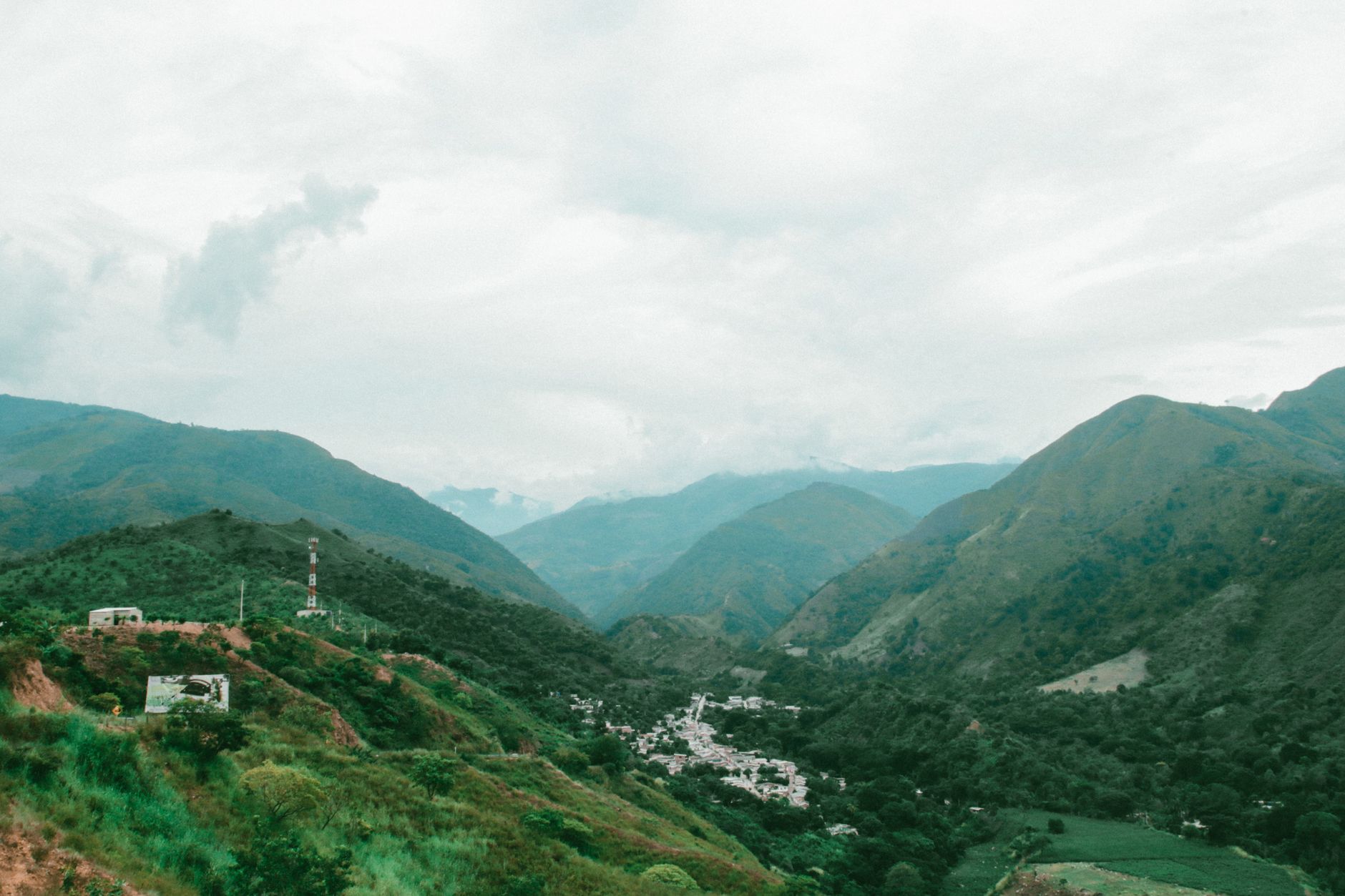
The country of magical realism: coffee from the Coffee Region, the Caribbean of Cartagena, the salsa of Cali and the Amazon rainforest. Pure diversity between two oceans and three mountain ranges.
Colombia is the country of magical realism turned into a travel destination: the walled colonial Caribbean of Cartagena, the green mountain ridges of the Coffee Region, the relentless salsa of Cali, the eternal spring of Medellín, the Amazon rainforest around Leticia, and the high Andean moorland that supplies Bogotá with its water. It is the second most biodiverse country on the planet and the only one in South America with coastlines on both the Caribbean and the Pacific. For travellers coming from North America it is also one of the easiest countries on the continent to reach, with direct flights from Miami, Fort Lauderdale, New York and Toronto landing not just in the capital but in Medellín and Cartagena too.
The country divides into large regions that almost function as separate countries: the Andean region with the three big cities (Bogotá, Medellín, Cali) and colonial towns such as Villa de Leyva; the Coffee Region (Salento, the Cocora Valley, the working coffee farms); the Caribbean (Cartagena, Santa Marta, Tayrona National Park, the island of San Andrés); the Pacific and the south (Popayán, San Agustín); and the Amazon and the Orinoco plains (Leticia, the multicoloured Caño Cristales). The classic first-time circuit strings together Bogotá, Medellín, the Coffee Region and Cartagena, and each leg is a cheap one-hour flight rather than a full day on the road.
What most people take home is the energy of Colombians themselves, and the range of climates and landscapes you can cross in a single trip: a short flight takes you from Andean cold to Caribbean heat. What surprises visitors arriving with the country's old reputation in mind is how far that era has receded — Colombia today is an established, well-organised tourist destination with good infrastructure. What still needs a clear head is urban petty crime, handled with the ordinary precautions of any large Latin American city, and one thing almost everyone underestimates: Bogotá sits at 2,600 m (8,600 ft), high enough that your first day there will feel slower than you planned.
Traveler's tip: the Colombian peso works in large numbers, so expect to see a lot of zeros on price tags. Pay in pesos whenever you can and avoid the exchange desks at the airport, where the rate is usually worse. Cards are accepted in the cities, but it is worth carrying cash for small towns, transport and markets.
Full converter for COP →The main gateway is El Dorado International Airport (BOG) in Bogotá, one of the biggest hubs in Latin America, with direct flights from Miami, Fort Lauderdale, New York, Toronto, Madrid and London. The other useful doors into the country are José María Córdova Airport (MDE), serving Medellín, Rafael Núñez (CTG) in Cartagena and Alfonso Bonilla Aragón (CLO) in Cali; Medellín and Cartagena also take direct flights from several US cities, which means you can often skip the capital altogether. The flag carrier is Avianca, with the widest domestic network. LATAM also operates, along with low-cost airlines such as Wingo and regional carriers linking the main cities. Because the country is so mountainous, domestic flights are usually the fastest and most practical way to cover long distances. Long-distance buses are widely used and cheap, with companies reaching almost every corner of the country, but bear in mind that road journeys can be very long because of the terrain. Cities have urban buses and mass transit systems such as Bogotá's TransMilenio and the Medellín Metro. For door-to-door trips, taxis and ride-hailing apps (Uber, DiDi and Cabify) work well in the big cities; agree or confirm the fare before you get in.
Colombia sits close to the equator, so it has no hot and cold seasons in the usual sense: it has dry seasons and wet seasons, and the climate of any given place depends far more on its altitude than on the month. The drier stretches run from December to March and, less reliably, from July to August, and those are generally the best windows to travel, especially for the Caribbean coast, Tayrona and any serious trekking. Note that December to mid-January and Holy Week are also the local high season, so expect more people and higher prices; the shoulder weeks either side are noticeably calmer.
Because each city has its own permanent climate, you are really choosing an altitude rather than a month. Bogotá is cool all year (12-18 °C / 54-64 °F, bring a jacket and an umbrella), Medellín and the Coffee Region hold that mild 'eternal spring', and the Caribbean coast is hot and humid 365 days a year. One date is genuinely fixed: Caño Cristales only shows its colours from June to November. If you want to plan around a festival, the big three are the Barranquilla Carnival (February or March, one of the largest carnivals in the world), the Feria de Cali (the last week of December) and Medellín's Feria de las Flores (August), when the city fills with flower growers carrying elaborate arrangements on their backs.
Colombian food is hearty, savoury and strongly regional rather than spicy — chilli is served on the side, if at all. The staples worth knowing: the arepa, a flat maize cake grilled or fried and eaten at any hour, plain alongside a meal or split and stuffed with cheese, eggs or shredded beef; the bandeja paisa, the flagship dish of Antioquia, a single enormous platter of beans, rice, minced beef, pork crackling, chorizo, fried egg, avocado, plantain and an arepa; ajiaco santafereño, Bogotá's thick chicken and potato soup flavoured with guascas, a local herb, and served with cream and capers; sancocho, the country's everyday stew; and on the coast, fried whole fish with patacón, a twice-fried disc of green plantain. Then there is the fruit, which is the real surprise: lulo, guanabana, maracuyá and granadilla turn up as fresh juices made with water or milk on every corner. Coffee, of course, is the national product, though Colombians themselves often drink tinto, a small weak black coffee sold from thermos flasks in the street.
Eating well is cheap if you eat local. The set lunch, called the menú del día or corrientazo — soup, a main course and a juice — costs between 12,000 and 25,000 pesos (about 3-6 USD) in a neighbourhood restaurant and is the single best value in the country. Arepas, empanadas and street fruit cost small change. Dinner at a mid-range restaurant runs 40,000-80,000 pesos (10-20 USD) per person. A 10% service charge, legally described as voluntary, is usually added to the bill and you are asked whether to include it; saying no is entirely normal and not considered rude, which is a different convention from the US. The drink to try is aguardiente, an anise-flavoured sugarcane spirit drunk neat in small shots, shared around a table rather than sipped alone. Practical advice: have your main meal at midday like Colombians do, and you eat better for less. Figures verified July 2026.
Colombia has moved a long way from its old reputation and is now an established tourist destination, but it still rewards the ordinary precautions of any large Latin American city. The main risk is opportunistic theft and street robbery in the cities (Bogotá, Cali and parts of Medellín). The local saying sums up the approach: no dar papaya, roughly 'don't hand anyone an easy opportunity' — keep your phone and valuables out of sight on the street, use ride-hailing apps (Uber, DiDi, Cabify) rather than flagging taxis, never accept drinks from strangers at night because drink-spiking with scopolamine does happen, and stay out of neighbourhoods you do not know after dark. Tourist areas are reasonably well policed. Security also varies a lot by region rather than nationwide: some rural and border areas remain off-limits to travellers while the main tourist routes are entirely normal, so check the current travel advice issued by your own government (the US State Department, the UK FCDO, Global Affairs Canada or Australia's Smartraveller) before you fix your route, since those advisories are updated area by area and change over time.
On health, there are no blanket vaccination requirements, but yellow fever vaccination is recommended, and sometimes required, if you are heading to the Amazon (Leticia), parts of the Caribbean or any jungle area; get it at least 10 days before travelling, since the certificate only becomes valid after that. Use insect repellent in tropical areas because of dengue. Tap water is drinkable and safe in the big Andean cities such as Bogotá and Medellín, but on the Caribbean coast, in San Andrés, in rural areas and in the Amazon, stick to bottled water. One thing visitors consistently underestimate is altitude: Bogotá stands at 2,600 m (8,600 ft) and Bogotá to sea level is a routine domestic flight, so take your first day slowly, drink water and go easy on alcohol until you have adjusted. The single nationwide emergency number is 123. Travel insurance with medical cover is strongly advisable, as private clinics expect payment or a guarantee up front. Verified July 2026.
Colombia is one of the better-value destinations in South America and considerably cheaper than the Caribbean islands or Central America for comparable quality. As a reference (verified July 2026, with the peso at around 4,000 to the US dollar): backpacking works on 30-45 USD a day, mid-range travel on 60-100 USD a day, and from about 130 USD a day upwards you are travelling comfortably. Cartagena and San Andrés are the most expensive places in the country by some margin; the Coffee Region, the Andean cities and the interior are noticeably cheaper.
Concrete figures: a hostel dorm bed costs 8-18 USD; a basic double room 25-55 USD, more in Cartagena. The midday corrientazo is 3-6 USD and a mid-range dinner 10-20 USD. Urban transport is very cheap: a ride on Bogotá's TransMilenio or the Medellín Metro costs under 1 USD, and a city trip by app runs 3-6 USD. Long-distance buses are cheap but slow because of the mountains, which is why most travellers fly: a domestic flight booked in advance (Bogotá-Cartagena, Medellín-Bogotá) can be had for 30-70 USD with Avianca, LATAM or Wingo, and buying those early is the biggest single saving on a two-week trip. Cards work in cities but plenty of small businesses are cash-only, and ATMs charge a withdrawal fee, so take out larger amounts less often. These are reference values, not fixed prices.
The language is Spanish, spoken with one of the clearest accents in the Americas — Bogotá Spanish is famous across the region for how neutral and easy to follow it is, which makes Colombia a good country in which to use whatever Spanish you have. English, however, does not get you very far: it works in Cartagena's tourist quarter, in international hotels, on organised tours and among younger people in Medellín and Bogotá, but outside those bubbles you should expect little to none, so a translation app and a handful of phrases are genuinely useful. A few words pay for themselves: '¿qué más?' is a greeting rather than a question, bacano and chévere both mean great, parcero or parce means mate or buddy, and tinto means a small black coffee, not red wine. Colombians are warm, formal in a friendly way and quick to help; usted is used even between friends in much of the country, and a greeting before a request is expected rather than optional. Music is everywhere and worth learning to recognise: vallenato, the accordion-driven ballad style of the Caribbean interior, is the sound of Colombian road trips, while salsa belongs to Cali and cumbia to the coast.
Practical details: electricity is 110-120 V, 60 Hz with type A and B sockets, exactly the same as the United States and Canada, so North American devices plug straight in with no adapter and no voltage converter, while travellers from the UK, Ireland, Europe and Australia need an adapter. Driving is on the right. For connectivity, buy an eSIM before you fly or a local SIM from Claro, Movistar or Tigo on arrival; coverage is good in cities and tourist towns and cheap by North American standards. Two tips from experience: do not be thrown by the number of zeros on price tags — the peso runs in thousands, and 1,000 pesos is roughly 0.25 USD — and install a ride-hailing app before you land, because it is the safest and most transparent way to move around the big cities. And make the most of the coffee: ask for a single-origin brew in a proper café rather than the weak street tinto, because this is one of the few countries where the good beans now stay at home.
The history of Colombia is the history of a geographical and human crossroads with no equal on the continent: the only country in South America with coastlines on both the Caribbean and the Pacific, a hinge between Central America and the south, crossed by three Andean ranges that enclose the Magdalena and Cauca valleys and open eastwards onto the Llanos of the Orinoco basin and the immense Amazon rainforest. On that fragmented relief — which for centuries made communication between regions almost impossible — highly developed pre-Columbian cultures took shape: the Muisca of the highland plateau, goldsmiths whose metalwork fed the myth of El Dorado; the Tairona of the Sierra Nevada, builders of stone cities; the Quimbaya, the Zenú, the Calima and the sculptors of San Agustín, authors of an ancient art that still astonishes today.
Out of the sixteenth-century conquest — led by Gonzalo Jiménez de Quesada, who founded Santa Fe de Bogotá in 1538 — came the New Kingdom of Granada, with Cartagena de Indias as its great walled port and the main point of entry for enslaved people into the Spanish empire. In 1717 the Crown raised it to the Viceroyalty of New Granada, which brought together the present-day territories of Colombia, Panama, Venezuela and Ecuador. The independence process, opened on 20 July 1810, culminated in Simón Bolívar's victory at the Bridge of Boyacá on 7 August 1819 and in the birth of Gran Colombia, a continental project that dissolved around 1830.
Read the full history of Colombia →Pick a region and open each destination to see what to do, prices and how to get there.
These are the sources we cite most across this country's guides, with how many times each appears. Hard data —tickets, opening hours, requirements, transport— comes from the official source and carries the date we checked it. Restaurant and hotel picks come from guides and reviews, and we say so on each page.