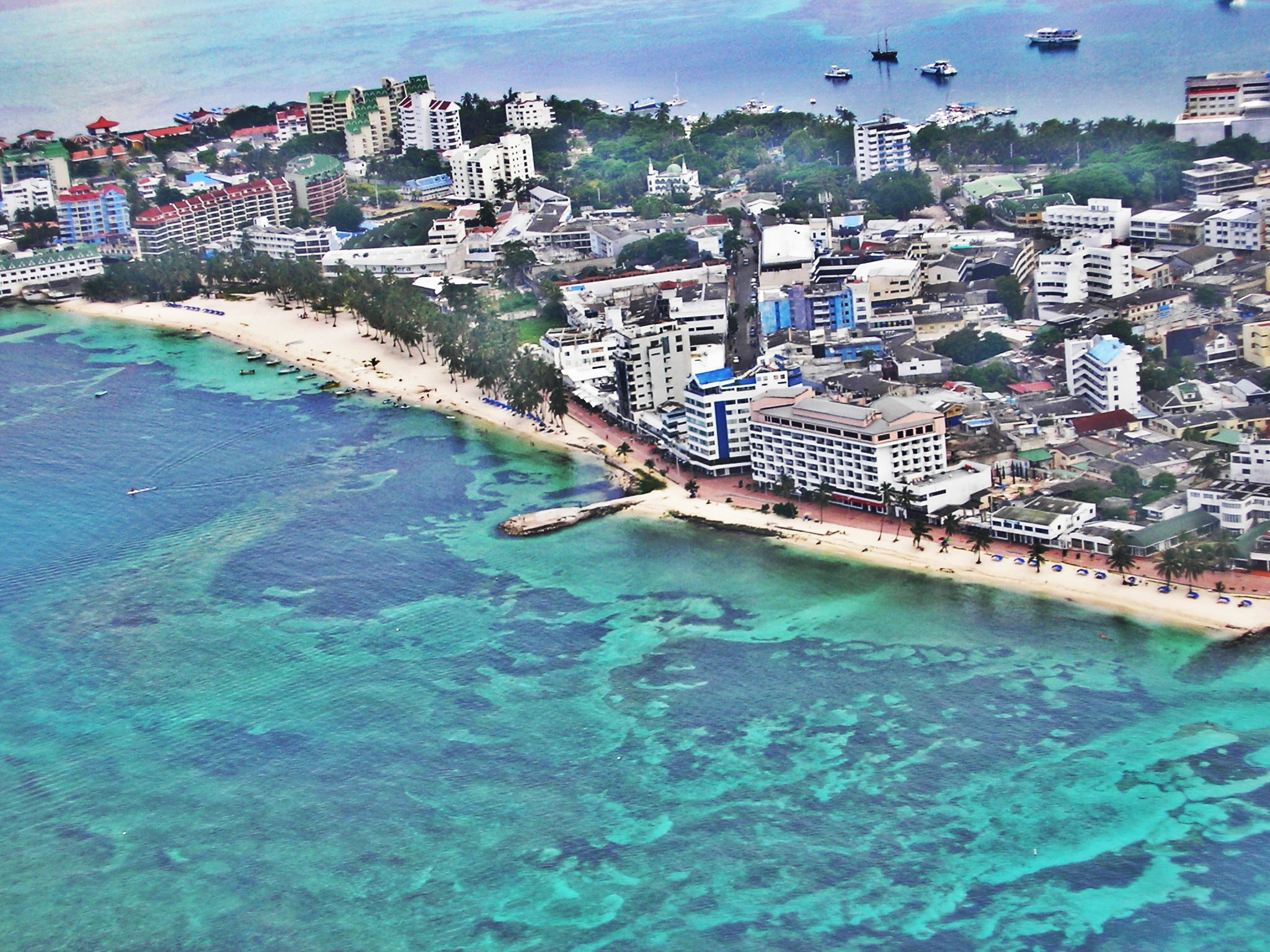
San Andrés is Colombia's most surprising slice of Caribbean: a small coral island lost at sea, closer to Nicaragua than to the Colombian mainland, famous for its 'sea of seven colors', that incredible palette of turquoises, emeralds and blues that surrounds the island and looks lifted from a postcard or a dream. It's the heart of the country's only island department, an archipelago bathed in warm, crystalline water, with reefs, white-sand cays and palms leaning over the sea.
But San Andrés is far more than dream beaches. It's an island with an Afro-Caribbean culture unique in Colombia: its Raizal population, descended from English settlers and enslaved Africans, speaks creole (an English-based creole), is mostly Protestant and has an identity, a music (reggae, calypso, soca) and a cuisine of its own, very different from the rest of the country. The whole archipelago is part of the Seaflower Biosphere Reserve, one of the most important marine protected areas in the Caribbean.
This guide covers San Andrés with a practical, warm eye: how to get there and what to know about entering the island, which beaches and cays to choose, where to snorkel and dive, how to loop the island, what to eat from the fascinating island cookbook and how to slip away to neighboring Providencia. San Andrés is color, warm sea and Caribbean culture: a different kind of experience within Colombia.
The Archipelago of San Andrés has a history very different from the rest of Colombia. Inhabited at various times and contested by several powers, it was colonized above all by English Puritans and by buccaneers in the 17th century (legend says the pirate Henry Morgan had his hideouts here), and was settled by English-speaking colonists and by enslaved Africans brought for the cotton plantations. From that mix was born the Raizal people, of Afro-Anglo-Caribbean culture, Protestant and creole-speaking. Although Spain claimed the archipelago, its population remained culturally tied to the Anglo world of the Caribbean. After independence, the islands passed to Gran Colombia and then to Colombia, which held on to them despite Nicaragua's claims, a sovereignty dispute that reached the International Court of Justice in the 21st century. In the mid-20th century, the declaration of San Andrés as a free port transformed the island with a commercial and tourism boom and a large influx of mainland population. The full history —Raizal culture, the pirates, the dispute with Nicaragua and the Seaflower Reserve— is on our history page.
Read the full history ↓Colombia's island Caribbean: islands of the 'sea of seven colours' off Central America, home to the Raizal people with their English-based creole and British roots, fought over by rival powers for centuries, with the Seaflower biosphere reserve.
Read the history of Archipelago of San Andrés, Providencia and Santa Catalina →A local guide tells you in half an hour what no sign at the site will ever explain. We look ours up on Civitatis: guided in Spanish and booked online with no fuss. They have over 20 activities in San Andres. Three are below so you get the idea: tap any of them and they all open.
If you book from here we earn a commission and you pay no more. Prices and availability come from Civitatis.
No exact prices: a scale from $ (budget) to $$$$$ (luxury), with 2-3 options per category.
Origins, formation and what the sources say.
The Archipelago of San Andrés, Providencia and Santa Catalina occupies a peculiar geographic position: a handful of coral islands and islets in the middle of the western Caribbean, far closer to the coast of Central America (off Nicaragua) than to mainland Colombia. That strategic location, on coveted maritime routes, would shape its entire history.
Before European colonization, the islands had no permanent population comparable to that of the great mainland cultures. Various sources mention possible contact with Indigenous peoples of the area (such as the Miskito of the Central American coast) and, of course, the arrival of Spanish navigators, who sighted and charted the archipelago in the 16th century without establishing significant settlements there. Spain claimed sovereignty over these islands as part of its American dominions.
The relative remoteness and the lack of effective Spanish settlement left the islands in an ambiguous position, open to the presence of other powers and of seafaring adventurers. It was that half-open door that allowed the settlers and buccaneers who would give San Andrés its distinctive identity, so unlike the rest of what is now Colombia, to arrive in the 17th century.
The real settlement of the archipelago began in the 17th century, and not at Spain's hand but England's. Around 1629-1631, English Puritan colonists (the same Protestant groups then colonizing North America) established themselves on Providencia, drawn by its climate and its position, founding a colony with a farming purpose and, at the same time, a base for harassing Spanish trade. Although the Spanish attacked and expelled these colonists at various points, the English presence left a deep and lasting cultural mark.
The archipelago's position, at the heart of the Spanish galleon routes, also made it a refuge for pirates, privateers and buccaneers. Tradition and legend particularly associate Providencia with the famous Welsh pirate Henry Morgan, who is said to have used the islands as a base of operations and a hiding place for his treasure; even today people speak of 'Morgan's cave' on San Andrés as a tourist attraction, more the product of myth than of historical certainty.
To work the plantations (mainly cotton) that the English colonists developed, enslaved Africans were brought in. From the encounter between English-speaking settlers, enslaved Africans and island isolation there emerged, over time, a new society: the foundation of the Raizal people, with their English-based creole language, their Protestant religion and their Afro-Caribbean culture, which persist to this day.
From the historical mix of English settlers, enslaved Africans and island isolation emerged the Raizal people, the archipelago's native population and the soul of its identity. The Raizal make up an ethnic group unique in Colombia, with characteristics that clearly set them apart from the rest of the country and that come directly from their Anglo-Caribbean history.
The Raizal's own language is San Andrés creole (or 'islander creole'), an English-lexicon creole with African influences, coexisting with English and, in modern times, with Spanish. In religion, unlike the Catholicism dominant in mainland Colombia, the Raizal are mostly Protestant, especially Baptist: the 19th-century First Baptist Church in La Loma is a symbol of that rootedness. Their music (calypso, mento, reggae, soca), their food (rondón, crab, coconut bread) and their traditions draw on the Anglophone Afro-Caribbean world, making them kin to islands like Jamaica more than to the Colombian interior.
This Raizal identity, forged over centuries of relative cultural autonomy, is one of the archipelago's great treasures and an essential component of Colombia's diversity. Today the Raizal call for recognition and protection of their language, their culture and their rights as the islands' original people, in a context where the mass arrival of mainland population has profoundly transformed the makeup of San Andrés.
Despite its English-rooted settlement, the archipelago ended up under Spanish and then Colombian sovereignty by way of treaties and colonial inheritance. Toward the end of the colonial period, the Spanish crown reasserted its authority over the islands, and after the wars of independence the archipelago was folded into Gran Colombia, the nation-building project led by Simón Bolívar, and then into the Republic of Colombia.
That incorporation did not, however, erase the islands' cultural singularity, and for a long time they kept their language, their religion and their Anglo-Caribbean customs with little intervention from a central state more than 700 kilometers away. Mainland Colombia, Catholic and Spanish-speaking, was a distant and different world for the Raizal, which generated (and still generates) tensions of identity and integration.
The process of 'Colombianizing' the archipelago intensified over time, especially through education in Spanish, state administration and, above all, the economic transformation of the 20th century. But sovereignty over these islands would not be free of conflict: their proximity to Nicaragua would make the archipelago the center of one of the most important territorial disputes in Colombia's recent history.
Two great events transformed San Andrés in the 20th century and the early 21st. The first was economic: in the middle of the 20th century, in 1953, under the government of General Gustavo Rojas Pinilla (whose name the island's airport bears today), San Andrés was declared a free port, that is, a trading zone with customs exemptions. This set off a commercial boom: the island filled with shops selling imported goods at good prices, drew thousands of shoppers and tourists from the mainland and prompted a mass migration of mainland Colombians to the islands. The look and the demographics of San Andrés changed radically, with heavy hotel and commercial development, not without environmental impact and tensions with the Raizal population, who became a minority in their own land.
The second great event was the territorial dispute with Nicaragua. Taking advantage of the islands' geographic closeness to its coast, Nicaragua claimed sovereignty for decades over the archipelago and, above all, over the surrounding waters. The case reached the International Court of Justice in The Hague, which in 2012 issued a ruling confirming Colombian sovereignty over the islands and cays but redrawing the maritime boundaries, granting Nicaragua a substantial portion of the sea Colombia considered its own. The ruling caused great dismay in Colombia and particularly affected Raizal fishermen, whose traditional fishing grounds were altered. The maritime question remains a sensitive matter.
In recent decades, alongside tourism development, awareness has grown of the archipelago's exceptional natural value. In 2000, UNESCO declared the Seaflower Biosphere Reserve, covering the archipelago and an enormous surrounding marine territory, making it one of the largest marine protected areas in the Caribbean. The reserve protects extensive coral reefs, seagrass meadows, mangroves and remarkable biodiversity, as well as the 'sea of seven colors' that is the region's main attraction.
Today San Andrés is one of the most visited tourist destinations in Colombia, especially by domestic travelers, drawn by its beaches, its sea, its free-port status and its all-inclusive packages. That success coexists with significant challenges: overpopulation on a small island with limited resources (fresh water, waste management), pressure on the fragile marine ecosystem and the need to protect Raizal culture and rights in the face of the island's transformation.
Nearby Providencia, hit hard by Hurricane Iota in 2020, went through a reconstruction process that was a reminder of the archipelago's vulnerability to natural phenomena and climate change. To visit San Andrés and Providencia today is to glimpse a profoundly different piece of Colombia: a Caribbean island of Afro-Anglo culture, dazzling sea and unique history, that invites travelers to enjoy it with respect for its nature and its people.