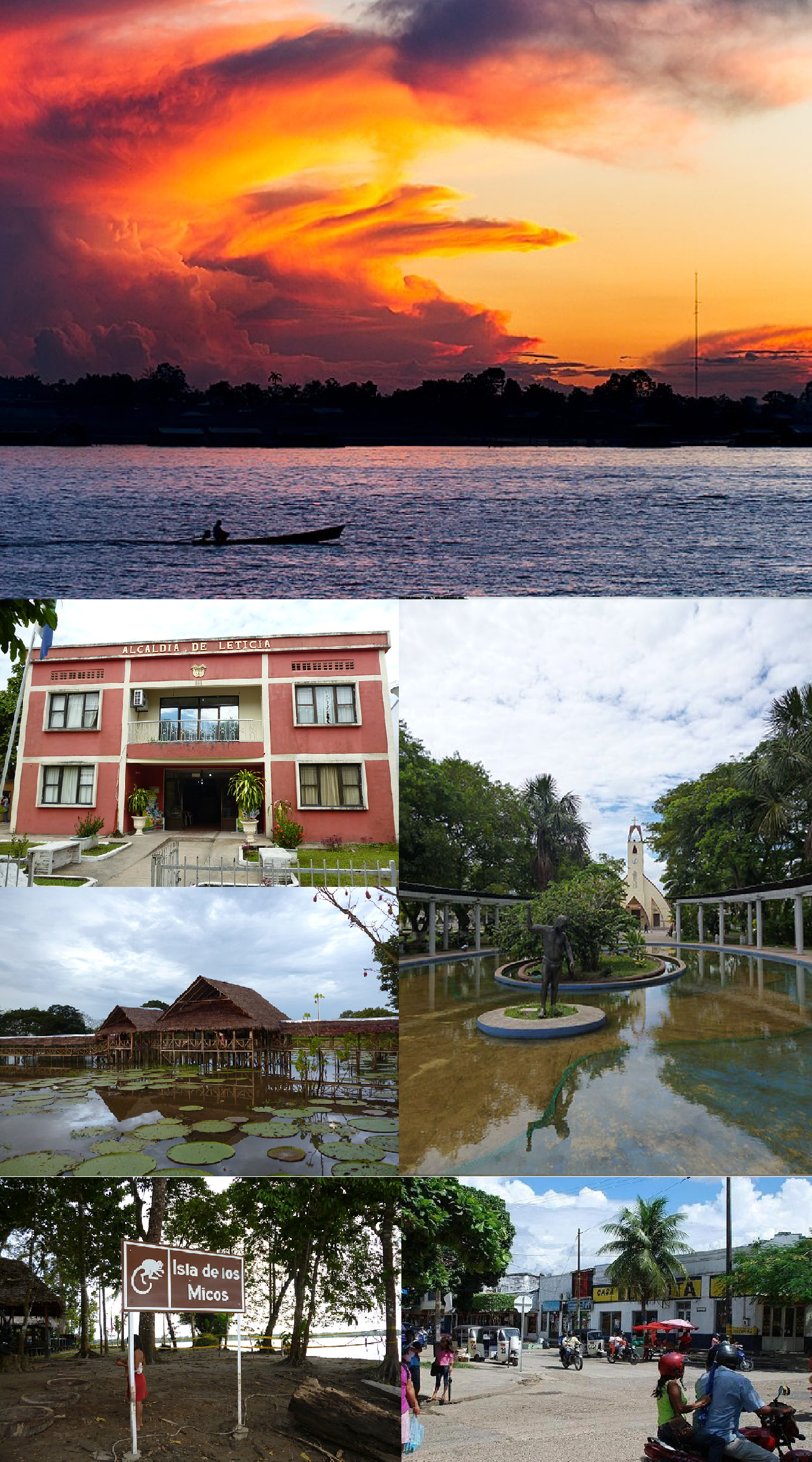
Few places make you feel so far from the known world as Leticia. In the far south of Colombia, where the country narrows until it touches the heart of the Amazon rainforest, this river city is Colombia's great gateway to the Amazon. No road reaches it: you arrive by air or by water, and that alone sets the tone of the trip. Here the Amazon, the mightiest river on the planet, marks both the border and daily life; here the forest begins where the last street ends; and here Colombia, Brazil and Peru meet at the legendary 'triple frontier'.
Leticia is a small, warm, mixed city where cultures, languages and currencies blend. Colombians, Brazilians and Peruvians share its streets and, above all, the Amazonian Indigenous peoples —Ticuna, Cocama, Yagua, Huitoto and others— who are the true owners of this land. Every evening, thousands of parrots and parakeets invade the sky above Parque Santander in an unforgettable natural spectacle. But the real Leticia is outside: upriver or deep in the forest, in Puerto Nariño, in the Tarapoto lakes where pink dolphins swim, in the nature reserves and in the communities that live to the rhythm of the river.
This guide covers the essentials of Leticia and the Colombian Amazon with a practical and warm eye: how to get around this triple frontier, what excursions to take, how to visit the forest and its communities with respect, when to go depending on the river level and how to prepare for such a special destination. Traveling to Leticia means stepping into the lungs of the planet, slowing down and letting the immensity of the Amazon work on you.
The Colombian Amazon region has been inhabited since time immemorial by numerous Indigenous peoples —Ticuna, Cocama, Yagua, Huitoto, Bora and many others— who lived (and live) from the river and the forest, in one of the areas of greatest biodiversity and cultural diversity in the world. Leticia's modern history is relatively recent and shaped by borders. The city was founded in the late 19th century (around 1867) as an outpost on the Amazon river and, for decades, which country it belonged to was disputed. In the early 20th century, boundary treaties between Colombia, Peru and Brazil gradually defined sovereignty over the area; the so-called 'Amazon Trapeze' —the strip that gives Colombia its outlet onto the Amazon river— was incorporated into the country. In 1932-1933 the Colombian-Peruvian conflict (the 'Leticia war') broke out, when a group of Peruvians took the city and set off a confrontation that ended with mediation by the League of Nations and the confirmation of Leticia as Colombian territory. The rubber era, in the late 19th and early 20th centuries, left a dramatic mark across the Amazon region: the extraction of latex involved the enslavement and genocide of Indigenous peoples, especially in the Putumayo area (the notorious Casa Arana case). Over time, Leticia established itself as capital of the department of Amazonas and as the center of a multicultural region, today turned toward ecotourism and coexistence between Colombia, Brazil and Peru. The full story is on our history page.
Read the full history ↓Colombia's door into the Amazon rainforest: the Trapecio in the far south, land of the Ticuna and other peoples, of the triple border with Peru and Brazil, of Leticia and Puerto Nariño and of the pink dolphins of the great river.
Read the history of Amazonas →A local guide tells you in half an hour what no sign at the site will ever explain. We look ours up on Civitatis: guided in Spanish and booked online with no fuss. They have 18 activities in Leticia. Three are below so you get the idea: tap any of them and they all open.
If you book from here we earn a commission and you pay no more. Prices and availability come from Civitatis.
No exact prices: a scale from $ (budget) to $$$$$ (luxury), with 2-3 options per category.
Origins, formation and what the sources say.
Long before there were borders, flags or cities, the vast Amazon region shared today by Colombia, Brazil and Peru was inhabited by numerous Indigenous peoples who lived —and still live— from the river and the forest. In today's Colombian Amazon Trapeze and its surroundings, peoples such as the Ticuna (the most numerous in the region), the Cocama, the Yagua, the Huitoto (Uitoto), the Bora and many others live side by side, each with their own language, their ancestral knowledge and their deep relationship with the land.
These peoples developed an extraordinary knowledge of one of the most complex and biodiverse ecosystems on the planet: the humid tropical forest. They knew (and know) how to read the river, predict its rises, cultivate small chagras or forest gardens, hunt and fish sustainably, and use thousands of plants to feed themselves, heal and build. Their lives revolved around water: the Amazon river and its tributaries were at once larder, road and axis of their worldview, peopled with myths and spirit beings, such as the pink dolphin capable of turning into a human.
The Amazon was not, then, an 'empty space' waiting to be discovered, but a densely inhabited and culturally rich territory. That Indigenous presence, ancient and alive, is the foundation on which the region's modern history was built —often violently— and remains today the soul of the Colombian Amazon. Understanding Leticia requires first recognizing the peoples who were here long before any border.
Leticia's modern history is relatively recent and marked, from the outset, by the question of borders. The city was founded in the late 19th century, around 1867, as an outpost on the banks of the Amazon river. In its origins, the settlement was linked to the Peruvian presence in the area, at a time when the boundaries between the young South American republics —Colombia, Peru, Brazil and Ecuador— deep in the Amazon rainforest were vague and disputed.
For much of its early history, the region of today's Amazon Trapeze was a remote territory, hard to reach, where state sovereignty was more nominal than effective. Real control lay with whoever managed to establish themselves on the river: traders, rubber tappers, missionaries and officials of one country or another. The immensity of the forest and the thin state presence turned these river borders into stages of latent tension between neighboring nations.
Leticia's strategic importance lay in its position: on the Amazon river, the great communication route for the whole region, at the point where three countries converge. Whoever controlled that stretch of river controlled access to an enormous interior territory. So, as the South American states consolidated through the 20th century, defining sovereignty over Leticia and its surroundings became a matter of the first order, which would end in treaties and, finally, in armed conflict.
In the late 19th and early 20th centuries, the whole Amazon lived through an episode as prosperous for some as it was tragic for the original peoples: the rubber boom. Growing world demand for latex —driven by industry, tires and new products— turned wild Amazonian rubber into an enormous source of wealth and set off a race to exploit the forest's trees. Great companies and 'rubber barons' emerged and amassed fortunes, while cities like Manaus and Iquitos enjoyed a spectacular boom.
But behind that bonanza lay one of the darkest chapters in the history of the Americas. Rubber extraction in regions such as the Putumayo rested on the enslavement, torture and extermination of thousands of Indigenous people, forced to work in inhuman conditions. The most notorious case was that of the Casa Arana (the Peruvian Amazon Company of the businessman Julio César Arana), whose atrocities against the Huitoto, Bora and other peoples in the Putumayo were denounced internationally in the early 20th century, in one of the first great human rights scandals of the modern era. Entire peoples were decimated.
This history, which directly affected the region of today's Colombian Amazon, left a deep and painful mark that Indigenous communities still remember. The rubber boom eventually faded when production moved to plantations in Asia, but its legacy of depopulation, displacement and trauma marked the Amazon. Getting to know Leticia and its region also means acknowledging this memory: the human cost on which much of the modern economic presence in the forest was built.
The episode that gave Leticia its place in Colombian national history was the Colombian-Peruvian conflict of 1932-1933, also known as the 'Leticia war'. Its origin lay in the boundary treaties that, in the early 20th century, had tried to define the Amazon borders between Colombia and Peru. In particular, the Salomón-Lozano Treaty of 1922 had recognized for Colombia the so-called Amazon Trapeze, the strip of territory that gives it an outlet onto the Amazon river, Leticia included.
Many Peruvians in the region did not accept that cession willingly. On 1 September 1932, a group of Peruvian civilians and soldiers seized Leticia by force, rejecting the treaty and claiming the territory for Peru. The Colombian government responded by organizing a military expedition that had to cross half a continent —coming up the Amazon from the Atlantic— to recover the area, in a campaign made difficult by the distance and the conditions of the forest. Fighting took place at various points in the Trapeze and along the Putumayo river, and the conflict stirred intense patriotic fervor in Colombia.
The war ended through diplomacy. The newly created League of Nations (forerunner of the UN) stepped in as mediator, administered the area temporarily and led to an agreement confirming Colombian sovereignty over Leticia and the Amazon Trapeze. That conflict, though brief, definitively established Leticia as Colombian territory and as the capital of the country's presence in the Amazon. It is remembered today as a key moment in the consolidation of Colombia's southern borders.
Established as Colombian territory and capital of the department of Amazonas, Leticia grew through the 20th century into what it is today: a small, warm, multicultural border city at the heart of the triple frontier between Colombia, Brazil and Peru. Being Colombia's only sizeable town on the Amazon river turned it into the meeting point of three nationalities and the country's gateway to the forest. Its proximity to Brazilian Tabatinga —practically joined to Leticia— and to Peruvian Santa Rosa makes the area a mosaic of languages, currencies and cultures.
For much of the 20th century, the region lived from fishing, the extraction of forest resources and border trade, with difficult periods tied to the illegal economies that also struck the Amazon. But in recent decades Leticia has found in ecotourism and cultural tourism a vocation that draws on its greatest treasure: nature and diversity. Today it's the base from which thousands of travelers head into the forest, sail the Amazon toward Puerto Nariño, look for pink dolphins in the Tarapoto lakes and meet Indigenous communities.
That tourism coexists with great challenges: conserving one of the most important and most threatened ecosystems on the planet, respecting the rights and culture of Indigenous peoples, and fighting deforestation and wildlife trafficking. Leticia is, in that sense, far more than a destination: it's a privileged vantage point for understanding the contemporary Amazon, with its overwhelming beauty, its cultural wealth and its fragility. Visiting it with awareness means joining, if only a little, the effort to preserve the lungs of the world.