Viajá con Gus
HomeColombiaSalento
Salento
🇨🇴 Colombia · Coffee Region

Salento

Jump to what you need
📌Department
Salento is a municipality in the department of Quindío, in the heart of Colombia's Coffee Region, declared by UNESCO as part of the Coffee Cultural Landscape of Colombia (2011). It's the oldest municipality in Quindío and one of the most picturesque and most visited towns in the country, famous for its brightly painted colonial houses, its cobbled streets and, above all, for being the gateway to the Cocora Valley, where the Quindío wax palm grows, Colombia's national tree and the tallest palm in the world. It's ringed by green mountains, coffee farms and cloud forest
📌Service city
Salento is a small town, so the big connections are made from Armenia (the capital of Quindío, with El Edén International Airport, about 25-30 km away) or from Pereira (with Matecaña International Airport, a bit further out). There are buses and transport to Salento from both cities. The town has a main square, lodgings, restaurants, cafés, ATMs (limited, so bring cash) and agencies that organize trips to the Cocora Valley and to coffee farms. It's the ideal base for exploring rural Quindío
📌Best time to go
The Coffee Region has a fairly stable temperate mountain climate all year, with pleasant days and cool nights. There's no marked summer and winter as in places with seasons, but rather drier and wetter periods. The driest stretches —and the best for hiking the Cocora Valley without so much mud— tend to fall around December-February and, in part, July-August. The rainy periods (especially April-May and October-November) bring mornings that can be clear and afternoons with rain. It's worth setting off early for the hikes. The tourist high seasons are the Colombian holidays (year-end, Semana Santa and mid-year), when the town fills up
📌Suggested days
Two days cover the essentials: a full day for the Cocora Valley hike among the wax palms, and another to explore the town of Salento (Calle Real, the Salento lookout, the square) and visit a coffee farm with a bean-to-cup tour. With 3 to 4 days you can add more farms, birdwatching, horseback rides, the nearby town of Filandia and side trips around Quindío. It's a destination that invites you to slow down, so it's worth not rushing it
📌Currency
Colombian peso (COP). It's worth carrying cash: although there are ATMs in town, they can run out of money in high season, and the Jeeps to the Cocora Valley, many farms and the food stalls don't always take cards. In 2025-2026, US$ 1 is worth around $3,900-4,300 COP (check the rate when you travel)
💱 COP exchange rate
Loading rate…
🌤️ Weather in Salento
Loading weather…

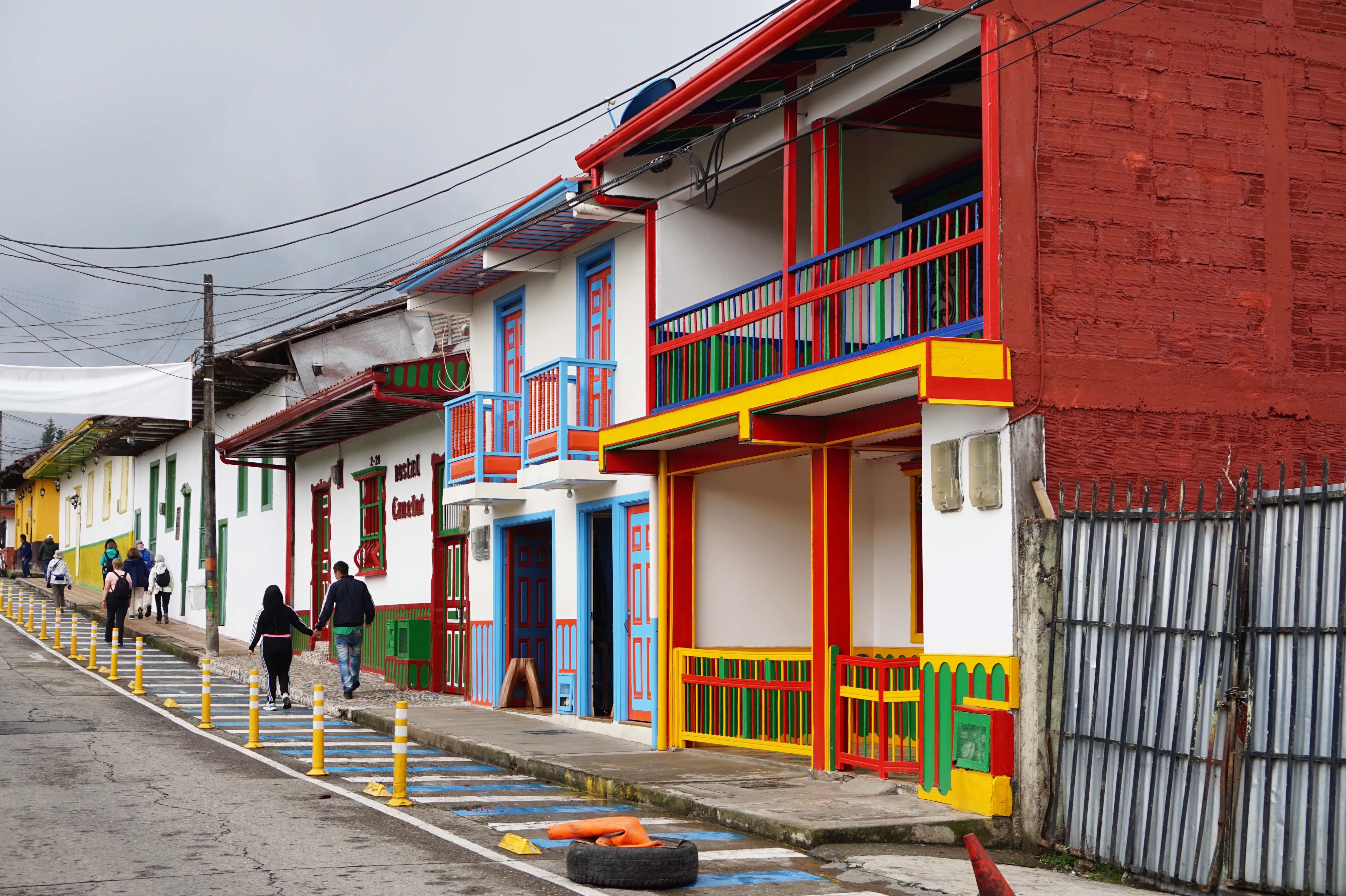
Salento is one of those towns that seem made to be fallen in love with at first sight. Perched in the mountains of Quindío, in the heart of the Coffee Region, it's the oldest municipality in the department and a festival of color: its colonial houses show off balconies, doors and windows painted in vivid tones —blues, greens, yellows, reds—, its cobbled streets climb and drop between cafés and craft shops, and the air smells of freshly brewed coffee and damp mountain. The whole ensemble is part of the Coffee Cultural Landscape of Colombia, a UNESCO World Heritage site since 2011.

But if anything has made Salento world-famous, it's what lies a few kilometers away: the Cocora Valley, a surreal landscape of green meadows dotted with Quindío wax palms, the tallest palm trees in the world and Colombia's national tree, which rise slender to 60 meters against a backdrop of mountains and clouds. Walking among them, with the mist sliding between the trunks, is one of the most memorable experiences Colombia has to offer.

This guide covers Salento with a practical, warm eye: how to hike the Cocora Valley, how to get there from Armenia or Pereira, what to do in town, how to enjoy a good coffee tour on a farm, where to eat Quindío trout and how to get around this friendly paisa country. Salento is about slowing down, color and nature: the soul of the Coffee Region at its most photogenic.

📖 History of Salento

Salento is the oldest municipality in Quindío and one of the oldest in the Coffee Region. Its origins go back to the early 19th century, tied to the so-called Camino Nacional or Camino del Quindío, a historic route that crossed the Central Cordillera linking the center of the country with the west, and which was travelled by muleteers, traders and even figures from Colombian history. The settlement took shape around 1842 and was given its present name in honor of a Spanish town. Salento was one of the focal points of the great Antioquian colonization of the 19th century, when thousands of paisa farmers came down from Antioquia founding towns across the mountains of central-western Colombia and planting the coffee farms that would give the whole region its identity. From that colonization came the architecture, the customs and the coffee culture that today make the Coffee Region a World Heritage Cultural Landscape. The full history —the Antioquian colonization, the Camino del Quindío, the coffee boom and the wax palm— is on our history page.

Read the full history ↓

🏛️ Salento is in Quindío

The small giant of Colombian coffee: heart of the UNESCO-listed Coffee Cultural Landscape, land of the Quimbaya and of the Antioquian colonisation, of the wax palms of the Cocora Valley — the national tree — of colourful towns such as Salento and Filandia, and of an Armenia that rose again from the 1999 earthquake.

Read the history of Quindío →

🗺️ What to see

1
Cocora Valley
The most iconic landscape in the Coffee Region: green meadows with the tallest wax palms in the world, Colombia's national tree.
The Cocora Valley is, beyond dispute, the great jewel of Salento and one of the most recognizable images in all Colombia. It's an intensely green mountain valley about 11 kilometers from town, where the Quindío wax palm grows (Ceroxylon quindiuense), declared Colombia's national tree in 1985 and considered the tallest palm in the world: it can top 60 meters. Watching them rise slender and solitary over the meadows, with mountains and mist behind, produces an almost unreal sensation, like a landscape from another planet. The valley forms part of the buffer zone of Los Nevados National Natural Park, and the wax palm is a protected species, having been threatened by felling (its trunk was used for Palm Sunday) and by the loss of its cloud forest habitat. Today it's a symbol of conservation and the heart of the region's nature experience. The classic way to see it is the circular hike (the Cocora Valley 'loop'), which usually takes between 5 and 6 hours. The full route crosses cloud forest, passes over suspension bridges above streams, climbs to the Casa de los Colibríes (Acaime, a reserve for watching hummingbirds) and comes back down through the upper zone where the most spectacular palm stands and the best viewpoints are. Anyone who doesn't want the long hike can head straight to the palm area on a shorter, scenic trail. Getting there: from Salento's main square the famous Jeep Willys leave (the iconic military vehicles left over from the postwar years, now a symbol of the Coffee Region) and take visitors to the valley entrance in about 30 minutes along a mountain road; they cost around $5,000 COP one way or $10,000 COP return per person (verified July 2026, market range). Best time and hour: set off early; mornings tend to be clearer, and in the afternoon rain and thick mist usually roll in. Tips: bring footwear for mud (the trail is usually muddy), a rain jacket, water, insect repellent and sunscreen. Access to the Bosque de las Palmas trail and the viewpoints costs around $20,000 COP, and entry to the Acaime Reserve (Casa de los Colibríes) another $20,000 COP per person (verified July 2026, market range). Respect the palms: don't touch them or lean on them.
ℹ️ Distance: About 11 km from Salento; reached by Jeep Willys from the square (30 min) · Best time: Early morning (afternoons usually bring rain and thick mist) · Admission: Jeep ~$5,000 COP (one way) / $10,000 COP (return); Bosque de las Palmas trail and viewpoints ~$20,000 COP; Acaime ~$20,000 COP (verified July 2026, market range) · Duration: Half a day to a full day (5-6 h hike or the short version)
2
Calle Real and the colorful colonial quarter
Salento's most photogenic street, with its colonial houses and colored balconies, cafés and craft shops.
Calle Real (Carrera 6) is Salento's tourist artery and its most photographed street: a cobbled lane climbing from the main square up to the lookout, flanked by low colonial houses painted in an explosion of vivid colors, with wooden balconies, carved doors and decorated skirting. It's the perfect setting for understanding the charm of coffee-country architecture, inherited from the Antioquian colonization, which blends the functional with the cheerful. Along the street come one after another specialty coffee shops —where you can try the coffee grown on the area's farms—, craft stores (hats, bags, guadua bamboo goods, embroidery), ice cream parlors, restaurants and souvenir shops. It's a pleasure to walk it slowly, drop into the cafés, chat with people and let yourself be carried along by the town's relaxed atmosphere. The street ends at the foot of the steps that climb to the Salento lookout, so walking it is also the natural prelude to going up for the views. At night, with the lights and the music, it keeps a quiet, agreeable feel. Getting there: it starts at Salento's main square (Plaza de Bolívar), right in the center. Best time: mid-morning or at sunset, with good light for photos; weekdays are less crowded than weekends and public holidays. Tips: comfortable footwear for the cobbles and the slopes; take the chance to buy coffee from the local farms as a souvenir and to try a traditional dessert.
ℹ️ Distance: In central Salento, starting from the main square · Best time: Mid-morning or sunset; fewer people on weekdays · Admission: Free (public street) · Duration: 1 to 2 hours (with cafés and shopping)
3
Salento lookout (Alto de la Cruz)
The town's balcony, at the top of a staircase, with views over the Cocora Valley and the Quindío mountains.
At the end of Calle Real, a staircase in several flights climbs to the Salento lookout, also known as Alto de la Cruz for the cross that crowns it. It's a few hundred steps taken at your own pace (there are landings to catch your breath and photograph the colorful town falling away below), and the reward at the top is well worth the effort. From up there a 360-degree panorama opens over the Quindío river valley, the green mountains of the cordillera and, on clear days, a view toward the Cocora Valley. It's one of the best places to grasp Salento's geography, wedged between mountains, and to watch the sun set over the Coffee Region. There are a couple of viewing platforms and, sometimes, a small kiosk for a drink. The climb is the perfect way to combine a wander down Calle Real with a scenic prize. It needs no guide or special preparation, just the will to climb stairs and a bit of breath. Getting there: on foot, up Calle Real to the end, where the staircase begins. Best time: at sunset for the best light, or early morning with clear skies. Tips: bring water and take the climb slowly; mountain weather changes fast, so a light rain jacket won't go amiss. The views reward those who go up in clear weather.
ℹ️ Distance: At the end of Calle Real, on foot from the center · Best time: Sunset or a clear morning · Admission: Free (open access) · Duration: 1 hour (climb, views and descent)
4
Coffee tour on a coffee farm
The essential Coffee Region experience: walking a coffee plantation and learning the whole process, from bean to cup.
Being in the Coffee Region and not doing a coffee tour would be like going to Rio and not seeing the Christ. Around Salento there are numerous coffee farms that open their doors to visitors to show the whole coffee process, from plant to cup, on a walk that combines landscape, culture and, of course, a good tasting. It's one of the most rewarding and instructive activities in the area. A typical tour walks the coffee plantation explaining the coffee varieties, the planting and care of the plant; then comes the picking (on some farms visitors can pick the ripe beans, the red 'cherries', with a basket at the waist, like the harvesters); and after that the pulping, washing, drying, hulling and roasting. The visit ends with a tasting: learning to grind, brew and savor the farm's coffee, picking out aromas and flavors. Many farms are small and family-run, which makes the experience very personal. Among the coffee farms and estates around Salento and Quindío there are options for every taste, from simple tours to premium experiences with accommodation. Colombian Coffee Region coffee is renowned worldwide, and understanding why, straight from the growers themselves, gives every cup a different flavor. Getting there: many farms are a few kilometers from Salento; you get there by Jeep, farm transport or an organized trip from town. Best time: in the morning; book ahead, especially in high season. Tips: ask whether the tour is in Spanish and how long it lasts; bring comfortable footwear for the plantation and sunscreen. Buy the farm's coffee as a souvenir: it's one of the best keepsakes in the region.
ℹ️ Distance: Farms a few km from Salento (Jeep, farm transport or organized trip) · Best time: In the morning; book ahead in high season · Admission: Approx. $40,000–100,000 COP per person depending on the farm and the experience (US$ 10–25); farms such as El Ocaso, Don Elías or Las Acacias (verified July 2026, market range) · Duration: 2 to 4 hours (more if it includes accommodation)
5
Plaza de Bolívar and central Salento
The town's heart, with its church, its Jeep Willys and the everyday life of the Coffee Region.
Plaza de Bolívar is Salento's nerve center and a good place to take the pulse of town life. It's a traditional paisa town square, with its trees, its benches, the statue of Simón Bolívar and, presiding over it, the parish church of Nuestra Señora del Carmen, its white facade and towers outlined against the mountains. Around the square cluster cafés, restaurants, lodgings and the coming and going of locals and visitors. One of the square's most characteristic daily spectacles is the Jeep Willys, the emblematic green and brightly colored vehicles that, since the mid-20th century, have been the transport of choice in the rural Coffee Region. Parked in a line, they wait to carry passengers and cargo to the Cocora Valley and the outlying hamlets. There's even a local tradition, the 'Yipao', which consists of loading a Jeep with as much coffee, plantains or furniture as possible, a pure postcard of the Quindío countryside. Calle Real starts at the square, so it's the natural launching point for exploring the town. It's also where the Jeeps to the Cocora Valley are arranged and where Salento's social life beats. Getting there: right in central Salento; the whole town is walkable from here. Best time: in the morning to see the Jeeps heading for Cocora, or at sunset for the atmosphere. Tips: this is where you catch the Jeep to the Cocora Valley (get there early in high season, they fill up); and where you soak up coffee culture watching the loaded Willys.
ℹ️ Distance: Central Salento; on foot · Best time: Morning (Jeeps heading to Cocora) or sunset · Admission: Free (public square) · Duration: 30 minutes to 1 hour
6
Birdwatching and cloud forest
The Coffee Region is a biodiversity paradise: hummingbirds, toucans and dozens of species in the forests of Cocora.
Colombia has the greatest bird diversity in the world, and the Salento area, with its cloud forests, its coffee plantations and the transition toward the páramos of Los Nevados, is one of the best places in the Coffee Region for birdwatching. For nature lovers, it's an unmissable activity that reveals another, quieter and more detailed face of the valley. One of the classic spots is the Acaime Nature Reserve, known as the 'Casa de los Colibríes' (house of the hummingbirds), in the Cocora Valley: a small reserve where, thanks to the feeders, several species of hummingbird gather and hover centimeters from visitors while you sip a hot chocolate or an agua de panela with cheese. It's a spectacle of color and movement that delights children and adults alike. The walk to Acaime is part of the long Cocora Valley circuit. Beyond the hummingbirds, the region's cloud forests and coffee plantations shelter toucans, tanagers, motmots, flycatchers and a great many more species. There are local guides who specialize in birds and organize early outings (the best hours for sightings) along trails and through reserves. It's a wonderful way to connect with Colombia's astonishing biodiversity. Getting there: within the Cocora Valley (Acaime) or in reserves and trails in the area, with a guide. Best time: very early in the morning, the best hours for birds. Tips: bring binoculars if you have them, neutral-colored clothing, patience and quiet. Hire a local bird guide to make the most of it; they know the places and the calls.
ℹ️ Distance: Cocora Valley (Acaime Reserve) and reserves in the area · Best time: Very early in the morning · Admission: Acaime ~$20,000 COP; bird guide ~$60,000–150,000 COP per outing depending on group size (verified July 2026, market range) · Duration: Half a day (can be combined with the Cocora hike)
7
Filandia (neighboring town)
Another colorful Quindío town, quieter than Salento, with a spectacular lookout over the Coffee Region.
A short distance from Salento lies Filandia, another of Quindío's prettiest towns and an excellent side trip for anyone who wants a 'less touristy' Salento. Filandia shares the coffee-country architecture of colorful colonial houses, wooden balconies and cobbled streets, but keeps a more authentic and peaceful atmosphere, with fewer crowds, which for many travelers makes it a hidden gem. Its main square, its specialty coffee shops and its basket-weaving workshops (Filandia is famous for its tradition of weaving bejuco vine into baskets) make wandering it a pleasure. The town's star is the Filandia lookout (also called Mirador Colina Iluminada), a multi-story wooden tower offering one of the widest panoramas in the Coffee Region: on clear days you can see three departments (Quindío, Risaralda and Valle del Cauca) and, in the distance, the snow peaks. Filandia has also won fame as a filming location, which has boosted its appeal. Combined with Salento, it lets you see two sides of Quindío coffee-country charm on the same trip. Getting there: by bus, Jeep or transport from Salento or Armenia (a short distance). Best time: any day; weekdays are even quieter. Tips: climb the lookout for the view; try a specialty coffee and, if you're into crafts, take a look at the basketwork. It's ideal for a half-day outing from Salento.
ℹ️ Distance: A short distance from Salento (bus or transport; via Armenia/Quindío) · Best time: Any day; quieter on weekdays · Admission: Walking the town is free; the Mirador Colina Iluminada charges ~$5,000–10,000 COP per person (verified July 2026, market range) · Duration: Half a day
Advertisements
What nobody tells you

💵 Prices

Tickets

TypePrice
Cocora Valley — Jeep Willys from Salento (return)Approx. $10,000 COP per person return ($5,000 COP one way) (verified July 2026, market range)
Cocora Valley — Bosque de las Palmas trail and viewpointsApprox. $20,000 COP per person (verified July 2026, market range)
Acaime Reserve (Casa de los Colibríes)Approx. $20,000 COP per person, usually includes a hot drink (verified July 2026, market range)
Calle Real and Salento's colonial quarterFree (public streets)
Salento lookout (Alto de la Cruz)Free (open access)
Coffee tour on a coffee farmApprox. $40,000–100,000 COP per person depending on the farm and the experience (verified July 2026, market range)
Plaza de Bolívar and the town centerFree
Birdwatching with a guideApprox. $60,000–150,000 COP per outing depending on group size (verified July 2026, market range)
Mirador Colina Iluminada in Filandia (neighboring town)Approx. $5,000–10,000 COP per person (verified July 2026, market range)
🔄 updated monthlyOfficial / reference values · double-check when buying

Activities and tours

ActivityPriceDurationOperator
Cocora Valley hike (loop among the wax palms)Approx. $50,000–70,000 COP per person counting Jeep ($10,000) + trail ($20,000) + Acaime ($20,000) (verified July 2026, market range)Half a day to a full dayJeeps from the square and local guides
Coffee tour on a coffee farm (bean to cup)Approx. $40,000–100,000 COP per person (US$ 10–25); e.g. Finca El Ocaso, Don Elías, Las Acacias2-4 hCoffee farms in the area
Horseback ride through the countryside and coffee plantationsApprox. $50,000–120,000 COP per person depending on length (verified July 2026, market range)2-3 hLocal horseback riding operators
Birdwatching with a guideApprox. $60,000–150,000 COP per outing depending on group size (verified July 2026, market range)Half a dayLocal bird guides
Trip to the town of Filandia and its lookoutApprox. $30,000–90,000 COP per person with transport (lookout ~$5,000–10,000 COP)Half a dayLocal transport and agencies
A game of tejo (traditional Colombian sport)Usually free with a purchase (beer); some courts charge ~$10,000–20,000 COP per group1-2 hTejo courts in town
🔄 updated monthlyOfficial / reference values · double-check when buying
Advertisements

🚌 How to get there and distances

Getting around

ModePriceDurationNotes
Jeep Willys (to the Cocora Valley and outlying hamlets)Approx. $5,000 COP per leg / $10,000 COP return to Cocora (verified July 2026, market range)30 min to CocoraThe iconic green vehicles leave from the main square (from 5:30 until 18:30). They depart when full; in high season it pays to be there early. They're an attraction and transport in one
On foot around townFreeVariableSalento is small and walkable: the square, Calle Real, the lookout and the lodgings are all close together
Mototaxi / local taxiApprox. $5,000–15,000 COP for a short ride in and around town (verified July 2026, market range)VariableFor short trips or to reach farms and lodgings a little out of the way. Availability is limited; ask around in town
Farm and hotel transportSometimes included in the tour, or ~$10,000–30,000 COP for the transferVariableMany coffee farms and rural lodgings offer transfers to their guests or to those who book the tour
🔄 updated monthlyOfficial / reference values · double-check when buying

How to get there

RouteAirlines / operatorsAvg. priceDuration
Armenia (El Edén Airport) → Salento (bus or transport)Quindío intercity buses (Armenia terminal)Approx. $7,000 COP by bus from the terminal; taxi from the airport ~$60,000–90,000 COPAbout 45 min to 1 h (some 25-30 km)
Pereira (Matecaña Airport) → Salento (bus, sometimes with a connection)Intercity buses (via Armenia or direct)Approx. $12,000–20,000 COP depending on the route; a direct taxi costs moreAbout 1 h to 1.5 h
Direct bus to Salento from the Armenia terminalQuindío cooperatives (roughly every 30 min)Approx. $7,000 COPAbout 45 min to 1 h
Flights to Armenia (AXM) or Pereira (PEI) from Bogotá, Medellín, etc.Avianca, LATAM, Wingo, othersApprox. $150,000–400,000 COP per leg (US$ 35–95) depending on how early you bookDepending on origin (from Bogotá, about a 50 min flight)
By road from Bogotá, Medellín or Cali (long-distance bus)Bolivariano, Expreso Palmira, Flota Occidental, othersApprox. $70,000–130,000 COP depending on originBogotá ~8 h; Medellín ~6 h; Cali ~4 h (to Armenia/Pereira and then on to Salento)
🔄 updated monthlyOfficial / reference values · double-check when buying

🏨 Where to stay

No exact prices: a scale from $ (budget) to $$$$$ (luxury), with 2-3 options per category.

CategoryPriceRecommended options
Charming coffee estates and farms$$$$$US$ 80–200 per night (approx. $330,000–820,000 COP). Traditional coffee farms turned into charming lodgings, surrounded by plantations and mountains, many with a coffee tour included and spectacular views (e.g. Finca El Ocaso, La Cabaña Eco Hotel). The most authentic Coffee Region experience
Boutique hotels and guesthouses in town$$$$$US$ 35–90 per night (approx. $145,000–370,000 COP). Mid-sized hotels and stylish guesthouses in Salento's colonial quarter (e.g. Hotel Salento Real), steps from the square and Calle Real, ideal for exploring the town on foot and setting off early for the Cocora Valley
Hostels and budget options$$$$$US$ 10–30 per night (approx. $40,000–125,000 COP); dorm bed from ~US$ 8. Hostels and guesthouses very popular with backpackers, with a social atmosphere, in town and around it. A good base on a tight budget
Glamping and cabins in nature$$$$$US$ 40–120 per night (approx. $165,000–500,000 COP). Glamping, cabins and eco-lodges in the nearby countryside, for sleeping among nature and coffee plantations with a degree of comfort. Very sought after for their setting; book ahead

🍴 Where to eat

TypePriceOptions / signature dish
Quindío trout (the signature dish)$$$$$$18,000–35,000 COP per dish (US$ 4.50–9). Trout is Salento's specialty: in garlic sauce, with mushrooms, marinara style or au gratin, served with the famous giant patacón. Restaurants such as La Gran Trucha or Donde Laurita specialize in it
Traditional paisa food and the bandeja$$$$$$18,000–40,000 COP per dish (US$ 4.50–10). Hearty paisa dishes: bandeja paisa, beans, arepa, chicharrón, sancocho and broths, in restaurants on the square and Calle Real
Specialty coffee shops$$$$$$4,000–15,000 COP per coffee (US$ 1–4). Cafés serving coffee grown on the region's farms, with baristas who explain varieties and brewing methods. Unmissable for anyone who loves good coffee
Budget options and street food$$$$$$2,000–12,000 COP (US$ 0.50–3). Empanadas, arepas, obleas, traditional sweets, fruit juices and simple food at local spots, for eating well without spending much
Advertisements

📖 History of Salento

Origins, formation and what the sources say.

The Camino del Quindío: a historic route across the cordillera

The history of Salento is bound up with a road. Long before the town existed, the region was crossed by one of the most important and most feared routes in Colombian geography: the Camino del Quindío, part of the so-called Camino Nacional, which crossed the Central Cordillera of the Andes linking the Magdalena river valley (the center of the country) with the Cauca river valley (the west). It was the compulsory pass for anyone heading from the center of New Granada toward Popayán, Cali or the Pacific.

The road had a reputation for brutality: cold páramos, humid jungle, quagmires and precipices made it an exhausting crossing that could last several days. The terrain was so difficult that, for a long time, travelers were carried on the backs of Indigenous and peasant porters, the famous 'silleteros' or cargueros, who bore people and their luggage in chairs strapped to their backs across the cordillera. That harsh, eloquent image is part of the region's historical memory.

Muleteers, traders, soldiers and historical figures all passed along the Camino del Quindío. It's said that independence leaders and distinguished travelers walked it, and that the scholar Alexander von Humboldt, on his famous Andean expedition at the start of the 19th century, took this route and left an account of how hard it was. It was precisely the importance of this road that in time prompted the founding of a settlement to serve as rest and support for travelers: Salento.

The Camino del Quindío and the human porters
Historical chronicles describe the Camino del Quindío as an extremely difficult route across the Central Cordillera, along which travelers were often carried by human porters. Humboldt's crossing of this area at the start of the 19th century is mentioned by various sources, though the specific details vary between accounts.
Source: https://es.wikipedia.org/wiki/Salento_(Quind%C3%ADo)

The founding of Salento (around 1842) and the origin of its name

Salento is considered the oldest municipality in the department of Quindío, and one of the oldest settlements in the whole area that today makes up the Coffee Region. Its origin is tied, as we've seen, to the Camino del Quindío: in the early years of the republic there arose a need for a support and rest point for those crossing the cordillera on that route, which gave rise to the settlement that would take shape as Salento.

The sources place the formal founding of the town around 1842 (with antecedents in the immediately preceding years). In its early days it went by other names, linked to the idea of a 'Nuevo Salento' or to the presence of convicts and settlers who worked on opening and maintaining the road. Over time the name Salento stuck, which by tradition evokes a region or town in southern Italy (the Salento, in Apulia) or has its root in European place names, though the exact origin admits several versions.

Through the 19th century, Salento grew as a mountain town and became one of the focal points of the great wave of colonization that was transforming all of central-western Colombia. Its strategic position on the cordillera route and, later, its ideal setting for growing coffee sealed its destiny as one of the emblematic towns of the coffee country.

The date and the name of Salento
The sources agree in identifying Salento as the oldest municipality in Quindío, founded around 1842. On the origin of the name there are several versions (a reference to the Italian Salento region or to other European place names), so it's best taken as a not entirely settled etymology.
Source: https://es.wikipedia.org/wiki/Salento_(Quind%C3%ADo)

The Antioquian colonization and paisa culture

The great phenomenon that shaped Salento and the whole Coffee Region was the Antioquian colonization, one of the most important processes in Colombian history. Through the 19th century, pushed by population growth and land shortages in their home region, thousands of Antioquian farmers set out on a mass migration southward, coming down through the mountains of the country's center-west and founding towns as they went.

These paisa settlers cleared and planted the hillsides, raised hamlets and brought with them a very distinctive way of life: dogged hard work, religiosity, attachment to large families, trade and an architecture of their own. The houses they built —of bahareque and timber, with wide corridors, carved balconies and, above all, an explosion of color on doors, windows and skirting— became the visual signature of the whole region. That colorful architecture is exactly what makes towns like Salento and Filandia so photogenic today.

The Antioquian colonization gave rise to much of the departments of Caldas, Risaralda and Quindío, and forged the 'paisa' cultural identity that defines this whole area. From that settler world came the customs that are tourist attractions today: the Jeep Willys loaded to the brim, tejo, the hearty food and, above all, coffee culture. Salento is, in many ways, a living museum of that colonizing epic.

The Antioquian colonization as a founding phenomenon
Historians agree that the 19th-century Antioquian colonization was decisive in settling what is now the Coffee Region and in forming paisa culture and coffee-country architecture. There is academic debate about how spontaneous or planned the process was and about the land conflicts associated with it.
Source: https://es.wikipedia.org/wiki/Colonizaci%C3%B3n_antioque%C3%B1a

Coffee and the Coffee Cultural Landscape, a World Heritage site (2011)

If the Antioquian colonization peopled the region, it was coffee that made it prosperous and gave it a worldwide identity. The mountain slopes of Quindío, with their altitude, temperate climate, volcanic soil and rainfall, proved ideal for growing high-quality arabica coffee. Through the 19th and 20th centuries, coffee became the great economic engine of the region and of Colombia as a whole, which grew to be one of the largest coffee exporters in the world.

All of life was organized around coffee: the coffee farms, the hand-picking of the beans by the 'chapoleros', the figure of the smallholder grower, the cooperatives, the tracks for bringing out the harvest and even the advertising icon of Juan Valdez. This economy of small and medium family farms shaped a unique landscape: a mosaic of coffee on the slopes, plantain groves, forest, farms of traditional architecture and colorful towns, all interwoven with the mountain.

That landscape, the product of more than a century of human adaptation to mountain terrain, was recognized by UNESCO. In 2011, the Coffee Cultural Landscape of Colombia —covering areas of the departments of Caldas, Risaralda, Quindío and Valle del Cauca, Salento included— was declared a World Heritage site in the cultural landscape category. The distinction recognizes the exceptional value of the relationship between coffee culture, architecture and the natural setting, which is exactly what travelers breathe in as they explore Salento.

What UNESCO recognized (2011)
The 2011 inscription corresponds to the 'Coffee Cultural Landscape of Colombia', classified as a cultural landscape, covering areas of Caldas, Risaralda, Quindío and Valle del Cauca. It recognizes the century-old tradition of growing coffee on small hillside farms and its relationship with the region's architecture and culture, not an isolated monument.
Source: https://whc.unesco.org/en/list/1121/

The Quindío wax palm, Colombia's national tree

No history of Salento would be complete without the star of its most famous landscape: the Quindío wax palm (Ceroxylon quindiuense). This palm, which grows in the cloud forests of the cordillera between 2,000 and 3,000 meters of altitude, is considered the tallest palm in the world: it can top 60 meters, rising slender and solitary above the meadows of the Cocora Valley. It was scientifically described by the scholar Humboldt and the botanist Aimé Bonpland at the start of the 19th century, during their expeditions through the area.

The wax palm owes its name to the waxy layer coating its trunk, which in other eras was harvested to make candles and other products. That exploitation, together with the felling of young palms to celebrate Palm Sunday and the loss of its cloud forest habitat, pushed the species into a threatened state. The palm grows very slowly and lives more than a century, so every tree felled represents a loss that's hard to recover.

In recognition of its value and its emblematic character, the Quindío wax palm was declared Colombia's national tree in 1985, and has been protected ever since. Today it's a symbol of Colombian identity and of the region's conservation effort. The palms travelers contemplate in the Cocora Valley are living relics, and walking among them is, beyond an aesthetic experience, an encounter with one of the botanical wonders of the planet.

The wax palm, symbol and protected species
The sources agree that the Quindío wax palm is the tallest palm in the world and was declared Colombia's national tree in 1985. It was threatened by felling (for its wax and for Palm Sunday) and by habitat loss, which is why it is today a protected species and a conservation emblem.
Source: https://es.wikipedia.org/wiki/Ceroxylon_quindiuense

Salento today: from stopover town to Coffee Region icon

For much of the 20th century, Salento was a quiet town given over to farming, coffee and mountain cattle raising, relatively removed from the great modern routes that ended up shifting far from the old Camino del Quindío. That quiet, paradoxically, helped keep its historic core of colorful houses and its natural surroundings intact, and in time these would turn out to be its greatest treasure.

From the last decades of the 20th century and, above all, in the 21st, Salento experienced an extraordinary tourism flowering. The recognition of the Cocora Valley and the wax palm, the declaration of the Coffee Cultural Landscape as a World Heritage site in 2011 and the boom in nature and experience travel turned the town into one of the most visited destinations in Colombia, by domestic and international travelers alike.

Today Salento lives largely off tourism, with its specialty coffee shops, its farm tours, its charming lodgings and the constant coming and going of Jeeps toward the Cocora Valley. The present challenge is to balance that boom with the conservation of its architectural and natural heritage and with the wellbeing of its community. But its essence remains: a mountain town of kind, hard-working people, where time seems to move more slowly and where coffee culture and the green of the palms still set the rhythm of life.

Salento's recent tourism boom
The sources agree that Salento went from being a remote farming town to a first-rank tourist destination in Colombia over recent decades, driven by the Cocora Valley and the Coffee Cultural Landscape declaration (2011). The impact of mass tourism on heritage conservation and the local community is a matter of debate.
Source: https://colombia.travel/es/salento

📚 Bibliography

  • Wikipedia (ES) — «Salento (Quindío)»: https://es.wikipedia.org/wiki/Salento_(Quind%C3%ADo)
  • Wikipedia (ES) — «Quindío»: https://es.wikipedia.org/wiki/Quind%C3%ADo
  • Wikipedia (ES) — «Colonización antioqueña»: https://es.wikipedia.org/wiki/Colonizaci%C3%B3n_antioque%C3%B1a
  • Wikipedia (ES) — «Eje cafetero»: https://es.wikipedia.org/wiki/Eje_cafetero
  • Wikipedia (ES) — «Paisaje Cultural Cafetero»: https://es.wikipedia.org/wiki/Paisaje_Cultural_Cafetero_de_Colombia
  • UNESCO — «Coffee Cultural Landscape of Colombia» (2011): https://whc.unesco.org/en/list/1121/
  • Wikipedia (ES) — «Ceroxylon quindiuense» (palma de cera): https://es.wikipedia.org/wiki/Ceroxylon_quindiuense
  • Wikipedia (ES) — «Valle de Cocora»: https://es.wikipedia.org/wiki/Valle_de_Cocora
  • Colombia.travel — «Salento»: https://colombia.travel/es/salento

❓ Frequently asked questions

How many days do I need in Salento?+
Two days cover the essentials: a full day for the Cocora Valley hike and another for the town (Calle Real, the lookout) and a coffee tour on a farm. With 3 to 4 days you can add more farms, birdwatching, horseback rides and a side trip to the nearby town of Filandia. It's a destination for slowing down, so don't rush it.
How do I get to Salento?+
The most practical way is to fly to Armenia (El Edén Airport, about 25-30 km away) or to Pereira (Matecaña) and from there take a bus or transport to Salento (around 45 min to 1.5 h depending on where you start). Long-distance buses also come from Bogotá, Medellín and Cali. From the Armenia terminal there are fairly frequent buses to the town.
What's the Cocora Valley hike like?+
The full circular hike takes between 5 and 6 hours: it crosses cloud forest, passes over suspension bridges, climbs to the Casa de los Colibríes (Acaime) and comes down through the most spectacular palm stands. There's also a short version that goes straight to the palm area. Set off early and bring footwear for mud, a rain jacket, water and insect repellent, because the trail is usually muddy and the rain comes in during the afternoon.
When is the best time to visit Salento?+
The climate is temperate mountain weather all year. The driest stretches —best for hiking Cocora without so much mud— tend to be around December-February and, in part, July-August. In the rainy periods the mornings can be clear and the afternoons wet, which is why it pays to head out early. The town fills up during Colombian holidays (year-end, Semana Santa and mid-year).
Is a coffee tour worth doing?+
Absolutely. Being in the Coffee Region and not doing a coffee tour means missing the soul of the region. On the farms you learn the whole process, from cultivation to cup, often picking the beans yourself and finishing with a tasting. It's instructive, beautiful and very personal, because many farms are family-run. Book ahead in high season.
Do I need to bring cash?+
Yes, it's advisable. Salento is a small town and, although there are ATMs, they can be limited or run out of money in high season, and not every Jeep, farm or shop takes cards. Bring enough cash for transport, admissions, meals and shopping, above all for the Jeeps to the Cocora Valley and for tips.
Is Salento safe for tourists?+
Salento is a quiet tourist town and, in general, safe, with a family atmosphere and plenty of visitors around. As anywhere, use common sense: look after your belongings, don't leave valuables in sight and pay attention on the hikes (proper footwear, stay on the trails). Out in nature, the main thing to watch is the weather and the muddy ground.
Sources consulted (12)
Still planning?
Explore more destinations in Colombia
See all destinations →
Advertisements
Image credits
Photos from Wikimedia Commons, each under its own licence (CC BY, CC BY-SA or public domain). Open each file to see its author and licence.
Calle 5, Salento 03