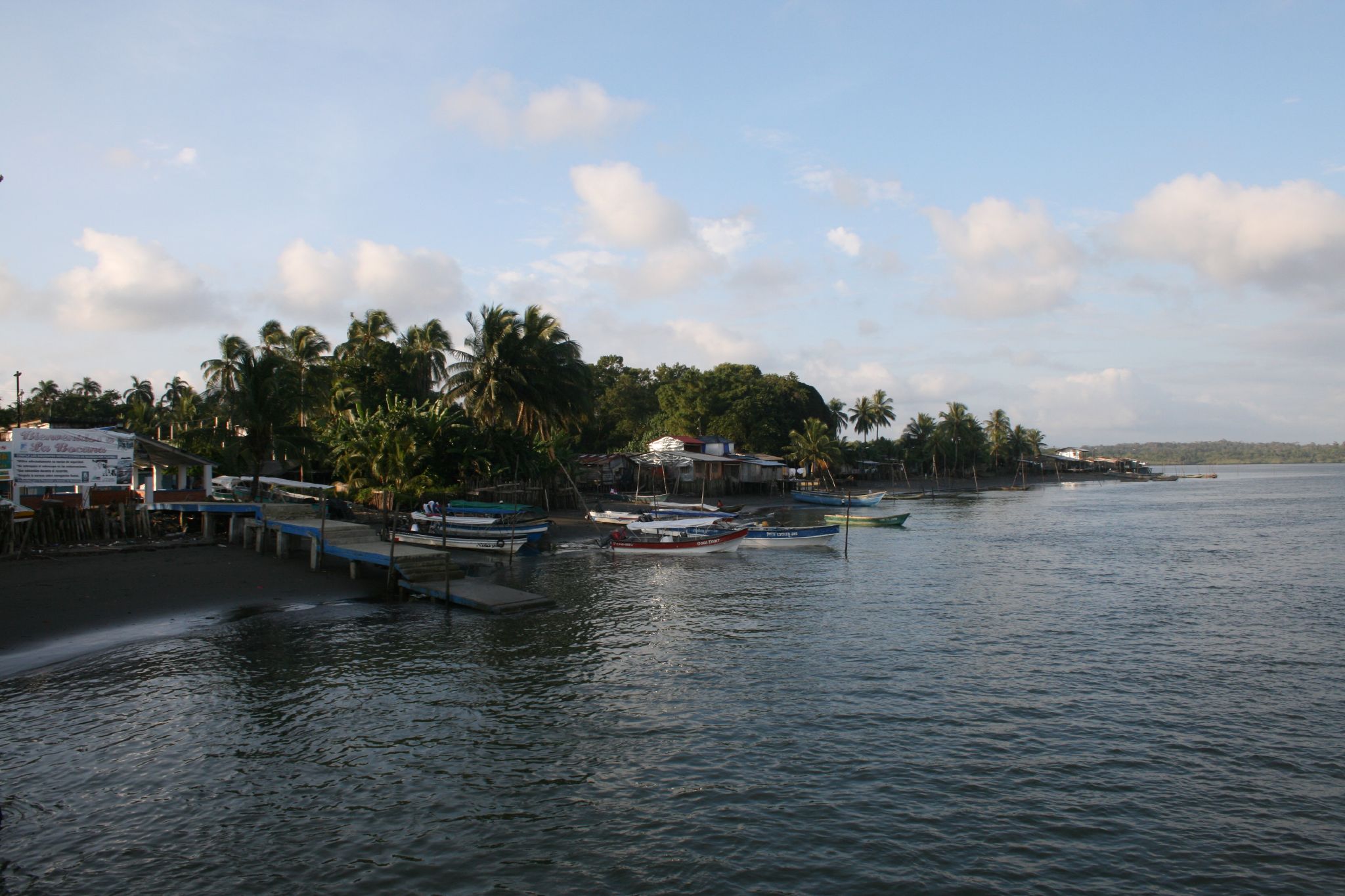
Buenaventura is the great city of the Colombian Pacific: the country's main seaport, through which much of its trade enters and leaves, and the urban heart of a predominantly Afro-Colombian region with a vibrant culture of music, dance and food. But for the traveler, Buenaventura is above all the gateway to some of the most beautiful nature destinations on the Pacific coast: the beaches of Juanchaco and Ladrilleros and the spectacular Bahía Málaga.
From its tourist pier depart the boats that carry you, across the sea, to these corners of jungle-backed beaches, waterfalls, mangroves and an ocean that welcomes humpback whales every year. Bahía Málaga in particular is one of the best places in Colombia for whale watching (between July and November), a spectacle that draws travelers from around the world.
This guide covers Buenaventura and its coastline with a practical eye: how to get there from Cali, how to take the boats to Juanchaco, Ladrilleros and Bahía Málaga, what to do (whales, beaches, waterfalls, Pacific culture), where to stay and eat, and what to bear in mind regarding safety and climate. Buenaventura is the door to the Valle del Cauca Pacific: port, Afro culture and whales.
Buenaventura was founded on 14 July 1540 by Juan de Ladrilleros, on the orders of Pascual de Andagoya, on the island of Cascajal, on a bay so calm they named it 'la Buenaventura' on the feast day of Saint Bonaventure. Its population was formed largely by Afro-descendants, brought during the colonial period for mining and other labor, who made the Valle del Cauca Pacific a region of strong Afro culture. With the construction of the railway and the road to Cali and the development of the port in the 19th and 20th centuries, Buenaventura established itself as the country's main Pacific port. Despite the wealth flowing through the port, the city has faced inequality and social challenges. The full history is on our history page.
Read the full history ↓The fertile valley of the Cauca River and the Pacific coast: land of sugar cane and its mills, of Cali — the salsa capital of the world — and of Buenaventura, the country's main Pacific port, with a deep Afro-Colombian heritage.
Read the history of Valle del Cauca →If you book from here we earn a commission and you pay no more. Prices and availability come from Civitatis.
No exact prices: a scale from $ (budget) to $$$$$ (luxury), with 2-3 options per category.
Origins, formation and what the sources say.
On 14 July 1540, after four days of arduous sailing among the inlets of the coast, a small Spanish expedition reached a bay so calm and sheltered that they decided to call it, quite simply, la Buenaventura — good fortune. That day was the feast of Saint Bonaventure, and the still waters of the inlet did the rest: the name stuck. The magistrate Pascual de Andagoya —who had sailed from Panama in February of that year to explore the South Sea— was the first to enter the bay, and before leaving he charged one of his men, Juan de Ladrilleros, with founding a settlement there. That surname was not lost: today it gives its name to Ladrilleros, one of the most visited beach villages on the coast.
The founding took place on the island of Cascajal, a strip of land some three kilometers long already inhabited by the local indigenous people, the Buscajaes, and on which the city's old quarter still stands today. Buenaventura was thus born as a strategic point for securing the Spanish Crown's access to the Pacific Ocean: a natural outlet to the sea for the trade and communications of southwestern New Granada. (It should be noted that there is a historical debate over whether Buenaventura should be considered a city of colonial founding or of republican refounding, because the settlement was moved and reorganized several times.)
During the colonial period, the Pacific coast of Valle del Cauca and Chocó was important for the gold worked from its rivers, an activity that demanded labor and was sustained largely by enslaved Africans. From that historical process comes the formation of the Afro-descendant population that is in the majority in Buenaventura and along the whole Pacific coast, and which gave rise to a culture of its own, immensely rich in music, dance, food and traditions. For centuries, however, Buenaventura remained a relatively modest port, hard to reach from the interior, separated from the Cauca valley by the Western cordillera and the rainforest. Effective connection with the center of the country and the great port development would come later, with the infrastructure works of the 19th and 20th centuries.
Buenaventura's destiny was sealed by its condition as a port. Through the 19th and 20th centuries, major infrastructure works transformed the city and its role in the country. The construction of the Pacific railway, which crossed the cordillera to connect Buenaventura with Cali and the Cauca valley, and later the road, finally integrated the port with the interior and allowed much of Colombia's foreign trade to be channeled through it.
With the growth of the coffee trade —for a long time the country's main export— and of international commerce in general, Buenaventura established itself as Colombia's main Pacific seaport, and one of the most important in the country. A very significant share of national imports and exports passes through its docks today, which gives it enormous economic weight.
That port importance, however, contrasts with the city's social reality. Despite the wealth flowing through the port, Buenaventura has historically faced high levels of poverty, inequality and social problems, which at various moments have led to protests by its people demanding investment and better conditions. That tension between the wealth passing across its docks and the deprivation of its people is one of the traits that mark Buenaventura's recent history.
Before the arrival of the Spanish, the Pacific coast of Valle del Cauca was inhabited by indigenous peoples such as the Nonama and other groups of the Emberá family and of the lowlands, who lived from fishing, hunting, gathering and navigating the rivers and estuaries. The dense rainforest of the Chocó biogeographic region —one of the rainiest and most biodiverse on the planet— and the difficult geography of mangroves and coastline made this territory a world apart, little penetrated for much of the colonial period.
Gold mining in the rivers of the Pacific was the engine that led the Crown and the encomenderos to bring, from the 17th century onward, thousands of enslaved Africans to work the mines. That population, subjected to brutal conditions, was also the protagonist of its own history of resistance: many managed to buy their freedom or escape, and communities of free people formed along the rivers. Out of that process came the foundation of today's Afro-Pacific society, with its collective territories, its community organization and its deep relationship with the river, the sea and the forest.
After the legal abolition of slavery in Colombia in 1851, the Black communities of the Pacific continued to inhabit and work the territory, keeping alive ways of life, knowledge and cultural expressions inherited from Africa and recreated in the Americas. It's that heritage that makes Buenaventura and its coastline an epicenter of Afro-Colombian culture today.
Buenaventura is the urban heart of Colombian Pacific culture, one of the most vibrant in the country. The Afro-descendant heritage finds expression in the chonta marimba and the traditional songs —recognized by UNESCO as Intangible Cultural Heritage of Humanity—, in the currulaos, the drums, the dances, the celebrations and, very especially, in a cuisine of fish, seafood and coconut milk that is one of Colombia's great culinary treasures.
In recent decades, Buenaventura has also gained importance as the gateway to nature tourism along the Valle del Cauca coast. From its pier depart the boats to the beaches of Juanchaco and Ladrilleros and to Bahía Málaga, today protected as Uramba National Natural Park, one of the best places in Colombia for watching the humpback whales that arrive in these waters each year to breed.
So Buenaventura combines several faces: the great industrial port that moves the country's trade, the Afro city with social challenges and an immensely rich culture, and the gateway to a coastline of beaches, waterfalls, rainforest and whales. For the traveler, getting to know Buenaventura and its coast means glimpsing a Pacific of enormous natural and cultural value, best explored with respect, supporting the communities and following local advice.