
 DestinationAustralia
 OriginUruguay
Work and Holiday visa (subclass 462) · Uruguayan citizenship
By Gus · Viaja con GusOur guide's data, reviewed on
What changes for Uruguay: 1,500 visas per program year and no letter of support.
A year to work and travel around Australia, applying from Uruguay. There are 1,500 visas per program year for Uruguay, and you don't need a letter of support. Here is everything that applies to you, in the order you'll do it.
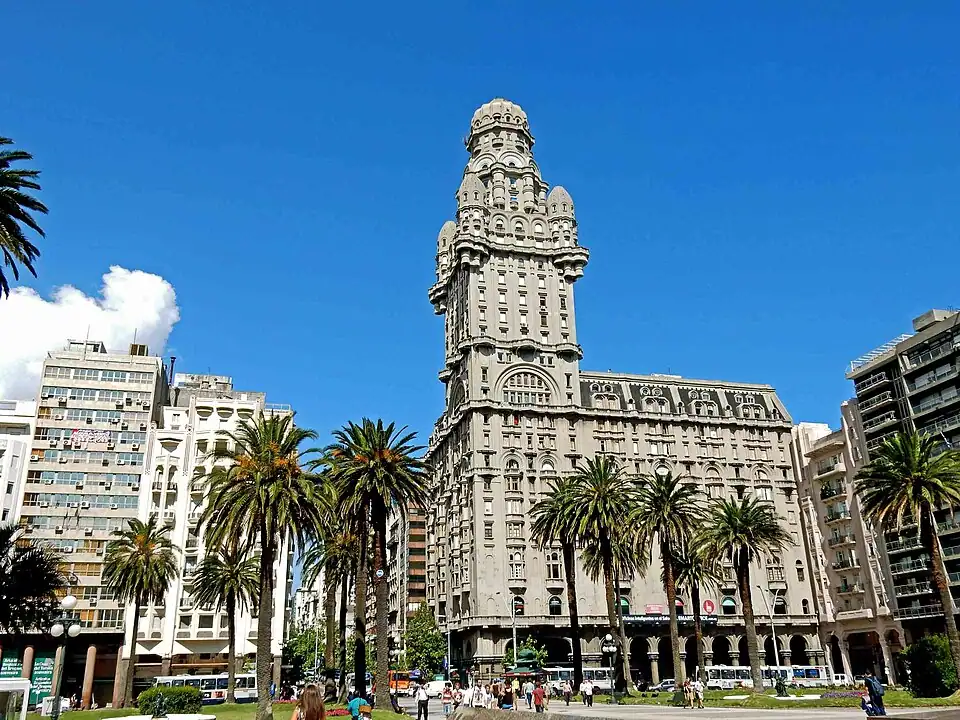
Photos: Sídney: «Skyline of Sydney CBD, Sydney Harbour Bridge, 2023» de Chris Olszewski, CC BY-SA 4.0, vía Wikimedia Commons · Montevideo: «Montevideo - Centro - Plaza Independencia - Palacio Salvo - Uruguay (34893291250)» de FLASHPACKER TRAVELGUIDE, CC BY-SA 2.0, vía Wikimedia Commons.
Between 18 and 30 inclusive on the day you apply. If you apply at 30 and turn 31 before they decide, they can still grant it.[3]
A tertiary degree from a university, institute or training center, or 2 years of university completed. Home Affairs accepts bachelor's degrees, graduate certificates and diplomas, and states that Certificate I to IV and the secondary school diploma don't count.[1]
With a test taken within the 12 months before you apply: IELTS (Academic or General) with an average of 4.5, PTE Academic 24 or TOEFL iBT 26. For the TOEFL you must register with the option «Taking TOEFL for Australia». CELPIP General 5, Michigan English Test 38, OET 1020 and LanguageCert Academic 38 are also accepted. Tests taken online from home don't count, and Cambridge C1 Advanced no longer qualifies: it was only valid if taken up to 6/8/2025, and today it is more than 12 months old. The other route is education: for example, at least 5 years of secondary school at a school where all classes were taught in English.[2]
Where to take the test in Uruguay and how much it costs →Home Affairs requires enough money to support yourself and to leave Australia at the end: «This is usually about AUD5,000 for your initial stay, plus the fare to where you are going after leaving Australia». You prove it with a bank statement or certification.[1]
How to show your funds from Uruguay →For the first 462 you must be outside Australia when you apply and when it is granted. The second and third can be requested from inside.[3]
You must not have entered Australia before on a 462 or 417 visa.[4]
You must meet the health and character requirements. You may be asked for a medical exam.[3]
How to get a police certificate in Uruguay →Government letter of support: Home Affairs lists Uruguay among the countries that don't need it («You do not need to provide a letter of support from your government if you are from:» … «Uruguay»).[1]
Everything is uploaded as scans to ImmiAccount. On translations, both things are true. Officially: Home Affairs asks for any document that isn't in English to be translated. In practice, the bank statement and documents in Spanish are accepted and the visa is still granted. If you do translate: no certification needed, and if the translator is outside Australia they don't need NAATI.
Valid Uruguayan passport (data and photo page).[3]
Birth certificate showing both your parents' names: Home Affairs asks for it together with the passport. If it isn't in English, see above for what to do about the translation.[11]
English test result, or proof of your studies in English.[3]
Degree, or proof of at least 2 years of university completed.[3]
Bank statement or bank certification for about AUD 5,000, plus the money for your departure ticket.[1]
Credit or debit card, or PayPal, to pay the fee.[3]
Medical exam or biometrics, only if Home Affairs asks for it.[3]
Build your checklist (no support letter): degree, IELTS and AUD 5,000 →
The exact fee for the day is given by Home Affairs' Visa Pricing Estimator.

Before opening the form, have your passport, English test result, proof of studies and bank statement scanned.[5]
It's the Home Affairs account where you fill in, pay for and track your application. You create it with your email at online.immi.gov.au.[5]
In ImmiAccount: New application, then Work and Holiday visa (462) and First Work and Holiday 462.[5]
Personal details, passport, studies, English, funds and the health and character questions. You can save and continue later.[5]
The form, field by field →Each one in its own section, legible and with a clear name.[5]
AUD 840 by card or PayPal. Once the payment is confirmed, the application is submitted and you receive the reference number (TRN).[5]
Home Affairs may ask you for a medical exam or biometrics. Allow about three months. Their notice is clear: «Do not book flights or make travel, work or study commitments until your visa has been granted».[1]
It's electronic and linked to your passport. From approval you have 12 months to enter Australia, and your year starts running when you enter.[5]
It starts on July 1, but applications can be submitted from July 2, Australian Eastern time, which is 13 hours ahead of Uruguay in July. Home Affairs doesn't publish the opening time; that Australian July 2 begins when it's July 1 at 11 a.m. in Uruguay.[3]
Uruguay's annual quota is 1,500 visas per program year. Home Affairs can pause intake before it fills (for example «when the cap is nearly filled»), and when it fills it closes until the following July 2. The traffic light above shows today's status.[12]
Home Affairs estimates: «The average processing time is expected to be around three months».[1]
You have 12 months from approval. You can leave and come back as many times as you like, but time spent outside Australia doesn't extend your year.[1]
Sydney has the most job openings, especially in hospitality, tourism and cleaning, and it's also the most expensive city to rent in. Melbourne is somewhat cheaper for rent, and Brisbane and the Gold Coast have a warm climate almost all year and a lower cost of living. Before you buy your ticket, compare what living in each one is like.[5]
Australia has very good public healthcare, Medicare, but with the 462 you're not covered. Medicare covers citizens and permanent residents, and partly people arriving from the eleven countries with a reciprocal health agreement; Uruguay is not one of them.[14]
And if you work as a casual, getting sick doesn't give you paid days either: "All employees except casuals are entitled to paid sick and carer's leave".[15]
Home Affairs recommends insurance and says so plainly: "You are personally liable for all your healthcare costs while you are in Australia". It can also impose condition 8501 on you, which requires you to keep insurance. We always recommend it.[1]
You land, go through immigration with your passport (the visa is electronic, nothing gets stuck in it), and the first thing you'll need is internet: the map, transport, letting people at home know you arrived.[5]
You'll need the Australian number in your first days: hospitality, farm and construction jobs are answered by phone or WhatsApp the same day, and the bank, myGov and the ATO send codes by SMS to a local number. We compared Telstra, Optus and Vodafone, prepaid and monthly plans. We still haven't got a code with any carrier.[7]
Next come the bank account, the tax number (TFN) and the retirement fund (super). They're covered in order in the first steps guide.
When you find work, check how much they have to pay you per hour and what they'll deduct for taxes.
With 88 days of specified work in regional areas you can apply for the second 462; with 179 days during the second, the third. Each one costs AUD 1,000.[5]
On 17/09/2026 the Minister for Home Affairs announced that the second and third visas would move to a lottery, but the Home Affairs pages still say "There are no caps for second or third Work and Holiday visas". Until the rule is published, the usual process applies: complete the days and apply.[5]
Does your job count toward the 88 days? Enter the postcode →
Home Affairs doesn't publish a time: it says applications open on July 2, Australian Eastern time. That day starts there when it's July 1 at 11 a.m. in Uruguay.[3]
For the first 462, no. You must be outside Australia when you apply and also on the day it's granted.[4]
No. Home Affairs lists Uruguay among the countries that don't need it.[1]
1,500 per program year, according to the official Home Affairs cap table.[3]
No. Cambridge C1 Advanced is only valid if you took it up to 6/8/2025, and the result must be less than 12 months old when you apply.[2]
No: up to 6 months with the same employer. You can also study courses of up to 4 months.[5]
Home Affairs asks you not to: “Do not book flights or make travel, work or study commitments until your visa has been granted”.[1]
