
 DestinationAustralia
 OriginChile
Work and Holiday visa (subclass 462) · Chilean citizenship
By Gus · Viaja con GusOur guide's data, reviewed on
What's different for Chile: a tertiary qualification or a passed third year of university.
One year to work and travel around Australia, applying from Chile. With Chilean citizenship you are asked for something not everyone has to provide: a tertiary qualification or the third year of university. Everything that applies to you is here, in the order you'll do it.
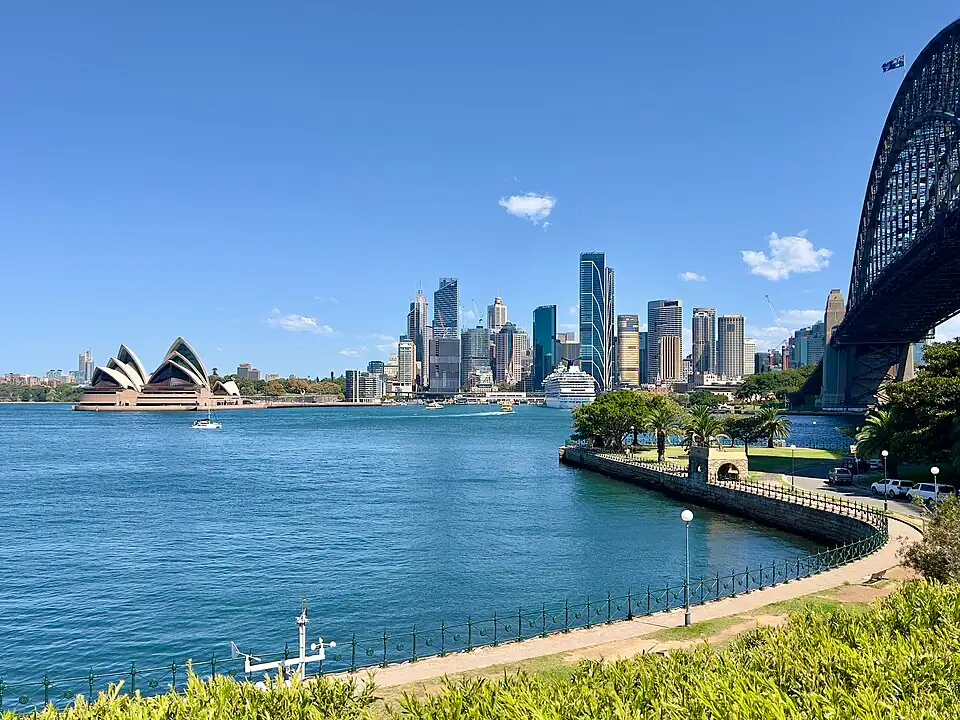
Photos: Sídney: «Skyline of Sydney CBD, Sydney Harbour Bridge, 2023» de Chris Olszewski, CC BY-SA 4.0, vía Wikimedia Commons · Santiago de Chile: «Santiago de Chile, Desde Cerro San Cristóbal (cropped)» de Omnespsx (D•ES), CC BY-SA 4.0, vía Wikimedia Commons.
First what is specific to Chile; then, what everyone applying for the 462 is asked for.
You need a tertiary qualification ("tertiary qualifications from a university, college or training centre", as Home Affairs puts it), or to have completed or been approved to start the third year of a university degree. Home Affairs accepts bachelor's degrees, graduate certificates and diplomas, and states that Certificate I to IV and the secondary school certificate do not count.[1]
Between 18 and 30 inclusive on the day you apply. If you apply at 30 and turn 31 before they decide, they can still grant it.[3]
With a test taken in the 12 months before you apply: IELTS (Academic or General) with an average of 4.5, PTE Academic 24 or TOEFL iBT 26. For the TOEFL you must register with the "Taking TOEFL for Australia" option. CELPIP General 5, Michigan English Test 38, OET 1020 and LanguageCert Academic 38 are also accepted. Tests taken online from home don't count. The other route is your studies: for example, at least 5 years of secondary school at a school where all classes were taught in English.[2]
Where to take the test in Chile and how much it costs →Home Affairs requires enough money to support yourself and to leave Australia at the end: "This is usually about AUD5,000 for your initial stay, plus the fare to where you are going after leaving Australia". You show it with a bank statement or bank certificate.[1]
How to show your funds →For your first 462 you must be outside Australia when you apply and when it is granted.[3]
Not having previously entered Australia on a 462 or 417 visa.[3]
Meet the health and character requirements. You may be asked for a medical exam and a police certificate.[3]
How to get your police certificate in Chile →Government support letter: Chile is among the countries that don't need one.[1]
Everything is uploaded as scans to ImmiAccount. As for translations, there are two sides. Officially: Home Affairs asks for any documents that aren't in English to be translated. In practice, the bank statement (cartola) and documents in Spanish are accepted and the visa is still granted. If you do translate: no certification needed, and if the translator is outside Australia they don't need NAATI.
Valid Chilean passport (data and photo page).[3]
Birth certificate showing both your parents' names: Home Affairs asks for it along with the passport. If it isn't in English, see above for what's best to do about the translation.[10]
English test result, or proof of your studies in English.[3]
Degree, or a certificate showing you completed or passed the third year of university.[1]
Bank statement (cartola) or bank certificate for about AUD 5,000, plus the money for your departure ticket.[1]
Credit or debit card, or PayPal, to pay the fee.[3]
Medical exam or biometrics, only if Home Affairs asks for it.[3]
Build your checklist for the 462: degree, IELTS and AUD 5,000 →
The exact fee for the day is given by Home Affairs' Visa Pricing Estimator.

Before opening the form, have your passport, English test result, education certificate and bank statement scanned.[4]
It's the Home Affairs account where you complete, pay for and track your application. You create it with your email at online.immi.gov.au.[4]
In ImmiAccount: New application, then Work and Holiday visa (462) and First Work and Holiday 462.[4]
Personal details, passport, education, English, funds and the health and character questions. You can save and continue later.[4]
The form, field by field →Each one in its own section, legible and with a clear name.[4]
AUD 840 by card or PayPal. Once payment is confirmed, the application is lodged and you receive the reference number (TRN).[4]
Home Affairs may ask you for a medical exam or biometrics. Allow about three months. Their notice is clear: «Do not book flights or make travel, work or study commitments until your visa has been granted».[1]
It's electronic and linked to your passport. From approval you have 12 months to enter Australia, and your year starts running when you enter.[4]
It starts on July 1, but applications can be lodged from July 2, Australian Eastern time. Home Affairs doesn't publish the opening time; that Australian July 2 begins when it's July 1 at 10:00 in mainland Chile.[4]
Home Affairs may pause intake before Chile's 3,400 places are filled (for example «when the cap is nearly filled»), and once they're filled it closes intake until the following July 2. The traffic light above shows today's status.[11]
Home Affairs estimates: «The average processing time is expected to be around three months».[1]
You have 12 months from approval. You can leave and come back as many times as you like, but time spent outside doesn't extend your year.[1]
Sydney has the most job openings, especially in hospitality, tourism and cleaning, and it's also the most expensive for rent. Melbourne is somewhat cheaper to rent, and Brisbane and the Gold Coast have warm weather almost all year and a lower cost of living. Before buying your ticket, compare what life is like in each one.[4]
Australia has very good public healthcare, Medicare, but with the 462 you're not covered. Medicare covers citizens and permanent residents, and partly those who arrive from the eleven countries with a reciprocal health agreement; Chile is not one of them.[13]
And if you work as a casual, getting sick doesn't give you paid days either: «All employees except casuals are entitled to paid sick and carer's leave».[14]
Home Affairs recommends insurance and says so bluntly: «You are personally liable for all your healthcare costs while you are in Australia». It can also impose condition 8501, which requires you to maintain insurance. We always recommend it.[1]
You land, go through immigration with your passport (the visa is electronic, nothing gets stuck in it) and the first thing you'll need is internet: the map, transport, letting people at home know you arrived.[4]
You'll need the Australian number in your first days: hospitality, farm and construction jobs are answered by phone or WhatsApp the same day, and the bank, myGov and the ATO send codes by SMS to a local number. We compare Telstra, Optus and Vodafone, prepaid and monthly plan. We still haven't gotten a code with any carrier.[6]
After that come the bank account, the tax number (TFN) and the retirement fund (super). They're in order in the first steps guide.
Once you find a job, check how much they have to pay you per hour and what they'll deduct for taxes.
With 88 days of specified work in regional areas you can apply for the second 462; with 179 days during the second, the third. Each costs AUD 1,000.[4]
On 17/09/2026 the Home Affairs minister announced that the second and third visas would move to a lottery, but the Home Affairs pages still say «There are no caps for second or third Work and Holiday visas». Until the rule is published, the usual applies: do the days and apply.[4]
Does your job count toward the 88 days? Enter the postcode →
For the first 462, no. You have to be outside Australia when you apply and also on the day it is granted.[3]
Home Affairs refers to tertiary qualifications «from a university, college or training centre» and does not name Chilean institutes one by one. What it does make clear is that Certificate I to IV and the secondary school certificate (enseñanza media) do not count.[1]
No. Home Affairs lists Chile among the countries that do not need a letter of support.[1]
It must have been taken within the 12 months before you apply, even if your score is higher than the minimum.[1]
No: up to 6 months with the same employer. You can also study courses of up to 4 months.[4]
Home Affairs asks you not to: «Do not book flights or make travel, work or study commitments until your visa has been granted».[1]
Home Affairs recommends it and may impose condition 8501 on you, which requires you to keep it. We always recommend it. With Chilean citizenship you do not have Medicare.[1]
