Viajá con Gus
HomeEcuadorBaños de Agua Santa
Baños de Agua Santa
🇪🇨 Ecuador · Sierra (Andean Highlands)

Baños de Agua Santa

Jump to what you need
📌Province
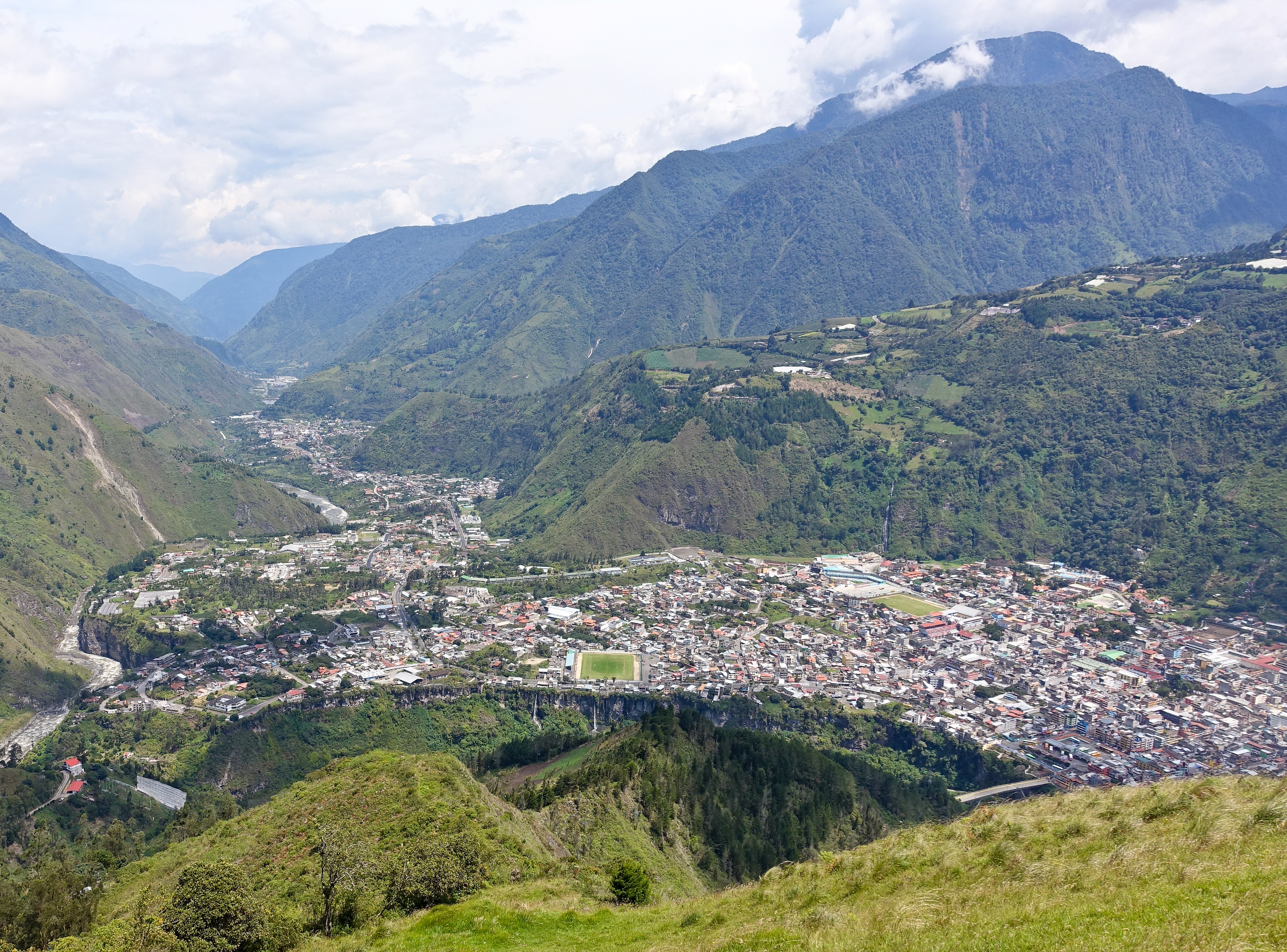
Tungurahua (Ecuador). Baños de Agua Santa is one of the most touristy cantons in Tungurahua province, in the Sierra (Andean Highlands) region, though its geography puts it in a privileged spot: it sits right on the transition between the Andes and the Amazon, which earned it the nickname 'Puerta del Oriente' or gateway to the Amazon. The town settles into a narrow valley at around 1,800 meters, at the foot of the Tungurahua volcano (the 'Gigante Negro', still active), ringed by intensely green mountains, waterfalls dropping on every side and a warm, humid climate that sets it apart from the rest of the cold highlands. It is Ecuador's adventure capital.
📌Service town
Baños itself holds every service and is the ideal base for the area. The bus terminal is a few blocks from the center and takes frequent buses from Quito (via Ambato), Ambato, Riobamba and from the Oriente (Puyo, Tena). There's no airport: the closest are Latacunga and, above all, Quito's Mariscal Sucre International Airport (about 3 to 3.5 hours by bus). The town is compact and you get around on foot: it has plenty of hostels and hotels, adventure travel agencies, bike and quad-bike rentals, restaurants, ATMs and pharmacies. This is where the Ruta de las Cascadas, the trips to the Casa del Árbol and the rafting, zipline and puenting outings all start.
📌Best time to go
You can visit Baños year-round because its climate is mild and humid, without the marked seasons of colder parts of the highlands. Even so, it's worth knowing that the driest, sunniest months usually run from September to February (bar the odd shower), while March to August can bring more rain, which keeps the waterfalls running hard but complicates some hikes and viewpoints (Tungurahua's summit and the views can vanish into cloud). Long weekends and Ecuadorian public holidays (Carnival in February/March, Holy Week, the November holiday) are the peaks: the town fills with domestic tourists and you should book accommodation ahead.
📌Suggested days
With 2 days you cover the essentials: the Pailón del Diablo waterfall, the Ruta de las Cascadas by bike or chiva as far as Río Verde, the Casa del Árbol with its 'swing at the end of the world' and a soak in the Virgen hot springs. With 3 to 4 days you add the adventure activities (rafting on the Pastaza, zipline, puenting), the cable car and waterfall at Manto de la Novia, the San Martín viewpoint and zoo, the Basílica de Nuestra Señora del Agua Santa and a hike to the viewpoints ringing the town (la Virgen, Bellavista, Runtún). If you're continuing into the Amazon, Baños is the perfect gateway toward Puyo and the Oriente.
💱 USD exchange rate
Loading rate…
🌤️ Weather in Baños de Agua Santa
Loading weather…

Few places in Ecuador pack so much magic into so little space as Baños de Agua Santa. Wedged into a narrow valley at around 1,800 meters, at the foot of the imposing Tungurahua volcano, the town lives surrounded by mountains carpeted in green, waterfalls tumbling down the slopes and a warm, humid air that announces how close the jungle is. There's a reason they call it the 'Puerta del Oriente', the gateway to the east: Baños is exactly where the Andes give way to the Amazon, and that geographical border hands it lush nature and a climate unlike anywhere else in the highlands.

Baños is, above all, Ecuador's adventure capital. People come here to run the Pastaza river on a raft, to hang from a zipline over the canyon, to throw themselves off a bridge on a puenting jump, to pedal the famous Ruta de las Cascadas down to the roaring Pailón del Diablo or to swing out over the void on the 'swing at the end of the world' at the Casa del Árbol, volcano in the background. And when the body asks for a break, there are the volcanic hot springs, which come up hot from the belly of Tungurahua and gave the town both its name and its reputation as a place of healing: 'Baños de Agua Santa', the baths of holy water.

This guide covers the essentials of Baños with a practical, warm eye: how to do the Ruta de las Cascadas, how to get up to the Casa del Árbol, where to take a thermal bath, which adventure activities to pick and how to move around the town and its surroundings. Baños is small, cheerful and entirely walkable, but it hides so many experiences that it pays to organize your days. It's one of those destinations almost nobody wants to leave, and that many come back to.

📖 History of Baños de Agua Santa

The Baños region was inhabited from pre-Hispanic times by peoples of Kichwa roots who already knew and revered the hot springs that rise at the foot of Tungurahua, crediting them with healing powers. With the arrival of the Spanish and the evangelization, the area became tied to the Dominican missionaries, who from the 16th century used this natural pass as a route toward the Amazonian Oriente for their missions. The name of the place fuses its two souls: 'Baños', for the thermal springs, and 'Agua Santa', for the devotion to the Virgin of Nuestra Señora del Agua Santa, around whom grew legends of apparitions and miracles linked to the waterfalls and to the hot springs themselves. For centuries it was a hamlet on the way through and a place of pilgrimage; only in the 20th century, as the roads improved and the highway toward Puyo was built, did Baños consolidate as a town and then as a canton (1944). The Tungurahua volcano, always there, shaped its history: after decades of quiet it became active again in 1999, forcing the town to be evacuated, and it had major eruptions in 2006 and 2008, up to a last one in February 2016 that closed its eruptive period (it has been calm ever since, with activity rated 'very low' by the Instituto Geofísico). Despite the risks, or perhaps because of the force of its nature, Baños reinvented itself over the last few decades as Ecuador's great capital of adventure tourism. The full story is on our history page.

Read the full history ↓

🏛️ Baños de Agua Santa is in Tungurahua

The «land of flowers and fruit» in the central Andes: territory of the Hambatos and Panzaleos, dominated by the active Tungurahua volcano, cradle of Ambato and of the «Three Juanes», reborn from the 1949 earthquake, Ecuador's capital of leather and footwear and home to Baños de Agua Santa, the gateway to the Amazon.

Read the history of Tungurahua →

🗺️ What to see

1
Pailón del Diablo waterfall
One of Ecuador's most impressive waterfalls: a wall of water crashing thunderously into a cauldron of rock.
The Pailón del Diablo (also called the Río Verde or Machay waterfall) is the most famous waterfall in Baños and one of the most impressive in Ecuador. The Río Verde plunges here in a powerful drop of around 80 meters that slams into the rocks and forms a 'pailón', a boiling cauldron of foam that throws up permanent mist and a roar you can hear from far off. The force of the water and the humid-forest setting make it a full sensory experience: you'll come out soaked and amazed. Getting there: it's in the village of Río Verde, some 17 to 18 kilometers east of Baños, on the road to Puyo. It's the last big landmark on the Ruta de las Cascadas, so you can arrive by bike, by chiva (an open tourist truck), on a scheduled bus toward Puyo, by quad bike or by taxi/tour. From the drop-off point, a cobbled path descends through the vegetation to several viewpoints; some trails take you right up to the falls, even behind the curtain of water through tunnels cut into the rock, and across hanging bridges with a head-on view. Best time: any day of the year; in the rainy season the flow is spectacular but the path gets slippery. Go early to avoid the crowds, especially on holidays. Tips: wear shoes with good grip and a rain layer, or accept that you'll get wet, and protect your phone and camera (the spray soaks everything). The descent and the climb back involve a lot of stairs, so allow time and take it slow. There is usually a small entry fee for the trail, which pays for the upkeep of the viewpoints.
ℹ️ Distance: Río Verde, about 17-18 km east of Baños, on the road to Puyo (bike, chiva, bus, quad bike or taxi) · Best time to go: Year-round; maximum flow in the rainy season; go early to avoid crowds · Entry: Approx. US$ 2 to 2.50 per person for access to the trail/viewpoint (there are two entrances, each charging separately; cash only). Open 8:00-18:00, with night visits until 23:30 (source: pailondeldiablo.ec and Tungurahua Turismo, verified July 2026) · Duration: 1 to 2 hours on site (plus travel time)
2
Ruta de las Cascadas
The classic Baños outing: some 60 km of descent through canyons and waterfalls, from Baños to Río Verde, by bike or chiva.
The Ruta de las Cascadas is the emblematic outing of Baños and one of the area's unmissable experiences. It's a stretch of the highway linking Baños with Puyo that drops down the canyon of the Pastaza river past a run of spectacular waterfalls: Agoyán, Manto de la Novia, San Pedro, San Jorge, Pailón del Diablo and many more. The route keeps losing altitude and easing into an increasingly jungly landscape, with viewpoints, hanging bridges and tarabitas (rustic cable cars) crossing the canyon. Getting there: it starts in Baños itself. The most popular and most fun way is to rent a bicycle in town and pedal down (it's mostly downhill) the roughly 16-18 km to Río Verde and the Pailón del Diablo; for the return you normally load the bike onto a bus or pickup. Another very typical option is the chiva, an open tourist truck that stops at the key points. You can also do it by quad bike, by motorbike or on a guided tour. Best time: any day of the year, ideally in good weather so you can enjoy the views; set off early to have the whole day. Tips: if you go by bike, check the brakes and helmet before leaving and pay attention to traffic on the stretches shared with vehicles (there are tunnels; many cyclists avoid them by taking the old road). Bring water, sunscreen, a rain layer and some cash for the tarabitas and the waterfall entries. Combine it with a swim at one of the waterfalls or hot springs along the way.
ℹ️ Distance: From Baños to Río Verde, about 16-18 km downhill through the Pastaza canyon · Best time to go: Year-round, in good weather; set off early · Entry: Riding the route is free; bike US$ 5-10/day, chiva US$ 3-5, tarabitas US$ 2, waterfall entries US$ 1-3 (2025) · Duration: Half a day to a full day
3
Casa del Árbol (swing at the end of the world)
The viewpoint with the famous 'swing at the end of the world' that swings out over the void facing the Tungurahua volcano.
The Casa del Árbol is one of the most photographed places in Ecuador and a must in Baños. It's a simple shelter built into a tree that originally served as a lookout post for the Tungurahua volcano. A rustic swing was hung there from a branch and, as you push off, it throws you out over the void above the mountainside: this is the celebrated 'swing at the end of the world', which went viral worldwide. The feeling of swinging over the abyss, with the valley and the volcano behind you, is pure adrenaline and a postcard at the same time. Getting there: it's high up in the Runtún sector, in the mountains above Baños, about 30-45 minutes from the center. You go up by tourist bus, by taxi, on an organized tour, by quad bike or by motorbike along a winding road that already hands you spectacular views of the town boxed in below. Today the site has several swings, ziplines, viewpoints and play areas. Best time: go on a clear day and early in the morning, because Tungurahua's summit tends to cloud over by mid-morning and the whole point is seeing the volcano. With luck, you'll see it steaming. Tips: bring warm clothes (it's colder and windier up there than in town) and charge the camera. There is usually a small entry fee. It pairs very well with the nearby Bellavista and la Virgen viewpoints, and with the Tungurahua trail.
ℹ️ Distance: Runtún sector, high above Baños; 30-45 min by tourist bus, taxi, tour or quad bike · Best time to go: Early morning and clear days (cloud hides the volcano) · Entry: Approx. US$ 1 per person to enter the site (source: Tungurahua Turismo, verified July 2026); organized tour from around US$ 6-10 · Duration: 1 to 2 hours (plus travel time)
4
Termas de la Virgen (hot springs)
The volcanic hot-spring pools right in the center, at the foot of a waterfall, that gave the town its name.
The hot springs are the very origin of Baños and one of its most relaxing experiences. The best known are the Termas de la Virgen (or Piscinas de la Virgen), in the middle of town at the foot of the Cascada del Cabello de la Virgen, which falls just behind the pools. The water comes up hot from the belly of the Tungurahua volcano, rich in minerals, and tradition credits it with healing properties: it is precisely this 'agua santa', holy water, that gave the town its name. There are pools at different temperatures, from very hot to cold, so you can alternate and enjoy the contrast. Getting there: they're a few blocks from the main square and the Basílica, so you can walk from almost anywhere in town. Other thermal complexes in the area are the Termas El Salado and the Termas Santa Ana / Santa Clara (some with pools and slides), a bit further from the center. Best time: they're perfect at the end of the day, after a day of adventure, or very early in the morning, when there tend to be fewer people. At night, the Termas de la Virgen open lit up and have a special atmosphere. Tips: bring your swimsuit, a towel, a swimming cap (usually compulsory) and a padlock for the locker. There is an entry fee. Drink plenty of water, don't overdo the very hot pools and respect the schedule (they usually run morning, afternoon and evening sessions).
ℹ️ Distance: Center of Baños, at the foot of the Cascada del Cabello de la Virgen (on foot) · Best time to go: Early morning or at night (fewer people and a better atmosphere) · Entry: Termas de la Virgen approx. US$ 2 by day and US$ 3 by night, per session (source: the thermal complexes of Baños, verified July 2026) · Duration: 1 to 2 hours
5
Basílica de Nuestra Señora del Agua Santa
The neo-Gothic sanctuary dedicated to the patron saint of Baños, with murals telling the story of her miracles.
The Basílica de Nuestra Señora del Agua Santa is the main church in Baños and the spiritual heart of the town. It's a neo-Gothic church built in volcanic stone, dedicated to the Virgin of Nuestra Señora del Agua Santa, the town's patron saint, around whose devotion grew legends of apparitions and miracles tied to the waterfalls and the hot springs. It is a very important place of pilgrimage, above all for the faithful of the Ecuadorian highlands and the Oriente. The most curious thing inside are the large canvases and murals hanging on the walls, which narrate, scene by scene, the miracles attributed to the Virgin: people saved from eruptions of the volcano, from floods, from falls and from accidents. It's almost a visual account of the history of Baños and of its people's relationship with the volcanic nature around them. The complex usually also has a small religious museum. Getting there: it's right in the center, facing the main park of Baños, so you can walk there from anywhere in town. Best time: you can visit any day; respect Mass times if you want to look around undisturbed. The patron saint festivities are an especially lively moment. Tips: go in respectfully (it's a working church), dress appropriately and take a while to read the murals of the miracles, which say a great deal about the identity of the place.
ℹ️ Distance: Center of Baños, facing the main park (on foot) · Best time to go: Any day; respect Mass times; the patron saint festivities are very lively · Entry: Free entry to the church (suggested donation); religious museum approx. US$ 0.50-1 (2025) · Duration: 30 to 45 minutes
6
Tungurahua volcano
The 'Gigante Negro' that dominates the landscape of Baños, an active volcano that shapes the life and the history of the town.
The Tungurahua volcano, known as the 'Gigante Negro', the black giant, is the 5,023-meter colossus that rises right above Baños and that completely defines the town's landscape and history. It's one of Ecuador's most active volcanoes: after decades of quiet, it became active again in 1999 (which forced the evacuation of Baños) and produced major eruptions in 2006, 2008 and up to a last one in February 2016, which closed its 1999-2016 eruptive period. It has been calm since then, with an activity level rated 'very low' by the Instituto Geofísico. Even dormant, seeing it loom over the valley is a reminder of the force living under the town. Getting there and seeing it: you don't climb to the summit as a tourist because of its activity, but the volcano can be admired from many viewpoints around Baños. The Casa del Árbol, in Runtún, is the best spot to see it head-on; it also dominates the view from the Bellavista and la Virgen viewpoints (the latter with the statue of the Virgin above the town) and the road up to Runtún. Some night tours go up to the viewpoints when the volcano is active to watch the glow. Best time: clear days, above all early in the morning, since the summit clouds over frequently. The show depends on how active the volcano is at the time. Tips: check the state of the volcano and the recommendations of the Instituto Geofísico and the local authorities before planning night viewpoint trips. Bring warm clothes for the high viewpoints and charge the camera: the views of the valley and the volcano are unforgettable.
ℹ️ Distance: Seen from the Runtún, Bellavista and la Virgen viewpoints, around Baños · Best time to go: Clear days, early morning (cloud hides the summit) · Entry: Looking at it from the viewpoints is free; viewpoint cafés with a minimum spend from approx. US$ 2-5 (2025) · Duration: 1 to 2 hours (at a viewpoint)
7
Rafting on the Pastaza river
One of the great adventures of Baños: running the rapids of the Pastaza river on a raft, between canyons and jungle.
Rafting (whitewater descent on a raft) is one of the star activities of Baños as Ecuador's adventure capital. The Pastaza river, which drops from the Andes toward the Amazon through the canyon at the foot of Baños, offers rapids of different grades of difficulty, in a setting of green walls, waterfalls and vegetation that gets junglier as you descend. It's an experience full of adrenaline, teamwork and a great deal of water. How it works and how to book: it's always done with specialized operators and guides who set out from town, provide the gear (raft, paddles, helmet, life jacket, wetsuit) and drive you to the put-in point. There are stretches for beginners and more demanding ones for those with experience; the operator assigns the run according to your level and the river conditions. Best time: it runs all year, but the flow and the difficulty vary with the rains; the wetter months raise the level of the river. The operator decides each day which stretch is safe. Tips: always book serious, licensed operators with certified guides and good gear; this is not an activity to improvise. Bring a change of clothes, sandals or shoes that can get wet, and sunscreen. Say so if you can't swim and always follow the guide's instructions.
ℹ️ Distance: Stretches of the Pastaza river near Baños (transfer included by the operator) · Best time to go: Year-round; river level and difficulty vary with the rains · Entry: Rafting with an operator approx. US$ 30 per person, with gear, guide and transfer (2025) · Duration: Half a day
8
Zipline over the canyon
Flying along a steel cable high above the Pastaza canyon and its waterfalls.
The canopy or zipline is another of the great adrenaline experiences in Baños. It means sliding along in a harness on a steel cable strung from one side of the canyon to the other, high above the Pastaza river, the waterfalls and the vegetation. The sensation of flying over the abyss, with the roar of the water below, is hard to forget. There are different formats, including the option of crossing 'Superman style' (face down, arms out). How it works and where: there are several zipline circuits along the Ruta de las Cascadas and around Baños, run by companies that provide the gear (harness, helmet, gloves, pulleys) and the staff. Many travelers fold it into the Ruta de las Cascadas, since several of the zipline points sit right on the road. Best time: year-round, ideally in good weather so you can enjoy the canyon views. Tips: choose licensed operators with gear in good condition and staff who check the harnesses properly. It's suitable even if you're not especially sporty, since the cable does the work, but do mention any physical condition. Put your phone away or secure it well; many companies offer to take photos or video of the ride.
ℹ️ Distance: Several circuits over the Pastaza canyon and along the Ruta de las Cascadas · Best time to go: Year-round, in good weather · Entry: Zipline with an operator approx. US$ 10 per ride (2025; Superman position or in pairs) · Duration: 1 to 2 hours (or combined with the Ruta de las Cascadas)
9
Puenting (bridge jump)
The adrenaline jump par excellence in Baños: throwing yourself off a bridge held by a rope.
Puenting is one of the most extreme and most popular activities in Baños, ideal for anyone after a strong dose of adrenaline. It means jumping off a bridge attached to a harness and a rope, in a pendulum fall that combines the sensation of free fall with the swing that follows out over the canyon and the river. It isn't exactly bungee jumping (the rope isn't elastic; it describes a pendulum), but the rush is just as intense. How it works and where: it's done from bridges around Baños, such as the San Francisco bridge over the Pastaza river, with operators who provide the harness, the helmet, the ropes and the staff who secure every jump. They explain the procedure, kit you out and stay with you throughout. Best time: year-round, ideally in good weather. Tips: this is one of the sports where choosing a serious, licensed operator matters most, with certified gear and experience; check references. Follow the staff's instructions to the letter and mention any health issue (back, heart, pregnancy). Terrifying as it looks from up there, thousands of people do it without trouble: the key is to go for it and trust the crew.
ℹ️ Distance: Bridges over the Pastaza river around Baños (e.g. the San Francisco bridge) · Best time to go: Year-round, in good weather · Entry: Puenting with an operator approx. US$ 20 per person, with gear and guides (photos/video +US$ 5; 2025) · Duration: 30 minutes to 1 hour (depending on the circuit)
10
Manto de la Novia (waterfall and tarabita)
One of the prettiest waterfalls on the Ruta de las Cascadas, crossed by a tarabita cable car over the canyon.
The Manto de la Novia is one of the most photogenic waterfalls on the Ruta de las Cascadas, named for its double drop of water, white and vaporous, that recalls a bride's veil. It falls down the wall of the Pastaza canyon and makes a beautiful picture, above all when the flow is strong. What makes it special, beyond the waterfall itself, is the way you get close to it: a tarabita, a kind of rustic cable car or basket hanging from a steel cable, crosses the canyon of the Pastaza river and leaves you practically facing the falls, hanging over the void. There is also a pedestrian suspension bridge to cross on foot, for anyone who would rather skip the tarabita. It's one of the classic stops on the bike or chiva run. Getting there: it's on the Baños-Puyo road, within the Ruta de las Cascadas, a few kilometers from Baños (before you reach Río Verde and the Pailón del Diablo). You get there by bike, chiva, bus, quad bike or taxi. Best time: any day of the year; after recent rain the flow is stronger. Tips: the tarabita and the bridge usually charge separately. Bring small bills. It's an ideal stop to combine with the rest of the waterfalls along the road; leave time for photos.
ℹ️ Distance: On the Baños-Puyo road, within the Ruta de las Cascadas (bike, chiva, bus or taxi) · Best time to go: Year-round; stronger flow with rain · Entry: Tarabita approx. US$ 2 per person; pedestrian suspension bridge free or around US$ 1 (2025) · Duration: 30 to 45 minutes (a stop along the route)
11
San Martín zoo and viewpoint
A complex on the edge of town with a zoo of native fauna, a viewpoint over the canyon and the Agoyán waterfall.
The San Martín sector, on the edge of Baños on the way to the Ruta de las Cascadas, gathers several attractions in one spot. The best known is the Zoológico San Martín (the Baños zoo), a center holding native Ecuadorian fauna —monkeys, birds, cats, reptiles and other Andean and Amazonian species— with a focus on conservation and education. It's a good plan, especially if you're traveling with kids. Very close by is the Serpentario San Martín, devoted to reptiles and amphibians, and above all the San Martín viewpoint and bridge, from where you take in the canyon of the Pastaza river and, depending on the spot, the Agoyán waterfall. The area also has viewpoints and the chance to cross the canyon by tarabita, with spectacular views of the river gorge. Getting there: San Martín is about 1.5 to 2 kilometers from the center of Baños, on the road to Puyo; you can walk (a nice outing), take a taxi or a bus, or make it the first stop on the Ruta de las Cascadas. Best time: any day; mornings tend to be quieter and the animals more active. Tips: combine it with the start of the Ruta de las Cascadas, since it's right on the way. The zoo and the serpentarium both charge entry. Bring water and sunscreen if you're walking from town.
ℹ️ Distance: San Martín sector, 1.5-2 km from the center on the road to Puyo (on foot, by taxi or bus) · Best time to go: Any day; quieter in the morning · Entry: Zoológico San Martín approx. US$ 3-4; serpentarium approx. US$ 2-3 (2025) · Duration: 2 to 3 hours (with the zoo and the viewpoints)
12
La Virgen, Bellavista and Runtún viewpoints
The natural balconies above Baños, with the statue of the Virgin, crosses and views over the town and the volcano.
Baños sits boxed into a valley ringed by mountains, and climbing to its viewpoints is one of the best ways to understand its geography and enjoy the landscape. The closest and most classic is the Mirador de la Virgen (Bellavista), reached by a stepped path that climbs from town up to the statue of the Virgin and a big lit cross that watch over the town from above. The walk is short but steep, and the reward is a panoramic view of all of Baños tucked into its valley. Higher up, the Runtún sector offers even loftier viewpoints (it's where the Casa del Árbol is) with views taking in the town, the canyon and, on clear days, the Tungurahua volcano head-on. The road up to Runtún, full of switchbacks, is itself a scenic outing that you can do on foot (for the fittest), by quad bike, motorbike, taxi or tour. Getting there: you climb to the Mirador de la Virgen/Bellavista on foot from the center up the steps (about 20-40 minutes depending on your pace); to Runtún, by vehicle up the winding road. Best time: early morning or at sunset, with good light and clearer skies; sunset over the town is lovely. Tips: bring water and comfortable shoes for the steps. For sunset, work out the descent before dark or come back by taxi. It pairs perfectly with the Casa del Árbol if you go up to Runtún.
ℹ️ Distance: Mirador de la Virgen/Bellavista on foot from the center; Runtún by vehicle up the winding road · Best time to go: Early morning or sunset, on clear days · Entry: Free (open access); viewpoint cafés with a minimum spend from approx. US$ 2-5 (2025) · Duration: 1 to 2 hours
Advertisements
What nobody tells you

💵 Prices

Tickets

TypePrice
Pailón del Diablo waterfall (trail/viewpoint access)US$ 2 to 2.50 per person per entrance; there are two trails charged separately, cash only (source: pailondeldiablo.ec / Tungurahua Turismo, verified July 2026)
Casa del Árbol (swing at the end of the world)US$ 1 per person to enter the site (source: Tungurahua Turismo, verified July 2026)
Termas de la Virgen (thermal pools)US$ 2 by day / US$ 3 by night, per session (source: the thermal complexes of Baños, verified July 2026)
Other hot springs (El Salado, Santa Ana / Santa Clara)US$ 3-10 depending on the complex (source: the thermal complexes of Baños, verified July 2026; El Salado approx. US$ 3-4)
Basílica de Nuestra Señora del Agua SantaFree entry (suggested donation); religious museum approx. US$ 0.50-1
Manto de la Novia (tarabita)Tarabita approx. US$ 2 per person; suspension bridge around US$ 1 (2025)
San Martín zoo and serpentariumZoo approx. US$ 3-4; serpentarium US$ 2-3 (2025)
La Virgen, Bellavista and Runtún viewpointsFree (open access); viewpoint cafés with a minimum spend from US$ 2-5
Tarabitas over the Pastaza canyonApprox. US$ 2 per person (2025)
🔄 updated monthlyOfficial / reference values · double-check when buying

Activities and tours

ActivityPriceDurationOperator
Ruta de las Cascadas by bicycle (Baños to Río Verde / Pailón del Diablo)Bike rental US$ 5-10 per day; waterfall entries and tarabitas charged separatelyHalf a day to a dayBike rental shops in town
Ruta de las Cascadas by chiva (open tourist truck)US$ 3-5 per personHalf a dayBaños agencies and chiva operators
Rafting on the Pastaza riverApprox. US$ 30 per person (gear, guide, transfer and photos)Half a dayLicensed adventure operators (Geotours, Aninga and others)
Zipline over the canyonApprox. US$ 10 per ride (in pairs or Superman position)1-2 hZipline companies along the Ruta de las Cascadas
Puenting (jump from the San Francisco bridge)Approx. US$ 20 per person (photos/video +US$ 5)30 min to 1 hLicensed puenting operators
Tour to the Casa del Árbol and the Runtún viewpointsApprox. US$ 8-15 per person for the tour (plus the US$ 1 entry)Half a dayLocal agencies and the tourist bus
Quad bike or buggy rental for the surroundingsUS$ 10-20 per hour approx. (2025)By the hourQuad bike rental shops in town
Combined rafting + zipline + canyoning tourApprox. US$ 50-70 per person for the full dayFull dayBaños adventure operators
Day trip to the Amazon (Puyo / jungle)US$ 40-70 per person depending on the programFull dayBaños travel agencies
🔄 updated monthlyOfficial / reference values · double-check when buying
Advertisements

🚌 How to get there and distances

Getting around

ModePriceDurationNotes
On foot through the centerFreeVariableBaños is a compact town: the center, the Basílica, the hot springs, the terminal and the hostels are all a few minutes' walk apart. The most practical way to move around town
Rental bicycleUS$ 5-10 per dayVariableIdeal for the Ruta de las Cascadas (mostly downhill). There are many rental shops in the center; check the brakes, helmet and lights. For the return you normally load the bike onto a bus or pickup
Chiva (open tourist truck)US$ 3-5 for the Ruta de las Cascadas; US$ 3-6 for the night tours to the viewpointsHalf a dayOpen trucks that run the Ruta de las Cascadas or climb to the viewpoints at night. A fun, cheap experience, very much a Baños thing
Quad bike / buggyUS$ 10-20 per hour approx.VariableVery popular for doing the Ruta de las Cascadas and the viewpoints on your own. Drive carefully and wear a helmet; respect the traffic on the road to Puyo
Taxi and pickup hireUS$ 1.50-3 within town; US$ 8-15 to the Casa del Árbol/Runtún (round trip with waiting time)VariableHandy for going up to Runtún and the Casa del Árbol, for custom trips or for coming back at night. Agree the price before getting in
Scheduled bus (road to Puyo)US$ 0.50-1.50 to the points along the Ruta de las Cascadas depending on distance; paid IN CASH to the driverVariableThe buses running from Baños to Puyo (the Oriente cooperatives) stop at the points along the Ruta de las Cascadas; useful and cheap for reaching Río Verde/Pailón del Diablo or getting back to town. Tell the conductor where you're getting off. They don't take cards or QR: coins or small bills
Public bus to the Casa del Árbol (Coop. Luna Sánchez, blue buses)Approx. US$ 1 per person (cash)40-60 minIt leaves from the corner of Pastaza and Vicente Rocafuerte streets, in the center. Typical departures 5:45, 11:00, 14:00 and 16:00; returns 8:00, 13:00, 16:00 and 18:00 (confirm on the day). Ask the driver to drop you at the Casa del Árbol. It's the cheapest way up to Runtún without a tour or a taxi (source: Geotours Baños, verified July 2026)
Real-time app and ticket purchaseFree (apps)N/ABaños has no app that tracks its urban buses live; Google Maps helps you locate the terminal and estimate routes, and Moovit works better in Quito and Ambato (the connecting hubs) than inside Baños. For the intercity bus, Cooperativa Baños sells tickets through its website (cooperativabanos.com) and by WhatsApp as well as at the ticket office; at the ticket office you can pay in cash or by card, but the local buses on the Ruta de las Cascadas and the taxis are cash only (source: Cooperativa Baños and Moovit, verified July 2026)
🔄 updated monthlyOfficial / reference values · double-check when buying

How to get there

RouteAirlines / operatorsAvg. priceDuration
Quito → Baños (bus, via Ambato)Coop. Baños, Amazonas and others (from Quitumbe or Carcelén terminals)US$ 4-7 per person (Coop. Baños approx. US$ 6; Amazonas approx. US$ 7.25)Approx. 3 to 3.5 hours
Ambato → Baños (bus)Coop. Baños and local cooperativesUS$ 1-1.50 per personApprox. 45 min to 1 hour
Riobamba → Baños (bus)Intercity cooperativesUS$ 2-3 per personApprox. 1.5 to 2 hours
Puyo / Tena (Amazon) → Baños (bus, via the waterfalls)Oriente cooperatives (Centinela del Oriente, Baños)US$ 2.50-5 per person depending on the originApprox. 1.5 to 2.5 hours depending on the origin
Quito airport (UIO) → Baños (taxi/transfer or bus with a connection)Private transfers or a bus from the Quito terminalUS$ 90-130 by private taxi; US$ 5-8 by bus (plus getting to the terminal)Approx. 3.5 to 4 hours
🔄 updated monthlyOfficial / reference values · double-check when buying

🏨 Where to stay

No exact prices: a scale from $ (budget) to $$$$$ (luxury), with 2-3 options per category.

CategoryPriceRecommended options
Budget and backpacker hostels$$$$$Plenty of hostels and guesthouses in the center, many with a shared kitchen and a social atmosphere: approx. US$ 8-25 a night (dorm bed or simple room). A classic stop on Ecuador's backpacker circuit
Mid-range hotels and hosterías in the center$$$$$Mid-range hotels and hosterías steps from the Basílica, the hot springs and the terminal: approx. US$ 30-70 a night; e.g. Hotel Sangay and hosterías in the town center. The most practical option for having everything at hand
Hotels with a thermal spa and views$$$$$Fuller-service hotels with a spa, thermal pools and valley views, several on the outskirts or high up in Runtún: approx. US$ 70-150 a night. Ideal for resting between activities
Upper-end lodges and resorts$$$$$Luxury resorts and lodges with a spa, good food and volcano views: approx. US$ 150-300 a night; e.g. Luna Runtún Adventure Spa, high up in Runtún. For public holidays, book ahead

🍴 Where to eat

TypePriceOptions / signature dish
Cafés, sweets and the melcocha of Baños$$$$$Baños is famous for its melcocha (hand-pulled sugarcane taffy) and its sugarcane; cafés and bakeries: melcocha and snacks from US$ 0.50-3; coffee and afternoon snacks US$ 2-6
Typical Ecuadorian and highland cooking$$$$$Locro de papa, chicken broth, fritada, hornado, llapingachos, cuy on occasion and local trout: approx. US$ 4-10 a dish; set lunches from US$ 3-4
International and vegetarian food (for backpackers)$$$$$Thanks to its international backpacker crowd: Italian, Mexican, Asian, pizzerias, burger places and vegetarian/vegan options: approx. US$ 7-15 a dish
Upscale restaurants and grills$$$$$More polished restaurants, grills and chef-driven menus in hotels and in the center: approx. US$ 15-28 a dish or set menu
Advertisements

📖 History of Baños de Agua Santa

Origins, formation and what the sources say.

Kichwa roots and the hot springs of Tungurahua

Long before the town we know today existed, the slopes and the valley at the foot of the Tungurahua volcano were inhabited by peoples of Kichwa roots, part of the Andean world of the central highlands of present-day Ecuador. For those communities, the mountain was no mere geographical feature: Tungurahua was a living entity, respected and feared, and the hot water rising from its skirts was a phenomenon loaded with meaning. That water should come up hot out of the ground, smelling of sulfur and tasting of minerals, was read as a manifestation of the volcano's power and of the fertility of the soil.

Those hot springs, volcanic in origin, were probably the first great draw of the place. Tradition credited them with healing and purifying properties, and it is quite possible they were used for health and ritual purposes from pre-Hispanic times. From that geological fact —hot water flowing out of Tungurahua— the town's own name would be born centuries later: 'Baños', the baths.

The valley also held a strategic position: it was one of the natural passes between the Andean highlands and the Amazonian lowlands, a gorge opened by the Pastaza river that linked two very different worlds. That condition of being a border and a corridor, between the Andes and the Oriente, would shape the whole later history of Baños and explains its nickname, 'Puerta del Oriente', the gateway to the east.

The hot springs as the origin of the name
The most widespread explanation of the name 'Baños' is that it comes from the volcanic hot springs that rise at the foot of Tungurahua, known and used since ancient times for their supposed healing properties. The 'de Agua Santa' part was added later out of religious devotion to the Virgin. The exact antiquity of pre-Hispanic ritual use should be taken as an approximation, since the documentation is scarce.
Source: https://es.wikipedia.org/wiki/Ba%C3%B1os_de_Agua_Santa

Evangelization, the Dominicans and the gateway to the Oriente

With the Spanish conquest and the colonial organization of the Royal Audiencia of Quito that followed, the Baños valley was folded into the network of roads and missions connecting the highlands with the Amazon. Its position in the gorge of the Pastaza river made it an obligatory waypoint for anyone looking to descend from the Andean highlands toward the Oriente, the vast and little-known jungle region.

The religious order that left the deepest mark on the area was the Dominicans. From the colonial period, Dominican missionaries had a significant presence in Baños and used it as a base and gateway for their evangelizing missions among the Amazonian peoples. That link with the order of Saint Dominic left a deep religious imprint on the identity of the place and explains much of its character as a center of faith and pilgrimage.

For centuries, Baños was above all that: a hamlet of passage, of rest and of devotion, where travelers recovered before or after facing the hard route into the jungle, and where pilgrims came for the waters and the shrine. That double condition —a place of transit toward the Amazon and a place of worship— survives today in its nickname 'Puerta del Oriente' and in its importance as a pilgrimage destination for the Ecuadorian highlands and the Oriente.

The role of the Dominicans in Baños
The sources tie the colonial and religious history of Baños closely to the Dominican order, which was in charge of the shrine and used the valley as the starting point for missions toward the Amazonian Oriente. The precise chronological details of the missionary presence vary between sources and are better taken as a general framework than as exact dates.
Source: https://es.wikipedia.org/wiki/Ba%C3%B1os_de_Agua_Santa

The Virgin of Agua Santa: legends, miracles and devotion

The religious soul of Baños turns around the Virgin of Nuestra Señora del Agua Santa, its patron saint. The town's Marian devotion is intimately tied to the nature surrounding it: the waterfalls, the hot springs and the volcano. Popular tradition tells of apparitions of the Virgin beside the falls and credits her with a long series of miracles, above all the protection of the inhabitants against the dangers of a setting as powerful as it is unstable.

That relationship between faith and nature took very concrete form in the Basílica de Nuestra Señora del Agua Santa, the neo-Gothic church in the center of town. Large canvases hang inside it that narrate, scene by scene, the miracles attributed to the Virgin: people saved from eruptions of the volcano, from floods, from landslides and from accidents on the roads. More than simple religious paintings, those murals are a visual account of the history of Baños and of the way its people have lived —in fear and in hope— under the shadow of Tungurahua.

Devotion to the Virgin of Agua Santa turned Baños into an important pilgrimage center. The patron saint festivities and the Marian celebrations fill the town with the faithful arriving from all over the highlands and the Oriente, mixing the Catholic faith inherited from the colony with the ancient relationship of Andean communities with water and the mountain. The city's full name, 'Baños de Agua Santa', seals that fusion between thermal water and the sacred for good.

Legends of the Virgin's apparitions and miracles
Local tradition attributes to the Virgin of Nuestra Señora del Agua Santa apparitions beside the waterfalls and numerous miracles of protection against eruptions, floods and accidents, depicted in the canvases of the Basílica. These are accounts of popular devotion, handed down by tradition, rather than historically verifiable facts, and should be taken as such.
Source: https://es.wikipedia.org/wiki/Ba%C3%B1os_de_Agua_Santa

From hamlet to town: parish status and cantonization (1944)

For much of its history, Baños was a small settlement, administratively tied to the city of Ambato and the province of Tungurahua, in the central highlands. Its growth was long constrained by its difficult geography: boxed into a narrow valley, surrounded by mountains and cut off by the Pastaza canyon, it was a relatively isolated place whose main connection to the rest of the country was the roads toward Ambato and the descent route into the Oriente.

The great change came with the improvement of communication routes over the 20th century, especially the construction and upgrading of the highway linking Baños with Puyo, crossing the canyon of the Pastaza river alongside the run of waterfalls that today are its greatest draw. That road not only eased trade and access to the Amazon, it laid the foundations of the town's tourist future by putting within travelers' reach a landscape of waterfalls and jungle that is hard to match.

Administrative recognition followed that growth. Baños gradually gained standing of its own until it became a canton of Tungurahua province in 1944, with its seat in the city of Baños de Agua Santa. Cantonization consolidated the town as the service center for its area and opened the way to the following decades, in which tourism —health, religious and, above all, adventure— would completely transform its economy and its shape.

The cantonization of Baños in 1944
The sources agree that Baños de Agua Santa was raised to the status of canton of Tungurahua province in 1944, after a period of growth linked to the improvement of the roads toward Ambato and toward the Oriente. The details of the earlier parish process may vary between local sources.
Source: https://es.wikipedia.org/wiki/Ba%C3%B1os_de_Agua_Santa

Tungurahua wakes up: the eruptions from 1999 to 2016

No account of the history of Baños is complete without the volcano that dominates it. Tungurahua, the 'Gigante Negro', is one of the most active volcanoes in Ecuador, and its shadow has always hung over the city. After several decades of relative calm through the 20th century, the volcano woke again in late 1999, beginning a new and prolonged eruptive period that would change life in Baños.

In 1999, faced with rising activity and the risk of a major eruption, the authorities ordered the evacuation of Baños and the nearby settlements. Thousands of people had to leave their homes and their businesses, in a traumatic episode that tested the whole community. The evacuation and the uncertainty hit the local economy hard, heavily dependent as it is on tourism. In time the inhabitants returned and learned to live with a volcano that, from then on, would remain intermittently active.

Tungurahua had significant eruptive episodes in the years that followed, with a particularly strong one in July and August 2006, which brought ashfall, pyroclastic flows in some ravines and damage to the surrounding settlements (with fatalities in the areas closest to the volcano, above all in Palitahua and other communities on its flanks), and new major pulses in 2008, 2010 and 2013. The last eruptive episode was recorded in February 2016 —pyroclastic flows confined to the upper part of the cone and ash columns, over some 19 days— and with it the long eruptive period begun in 1999 came to a close. Since then, the Instituto Geofísico has kept the volcano at a 'very low' level of activity, and in 2018 it stopped classifying it as 'erupting' and considered it simply 'active'. Baños lived through all those years under permanent monitoring, with evacuation plans and alert systems. Far from giving up, the city showed remarkable resilience: it kept receiving travelers, and even the spectacle of the active volcano —visible at night from the viewpoints— added to its tourist appeal, in a relationship between the town and its mountain as risky as it is fascinating.

The eruptive process from 1999 to 2016
Tungurahua resumed eruptive activity toward the end of 1999, which prompted the evacuation of Baños, and had major episodes in later years (2006, 2008, 2010, 2013), with 2006 standing out for its intensity and its fatalities. According to the Instituto Geofísico, the last episode was in February 2016 and closed the 1999-2016 eruptive period; since then the volcano has shown 'very low' activity and in 2018 it stopped being considered 'erupting'.
Source: https://www.igepn.edu.ec/tungurahua
Living alongside the volcano, and monitoring it
After the eruptive period began, Baños came under permanent watch by the Instituto Geofísico of the Escuela Politécnica Nacional, with evacuation plans and alerts. The city developed remarkable tourist resilience, living alongside the volcanic activity. It is worth checking the volcano's current status before any visit.
Source: https://en.wikipedia.org/wiki/Tungurahua

The reinvention: Baños, Ecuador's adventure capital

Over the last few decades, Baños de Agua Santa went through a deep transformation that turned it into one of the most visited destinations in Ecuador and the country's undisputed capital of adventure tourism. What for centuries was a town of passage, of hot springs and of pilgrimage knew how to use its extraordinary natural conditions —the Pastaza canyon, the run of waterfalls, the mountains, the hot springs and the closeness of the jungle— to reinvent itself as a huge open-air adventure park.

The offering multiplied: rafting on the Pastaza river, canopy and ziplines over the canyon, puenting off the bridges, cycling the famous Ruta de las Cascadas, quad bikes, horseback riding and hiking. On top of that base of adrenaline came icons that traveled the world, such as the 'swing at the end of the world' at the Casa del Árbol, which went viral online and drew travelers from across the planet, or the imposing Pailón del Diablo waterfall. The old hot springs kept playing their part: restorative rest after the adventure.

Today Baños combines all its historical layers in a single experience: the pilgrim praying in the Basílica of the Virgin of Agua Santa, the backpacker crossing the world and basing themselves in its hostels, the Ecuadorian family arriving on a public holiday to bathe in the hot springs and the adventurer riding down to the Pailón del Diablo all coexist in a small, cheerful, vibrant town. Under the permanent gaze of Tungurahua, Baños remains what it always was —a gateway between the Andes and the Amazon, a place of waters and of faith— but projected into the 21st century as one of South America's great nature and adventure destinations.

Baños as Ecuador's adventure capital
Various tourism and official sources describe Baños de Agua Santa as Ecuador's 'adventure capital' for its concentration of outdoor sports (rafting, canopy, puenting, cycling, waterfalls) and for viral icons such as the swing at the Casa del Árbol. It is a characterization widely accepted in the country's tourism promotion.
Source: https://ecuador.travel/

📚 Bibliography

  • Wikipedia (ES) — «Baños de Agua Santa»: https://es.wikipedia.org/wiki/Ba%C3%B1os_de_Agua_Santa
  • Wikipedia (EN) — «Baños de Agua Santa (canton)»: https://en.wikipedia.org/wiki/Ba%C3%B1os_de_Agua_Santa_(canton)
  • Wikipedia (ES) — «Tungurahua (volcán)»: https://es.wikipedia.org/wiki/Tungurahua
  • Wikipedia (EN) — «Tungurahua»: https://en.wikipedia.org/wiki/Tungurahua
  • Wikipedia (ES) — «Río Pastaza»: https://es.wikipedia.org/wiki/R%C3%ADo_Pastaza
  • Instituto Geofísico (EPN) — Volcán Tungurahua: https://www.igepn.edu.ec/tungurahua
  • Ecuador Travel (oficial): https://ecuador.travel/
  • GAD Municipal de Baños de Agua Santa (oficial): https://www.banios.gob.ec/

❓ Frequently asked questions

Why is it called Baños 'de Agua Santa'?+
Because of its hot springs and its religious devotion. The hot water sources rising from the Tungurahua volcano gave the name 'Baños', the baths, and tradition credits them with healing properties. The 'de Agua Santa' part comes from the Virgin of Nuestra Señora del Agua Santa, the town's patron saint, around whom grew legends of miracles tied to the waterfalls and the hot springs. The full name fuses the town's two souls: volcanic nature and faith.
How many days should I stay in Baños?+
With 2 days you cover the essentials: the Ruta de las Cascadas as far as the Pailón del Diablo, the Casa del Árbol and a soak in the hot springs. With 3 to 4 days you add the adventure activities (rafting, zipline, puenting), the Manto de la Novia, San Martín, the viewpoints and the Basílica. If you're going on to the Amazon, Baños is the ideal gateway toward Puyo and the Oriente.
Is it dangerous because of the Tungurahua volcano?+
Tungurahua is an active volcano, but it is going through a calm phase. Its last eruptive period ran from 1999 to 2016, with strong episodes in 1999 (which forced the town to be evacuated), 2006 and 2008, and a final eruption in February 2016. Since then, the Instituto Geofísico (IGEPN) has kept its internal and surface activity classified as 'very low': low seismicity, no relevant gas emissions and no morphological changes in the crater (latest overflights in 2024 and 2025). The town lives with the volcano under permanent monitoring, with evacuation plans and signposted routes. As a tourist, the sensible thing is to check the state of the volcano when you arrive; in practice, a visit today goes entirely normally.
How do I do the Ruta de las Cascadas?+
There are several ways. The most popular is to rent a bicycle in town and pedal down (it's mostly downhill) to Río Verde and the Pailón del Diablo, coming back by bus or pickup with the bike. You can also do it by chiva (an open tourist truck that stops at the key points), by quad bike, by motorbike, on a scheduled bus toward Puyo or on a guided tour. Set off early to make the most of the day and bring water, a rain layer and cash for the tarabitas and the entries.
Are the hot springs worth it?+
Yes, they're part of the essence of Baños. The Termas de la Virgen, right in the center at the foot of a waterfall, are the best known, with pools at different temperatures. There's also El Salado and other options nearby. It's best to go early in the morning or at night, when there are fewer people. Bring a swimsuit, a towel, a swimming cap (usually compulsory) and a padlock, and drink plenty of water when you come out of the hot pools.
Is Baños good for adventure tourism?+
It is Ecuador's adventure capital. Here you can go rafting on the Pastaza river, ziplining over the canyon, puenting off the bridges, cycling the Ruta de las Cascadas, quad biking, horseback riding and hiking. The key is to always book serious, licensed operators with gear in good condition and trained guides, and to follow their instructions. There are activities for every level, from the gentlest to the most extreme.
How do I get to Baños?+
By bus, most commonly. From Quito it's about 3 to 3.5 hours (via Ambato); from Ambato, under an hour; from Riobamba, 1.5 to 2 hours; and from the Amazon (Puyo, Tena), along the waterfall road itself. The bus terminal is a few blocks from the center. Baños has no airport: the most used is Quito's, from where you continue by bus or private transfer. Once you're there, you get around the town on foot.
How do you pay for the bus in Baños, and is there an app to track it live?+
For the intercity bus (from Quito, for example), Cooperativa Baños sells tickets through its website and by WhatsApp, and at the terminal ticket office you can pay in cash or by card. But the local buses on the Ruta de las Cascadas, the bus to the Casa del Árbol and the taxis are cash only, with coins or small bills. There is no app that tracks the Baños buses live; Google Maps is useful for locating the terminal and estimating routes, and Moovit has better coverage in Quito and Ambato. Carry change and check the timetables at the terminal.
How do I get to the Casa del Árbol by public transport?+
Besides the tours and taxis, there is a public bus run by Cooperativa Luna Sánchez (blue buses) that climbs to the Casa del Árbol for approximately US$ 1. It leaves from the corner of Pastaza and Vicente Rocafuerte streets, in the center of Baños, with typical departures at 5:45, 11:00, 14:00 and 16:00 (and returns at 8:00, 13:00, 16:00 and 18:00), though it's worth confirming the times on the day. Ask the driver to drop you at the Casa del Árbol. The ride takes 40-60 minutes along a winding road with views.
Sources consulted (26)
Still planning?
Explore more destinations in Ecuador
See all destinations →
Advertisements
Image credits
Photos from Wikimedia Commons, each under its own licence (CC BY, CC BY-SA or public domain). Open each file to see its author and licence.
Banos