Viajá con Gus
Home › Somalia › Mogadishu
Mogadishu
🇸🇴 Somalia · Mogadishu and Banaadir (south, with the utmost caution)

Mogadishu

🪪 What do I need to enter Somalia?Pick your citizenship and we tell you the visa, the days and the paperwork, with the official source.

By leaving your email and citizenship you agree to receive the documents you asked for and weekly travel news. You can unsubscribe whenever you want. How we handle your data.
Jump to what you need
📌Security warning
THIS GUIDE IS FOR INFORMATION ONLY, NOT AN INVITATION TO TRAVEL. Every foreign ministry advises against travel to Somalia. The US Department of State keeps Somalia at Level 4 “Do Not Travel”, the highest category, in its advisory renewed on 21 May 2026, citing crime, kidnapping, terrorism, civil unrest, health risks, landmines and piracy. The British Foreign, Commonwealth & Development Office advises against all travel to Somalia (update of 4 June 2026) and warns that its consular support is “severely limited”, with no in-person assistance from British Embassy staff in Mogadishu. Spain's Ministry of Foreign Affairs, in its country page updated on 28 May 2026, states verbatim: «se desaconseja el viaje bajo cualquier circunstancia» (“travel is advised against under any circumstances”), with a high risk of kidnapping for financial or political motives and several Western citizens already kidnapped in the country. Spain has no embassy in Somalia: representation is handled by the Embassy in Nairobi (consular emergency +254 733 631 144).
📌Specific threat in the city
Al Shabaab retains the ability to carry out attacks inside Mogadishu despite being driven out of formal control of the capital in August 2011: car bombs, suicide attacks and armed assaults on hotels, restaurants, public buildings and the airport corridor. In February 2025 the group launched an offensive in the Shabelle valley with the stated aim of encircling the capital, and in July that year it retook towns about 40 km south-west of Mogadishu. The British FCDO records rocket attacks on the international airport in April 2025. Foreigners are considered priority kidnapping targets, including journalists, aid workers and business travellers.
📌How visits work in practice
Independent tourism does not exist in Mogadishu. Anyone who goes in does so with a registered local operator, a letter of invitation, a permit from the Ministry of Tourism and a mandatory armed escort for every journey outside their accommodation. Operators that publish itineraries work with two-vehicle convoys and teams of four guards; accommodation means fortified compounds with blast walls, barriers and baggage searches. None of this removes the risk: it manages it.
📌Location and population
Capital of Somalia and of the Banaadir region, on the Indian Ocean, on the country's southern coast. It is by far the largest Somali city: its urban area had around 3,26 million inhabitants in 2025. The city has grown explosively through internal displacement and the return of the diaspora; between 2020 and 2025 more than 6.000 new buildings went up, largely funded by diaspora investment and Turkish cooperation.
📅Climate and best time to go
Hot semi-arid climate (BSh), with average temperatures around 30 °C all year: April is the hottest month (about 31 °C) and August the coolest (about 28 °C). There are two rainy seasons: the gu, from April to June, which brings about 65 % of annual rainfall, and the deyr, from October to December, with around 25 %. Average annual rainfall is around 537 mm, with very high variability between drought years and flood years. The most comfortable window in terms of climate is the dry season from December to March.
📌Language and currency
Official languages: Somali and Arabic; English and Italian have a residual presence, the latter as a colonial legacy. The economy is de facto dollarised: the US dollar is used for almost every transaction of any size, and the Somali shilling circulates mainly in small amounts. Mobile money is hugely widespread —EVC Plus, from Hormuud Telecom, is the dominant platform, and mobile money penetration in the country is estimated at around 73 %—, but foreign visitors depend on cash in dollars: there is no usable international ATM network and cards are not generally accepted.
📌Entering the country
The visa situation keeps changing and should be checked against the official source before taking any steps. The official portal is evisa.gov.so. Specialist guides from 2026 describe a visa on arrival at Aden Adde airport for about USD 50-60 in cash, valid for 30 days and extendable for another 30 at the Immigration Department in Mogadishu; other sources from the same year say that since January 2026 an e-visa or prior electronic authorisation is required and that the visa on arrival is no longer routine at federal airports. One local operator charges USD 64 for the e-visa (2026). A yellow fever certificate is required if arriving from an endemic country, along with a passport valid for six months. Puntland, Jubaland and Somaliland also issue their own permits.
📌Getting there
Aden Adde International Airport (MGQ), inside the secure zone next to the city. The usual international routes are Istanbul, Doha, Addis Ababa, Dubai, Nairobi and Djibouti, with Ethiopian Airlines, Qatar Airways, Turkish Airlines, flydubai, EgyptAir, Uganda Airlines and the Somali carriers Jubba Airways and Daallo Airlines. The schedule is unstable: following security alerts, Turkish Airlines and Qatar Airways temporarily suspended their flights to Mogadishu, while Ethiopian and Uganda Airlines kept operating. In addition, the US aviation authority bars civil flights under its jurisdiction from flying over the Mogadishu flight information region below 26.000 feet. Check the status of routes before making any plans.
💱 SOS exchange rate
Loading rate…
🌤️ Weather in Mogadishu
Loading weather…

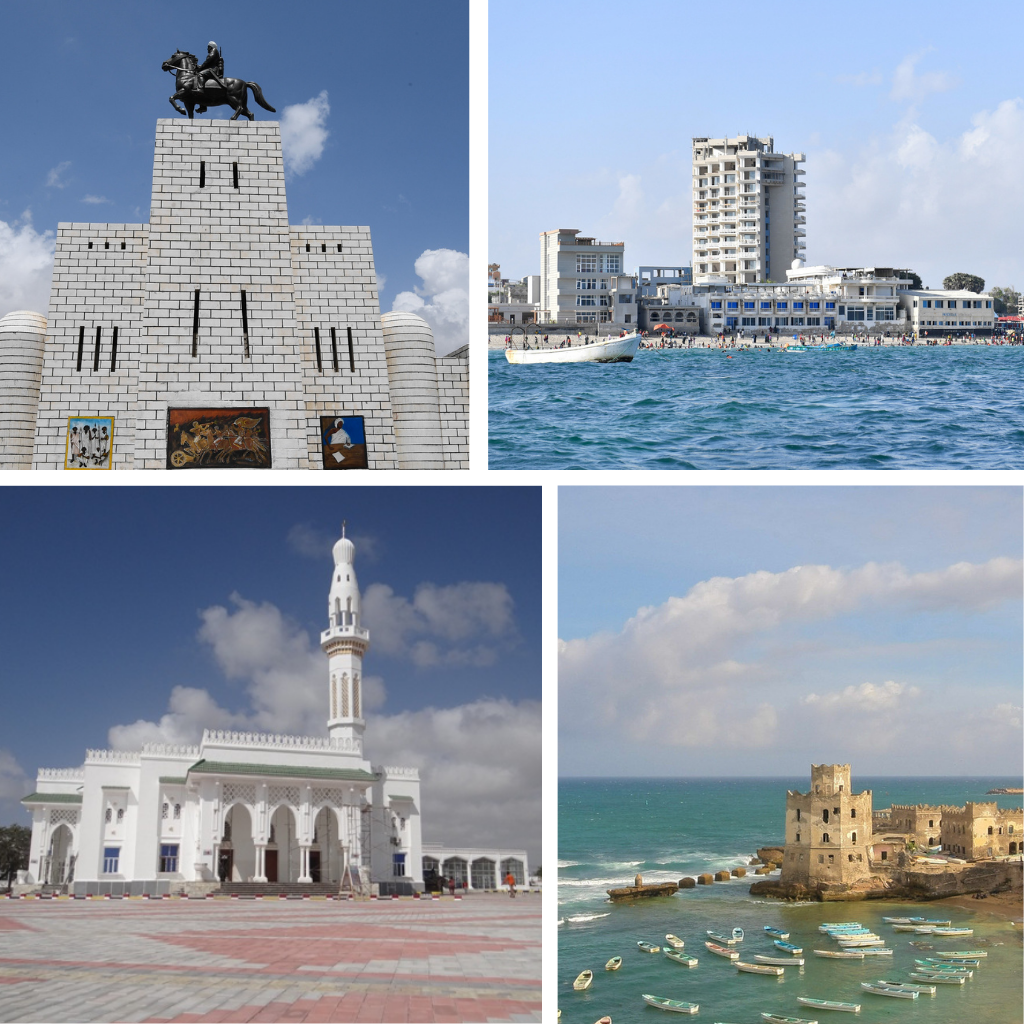
Mogadishu is one of the oldest and most battered cities on the Indian Ocean. Before it became a byword for war it was Xamar: a Swahili city-state built of coral stone that minted its own coins, exported textiles to Egypt and welcomed Ibn Battuta, who in 1331 described it as an enormous and extremely wealthy city. That past is still there, in the alleys of Hamar Weyne and Shangani, in the Arba'a Rukun mosque of 1268-1269 and in the layout of the old port.

On top of that layer came all the others: the Sultanate of Mogadishu, the Ajuran Empire, the Portuguese and Omani presence, the Zanzibar protectorate, Italian Somaliland, which made the city its capital from 1905 and left it a Norman-style cathedral and a monumental centre, independence in 1960, the dictatorship of Siad Barre and, since 1991, three and a half decades of civil war that destroyed or damaged half of the city's buildings and wiped out much of that heritage.

This guide is not an invitation to travel: Somalia sits at the highest alert level of every foreign ministry, and Mogadishu carries a real risk of attacks and of kidnapping of foreigners. It is a guide to understanding the city —what it was, what it lost, what is being rebuilt and how the very limited visiting that exists works today—, so that anyone weighing a trip for work, aid, journalism or family ties knows exactly what they are exposing themselves to and has dated, attributed information to go on.

📖 History of Mogadishu

Mogadishu, Xamar in Somali, was one of the great ports of the western Indian Ocean in the Middle Ages: a coral-stone trading city-state, with 13th-century mosques still standing, its own currency and a textile industry that exported to Egypt and the Arab world. Ibn Battuta visited in 1331 and described it as “an exceedingly large city”. It later became part of the Ajuran Empire, fell into the orbit of Oman and the Sultanate of Zanzibar, and in 1905 became the capital of Italian Somaliland, which gave it a monumental centre and what was at the time the largest Christian cathedral in Africa. Somalia became independent in 1960 with Mogadishu as its capital; in 1969 Siad Barre seized power, and in 1991 his fall opened a civil war that devastated the city, destroyed or damaged about half of its buildings and made it the stage for the international intervention, the 1993 battle and, from 2007, the conflict with Al Shabaab, which was driven out of control of the capital in August 2011 but can still carry out attacks there.

Read the full history ↓

🏛️ Mogadishu and Banaadir (south, with extreme caution)

A thousand years as an Indian Ocean port in Africa's most battered city: medieval textiles, coral-stone houses, Italian art deco, the civil war's green line and a stop-start reconstruction.

Read the history of Mogadishu and Banaadir (south, with extreme caution) →

🗺️ What to see

1
The medieval heart of the city: two neighbourhoods of coral-stone houses, narrow alleys and centuries-old mosques that preserve the layout of the old Indian Ocean trading port. According to the heritage organisation Horn Heritage, they are “deeply scarred” by the fighting of the civil war, and urgent documentation of the true extent of the destruction is still pending. It is the country's foremost historic ensemble and the reason Mogadishu matters beyond the headlines.
2
Arba'a Rukun Mosque
In the medieval district of Shangani, built around the year 667 AH (1268-1269 AD), it is one of the oldest mosques in Mogadishu. Its mihrab bears an inscription from the same year with the name of its founder, Khusra ibn Mubarak al-Shirazi, carved directly into the stone: a rarity in buildings of that age and exceptional documentary evidence of medieval Mogadishu.
3
Fakr ad-Din Mosque
In Hamar Weyne, the oldest part of the city. It is the oldest mosque in Mogadishu and is considered the fifth oldest in Africa; it was built around the same time as Arba'a Rukun. It stands out for its conical minaret, a rare form in the architecture of the East African coast.
4
Ruins of Mogadishu Cathedral
Built between 1923 and 1928 by the Italian administration, designed by the architect Antonio Vandone in Norman style and inspired by Cefalù Cathedral (Sicily). When it opened it was the largest Christian cathedral in Africa and the tallest building in the capital, at 37 metres. Much of it was destroyed in 2008 by Al Shabaab: the outer walls and large stone arches remain. In 2013 the diocese announced restoration plans that have so far not led to a full reconstruction.
5
Old port lighthouse
The Italian colonial-era lighthouse, built in the early 20th century over the old port, is one of the city's most recognisable silhouettes and appears on almost every operator itinerary. On 7 May 2023 it partially collapsed, killing four people, a reminder of the real state of preservation of Mogadishu's heritage.
6
Lido Beach (Liido)
The city's urban beach, north of the old town: pale sand, turquoise water and, on Fridays, whole families, football games and food stalls. It is the symbol of Mogadishu's fragile normality and also a repeated target: on 2 August 2024 it was hit by a suicide bombing and armed assault at the Beach View restaurant. A month later people were back.
7
Bakara Market
Mogadishu's great market and one of the places most charged with the country's recent history: it was the hub of the informal economy throughout the war and a key scene of the 1993 fighting. It is still the commercial pulse of the city. It is a sensitive area in security terms and operators treat it with extreme caution.
8
Next to the old port, where the Indian Ocean catch comes in at dawn and is auctioned in the open air amid shouting, ice and beached dhows. It is the liveliest and least monumental scene in the old town, and one of the fixed stops on guided itineraries.
9
Daljirka Dahsoon (Tomb of the Unknown Soldier)
The obelisk honouring those who fell for independence, right in the centre. It is one of the city's civic landmarks and a regular stop on escorted tours, alongside the monument to the Somali Youth League (SYL), the organisation that led the independence movement.
10
National Museum of Somalia (Garesa building)
Housed in the Garesa building, from the 1930s, which became the national museum after independence. It was badly damaged during the civil war and rebuilt in 2019. It is the most serious attempt to preserve and display the country's material story, from medieval Mogadishu to the 20th century.
11
Peace Garden
A reclaimed urban park in the city centre, with gardens, cafés and public space, a symbol of the reconstruction effort of the past decade. It appears on practically every operator itinerary as a showcase of a Mogadishu that is rebuilding itself.
12
Seafront and Maka al-Mukarama avenue
The commercial artery running through the city and the Indian Ocean waterfront are where contemporary Mogadishu is concentrated: new diaspora-funded buildings, fortified hotels, shops, Turkish-funded hospitals and heavy traffic. Driving through them in convoy is the usual way to read the real pulse of the capital today.
📶I have never landed without internet. I arrive and my phone connects to the strongest network in the country I am visiting: I can say I landed, sort out transport, book tours and keep posting, at a seriously good price. I always use the Maya eSIM — check their plans by clicking the banner.See plans →Maya Mobile eSIM — skip roaming fees, unlimited data
What nobody tells you

💵 Prices

Tickets

TypePrice
Sitios históricos del casco antiguo (mezquitas, ruinas de la catedral, faro, Hamar Weyne, Shangani)There is no ticketing system and no published official fees. Access is arranged through the operator and the local authorities and is part of the tour cost, not a ticket. There is no verifiable source for individual prices (2026)
Museo Nacional de Somalia (edificio Garesa)No verifiably published official fee. Access is coordinated with the operator and depends on whether the museum is open at any given time (2026)
Playa de Lido y Peace GardenPublic spaces, free entry. The real cost is the security logistics to get there (2026)
Permiso de visita y registro ante el Ministerio de TurismoRegistration of foreign visitors and supervision by the Ministry of Tourism are mandatory and are handled by the operator; the cost is included in the package. There is no itemised public fee (2026)
VisadoSpecialist sources from 2026 cite a visa on arrival for USD 50-60 in cash and an e-visa for USD 60; one local operator charges USD 64 for the e-visa. Sources contradict each other on whether the visa on arrival is still in force in 2026: check the official portal evisa.gov.so before taking any steps
🔄 updated monthlyOfficial / reference values · double-check when buying

Activities and tours

3-day Mogadishu tour with a two-vehicle security team
Duration3 days / 2 nights
OperatorRocky Road Travel (international operator with a local partner)
Price
From USD 1.190 per person based on 4 travellers (rate published by Rocky Road Travel, 2026). This is not an official or government rate: it is a private operator's price
Mogadishu leg within a Horn of Africa circuit
Duration3 days within a combined trip with Djibouti, Somaliland and Eritrea
OperatorYoung Pioneer Tours
Price
USD 1.495 for the 3-day Mogadishu segment (15-17 May 2026), group limited to 10 people, with an expert guide and a vetted armed security team; includes meals and visa handling (rate published by Young Pioneer Tours, 2026)
Guided tour of the old town (Hamar Weyne, Shangani, fish market, lighthouse, cathedral ruins)
DurationHalf day
OperatorLocal operators registered with the Ministry of Tourism, with escort
Price
Not sold separately: it is part of the operator's package. No verifiable unit price (2026)
Visit to Lido Beach and the seafront
Duration1 to 2 h, always in daylight
OperatorLocal operator with escort
Price
No entry cost; the expense is the security detail, included in the package (2026)
Mandatory armed escort for all movements
DurationEntire stay
OperatorSecurity companies hired by the local operator
Price
Mandatory for every foreigner moving outside their accommodation. Operators describe teams of four guards and convoys of one or two vehicles; the cost is built into the package rate and is not published separately (2026)
Domestic flight to other cities (Kismayo, Baidoa, Garowe, Bosaso)
DurationShort flights
OperatorSomali airlines (Jubba Airways, Halla, Daallo and others)
Price
No verifiably published fares; booked through the operator and requiring separate permits from each federal member state (2026)
🔄 updated monthlyOfficial / reference values · double-check when buying

🚌 How to get there and distances

Getting around

Private convoy with armed escort
DurationDepends on route
Price
Included in the operator's package; not sold separately and has no public rate (2026)
Notes
This is the only way a foreigner moves around Mogadishu in practice. Operators describe convoys of one or two vehicles with four guards, with the head of security empowered to change or cancel the itinerary without discussion
Aden Adde airport ↔ city transfer
DurationVaries with checkpoints
Price
Included in the package; operators flag it as one of the most sensitive stretches (2026)
Notes
The airport corridor has been a repeated target: the British FCDO records rocket attacks on the international airport in April 2025. Several places to stay used by foreigners are deliberately located right next to the airport compound
Taxi, bajaj (auto-rickshaw) and city minibus
DurationVariable
Price
Local fares in Somali shillings or dollars, very low; there is no published fare table and they are not a realistic option for a foreigner (2026)
Notes
This is how the city's residents get around. For a foreign visitor, travelling this way runs directly against every security recommendation and the operators' own protocol
On foot
Free
Notes
Walking around the city without an escort is not an option that any operator or foreign ministry considers. Walks through the old town are done with the security team and kept short
Armoured vehicle
DurationDepends on route
Price
Some operators offer convoys with armoured vehicles as a premium category; the price is quoted case by case and not published (2026)
Notes
Category used mainly by international organisations, companies and the press
🔄 updated monthlyOfficial / reference values · double-check when buying

How to get there

RouteAirlines / operatorsAvg. priceDuration
Istanbul → Mogadishu (MGQ)Turkish Airlines (subject to suspensions due to security alerts)No verifiable fixed fare; varies by season and availability (2026)Long flight, usually with a stopover
Addis Ababa → Mogadishu (MGQ)Ethiopian AirlinesNo verifiable fixed fare (2026)Just over 2 h
Doha → Mogadishu (MGQ)Qatar Airways (with occasional suspensions after security alerts)No verifiable fixed fare (2026)About 5 h
Nairobi → Mogadishu (MGQ)Regional and Somali airlines (Jubba Airways, Daallo and others)No verifiable fixed fare (2026)About 2 h
Dubai → Mogadishu (MGQ)flydubaiNo verifiable fixed fare (2026)About 4 h
By road from the interior or from KenyaNot applicable for foreign travellers——
🔄 updated monthlyOfficial / reference values · double-check when buying

🏨 Where to stay

No exact prices: a scale from $ (budget) to $$$$$ (luxury), with 2-3 options per category.

High-end fortified hotels
Price$$$$$
Recommended options
The Jazeera Palace Hotel, facing the Indian Ocean, lists rooms from around USD 85 a night on booking platforms, with suites between USD 260 and USD 410 (published rates, 2026). Like the rest of the category, it operates as a closed compound, with blast barriers, guards and luggage screening
Hotels with reinforced security near the airport
Price$$$$$
Recommended options
Places such as the Decale Hotel and the Peace Hotel are deliberately located next to or opposite the Aden Adde airport terminal, and they are the most used by press, aid workers and business travellers, precisely because they are close to the secure zone. They do not publish verifiable official rates; bookings go through the operator. The aggregator Tripadvisor shows accommodation in Mogadishu from around USD 72 a night (2026)
Accommodation included in a package
Price$$$$$
Recommended options
The most common arrangement: the hotel is part of the operator's package, with a single room, three meals a day, wifi and transfers included, and no breakdown of the hotel rate. The cost of accommodation cannot be separated from the cost of security (2026)
Guesthouses and local hotels
Price$$$$$
Recommended options
There is a wide range of hotels and guesthouses for Somalis and for the diaspora, at much lower prices, but with no security arrangements for foreigners. No operator or foreign ministry recommends this option to a foreign visitor, and there are no verifiably published rates (2026)

🍴 Where to eat

Restaurantes de hotel dentro del recinto
Price$$$$$
Options / signature dish
This is where foreign visitors actually eat: Somali and international food inside the accommodation's perimeter, usually on a full-board basis included in the package. There is no public menu with prices (2026)
Cocina somalí tradicional
Price$$$$$
Options / signature dish
The local repertoire: bariis iskukaris (spiced rice with meat or goat), suqaar, hilib ari (roast goat), sabaayad and canjeero (flatbreads), grilled Indian Ocean fish, and shaah cadeys, tea with milk and spices. Operators include a traditional lunch in their itineraries. No verifiable price list
Pescado y marisco del Índico
Price$$$$$
Options / signature dish
Lobster, tuna, snapper and fresh seafood landed at the old port of Hamar Weyne. It is the city's best food and the most closely tied to its maritime history. The seafront restaurants are also the ones that have suffered the most attacks: the choice is made by the security team, not the visitor
Herencia italiana
Price$$$$$
Options / signature dish
Half a century of Italian administration left its mark on the table: pasta —baasto, often served with Somali sauce and banana— is part of everyday cooking, as is Italian-style coffee in some places in the centre. No verifiable prices
Puestos de calle y mercados
Price$$$$$
Options / signature dish
Sambusa (samosas), fruit, fried fish and tea in the Bakara and Hamar Weyne markets. Extremely cheap and completely local, but outside any operator's security protocol. No published prices

📖 History of Mogadishu

Origins, formation and what the sources say.

Xamar: the city-state of the Indian Ocean

Long before its name became linked with war, Mogadishu — Xamar in Somali — was one of the great ports of the western Indian Ocean. The Somali coast was part of a trading system that linked the Horn of Africa with Arabia, Persia, India and, along the monsoon route, China. The winds did the rest: between November and March the northeast monsoon pushed the dhows south; between April and September the southwest monsoon carried them back home. Cities such as Mogadishu, Merca and Brava were built around that rhythm.

From early on, the city grew around two cores that still exist: Hamar Weyne and Shangani. The architecture of that period has an unmistakable signature: coral stone cut from the reefs of the Indian Ocean, which gave the buildings their typical white colour and remarkable durability. Multi-storey houses, inner courtyards, carved doors and narrow alleys designed for shade and breeze: the same building language you find in Lamu, Zanzibar or Kilwa, with Mogadishu as its northern end.

At its medieval height, Mogadishu was a city-state with its own sultanate. It minted its own coins and built up a textile industry that exported its cloth. Its fabrics, known in Arabic sources by the city's name, reached Egypt and the wider Arab world. It also controlled a large part of the regional gold trade. In the 13th century it came into the orbit of the Ajuran empire, the great Somali power of the interior and the coast between the 13th and 17th centuries, which ran a system of wells, stone fortresses and river control along the Shabelle and Juba rivers.

The best-known account comes from Ibn Battuta, the traveller from Tangier who stopped in the city in 1331 on his way to Kilwa. He described it as an enormously large city with extremely wealthy merchants, famous for its textiles, and he recorded the protocol used to receive visitors of rank. It is one of the best written snapshots we have of the Swahili Indian Ocean in the 14th century.

en.wikipedia.org · Mogadishuen.wikipedia.org · Ajuran Sultanate

The 13th-century mosques and the stone that still stands

Against all odds, two buildings survive from medieval Mogadishu, and they are the most valuable heritage the country has. Both went up at almost the same time, in the second half of the 13th century, when the city was at its peak.

The Fakr ad-Din Mosque (Masjid Fakhr ad-Din) is in Hamar Weyne, the oldest part of the city. It is the oldest mosque in Mogadishu and one of the five oldest in Africa. Its most striking feature is a conical minaret. That shape is rare on the East African coast, where most minarets are square or cylindrical.

The Arba'a Rukun Mosque is in the medieval district of Shangani and was built around the year 667 of the Hijra, which is 1268-1269 CE. Its value as a record is exceptional: the mihrab keeps an inscription from that same year giving the founder's name, Khusra ibn Mubarak al-Shirazi. Having the patron's name carved straight into the stone of the prayer niche is rare in buildings that old, and it makes the Arba'a Rukun a key piece for dating and understanding 13th-century Mogadishu.

The mention of al-Shirazi also points to a deeper debate among historians of the Swahili coast. Local traditions credit settlers from Shiraz, in Persia, with founding several of these cities. Archaeological and linguistic research over recent decades, however, stresses that Swahili civilisation was fundamentally African, and that local elites took on Persian and Arab genealogies as a sign of prestige and of belonging to the Islamic world of the Indian Ocean. Both stories live side by side in the stones of Shangani.

On the origins of the coastal elites: local chronicles claim Persian founders (the so-called Shirazi tradition), and that claim appears in the Arba'a Rukun inscription itself. Modern archaeology and linguistics, on the other hand, see Swahili civilisation as an African development of the coast that took on Perso-Arab lineages and references as symbolic capital. Neither reading takes anything away from the building: what is dated and signed in the stone is 1268-1269 and the name Khusra ibn Mubarak al-Shirazi.
en.wikipedia.org · Arba'a Rukun Mosqueen.wikipedia.org · Fakr ad Din Mosque

Portuguese, Omanis and Italians: the city changes hands

The arrival of the Portuguese in the Indian Ocean from 1498 broke the trading balance of the coast. Mogadishu was not razed like Kilwa or Mombasa, but the new maritime order, with Lisbon charging tolls on the monsoon routes, wore down the role of the Somali ports. The city entered a long period of decline in which its fortunes were tied to whichever powers controlled the sea.

In the 18th and 19th centuries, the southern Somali coast came under the influence of Oman and then of the Sultanate of Zanzibar. Zanzibar nominally ran the Banaadir ports (Mogadishu, Merca, Brava and Warsheikh) and collected customs duties through local governors. Real power, however, was split between those governors, the urban lineages of Hamar Weyne and Shangani, and the clan confederations of the interior, above all the Geledi Sultanate, which controlled the caravan trade of the Shabelle valley.

Italy arrived at the end of that process. From the 1890s it leased and then acquired the Banaadir ports during the colonial scramble for Africa, and in 1905 it took formal control of Mogadishu, which became the capital of Italian Somaliland. That status reshaped the city physically: avenues were laid out, and a monumental administrative centre, public buildings, the governor's palace, the harbour lighthouse and, between 1923 and 1928, the cathedral were built.

Mogadishu Cathedral was the most ambitious architectural gesture of the colonial period. Antonio Vandone designed it in the Norman style, taking Cefalù Cathedral in Sicily as his model. At 37 metres it was the tallest building in the capital, and when it opened it was the largest Christian cathedral in Africa. Standing next to the coral-stone old town, it was a statement of intent: two cities laid on top of each other that never fully merged.

The Second World War cut short Italy's colonial project in the Horn. British troops occupied Italian Somaliland in 1941 and ran the territory until 1950. That year Italy returned as administering power under a United Nations trusteeship, with a fixed ten-year deadline to lead the territory to independence.

en.wikipedia.org · Italian Somalilanden.wikipedia.org · Mogadishu Cathedral

Independence, republic and dictatorship (1960-1991)

On 1 July 1960, the Italian trust territory joined British Somaliland, which had become independent five days earlier, to form the Somali Republic, with Mogadishu as its capital. Hopes were enormous: a new state with a shared language and a strong national identity, on a continent that was decolonising at full speed. The independence movement had been led by the Somali Youth League, whose monument still stands in the city centre, as does the Daljirka Dahsoon, the obelisk to the unknown soldier.

The first decade of the republic was parliamentary and competitive, but also unstable, with growing political fragmentation. In October 1969, after President Abdirashid Ali Shermarke was assassinated, the army took power and General Mohamed Siad Barre set up a military regime that would rule for twenty-one years.

The Barre era left a deep and contradictory mark on Mogadishu. On one side there were mass literacy campaigns, and in 1972 Somali got an official Latin script; until then it had no standardised written form in general use. There were also public works, state industry and a rhetoric of national unity against “tribalism”. On the other side there was a one-party state, a personality cult, security services everywhere, repression of dissent, and a clan-based way of handling power that in practice contradicted everything the regime said in public.

The Ogaden War against Ethiopia (1977-1978), lost after Soviet support switched to Addis Ababa, marked the beginning of the end. The defeat, its economic cost, the arrival of hundreds of thousands of refugees and harsher repression fed armed insurgencies in the north and centre of the country throughout the 1980s. In January 1991, the militias of the United Somali Congress took Mogadishu and Siad Barre fled. There was no transition: the Somali state fell apart.

en.wikipedia.org · Somali Republicen.wikipedia.org · Siad Barre

Civil war, international intervention and a city destroyed

The fall of the regime did not lead to a new government but to a war between factions. Mogadishu was split by a “green line” separating the territories of the main warlords, with artillery fights in densely populated areas. The result, over years, was devastating: according to the heritage organisation Horn Heritage, since the late 1980s the war has damaged or destroyed around 50 % of all the buildings in the city. The historic districts of Hamar Weyne and Shangani were badly scarred, and there is still no systematic record of how far the destruction really went.

The famine that came with the collapse led to an international intervention. The UNOSOM mission and, from December 1992, the US-led Operation Restore Hope tried to secure humanitarian aid in a place with no state. Things came to a head on 3 and 4 October 1993 in the Battle of Mogadishu: two US helicopters were shot down and there were hours of urban fighting around the Bakara market. The episode, known around the world through the account “Black Hawk Down”, sped up the US withdrawal and, in 1995, the end of the UN mission. Somalia was left on its own.

Over the following decade, real power in the city was shared among militias, business people and neighbourhood Islamic courts, which handled justice and security where there was no state. In 2006, the Islamic Courts Union brought those structures together and took control of Mogadishu, imposing an order that much of the population welcomed with relief after fifteen years of anarchy. At the end of that year, an Ethiopian military intervention with international backing drove the courts out of the capital.

Al Shabaab, the most radical wing of the Islamic Courts Union, emerged from its break-up. It became a nationwide insurgency and in 2012 declared its affiliation with Al Qaeda. Al Shabaab controlled large parts of Mogadishu between 2007 and 2011, and it was during that time, in 2008, that it destroyed much of the 1928 cathedral: today only the outer walls and the large stone arches remain. The African Union mission AMISOM, deployed from 2007, and Somali forces managed to push the group out of control of the capital in August 2011.

hornheritage.org · Mogadishus vanishing heritageen.wikipedia.org · Battle of Mogadishu (1993)

Reconstruction, risk and the city today

Pushing Al Shabaab out of control of the capital in August 2011 began the longest period of rebuilding since 1991. Part of the diaspora came back, bringing money and drive. Turkey became the most visible international partner, with public works, a hospital, the airport, schools and a diplomatic presence. Hotels, shopping centres and residential towers went up. Between 2020 and 2025 more than 6,000 new buildings were put up in the city, one of the fastest rates of urban growth in the world, and in 2025 the urban area had around 3.26 million inhabitants.

That rebuilding goes on alongside a conflict that has not ended. Al Shabaab lost territorial control of Mogadishu but can still operate inside the city: car bombs, suicide attacks and armed assaults on hotels, restaurants, public buildings and the airport corridor. On 2 August 2024, a suicide bombing followed by an armed assault hit the Beach View restaurant on Lido beach, the most popular place to relax in the capital. A month later, locals were back on the beach.

The international security set-up has also changed. The ATMIS mission ended on 31 December 2024 and was replaced from 1 January 2025 by AUSSOM, the African Union Support and Stabilization Mission in Somalia, with an initial twelve-month mandate and an open debate over how to fund it. On 20 February 2025, Al Shabaab launched an offensive in the Shabelle valley with the stated goal of surrounding the capital and winning back the ground it lost in the government's 2022 offensive. In July that year it retook the towns of Sabiid and Anole, about 40 kilometres southwest of Mogadishu.

Meanwhile, heritage keeps disappearing in ways quieter than war. The colonial harbour lighthouse partly collapsed on 7 May 2023, killing four people. The tower of the Abdulaziz Mosque, the oldest surviving one in the city, was demolished in May 2013 as part of a foreign-funded “restoration” project. The Italian governor's palace was pulled down by the military regime and replaced by the Uruba hotel, which has also been destroyed. The National Museum, in the 1930s Garesa building, was rebuilt in 2019 and is the most serious institutional effort to preserve the country's material memory.

Mogadishu today is both things at once: a city of three million people rebuilding at remarkable speed, and the capital of a country that every foreign ministry in the world places at its highest alert level. Telling the first story without the second would be a lie; telling the second without the first would do an injustice to eight hundred years of history.

en.wikipedia.org · Mogadishuen.wikipedia.org · 2025 Shabelle offensiveen.wikipedia.org · 2024 Lido Beach attack

📚 Bibliography

  • Wikipedia (EN) — «Mogadishu»: https://en.wikipedia.org/wiki/Mogadishu
  • Wikipedia (EN) — «Arba'a Rukun Mosque»: https://en.wikipedia.org/wiki/Arba%27a_Rukun_Mosque
  • Wikipedia (EN) — «Fakr ad-Din Mosque»: https://en.wikipedia.org/wiki/Fakr_ad-Din_Mosque
  • Wikipedia (EN) — «Mogadishu Cathedral»: https://en.wikipedia.org/wiki/Mogadishu_Cathedral
  • Wikipedia (EN) — «Italian Somaliland»: https://en.wikipedia.org/wiki/Italian_Somaliland
  • Wikipedia (EN) — «Ajuran Sultanate»: https://en.wikipedia.org/wiki/Ajuran_Sultanate
  • Wikipedia (EN) — «Battle of Mogadishu (1993)»: https://en.wikipedia.org/wiki/Battle_of_Mogadishu_(1993)
  • Wikipedia (EN) — «2025 Shabelle offensive»: https://en.wikipedia.org/wiki/2025_Shabelle_offensive
  • Wikipedia (EN) — «2024 Lido Beach attack»: https://en.wikipedia.org/wiki/2024_Lido_Beach_attack
  • Horn Heritage — «Mogadishu's Vanishing Heritage»: https://www.hornheritage.org/mogadishus-vanishing-heritage/
  • Combating Terrorism Center (West Point) — «Somalia at a Crossroads: Resurgent Insurgents, Fragmented Politics, and the Uncertain Future of AUSSOM»: https://ctc.westpoint.edu/somalia-at-a-crossroads-resurgent-insurgents-fragmented-politics-and-the-uncertain-future-of-aussom/
  • FCDO (United Kingdom) — Somalia travel advice, updated 4 June 2026: https://www.gov.uk/foreign-travel-advice/somalia

❓ Frequently asked questions

Can you travel to Mogadishu as a tourist?+
Legally yes, and there are operators selling itineraries; in terms of risk, every foreign ministry advises against it without qualification. The U.S. Department of State keeps Level 4 «Do Not Travel» (renewed on 21 May 2026), the British FCDO advises against all travel to Somalia (4 June 2026), and the Spanish Ministry of Foreign Affairs literally says «se desaconseja el viaje bajo cualquier circunstancia» (travel is advised against under any circumstances) (28 May 2026). Independent tourism does not exist: entering without an operator, without permits and without an armed escort is not a realistic alternative. This guide informs; it does not recommend going.
What consular assistance is there if something goes wrong?+
Very little, and it is worth being clear about that before deciding. The British FCDO says its support in Somalia is «severely limited», with no in-person assistance from embassy staff in Mogadishu, and that anyone who stays in the country does so at their own risk, with a personal emergency plan that does not rely on the British Government. Spain has no embassy in Somalia: representation is through the Embassy in Nairobi, with consular emergency phone +254 733 631 144. The United Kingdom also maintains a stated policy of not paying ransoms.
Why does Mogadishu matter if the risk is so high?+
Because its heritage is first-rate and explains a central part of the history of the Indian Ocean. It was a trading city-state that minted its own coinage and exported textiles to Egypt; Ibn Battuta described it in 1331 as an enormously large city. It preserves 13th-century mosques —the Arba'a Rukun, from 1268-1269, with the founder's name carved into the mihrab, and the Fakr ad-Din, the oldest in the city and the fifth oldest in Africa— and two entire districts built of coral stone. Understanding it does not require going: it requires telling it well.
How much heritage was lost in the war?+
A great deal. According to the heritage organisation Horn Heritage, from the late 1980s the civil war damaged or destroyed around 50 % of the city's buildings, and the historic districts of Hamar Weyne and Shangani were deeply scarred. The 1928 cathedral, the largest in Africa when it opened, was largely destroyed by Al Shabaab in 2008. The colonial lighthouse partially collapsed on 7 May 2023, killing four people. The tower of the Abdulaziz mosque was demolished in May 2013 during a «restoration» project. The National Museum, in the Garesa building, was rebuilt in 2019.
How much does an organised trip to Mogadishu cost?+
Only operator rates are available, and they are not official prices. Rocky Road Travel lists a 3-day, 2-night tour from USD 1.190 per person based on four travellers, with a two-vehicle security team (2026). Young Pioneer Tours sells the Mogadishu leg of its Horn of Africa combo at USD 1.495 for three days, with meals, guide and a vetted armed team (2026). Somalia Security and Tours offers a five-day tour of Kismayo and the Bajuni Islands from USD 2.299, with four armed escorts (2026). On top of that come international flights and the visa.
How does money work in Mogadishu?+
The economy is effectively dollarised: the US dollar is used for almost everything beyond small amounts, and the Somali shilling circulates for small change. Mobile money is huge —EVC Plus, from Hormuud Telecom, is the dominant platform, with mobile money penetration estimated at around 73 % of the country— but it is designed for local numbers. For a foreigner, in practice that means cash in dollars, in notes in good condition: there is no usable international ATM network and cards are not widely accepted.
When is the best time to go, weather-wise?+
The dry season, from December to March, with average temperatures around 30 °C and minimal rain. The two wet seasons are the gu (April to June), which brings about 65 % of the 537 mm average annual rainfall, and the deyr (October to December), with about 25 %. That said, in Mogadishu the calendar that counts is not the weather one but the security one, and that has no season.

More places in Somalia

Playa de LidoSheikhZeila (Saylac)Archipiélago BajuniBaidoaBerbera
See every place in Somalia →The history of Somalia →
Sources consulted (16)
Still planning?
Explore more destinations in Somalia
See all destinations →
Image credits
Photos from Wikimedia Commons, each under its own licence (CC BY, CC BY-SA or public domain). Open each file to see its author and licence.
Mogadishu