Viajá con Gus
Home › Somalia › Laas Geel
Laas Geel
🇸🇴 Somalia · Somaliland: Hargeisa and the interior (more stable, limited recognition)

Laas Geel

🪪 What do I need to enter Somalia?Pick your citizenship and we tell you the visa, the days and the paperwork, with the official source.

By leaving your email and citizenship you agree to receive the documents you asked for and weekly travel news. You can unsubscribe whenever you want. How we handle your data.
Jump to what you need
📌What it is
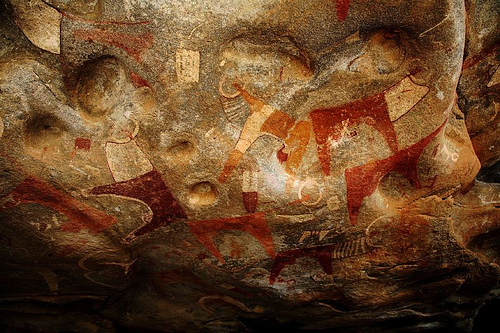
Laas Geel, Somali for “the camels' well”, is a granite outcrop in the Somaliland desert with around twenty rock shelters covered in polychrome paintings between 5,500 and 4,500 years old. It is one of the best-preserved rock art sites in Africa and the first of its style found in the Horn of Africa. The main figures are long-horned cows with necklaces and ceremonial breastplates, painted in red, white, yellow and black. Around them are human figures with outstretched arms, dogs, giraffes and antelopes.
📌Location
In the Maroodi Jeex region, about 50 kilometres north-east of Hargeisa, on the road towards Berbera, where two seasonal watercourses meet. The site sits on a granite hill. From where you leave the vehicle it's a 15 to 20-minute walk, and the last stretch is a climb over rock. Approximate coordinates: 9°46′51″N, 44°26′37″E.
📌Discovery
Local herders had always known about the paintings and avoided camping under the shelters out of respect. But the site had never been documented scientifically until November–December 2002, when the French archaeological mission “Premières Sociétés de Production dans la Corne de l'Afrique” found it. The mission was led by Xavier Gutherz (Université Paul Valéry Montpellier, CNRS). They were looking for shelters with archaeological deposits to study the origins of herding in the Horn of Africa, and came across what the French press itself called “the African Lascaux”.
📌World Heritage (the key fact)
Laas Geel is NOT on the UNESCO World Heritage List, and it isn't for lack of merit. The reason is political. Only States Parties to the World Heritage Convention can nominate sites on their territory, and Somaliland is not internationally recognised, so it can't submit a nomination of its own. UNESCO did send conservation expert missions in 2010 and 2016. Since 2023–2024, a French cooperation programme with Expertise France and Somaliland's Department of Archaeology has been working to strengthen the site's protection. It is probably the most important archaeological site in Africa with no international status.
📌Mandatory permit
To visit Laas Geel you need a permit from Somaliland's Ministry of Tourism (Ministry of Trade and Tourism). You get it in Hargeisa and hand it to the site guard. The price recent travellers report most often is US$ 25 per person. The Against the Compass guide mentions US$ 35 with a guide included. There's no official price list published online, so check on the day. Go early in the morning: aim to be at the Ministry counter around 8:00. The permit is issued the same day.
📌SPU escort
Outside the main cities, foreigners must travel with an armed escort from the Special Protection Unit (SPU), Somaliland's protection police. This is the norm for Laas Geel. Wikivoyage puts the cost at US$ 15-40 per day, negotiable down to about US$ 15. Several travellers mention a flat package of around US$ 100 for a hired taxi from Hargeisa with the escort included. You arrange it in Hargeisa, not on the road.
📌Best time and hours
November to February, the cool, dry season. The site is in the open and there's no shade on the way up. Go early in the morning or late in the afternoon and avoid the middle of the day, especially between June and August. Early-morning light is also the best for seeing the pigments. There are no official opening hours. The guard lives on site, and you arrange access along with the permit.
📌Duration of the visit
The trip from Hargeisa takes a long half day or a full day: about an hour's drive each way, a 15 to 20-minute walk in, and one to two hours at the shelters. Many travellers combine it with the onward trip to Berbera, since Laas Geel is on the same road.
📌Safety
Important notice. The US Department of State keeps all of Somalia, Somaliland included, at Level 4, “Do Not Travel” (update of 14 May 2025). The British FCDO takes a more nuanced view. It advises against all travel to Somalia except the regions of Awdal, Maroodi Jeex and Sahil, where it advises only against non-essential travel (June 2026 version). Laas Geel is in Maroodi Jeex, inside that less restrictive zone, and visitors come regularly with a permit and an escort. Even so, consular support is practically non-existent and medical care is very limited. Travel with insurance that explicitly covers destinations under travel advisories.
💱 SOS exchange rate
Loading rate…
🌤️ Weather in Laas Geel
Loading weather…

There's one concrete reason to travel to Somaliland, and it's this granite hill lost among acacias fifty kilometres from Hargeisa. In about twenty natural shelters, protected from the rain by rock overhangs, hundreds of figures painted some five thousand years ago survive in red, white, yellow and black. The cows have huge lyre-shaped horns and bodies covered in necklaces and ceremonial breastplates. They are so crisp it's hard to believe: the pigments look fresh.

Laas Geel was only documented in December 2002. That's when a French archaeological mission led by Xavier Gutherz arrived, looking for shelters with stratigraphy to study the origins of herding in the Horn of Africa. Local herders had known the site all their lives and treated it with respect; science didn't know it existed. The find changed the map of African rock art. Its style had never been seen in the region before, and it is among the best preserved on the continent.

And yet the site isn't on the World Heritage List. That has nothing to do with its value. Only recognised states can submit nominations, and Somaliland isn't one. A world-class site looked after by one guard, a twenty-five-dollar permit and the goodwill of the local herders: that contradiction sums up pretty well what travelling here is like. This guide explains how to organise the visit: the permit, the escort, the transfer, what exactly you'll see and how to help protect it.

📖 History of Laas Geel

The paintings at Laas Geel were made by herding communities of the African Neolithic between 5,500 and 4,500 years ago, in the 3rd millennium BCE. That was when cattle herding was taking hold in the Horn of Africa. The artists mostly painted cows with lyre-shaped horns and bodies covered in necklaces, breastplates and ceremonial robes. Alongside them are schematic human figures with open arms, domestic dogs, giraffes and antelopes. Together they portray a society for which cattle were sacred as well as a livelihood. The shelters stayed in use afterwards. Later phases show fat-tailed sheep, and the very last ones have engravings of dromedaries, the animal that would dominate the region's history. The site remained off every scientific record until November–December 2002. Then the French mission led by Xavier Gutherz documented it and introduced it to the world as “the African Lascaux”. Since then it has become Somaliland's heritage emblem and one more argument in its claim for international recognition.

Read the full history ↓

🏛️ Laas Geel is in Somaliland: Hargeisa and the interior (more stable, limited recognition)

5,000-year-old rock art, a capital rebuilt from the rubble of 1988, and a state with its own currency, passport and elections that the world took thirty-four years to start recognising.

Read the history of Somaliland: Hargeisa and the interior (more stable, limited recognition) →

🗺️ What to see

1
Shelter 7, the panel of ceremonial cows
The most spectacular group, and the one in every photo: rows of white-and-red cattle with very long lyre-shaped horns. A distinctive painted “breastplate” or robe covers their chest and back, and they wear necklaces and ornaments around the neck. Below or beside them are schematic human figures with raised arms, as if in worship. This is the panel that defined the so-called Ethiopian-Arabian style in the Horn of Africa.
2
The lyre-horned cows and their ornaments
Up close, the detail is remarkable. The animals are painted with necklaces, bands and geometric patterns. Archaeologists read these as real ceremonial ornaments, not just decoration in the painting. This is the oldest known visual evidence of a cattle cult in the region. That's exactly why the French mission was looking for sites like this: to study the “first producing societies” of the Horn of Africa.
3
The human figures with outstretched arms
Next to the animals are people drawn very schematically, with triangular or stick-like bodies and arms open upwards. They are usually read as the herder-artists themselves or as officiants of a ritual. Some appear to wear headdresses or carry weapons.
4
The domestic dog and other canids
One of the details specialists cite most: among the herds there's a clearly domestic dog and other canids. It's direct evidence of the bond between herder, cattle and working animal five thousand years ago.
5
The giraffe and the wildlife
Besides the cattle there are giraffes, antelopes and other wild animals. They're a window onto the climate. They point to a much wetter, more wooded Horn of Africa than today's semi-desert, during the so-called African Humid Period, and they help place the paintings in time.
6
The later phases: fat-tailed sheep and engraved dromedaries
The site wasn't painted all at once. Later layers show fat-tailed sheep and wild animals. In the final stage come engravings, no longer paintings, of dromedary herds. That change of animal marks the shift towards the camel economy that defines the Horn of Africa, past and present.
7
The twenty-odd shelters and a full loop of the hill
Laas Geel isn't a single cave but a whole group. The granite hill has around twenty painted shelters and hollows, which vary in quality and how easy they are to reach. The site guard usually comes along and shows you the main panels. If you have time and proper footwear, you can walk all the way around the hill and see secondary panels that fewer people visit.
8
The view from the top over the meeting of the wadis
From the upper shelters you look down on two seasonal watercourses meeting in a plain of acacias and termite mounds. That's exactly why the place is called Laas Geel, “the camels' well”. There's water under the dry riverbed, and herders still water their animals there, just as they did five thousand years ago.
9
Conservation is up to you too
The granite overhangs are the reason the paintings have survived so well: they shield them from rain and direct sun. Today's threats are different: recent graffiti and vandalism, wasp nests, wind erosion and visitors brushing against the rock. Don't touch the walls, don't wet the pigments, don't use flash without asking first, and don't leave the marked path.
10
The herder guardians and the goats
For decades, the local herding communities informally looked after the site. The recent cooperation programme is now training them as official guides and conservators. Chatting with the guard and with the herders watering their animals below is part of the visit. It shows you the site is alive, not mummified.
11
Somaliland's other rock art sites
Laas Geel isn't alone. The region has some thirty documented sites from the same period. They include Dhambalin (found in 2007, with the region's earliest depictions of sheep), Karinhegane, Dhagah Kureh and Dhagah Nabi Gelay. Some can be visited with a permit and a guide. Ask at the Ministry of Tourism or your agency if you want to extend your archaeology route.
12
Laas Geel is on the road from Hargeisa to Berbera, so the visit leads naturally into the drive down to the Gulf of Aden across the Golis range. If you've already hired the vehicle and escort, make the most of it and carry on rather than going back to Hargeisa.
📶I have never landed without internet. I arrive and my phone connects to the strongest network in the country I am visiting: I can say I landed, sort out transport, book tours and keep posting, at a seriously good price. I always use the Maya eSIM — check their plans by clicking the banner.See plans →Maya Mobile eSIM — skip roaming fees, unlimited data
What nobody tells you

💵 Prices

Tickets

TypePrice
Permiso del Ministerio de Turismo de Somalilandia (obligatorio)US$ 25 per person according to most recent traveller reports; Against the Compass quotes US$ 35 with a guide included. Arranged in Hargeisa in the morning and handed to the site guard. No official price list is published online: check on the day (2025-2026)
Escolta SPU (Special Protection Unit)US$ 15-40 per day according to Wikivoyage, negotiable to around US$ 15. Mandatory for foreigners outside the main cities (2026)
Paquete completo desde Hargeisa (taxi contratado + escolta)Around US$ 100 for the vehicle with armed escort, according to traveller reports (Unusual Travel Blog, The Candy Trail). It's split among the passengers, so it pays to form a group (2025)
Propina al guardia del sitio y al guía localNot mandatory, but customary and appreciated: a few dollars per person (2026)
🔄 updated monthlyOfficial / reference values · double-check when buying

Activities and tours

ActivityPriceDurationOperator
Half-day or full-day trip from HargeisaAround US$ 100 for the vehicle with escort, plus US$ 25 per person for the permit (2025)5 to 7 h in total, with 1 to 2 h at the siteHired taxi with SPU, local agency in Hargeisa or your hotel
Guided visit of the shelters with the site guardIncluded in the permit; tipping is customary1 to 2 hGuard and community guides trained by Somaliland's Department of Archaeology
Laas Geel + Berbera on the same tripThe vehicle is hired by the day or per trip; it works out cheaper than two separate outings from HargeisaFull day with a night in BerberaLocal agency or car with driver
Extended archaeology circuit (Laas Geel + Dhagah Kureh + Dhagah Nabi Gelay or other rock art sites)No published rates: get a quote from an agency; additional permits required1 to 3 daysSpecialist agencies and the Ministry of Tourism
Photographing the rock artNo specific charge reportedAs you likeOn your own, always checking with the guard about flash and tripods
🔄 updated monthlyOfficial / reference values · double-check when buying

🚌 How to get there and distances

Getting around

Hired car with driver from Hargeisa
DurationAbout 1 h for 50 km
Price
Around US$ 100 for the package with escort according to recent reports; negotiable
Notes
This is the standard way, and practically the only one. The last few kilometres are dirt track and a 4x4 is advisable, especially after rain
Walk in
Free
Duration15 to 20 min from the parking area to the shelters
Notes
Stony ground with a final climb over rock. Closed shoes, a hat and water. No shade or facilities along the way
Public transport
Not workable in practice
Notes
Minibuses on the Hargeisa-Berbera road pass through the area, but the site is off the main road, there's no useful signage, and you can't get in without a permit and escort. Not a realistic option
🔄 updated monthlyOfficial / reference values · double-check when buying

How to get there

Hargeisa → Laas Geel
Airlines / operatorsHired taxi or agency 4x4, with SPU escort
Avg. priceAround US$ 100 for the vehicle with escort (2025); permit extra
DurationAbout 1 h for 50 km
Laas Geel → Berbera
Airlines / operatorsSame hired vehicle
Avg. priceNegotiated with the driver; best agreed before leaving Hargeisa
DurationAbout 2 h to the coast, across the Golis
International arrival at Hargeisa (HGA)
DurationAddis Ababa-Hargeisa, just over 1 h
Airlines / operators
Ethiopian Airlines via Addis Ababa, flydubai and Air Arabia via Dubai/Sharjah, Daallo Airlines, Jubba Airways
Avg. price
Depends on route and season; Wikivoyage names Djibouti as the cheapest origin, at around US$ 125 one way plus about US$ 100 in taxes (2026)
Overland from Ethiopia (Tog Wajaale)
Local fare, cheap
Airlines / operatorsMinibuses and shared 4x4s from Jijiga and Harar
Duration1.5 to 2 h from the border to Hargeisa
🔄 updated monthlyOfficial / reference values · double-check when buying

🏨 Where to stay

No exact prices: a scale from $ (budget) to $$$$$ (luxury), with 2-3 options per category.

No accommodation at Laas Geel
Price$$$$$
Recommended options
The site has no hotel, official campsite or facilities. You visit from Hargeisa, an hour away, or on the way to Berbera. Overnighting in the shelters isn't allowed, and it would be a terrible idea for conservation anyway
Hargeisa base: upmarket
Price$$$$$
Recommended options
Maansoor Hotel from about US$ 58 a night according to its own rate sheet (2026); Ambassador Hotel and Damal Hotel are in the same bracket. Tripadvisor puts Hargeisa's top ten hotels from about US$ 79 (2026)
Hargeisa base: mid-range and budget
Price$$$$$
Recommended options
About US$ 20-60 a night. The Maamu Hotel, popular with backpackers, was around US$ 20-25 according to Against the Compass (2026); Tripadvisor puts the starting price for Somaliland at around US$ 27
Berbera base
Price$$$$$
Recommended options
If you continue to the coast: the Barwaqo Hotel was listed with private rooms from about US$ 10 according to Against the Compass (2026), and there are beach options such as the more upmarket Maan-Soor at Batalaale

🍴 Where to eat

Sin servicios en el sitio
Price$$$$$
Options / signature dish
There's no kiosk, restaurant or drinking water at Laas Geel. Bring plenty of water (at least two litres per person), fruit and something to eat from Hargeisa, and take all your rubbish back with you
Parada en la ruta a Berbera
Price$$$$$
Options / signature dish
Villages along the road have tea stalls, sambusas and simple food for under a dollar. Hygiene varies: these are the usual stops for truckers and herders
Comer en Hargeisa antes o después
Price$$$$$
Options / signature dish
A basic Somali meal costs around 10,000-20,000 Somaliland shillings (Against the Compass, 2026), roughly US$ 1-2; a mid-range restaurant, 30,000-40,000 shillings. Bariis iskukaris, goat, grilled camel and canjeero
Restaurantes de gama alta en Hargeisa
Price$$$$$
Options / signature dish
Around US$ 8-12 for a main course at the capital's best restaurants (Against the Compass, 2026): Yemeni, Turkish and international food. No alcohol, as everywhere in the territory

📖 History of Laas Geel

Origins, formation and what the sources say.

A green Horn of Africa: the landscape that made Laas Geel possible

To understand Laas Geel, you have to picture a different Somaliland. Between roughly 9000 and 3000 BCE, North Africa and the Horn went through what is known as the African Humid Period: a cycle of stronger monsoons that filled the Sahara with lakes, lengthened rivers and covered regions that are semi-desert today with wooded savannah. In the Horn of Africa, that meant pasture, more reliable watercourses and wildlife that included giraffes, elephants, antelopes and large bovids.

It was in this landscape that one of the decisive shifts in African history took place: the move from hunting and gathering to food production. Domesticated cattle reached the Horn of Africa from the north and north-west, and by the 4th and 3rd millennia BC they were already supporting settled pastoral communities. The French archaeological mission that worked in the region carries exactly that name, “Premières Sociétés de Production dans la Corne de l'Afrique”, meaning “First Producing Societies in the Horn of Africa”. That was precisely its goal: to trace the moment when these societies began raising animals instead of hunting them.

The painters did not choose the spot by chance. Laas Geel rises where two wadis meet. These are seasonal watercourses that flow after the rains and keep moisture under their sandy beds for the rest of the year. In Somali, the name means “the camels' well”: five thousand years later, herders still water their flocks there. The granite outcrop also offers some twenty natural shelters, with overhangs that protect the walls from direct rain and the midday sun. Water, shade, shelter and smooth rock: everything a pastoral camp needs, and everything a painter needs.

archeologie.culture.gouv.fr · Laas geel african lascauxen.wikipedia.org · Laas Geel

The paintings: sacred cows, herders and dogs

What survives in the Laas Geel shelters is, in essence, a portrait of a society told through its central obsession: cattle. The main panels are dominated by stocky, flat-backed cattle with very long lyre-shaped horns, painted in red, white, yellow and black. What makes them exceptional is not the cows themselves (African pastoral rock art is full of cows) but the way they are dressed. The animals wear collars around their necks and a wide “plastron”, or cloak, covering the chest and back, decorated with bands and geometric patterns.

These ornaments are not artistic licence. Archaeologists read them as real ceremonial decoration, placed on the animals on ritual occasions. If that reading is right, Laas Geel is the oldest known visual evidence of a cattle cult in the Horn of Africa, a tradition that runs through the millennia and is still alive in the pastoral cultures of East Africa. The cow was not just food and wealth: it was an object of veneration.

Alongside the animals are highly schematic human figures with triangular or stick-like bodies and arms raised upwards, a pose usually read as worship or as herding. Some seem to wear headdresses. Specialists believe they depict the painters themselves and the herders who lived in the shelters. The scene is completed by a clearly domestic dog and other canids, a giraffe, antelopes and other wild animals: fauna that confirms a far wetter environment than today's.

The style came as a surprise. When the French published it, it was the first group of its kind documented in the Horn of Africa: polychrome paintings from an original school, later linked with those at Dhambalin and Karinhegane under the label of the “Ethiopian-Arabian” style. And Laas Geel was not painted all at once. Later phases add fat-tailed sheep and wild animals, and the final stage brings engravings, not paintings, of dromedary herds: a sign that the economy had shifted towards the camel, the animal that dominates the Horn of Africa both historically and today.

The most widely accepted dating places the main paintings at between 5,500 and 4,500 years old, that is, in the 3rd millennium BC. Figures of 10,000 or 11,000 years also circulate and are often repeated in the press and in popular guides, but they are not supported by archaeological research at the site.
The ornaments painted on the cattle (collars and plastrons) are mostly interpreted as ceremonial decoration actually placed on the animals, not as a decorative convention of the artist. This is the basis for the argument that Laas Geel documents a cattle cult.
The cultural and linguistic identity of the painters is unknown. No continuity has been shown between the painters of the 3rd millennium BC and today's Somali populations, although the pastoral tradition does show remarkable long-term persistence in the region.
en.wikipedia.org · Laas Geelafricanrockart.britishmuseum.org · Laas geel

December 2002: the discovery of “the African Lascaux”

Laas Geel was never lost. Local herders had known about the shelters for generations and, according to accounts gathered by the archaeologists, avoided camping beneath the paintings out of respect, believing them to be special. What did not exist was a scientific record: no publication, no plan and no photograph in the archaeological literature.

That changed in November and December 2002. The French mission “Premières Sociétés de Production dans la Corne de l'Afrique”, funded by France's Ministry for Europe and Foreign Affairs and linked to the Djibouti Research Institute, was surveying the region for rock shelters with stratified archaeological deposits that could date the beginnings of herding. It was led by Xavier Gutherz of Paul Valéry University Montpellier (CNRS), who headed it from 2001 to 2013. Roger Joussaume had founded the mission in 1984, and J. Cauliez has led it since 2013.

When the team reached the granite hill and saw the panels, they knew straight away that they were looking at something on a different scale. The preservation was extraordinary: the overhangs had shielded the pigments from rain and direct sun for five millennia. French publicity nicknamed the site “the African Lascaux”, a grandiose comparison but an effective way to explain what it was.

The news had a double effect. In the archaeological world, it redrew the map of rock art in the Horn of Africa and set off new work in the region: over the following decade, some thirty sites from the same period were documented, among them Dhambalin, found in 2007 and notable for including the area's first depictions of sheep. In Somaliland, the discovery became a matter of state: heritage of world importance, on its own territory, under its own name.

archeologie.culture.gouv.fr · Laas geel african lascauxen.wikipedia.org · Laas Geel

The site that cannot be World Heritage

Here is the paradox that makes Laas Geel unique. Its exceptional state of preservation, its stylistic originality and what it tells us about the origins of African herding mean the site easily meets the criteria for a World Heritage property. But it is not on the List, and it probably won't be for a long time.

The reason is procedural. The 1972 World Heritage Convention states that nominations can only be submitted by States Parties, and only for properties within their own territory. Somaliland is not a State Party because no country recognises it, so it cannot nominate anything. Somalia, which is a State Party and claims the territory, does not administer it and has no access to the site. The result is a gap: a site of global importance left outside the international heritage protection system.

That does not mean it has been completely abandoned. UNESCO sent conservation expert missions in 2010 and 2016 to assess the state of the site. Somaliland set up a Department of Archaeology under the Ministry of Commerce and Tourism. For years it was headed by the Somali archaeologist Sada Mire, who trained in London and is one of the most prominent voices on Somali heritage, and it established the system of permits and guards in place today. Since 2023-2024 there has also been a French cooperation programme, involving Expertise France and the return of French archaeologists, built around three goals: strengthening local heritage management, applying direct protection measures at Laas Geel and other sites, and putting local communities at the centre of conservation.

That last point is more than rhetoric. For decades, local herders were the site's informal guardians, and the programme is now training them as official guides, custodians and conservators. It is a pragmatic response to the lack of an international umbrella: if the global system cannot protect Laas Geel, then the people who live next door will.

theworld.org · Protecting somalilands endangered cave…

Threats, tourism and the political use of rock art

The risks Laas Geel faces today do not come from deep time, which the granite handled fairly well. They come from the present. Graffiti and deliberate vandalism on the panels have been documented, along with wasp nests that damage the painted surface, wind erosion, drifting sand and the wear caused simply by visitors brushing against the rock. With no infrastructure (no walkways, no railings, no display cases and very few staff), conservation depends to a huge extent on how visitors behave.

Visitor numbers are still modest in absolute terms, but for Somaliland they matter. Laas Geel is the territory's main tourist attraction and the selling point of almost every tour operating in the area. The current system (a Ministry of Tourism permit arranged in Hargeisa, a guard at the site and an armed escort on the road) serves both to control access and to raise revenue, although there is no published official price list and no formal management plan available to the public.

There is also a political side that is hard to ignore. Somaliland uses Laas Geel as an international calling card: heritage of universal value in a territory that has governed itself since 1991 and is seeking recognition. For Hargeisa, the fact that the site cannot be added to the World Heritage List because of that lack of recognition is a concrete, easy-to-explain example of the cost of living outside the international system. The international press has covered it from that angle several times.

For travellers, all of this has a very practical meaning. You are visiting a world-class archaeological site with no protection machinery behind it: don't touch the walls, don't wet the pigments, don't leave the path, ask before using flash, don't take anything away and carry all your rubbish out with you. At Laas Geel, conservation is quite literally a matter of individual behaviour.

washingtonpost.com · Somaliland independence laas geel rock…

📚 Bibliography

  • Wikipedia (EN) — “Laas Geel”: https://en.wikipedia.org/wiki/Laas_Geel
  • Ministère de la Culture (France), Archéologie — “Laas Geel: the African Lascaux”: https://archeologie.culture.gouv.fr/en/laas-geel-african-lascaux
  • British Museum — African Rock Art Image Project: Laas Geel, Somaliland: https://africanrockart.britishmuseum.org/country/somalia-somaliland/laas-geel/
  • Bradshaw Foundation — “Laas Geel rock art site in Somaliland”: https://www.bradshawfoundation.com/news/cave_art_paintings.php?id=Laas-Geel-rock-art-site-in-Somaliland
  • Sada Mire — “Digitally Preserving Heritage at Risk: Somaliland Rock Art — Laas Geel, Dhagah Kureh and Dhagah Nabi Gelay”: https://www.sadamire.com/somaliland-rock-art-laas-geel-dhagah-kureh-and-dhagah-nabi-gelay/
  • Sada Mire — “Mapping the Archaeology of Somaliland: Religion, Art, Script, Time, Urbanism, Trade and Empire”, African Archaeological Review: https://link.springer.com/article/10.1007/s10437-015-9184-9
  • Saxafi Media — “French Archaeologists Return To Somaliland's Laas Geel: A New Era Of Heritage Protection” (the site is no longer online)
  • The World (PRX) — “Protecting Somaliland's endangered cave paintings”: https://theworld.org/stories/2016/08/01/protecting-somalilands-endangered-cave-paintings
  • The Washington Post — “Somaliland hopes 10,000-year-old rock paintings can propel its independence movement” (1 February 2021): https://www.washingtonpost.com/world/2021/02/01/somaliland-independence-laas-geel-rock-paintings/
  • Ancient Origins — “Laas Geel Complex and The Magnificent Ancient Rock Art of Somaliland”: https://www.ancient-origins.net/ancient-places-africa/laas-geel-complex-and-magnificent-ancient-rock-art-somalia-003174
  • Young Pioneer Tours — “Laas Geel, the most beautiful archaeological site you've never heard of” (2025): https://www.youngpioneertours.com/laas-geel-somaliland-most-beautiful-site/
  • UNESCO — Convention Concerning the Protection of the World Cultural and Natural Heritage (1972), on the nomination procedure for States Parties: https://whc.unesco.org/es/convencion/

❓ Frequently asked questions

Why isn't Laas Geel a World Heritage Site?+
For purely legal and political reasons, not because of its heritage value. The UNESCO World Heritage Convention only lets States Parties nominate sites on their own territory. No state recognises Somaliland, so it can't submit nominations of its own, and Somalia doesn't control the territory. As a result, one of the best-preserved rock art sites in Africa is left off the list. UNESCO did send conservation expert missions in 2010 and 2016. Since 2023–2024, a French cooperation programme with Expertise France has been working with Somaliland's Department of Archaeology to strengthen the site's management.
How old exactly are the paintings?+
Archaeologists broadly agree they are between 5,500 and 4,500 years old, which puts them in the 3rd millennium BCE, when cattle herding was taking hold in the Horn of Africa. Online you'll find figures of 10,000 or even 11,000 years. These are early popular estimates that research doesn't support. If you want one safe phrase: around five thousand years.
What permits do I need and where do I get them?+
A permit from Somaliland's Ministry of Tourism. You arrange it in Hargeisa, ideally at the counter around 8:00, and it's issued the same day. The most commonly reported price is US$ 25 per person. You hand this paper to the site guard. On top of that, outside the cities foreigners must travel with an armed SPU escort, also arranged in Hargeisa (US$ 15-40 per day). Your hotel or agency can handle everything, which is the most practical option if you're short on time.
How much does the whole trip from Hargeisa cost?+
As a guide, several travellers report around US$ 100 for the hired vehicle with armed escort, plus US$ 25 per person for the permit, plus a tip for the guard. The vehicle is the big cost and it's shared, so forming a group in Hargeisa makes the trip much cheaper. Ask at your hotel whether other travellers are going the same day. All these prices are from 2025-2026 and there's no official price list, so treat them as ballpark figures.
Is it safe to go to Laas Geel?+
It's one of the most common outings for tourists in Somaliland and it runs normally, with a permit and an escort. The site is in the Maroodi Jeex region, one of the three — along with Awdal and Sahil — that the British FCDO excludes from its highest warning level, although it still advises against all but essential travel (June 2026). The U.S. Department of State, on the other hand, keeps Level 4 “Do Not Travel” for all of Somalia, Somaliland included (May 2025). In other words: it isn't Mogadishu, but it isn't an ordinary destination either. Consular assistance is almost non-existent, healthcare is very limited and specific travel insurance is essential.
How should I behave at the site?+
With the same care as at any top-tier archaeological site, and a bit more, because here there are no railings or display cases. Don't touch the painted walls: the oils from your skin degrade the pigments. Don't wet the rock to “bring out” the colours, a destructive practice you can see in old photos. Don't leave the path, don't move stones, don't take anything away and don't leave litter. Ask the guard before using a flash or tripod. The site already suffers from graffiti, vandalism and wasp nests: don't add to the list.
Can it be combined with other archaeological sites?+
Yes. Somaliland has around thirty documented rock art sites from the same period as Laas Geel. The most often cited are Dhambalin, found in 2007 and famous for including the earliest depictions of sheep in the region, and the Dhagah Kureh and Dhagah Nabi Gelay complexes, studied by Somali archaeologist Sada Mire. They require additional permits, more time and usually a 4x4: they're arranged through an agency or directly with the Department of Archaeology.
What's the best time of day to visit?+
Early in the morning. There's no shade on the approach path, the granite builds up heat and between June and August the middle of the day is unbearable. On top of that, the low-angled light of the morning or late afternoon is what best reveals the pigments and the relief. As for the time of year, November to February.

More places in Somalia

MogadiscioPlaya de LidoSheikhZeila (Saylac)Archipiélago BajuniBaidoa
See every place in Somalia →The history of Somalia →
Sources consulted (14)
Still planning?
Explore more destinations in Somalia
See all destinations →
Image credits
Photos from Wikimedia Commons, each under its own licence (CC BY, CC BY-SA or public domain). Open each file to see its author and licence.
Laas Geel