
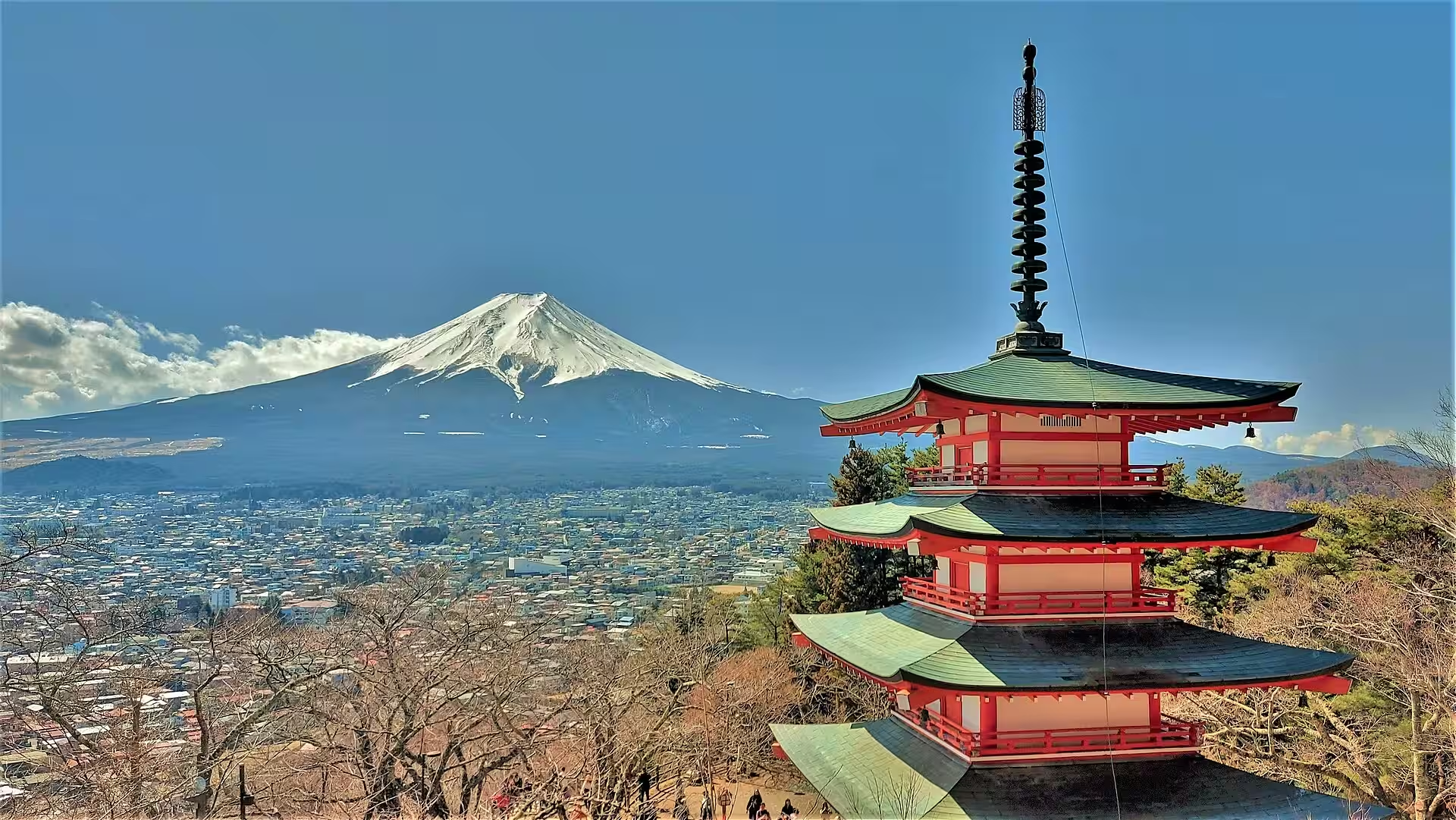
 Photo: Stjepko Krehula · CC BY 4.0 · source
How they speak in Japan 2026-2027: basic Japanese for working on a Working Holiday
By Gus · Viaja con Gus
Photo: Shinjuku and Mount Fuji (Tokyo), "Skyscrapers of Shinjuku 2009 January" by Morio, CC BY-SA 3.0, Wikimedia Commons.

Two
hiragana and katakana
Phrases
68
with "Copy"
JLPT levels
5
from N5 to N1
Polite form
Desu and masu
with customers and bosses
🔗 Copy link
Your daily life in Japan on a Working Holiday
📘 Full guide See → 🗣️ How they speak You are here 🏡 Daily life See →💬 Latin community See →💼 Finding work See →
⚡ Quick answer
How do they speak in Japan and how much Japanese do you need to work on a Working Holiday?
In Japan people speak at three levels of politeness: with customers, bosses and strangers the polite form is used, which ends in "desu" and "masu". For work, hiragana, katakana and the fixed customer-service phrases help. The level of Japanese each job requires is set by the employer in the job ad; the JLPT, from N5 to N1, is the official exam that measures it. Three phrases used all day long are "sumimasen" (excuse me), "arigatō gozaimasu" (thank you) and "onegai shimasu" (please).
Key facts in one line
🗣️ How do they speak in Japan?
In Japan people speak differently depending on who they are talking to: there is a casual form, between friends, a polite form, which ends in "desu" and "masu", and an honorific language, the one staff use with customers. On a Working Holiday, the level of Japanese each position requires is set by the employer in the ad.
For almost everything
Polite form
"desu" and "masu"
The three phrases
Sumimasen
arigatō, onegai shimasu
For reading
Hiragana and katakana
the two syllabaries
For work
Fixed phrases
always the same
🧭 What do you say in Japanese in each work situation?
What situation? Choose I arrive at work I finish my shift A customer comes in I do not understand what they are saying I made a mistake I want to ask for something
Source: the phrase tables in this guide.
👋 How do you greet people in Japanese?
In Japanese you greet people with "ohayō gozaimasu" in the morning, "konnichiwa" during the day and "konbanwa" in the evening. You do not shake hands or kiss: you bow your head slightly.
| In Spanish | In Japanese | How it sounds | Copy |
|---|---|---|---|
| Good morning. | おはようございます。 | Ohayō gozaimasu. | Copy |
| Good afternoon. | こんにちは。 | Konnichiwa. | Copy |
| Good evening (on arrival). | こんばんは。 | Konbanwa. | Copy |
| Good night (going to sleep). | おやすみなさい。 | Oyasuminasai. | Copy |
| Nice to meet you. | はじめまして。 | Hajimemashite. | Copy |
| Glad to work with you. | よろしくお願いします。 | Yoroshiku onegai shimasu. | Copy |
| See you later. | またね。 | Mata ne. | Copy |
| My name is María. | マリアと申します。 | Maria to mōshimasu. | Copy |
Tap "Copy" to paste the Japanese phrase into the translator and hear how it sounds.
🙏 How do you say thank you, excuse me and please in Japanese?
In Japanese, "thank you" is "arigatō gozaimasu", "excuse me" is "sumimasen" and "please" is "onegai shimasu". "Sumimasen" serves three purposes: to get someone's attention, to apologize and to thank someone for a bother.
| In Spanish | In Japanese | How it sounds | Copy |
|---|---|---|---|
| Excuse me. | すみません。 | Sumimasen. | Copy |
| Thank you very much. | ありがとうございます。 | Arigatō gozaimasu. | Copy |
| Please. | お願いします。 | Onegai shimasu. | Copy |
| Sorry. | ごめんなさい。 | Gomen nasai. | Copy |
| You're welcome. | どういたしまして。 | Dō itashimashite. | Copy |
| Yes. | はい。 | Hai. | Copy |
| No. | いいえ。 | Iie. | Copy |
| It's fine. | 大丈夫です。 | Daijōbu desu. | Copy |
| I don't understand. | わかりません。 | Wakarimasen. | Copy |
| Once more, please. | もう一度お願いします。 | Mō ichido onegai shimasu. | Copy |
| Slower, please. | ゆっくりお願いします。 | Yukkuri onegai shimasu. | Copy |
| Do you speak English? | 英語を話せますか。 | Eigo o hanasemasu ka. | Copy |
Tap "Copy" to paste the Japanese phrase into the translator and hear how it sounds.
🎚️ What are the levels of politeness in Japanese?
Japanese has three levels of politeness: casual, polite and honorific. With customers, bosses and strangers the polite form is always used. The honorific is learned as fixed phrases for work.
| Level | With whom | Example: "Are you eating?" |
|---|---|---|
| Casual ( タメ口 ) | Friends and trusted colleagues | 食べる? (Taberu?) |
| Polite ( 丁寧語 ) | Bosses, colleagues and strangers | 食べますか。 (Tabemasu ka.) |
| Honorific ( 敬語 ) | Customers | 召し上がりますか。 (Meshiagarimasu ka.) |
How do you address a boss or a customer in Japanese? With the surname plus "san", and never with "anata", which means "you" but sounds distant. You do not add "san" to your own name.
💼 What Japanese phrases are used at work in Japan?
At work in Japan three phrases are used every day: "ohayō gozaimasu" on arrival, "otsukaresama desu" at the end of the shift and "osaki ni shitsurei shimasu" when leaving before the others.
| In Spanish | In Japanese | How it sounds | Copy |
|---|---|---|---|
| Good morning (arriving for the shift). | おはようございます。 | Ohayō gozaimasu. | Copy |
| Good work (at the end of the shift). | お疲れ様です。 | Otsukaresama desu. | Copy |
| I'm leaving before you. | お先に失礼します。 | Osaki ni shitsurei shimasu. | Copy |
| Understood. | わかりました。 | Wakarimashita. | Copy |
| Understood (to a customer or boss). | かしこまりました。 | Kashikomarimashita. | Copy |
| Could you show me? | 教えてください。 | Oshiete kudasai. | Copy |
| Is it right like this? | これでいいですか。 | Kore de ii desu ka. | Copy |
| I apologize. | 申し訳ありません。 | Mōshiwake arimasen. | Copy |
| I can't come tomorrow. | 明日は来られません。 | Ashita wa koraremasen. | Copy |
| May I take a break? | 休憩してもいいですか。 | Kyūkei shite mo ii desu ka. | Copy |
Tap "Copy" to paste the Japanese phrase into the translator and hear how it sounds.
🛎️ What Japanese phrases are used to serve customers in Japan?
In Japan, customer service uses set phrases: "irasshaimase" on greeting, "shōshō omachi kudasai" to ask people to wait and "arigatō gozaimashita" when they leave. They are always the same, so it is best to learn them by heart.
| In Spanish | In Japanese | How it sounds | Copy |
|---|---|---|---|
| Welcome. | いらっしゃいませ。 | Irasshaimase. | Copy |
| How many people are you? | 何名様ですか。 | Nanmei-sama desu ka. | Copy |
| This way, please. | こちらへどうぞ。 | Kochira e dōzo. | Copy |
| Have you decided? | ご注文はお決まりですか。 | Gochūmon wa okimari desu ka. | Copy |
| One moment, please. | 少々お待ちください。 | Shōshō omachi kudasai. | Copy |
| Sorry for the wait. | お待たせしました。 | Omatase shimashita. | Copy |
| That's 1,000 yen. | 千円でございます。 | Sen-en de gozaimasu. | Copy |
| Thank you very much (on leaving). | ありがとうございました。 | Arigatō gozaimashita. | Copy |
Tap "Copy" to paste the Japanese phrase into the translator and hear how it sounds.
📝 What to say in Japanese at a job interview in Japan?
At a job interview in Japan you say your name, your country, your visa, the days you are available and close with "yoroshiku onegai shimasu".
| In Spanish | In Japanese | How it sounds | Copy |
|---|---|---|---|
| I'm from Argentina. | アルゼンチン出身です。 | Aruzenchin shusshin desu. | Copy |
| I have a Working Holiday visa. | ワーキングホリデービザを持っています。 | Wākingu horidē biza o motte imasu. | Copy |
| I can work five days a week. | 週五日働けます。 | Shū itsuka hatarakemasu. | Copy |
| I speak a little Japanese. | 日本語が少し話せます。 | Nihongo ga sukoshi hanasemasu. | Copy |
| I have experience in restaurants. | レストランで働いた経験があります。 | Resutoran de hataraita keiken ga arimasu. | Copy |
| How much is the hourly pay? | 時給はいくらですか。 | Jikyū wa ikura desu ka. | Copy |
| Do they reimburse transport? | 交通費は出ますか。 | Kōtsūhi wa demasu ka. | Copy |
| I am at your disposal. | よろしくお願いします。 | Yoroshiku onegai shimasu. | Copy |
Tap "Copy" to paste the Japanese phrase into the translator and hear how it sounds.
🏪 What are you asked in Japanese at a shop counter in Japan?
At the shop counter in Japan they ask if you want a bag, if you want your food heated and if you have a points card. All three are answered with "hai, onegai shimasu" (yes, please) or "daijōbu desu" (not needed).
| In Spanish | In Japanese | How it sounds | Copy |
|---|---|---|---|
| Do you need a bag? | 袋はご利用ですか。 | Fukuro wa goriyō desu ka. | Copy |
| Shall I heat it up? | 温めますか。 | Atatamemasu ka. | Copy |
| Do you have a points card? | ポイントカードはお持ちですか。 | Pointo kādo wa omochi desu ka. | Copy |
| Is it to eat here? | 店内でお召し上がりですか。 | Tennai de omeshiagari desu ka. | Copy |
| Yes, please. | はい、お願いします。 | Hai, onegai shimasu. | Copy |
| Not needed. | 大丈夫です。 | Daijōbu desu. | Copy |
Tap "Copy" to paste the Japanese phrase into the translator and hear how it sounds.
🔢 How do you say numbers and prices in Japanese?
In Japanese, prices are said with the number plus "en": one hundred yen is "hyaku-en", a thousand is "sen-en" and ten thousand, "ichiman-en". Japanese counts in units of ten thousand: 50,000 is "five ten-thousands", "goman".
| Number | In Japanese | How it sounds |
|---|---|---|
| 1 | 一 | ichi |
| 2 | 二 | ni |
| 3 | 三 | san |
| 4 | 四 | yon |
| 5 | 五 | go |
| 6 | 六 | roku |
| 7 | 七 | nana |
| 8 | 八 | hachi |
| 9 | 九 | kyū |
| 10 | 十 | jū |
| 100 | 百 | hyaku |
| 1.000 | 千 | sen |
| 10.000 | 一万 | ichiman |
🕒 How do you say days and times in Japanese?
In Japanese the days of the week end in "yōbi" and the hours in "ji": Monday is "getsuyōbi" and three o'clock is "sanji".
| Day | In Japanese | How it sounds |
|---|---|---|
| Monday | 月曜日 | getsuyōbi |
| Tuesday | 火曜日 | kayōbi |
| Wednesday | 水曜日 | suiyōbi |
| Thursday | 木曜日 | mokuyōbi |
| Friday | 金曜日 | kin'yōbi |
| Saturday | 土曜日 | doyōbi |
| Sunday | 日曜日 | nichiyōbi |
| Today | 今日 | kyō |
| Tomorrow | 明日 | ashita |
🚑 How do you ask for help in Japanese in Japan?
**To ask for help in Japanese, say "tasukete kudasai"; for an ambulance, "kyūkyūsha o onegai shimasu", and the number is 119, according to the JNTO.**
| In Spanish | In Japanese | How it sounds | Copy |
|---|---|---|---|
| Help, please. | 助けてください。 | Tasukete kudasai. | Copy |
| An ambulance, please. | 救急車をお願いします。 | Kyūkyūsha o onegai shimasu. | Copy |
| Call the police. | 警察を呼んでください。 | Keisatsu o yonde kudasai. | Copy |
| I'm lost. | 道に迷いました。 | Michi ni mayoimashita. | Copy |
| I lost my wallet. | 財布をなくしました。 | Saifu o nakushimashita. | Copy |
| I don't feel well. | 気分が悪いです。 | Kibun ga warui desu. | Copy |
Tap "Copy" to paste the Japanese phrase into the translator and hear how it sounds.
→ Health in Japan: the national insurance and how you get care
😎 What slang do young people use in Japan?
Japanese youth slang revolves around a few words: "yabai" (awesome/terrible), "maji" (seriously), "sugoi" (great) and "kawaii" (cute). It is spoken among friends: it is not used with customers or bosses.
| In Spanish | In Japanese | How it sounds | Copy |
|---|---|---|---|
| Awesome (good or bad). | やばい | Yabai | Copy |
| Seriously? | マジで? | Maji de? | Copy |
| Great. | すごい | Sugoi | Copy |
| Cute. | かわいい | Kawaii | Copy |
| That's funny. | ウケる | Ukeru | Copy |
| That's delicious. | うまい | Umai | Copy |
| What a pain. | めんどくさい | Mendokusai | Copy |
| Good work (among friends). | おつ | Otsu | Copy |
| No idea. | 知らん | Shiran | Copy |
| Sure. | いいよ | Ii yo | Copy |
Tap "Copy" to paste the Japanese phrase into the translator and hear how it sounds.
✂️ Which shortened words are used every day in Japan?
In Japan long words get shortened: part-time work is "baito", the convenience store is "konbini" and the cell phone is "sumaho".
| Say it | In Japanese | What it is |
|---|---|---|
| Baito | バイト | Part-time work (from "arubaito") |
| Konbini | コンビニ | Convenience store |
| Sumaho | スマホ | Cell phone |
| Famiresu | ファミレス | Family restaurant |
| Pasokon | パソコン | Computer |
| Eakon | エアコン | Air conditioner |
| Depāto | デパート | Department stores |
🏯 How do they speak in Osaka and Kansai?
**In Osaka, Kyoto and Kobe they speak the Kansai dialect: "thank you" is "ōkini", "very" is "meccha" and "it's not possible" is "akan".** At work the standard Japanese is used just the same; the dialect is heard among colleagues and with regular customers.
| In Spanish | In Kansai | In standard Japanese |
|---|---|---|
| Thank you | おおきに (ōkini) | ありがとう (arigatō) |
| Very | めっちゃ (meccha) | とても (totemo) |
| It's not possible | あかん (akan) | だめ (dame) |
| Really | ほんま (honma) | 本当 (hontō) |
| How much does it cost? | なんぼ? (nanbo?) | いくら? (ikura?) |
| What are you saying? | なんでやねん (nande ya nen) | どうして (dōshite) |
🪧 What do the most common signs in Japan say?
Ten common signs in Japan are these: entrance, exit, open, closed, restroom, no smoking, free, discount, half price and staff wanted.
| Sign | How it sounds | What it says |
|---|---|---|
| 入口 | iriguchi | Entrance |
| 出口 | deguchi | Exit |
| 営業中 | eigyōchū | Open |
| 準備中 | junbichū | Closed, preparing |
| お手洗い | otearai | Restroom |
| 禁煙 | kin'en | No smoking |
| 無料 | muryō | Free |
| 割引 | waribiki | Discount |
| 半額 | hangaku | Half price |
| アルバイト募集 | arubaito boshū | Part-time staff wanted |
🔤 How is Japanese written?
Japanese is written with three systems at once: hiragana and katakana, which are syllabaries, and kanji, the characters of Chinese origin. Katakana is used for foreign words, such as your name and many dishes on the menu.
| System | What it is used for | Example |
|---|---|---|
| Hiragana | Japanese words and endings | ありがとう |
| Katakana | Foreign words and names | アルバイト |
| Kanji | The meaning of words | 日本語 |
🔊 How is Japanese pronounced?
Japanese is pronounced almost the way it is read in Spanish: the five vowels sound the same. The line over a vowel, as in "ō", means it lasts twice as long. The "r" is soft, like the "r" in "pero". The final "u" is barely heard: "desu" sounds like "des" and "masu" like "mas".
🎓 What are the JLPT levels and which one do you need to work in Japan?
The JLPT is the official Japanese exam and has five levels, from N5, the most basic, to N1; it is taken in July and in December. The level each position requires is set by the employer in the job ad.
| Level | What you can do | What the JLPT says |
|---|---|---|
| No Japanese | Polite phrases | Not a JLPT level |
| N5 | Basic phrases, said slowly | Understand some basic Japanese |
| N4 | Basic conversation | Understand basic Japanese |
| N3 | Everyday conversation | Understand everyday Japanese, to a point |
| N2 and N1 | Newspapers, news and conversation at natural speed | Understand Japanese in varied situations |
🧭 What to study according to your Japanese level?
How much Japanese do you know? Choose Nothing I read hiragana and katakana N5 N4, basic conversation N3 or higher
Source: the level summary on the official JLPT website.
→ Ways to stay longer in Japan→ Latin community and groups in Japan
📂 What should you learn of Japanese before traveling to Japan?
Before traveling to Japan it is worth learning six things: hiragana, katakana, polite phrases, work phrases, numbers and how to introduce yourself.
✅ Checklist of basic Japanese for working in Japan
Hiragana Japanese words and endings
Katakana foreign words and names
Polite phrases excuse me, thank you, please
Work phrases customer-service formulas
Numbers and prices up to ten thousand
Introducing yourself name, country and what you are looking for
0 of 6 done · Saved on this device.
🪜 How do you learn basic Japanese for working in Japan, step by step?
Basic Japanese for working in Japan is learned in six steps: the two syllabaries, polite phrases, work phrases, the polite form, practice with Japanese speakers and the JLPT exam.
- 1 Learn hiragana and katakana They are learned one syllabary at a time and can be practiced with an app.
- 2 Memorize the polite phrases Excuse me, thank you and please are used all day long.
- 3 Learn your work phrases The customer-service formulas are always the same.
- 4 Always speak politely With customers, bosses and strangers, use the form ending in "desu" and "masu".
- 5 Practice with Japanese speakers In a language exchange, in a share house mixed one, or in a municipal course.
- 6 Take the JLPT It is held in July and December; in some cities outside Japan it is given on only one of the two dates.
⚠️ What mistakes should you avoid when speaking Japanese in Japan?
The five most common mistakes when speaking Japanese in Japan are: speaking casually to a customer or boss, saying "anata", putting "san" on yourself, using slang at work and not learning to read.
- Speaking casually to a customer or boss: use the form ending in "desu" and "masu".
- Saying "anata": use the surname plus "san".
- Putting "san" on yourself: "san" is only for others.
- Using slang at work: "yabai" and "maji" are for friends.
- Not learning to read: without hiragana and katakana you cannot understand the signs or menus.
📖 What do keigo, senpai and tatemae mean in Japanese?
To understand how people speak in Japan there are eleven terms: the honorific language, the polite form, the casual form, senpai and kōhai, tatemae and honne, reading the atmosphere, listening responses, baito and the Kansai dialect.
Tap "Copy" to paste the Japanese phrase into the translator and hear how it sounds.
➡️ What to do after learning basic Japanese?
With basic Japanese learned, what comes next is looking for work, getting to know the customs and finding someone to practice with.
Your next step
→ How to find work in Japan on a Working Holiday→ Daily life and culture in Japan→ Latin community and groups in Japan→ First days in Japan: the procedures in order
🛂 What is the Working Holiday in Japan like depending on your citizenship?
The Working Holiday in Japan has a quota, an opening date and procedures that differ depending on your citizenship: choose yours to see the requirements.
🧭 What guides are there for doing a Working Holiday in Japan?
The Viaja con Gus Working Holiday guides for Japan cover the whole process: the form, the first procedures, where to live, work, money and daily life.
Working Holiday guides for Japan
📘 Full guide See →📝 The form See →✅ First days See →🪪 Residence card See →🏦 Bank account See →📱 SIM and phone See →🏠 Where to live See →🏙️ Which city to arrive in See →📍 Living in each city See →💼 Finding work See →⚖️ Permitted jobs See →⛷️ Snow season See →💵 Cost of living See →🏥 Health See →🚆 Transport See →🧾 Taxes when leaving See → 🗣️ How they speak You are here 💬 Latin community See →☀️ Climate See →🏡 Daily life See →🔮 Staying longer See →
📶 How do you get internet, use a VPN and send money from Japan on a Working Holiday?
When you arrive you will need data to let people know you have landed, find your accommodation and start looking for work. And when you work in another country, sooner or later you will want to send money home. This is what I use myself.
You land and your phone already has data, without changing SIM or looking for wifi. With the code VIAJACONGUS you get a 10% discount.
See Maya Mobile plans →
Connecting to hostel and airport wifi is not safe. A VPN protects your data, your passwords and banking apps.
Learn about Surfshark →
Send money home in minutes and with low fees. With the code AMB6M8 you get USD 20 off your first transfer.
See discounts →
Affiliate links: we earn a commission. Ad - paid Remitly Ambassador. The Remitly code applies to transfers from the countries where it operates: check in the app whether it applies in your country.
What is an eSIM and is it useful for a Working Holiday in Japan? It is a virtual SIM that you install from an app or a QR code, with no physical card. It gives you data as soon as you land, before you get a local number; afterwards many people switch to a prepaid plan in the country to have their own number.
Is my phone compatible with eSIM for traveling to Japan? Most iPhones from the XS onward and many recent Android phones are. Check in your phone's settings before traveling and confirm it is unlocked.
Do I need a local number on a Working Holiday in Japan? Yes, in the long run: banks, employers and official procedures ask for one. The eSIM covers your first days; after that get a SIM or a plan in the country.
What is a VPN for on a Working Holiday in Japan? To protect your data and your banking apps when you use hostel, airport or café wifi, where anyone on the same network could see your traffic.
What is the cheapest way to send money home from Japan on a Working Holiday? A transfer service that shows the fee and the final amount before you send, generally cheaper than an international bank transfer.
Do you have a question about this topic?
We answer it with the official source and publish it here.
Your email is not published; we only use it to notify you. How we protect your data.
❓ More questions and answers about how they speak in Japan
Do I need to speak Japanese for a Working Holiday in Japan?
The requirements for the Working Holiday in Japan are published by the Japanese Embassy of your citizenship; check them there. The level of Japanese for each job is requested by the employer in the job ad.
How much Japanese do I need to work in Japan?
To work in Japan, the level of Japanese is set by each employer in the job ad; the JLPT, from N5 to N1, is the official exam that measures it.
How do you say thank you in Japanese?
Thank you is said in Japanese as "Arigatō gozaimasu".
How do you say excuse me in Japanese?
Excuse me is said in Japanese as "Sumimasen": it is used to get attention, apologize and thank.
How do you say please in Japanese?
Please is said in Japanese as "Onegai shimasu".
How do you say hello in Japanese?
Hello is said in Japanese as "Konnichiwa" during the day, "ohayō gozaimasu" in the morning and "konbanwa" in the evening.
How do you say "I don't understand" in Japanese?
"I don't understand" is said in Japanese as "Wakarimasen".
What does "otsukaresama desu" mean?
"otsukaresama desu" means "Good work": it is said at the end of the shift.
What does "irasshaimase" mean?
"irasshaimase" means "Welcome": staff say it when a customer comes in.
What does "yoroshiku onegai shimasu" mean?
"Yoroshiku onegai shimasu" means something like "I'm at your service": it is said when introducing yourself and when asking a favor.
What does "kashikomarimashita" mean?
"kashikomarimashita" means "Understood", in the form used with customers and bosses.
What does "shōshō omachi kudasai" mean?
"Shōshō omachi kudasai" means "One moment, please."
What does "yabai" mean?
"yabai" means "Awesome" or "terrible": it is used for something very good or very bad.
What does "maji" mean?
"Maji" means "seriously".
What does "sugoi" mean?
"Sugoi" means "great" or "incredible".
What does "kawaii" mean?
"Kawaii" means "cute" or "adorable".
What does "baito" mean?
"baito" means part-time work: it is the short form of "arubaito".
What is keigo?
Keigo is the honorific language of Japanese, the one staff use with customers.
How do you address a boss in Japanese?
A boss is addressed in Japanese with the surname plus "san", and in the polite form.
What does "senpai" mean?
"senpai" means the colleague who joined work or school before you.
How do they speak in Osaka?
In Osaka they speak the Kansai dialect: "ōkini" for thank you, "meccha" for very and "akan" for it's not possible.
What does "ōkini" mean?
"Ōkini" means "thank you" in the Kansai dialect.
How many letters does Japanese have?
Japanese is written with two syllabaries, hiragana and katakana, and with kanji, the characters of Chinese origin.
How do you learn hiragana and katakana?
Hiragana and katakana are learned one syllabary at a time; a review app helps you practice them.
Is Japanese hard to pronounce for a Spanish speaker?
No: pronouncing Japanese is not hard for a Spanish speaker, because the five vowels sound the same as in Spanish.
What is the JLPT?
The JLPT is the official Japanese exam, with five levels, from N5 to N1.
When is the JLPT taken?
The JLPT is taken in July and December.
What do they ask at a konbini checkout?
At a konbini checkout in Japan they ask if you want a bag, if they should heat your food and if you have a points card.
How are prices said in Japanese?
Prices are said in Japanese with the number plus "en": a thousand yen is "sen-en" and ten thousand, "ichiman-en".
How do you ask for help in Japanese?
To ask for help in Japanese you say "tasukete kudasai"; for an ambulance, "kyūkyūsha o onegai shimasu", and the number is 119, according to the JNTO.
What does "eigyōchū" mean on a sign?
"Eigyōchū" on a sign means "open".
Can you say "anata" in Japanese?
It is better not to say "anata" in Japanese: use the person's surname plus "san".
Do you know someone who could use it?
Send this page via WhatsApp or copy the link.
Send via WhatsAppCopy link
💬 Comments and questions: How they speak in Japan
0 comments Newest first
No comments yet. Be the first.
Any doubts left? Leave your question below and I will answer you personally. And if you have already been through this, tell us how it went: your experience helps the next traveler.
Leave your comment or question
Do you want to subscribe to updates? * Yes No
Publish
🛠️ Working Holiday tools
🏙️ Which city do I move to? → Choose the country and see which city you will adapt to best.📋 What papers do I need? → The exact list of documents according to your citizenship and destination, to tick off. ⭐ Popular🎯 Which country suits me? → Filter by age, language, degree and cost, and find your best destination. 🔥 Most read📢 What opened and what closed? → The quotas that opened, sold out or were paused, with the date and the official source.🤝 Pacific Alliance → The agreement between Chile, Colombia, Mexico and Peru, and what it entitles you to.🗓️ When does the quota open? → Month by month, when each country opens or renews. Several sell out within hours. ⭐ Popular🚗 Does my license work there? → Whether you can drive with your country's license, for how long, and whether they swap it without an exam.🗣️ How do they speak there? → The real slang of each country, so you can get by like a local from day one.
📚 More Working Holiday guides
🏠 How to find accommodation on your Working Holiday📜 Criminal record and Hague Apostille✍️ Motivation letter and CV for the consular appointment🗣️ How to get the English certificate💰 How to prove funds and savings 🔥 Most read💼 How to find work on a Working Holiday ⭐ Popular🏦 Bank account and money management📄 CV and interviews for work⚠️ Common mistakes that cost you the quota or the visa ⭐ Popular📖 Glossary of Working Holiday terms🧾 Taxes in Japan for a Working Holiday ⭐ Popular🧾 Taxes and tax refunds (tax return)🚗 Driving license on a Working Holiday✈️ What a Working Holiday is: the complete guide 🔥 Most read🧮 How much a Working Holiday costs🛬 First steps on arrival in Japan⚖️ Pros and cons of the Working Holiday🏥 Traveler assistance (travel insurance) for a Working Holiday ⭐ Popular
📑 Sources on how they speak in Japan See sources ▾
Japanese-Language Proficiency Test (JLPT): official site JLPT: summary of levels N1 to N5 JNTO: medical guide and emergency numbers (119 and 110) Last verified: November 2026 . Rules, quotas and amounts change often: always confirm with the official source before starting any procedure. How we verify →
Who writes this guide
Gus, from Viaja con Gus
I worked in tourism in Argentina, Brazil, Paraguay, Croatia and the United States. I check every figure in this guide against the official source and update it when it changes.
Learn more about me →@holaviajacongusHow we verify →
Affiliate link: we earn a commission.
civitatis
×
Tours, excursions and tickets in Spanish
Free tours and guided visits
Book your activity!
Photo: "Bagan, Burma" by Corto Maltese 1999, CC BY 2.0.
🇯🇵 Japan guide 🗣️ How they speak ❓
