
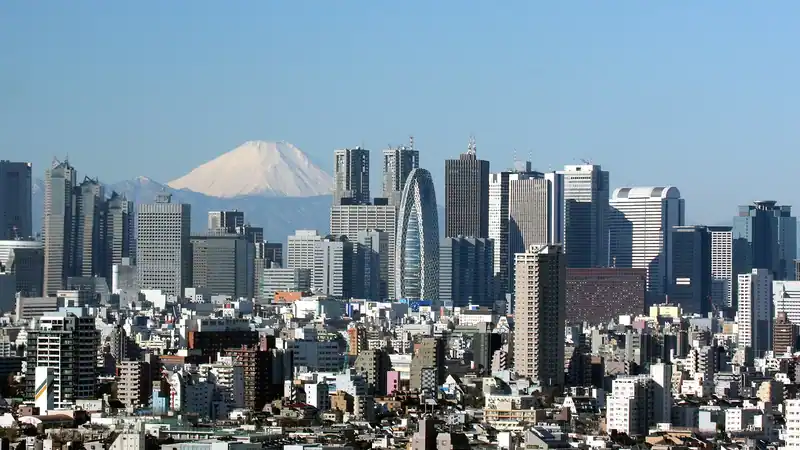
What is the weather like in Japan and when is it best to arrive on a Working Holiday?
Japan has four distinct seasons, the reverse of the southern hemisphere: in August the average maximum reaches 33.7 °C in Kyoto and Osaka, and in January it goes from -0.4 °C in Sapporo to 19.8 °C in Naha (1991-2020 normals from the Japan Meteorological Agency, JMA). To settle in, this guide recommends arriving in spring, from March to May, or in October and November, with mild weather. Anyone going for the snow season has to arrive before its resort opens, because the dates vary from one to another. In Tokyo, the rainy season runs on average from 7 June to 19 July, and September is the month with the most typhoons nearby.
- What is the hottest month in Japan?
- August, in all the cities in this guide except Naha (July): 33.7 °C average maximum in Kyoto and Osaka and 31.3 °C in Tokyo.
- What is the coldest month in Japan?
- January: from -0.4 °C maximum in Sapporo to 19.8 °C in Naha.
- When is the rainy season in Japan?
- It is called tsuyu. In Tokyo it runs, on average, from 7 June to 19 July; in Okinawa, from 10 May to 21 June.
- When are there typhoons in Japan?
- Near Tokyo, mainly in September; near Okinawa, mainly in August and September.
- What is the hottest city in Japan in August?
- Of the cities in this guide, Kyoto and Osaka, with 33.7 °C average maximum.
- What is the coldest city in Japan in January?
- Of the cities in this guide, Sapporo, with an average minimum of -6.4 °C.
- What is the sunniest city in Japan?
- Of the cities in this guide, Nagoya, with 2,141 hours of sun a year.
- When is the snow season in Japan?
- It varies by resort: at Niseko Grand Hirafu, the 2026-2027 season is scheduled from 28 November 2026 to 5 May 2027.
☀️ What is the weather like in Japan on a Working Holiday?
Japan's weather has four distinct seasons: a hot and very humid summer, a dry and cool winter on the Pacific coast, and snow in Hokkaido and on the Sea of Japan coast. It varies a lot from one city to another: Sapporo it has maximums below zero in January and Naha has a mild winter, with a January maximum of 19.8 °C.
🧭 What is the weather like in your Japanese city each month?
Source: JMA climate normals 1991-2020 (Japan Meteorological Agency), with the average maximum and minimum and the rainfall for each month.
🍂 When does each season of the year fall in Japan?
In Japan spring runs from March to May, summer from June to August, autumn from September to November and winter from December to February, according to the Japan Meteorological Agency. There are also two seasons of its own: the rainy season (tsuyu), which in Tokyo runs on average from 7 June to 19 July, and the typhoon season, which near Tokyo peaks in September.
| Season | Months | How it is |
|---|---|---|
| Spring | March to May | Mild; in Tokyo the cherry trees bloom, on average, on 24 March |
| Rainy season | In Tokyo, from 7 June to 19 July (average) | In Okinawa, from 10 May to 21 June; the JMA gives no dates for Hokkaido |
| Summer | June to August | Up to 33.7 °C average maximum in August (Kyoto and Osaka) |
| Typhoons | Peak in August (Okinawa) and September (Tokyo) | Typhoons approaching per month, on average: Okinawa, 2.2 in August and 1.9 in September; Kanto-Koshin, 1.2 in September |
| Autumn | September to November | In Tokyo the average maximum drops from 27.5 °C in September to 16.7 °C in November |
| Winter | December to February | Dry and cool on the Pacific side; snow in Hokkaido and on the Sea of Japan coast |
🔄 Are Japan's seasons the reverse of Argentina's, Chile's and Uruguay's?
Yes: Japan is in the northern hemisphere, so its seasons run opposite to Argentina's, Chile's and Uruguay's. January is deep winter and August deep summer. Spain and Italy have the same seasons as Japan.
| Months | In Japan | In the southern hemisphere |
|---|---|---|
| December to February | Winter | Summer |
| March to May | Spring | Autumn |
| June to August | Summer | Winter |
| September to November | Autumn | Spring |
🏙️ What is the weather like in each Japanese city?
In August the average maximum passes 28 °C in all the Japanese cities in this guide except Sapporo (26.4 °C); the difference lies in winter, which runs from -6.4 °C minimum in Sapporo to 14.9 °C in Naha.
| City | January (maximum and minimum) | August (maximum and minimum) | Rainiest month | Hours of sun a year |
|---|---|---|---|---|
| Tokyo | 9.8 °C and 1.2 °C | 31.3 °C and 23.5 °C | October, 234.8 mm | 1.926,7 |
| Yokohama | 10.2 °C and 2.7 °C | 31 °C and 24.3 °C | September, 241.5 mm | 2.018,3 |
| Osaka | 9.7 °C and 3 °C | 33.7 °C and 25.8 °C | June, 185.1 mm | 2.048,6 |
| Kyoto | 9.1 °C and 1.5 °C | 33.7 °C and 24.7 °C | July, 223.6 mm | 1.794,1 |
| Kobe | 9.4 °C and 3.1 °C | 32.2 °C and 26.1 °C | July, 187.9 mm | 2.083,7 |
| Nagoya | 9.3 °C and 1.1 °C | 33.2 °C and 24.7 °C | September, 231.6 mm | 2.141 |
| Fukuoka | 10.2 °C and 3.9 °C | 32.5 °C and 25.4 °C | July, 299.1 mm | 1.889,4 |
| Hiroshima | 9.9 °C and 2 °C | 32.8 °C and 25.1 °C | July, 279.8 mm | 2.033,1 |
| Sapporo | -0.4 °C and -6.4 °C | 26.4 °C and 19.1 °C | September, 142.2 mm | 1.718 |
| Sendai | 5.6 °C and -1.3 °C | 28.2 °C and 21.6 °C | September, 192.6 mm | 1.836,9 |
| Kanazawa | 7.1 °C and 1.2 °C | 31.3 °C and 24.1 °C | December, 301.1 mm | 1.714,1 |
| Nagano | 3.8 °C and -3.9 °C | 31.1 °C and 21.5 °C | July, 137.7 mm | 1.969,9 |
| Niigata | 5.3 °C and 0.1 °C | 30.8 °C and 23.3 °C | December, 225.9 mm | 1.639,6 |
| Naha (Okinawa) | 19.8 °C and 14.9 °C | 31.8 °C and 26.8 °C | June, 284.4 mm | 1.727,1 |
| City | Climate |
|---|---|
| Tokyo | Very hot and humid summer; dry, sunny and cool winter, with very little snow |
| Yokohama | Almost the same as Tokyo, a little milder and windier because of the bay |
| Osaka | Hotter summer than Tokyo's, with nights that do not cool down; short, dry and mild winter |
| Kyoto | In a closed valley: a very hot, still summer; winter colder than Osaka's and Kobe's |
| Kobe | Hot summer with more breeze, between the sea and the mountains; mild, dry winter, with almost no snow |
| Nagoya | One of the hottest summers in this guide (33.2 °C maximum in August); dry, sunny and cool winter |
| Fukuoka | One of the mildest of the big cities: very humid summer, mild winter and a lot of rain in June and July |
| Hiroshima | Hot and humid summer; mild, dry winter, with very little snow and quite a lot of sun |
| Sapporo | The snowiest of the cities in this guide: 479 cm of snowfall a year; cool summer |
| Sendai | The coolest summer in Honshu in this guide (28.2 °C maximum in August) and a cold but dry winter |
| Kanazawa | The rainiest of the cities in this guide: 2,401.5 mm a year, with its wettest month in December |
| Nagano | Mountain climate: cold winter with snow; dry summer that cools down at night |
| Niigata | Sea of Japan coast: grey, windy winter with a lot of snow; hot and humid summer |
| Naha (Okinawa) | Subtropical, with a January maximum of 19.8 °C; August and September are the months with the most typhoons nearby around Okinawa |
🏆 Which are Japan's coldest, hottest, rainiest and sunniest cities?
Of the Japanese cities in this guide, the coldest is Sapporo, the hottest are Kyoto and Osaka, the rainiest is Kanazawa and the sunniest is Nagoya.
| What | Cities |
|---|---|
| Coldest January (minimum) | Sapporo, -6.4 °C · Nagano, -3.9 °C · Sendai, -1.3 °C |
| Mildest January (maximum) | Naha (Okinawa), 19.8 °C · Yokohama, 10.2 °C · Fukuoka, 10.2 °C |
| Hottest August (maximum) | Osaka, 33.7 °C · Kyoto, 33.7 °C · Nagoya, 33.2 °C |
| Coolest August (maximum) | Sapporo, 26.4 °C · Sendai, 28.2 °C · Niigata, 30.8 °C |
| Most rain in the year | Kanazawa, 2,401.5 mm · Naha (Okinawa), 2,161 mm · Niigata, 1,845.9 mm |
| Least rain in the year | Nagano, 965.1 mm · Sapporo, 1,146.1 mm · Sendai, 1,276.7 mm |
| Most hours of sun | Nagoya, 2,141 · Kobe, 2,083.7 · Osaka, 2,048.6 |
🛬 Which month is best to arrive in Japan on a Working Holiday?
By this guide's criteria, it is best to arrive in Japan in spring, from March to May, or in October and November: the weather is mild for looking for a room and work. Anyone going for the snow season has to arrive before its resort opens, because the dates vary from one to another. August is the hardest month to settle in, because of the humid heat.
| Your plan | When to arrive | Why |
|---|---|---|
| Settling in a city | March to May, or October and November | Mild weather |
| Snow season | Before the resort opens | Varies by resort: Niseko Grand Hirafu scheduled it from 28/11/2026 to 5/5/2027 |
| Avoiding the heat | Any month except July and August | Up to 33.7 °C average maximum in August (Kyoto and Osaka) |
| Living in Okinawa | November to April | Months with less rain in Naha (from 101.6 to 161 mm) and with 0.3 typhoons nearby or fewer per month |
🧭 What awaits you in Japan depending on the month you arrive?
Source: seasons, 1991-2020 normals, tsuyu and typhoons from the Japan Meteorological Agency (JMA), and the snow season from the Grand Hirafu calendar. Which month is best is this guide's criteria.
📅 What is Tokyo's weather like month by month?
In Tokyo the average maximum goes from 9.8 °C in January to 31.3 °C in August, and the rainiest months are September and October.
| Month | Maximum | Minimum | Rain |
|---|---|---|---|
| January | 9.8 °C | 1.2 °C | 59.7 mm |
| February | 10.9 °C | 2.1 °C | 56.5 mm |
| March | 14.2 °C | 5 °C | 116 mm |
| April | 19.4 °C | 9.8 °C | 133.7 mm |
| May | 23.6 °C | 14.6 °C | 139.7 mm |
| June | 26.1 °C | 18.5 °C | 167.8 mm |
| July | 29.9 °C | 22.4 °C | 156.2 mm |
| August | 31.3 °C | 23.5 °C | 154.7 mm |
| September | 27.5 °C | 20.3 °C | 224.9 mm |
| October | 22 °C | 14.8 °C | 234.8 mm |
| November | 16.7 °C | 8.8 °C | 96.3 mm |
| December | 12 °C | 3.8 °C | 57.9 mm |
❄️ What is winter like in Japan?
Japan's winter is dry, sunny and cool in Tokyo, Osaka and Nagoya, with January maximums of 9.3 to 9.8 °C, and cold and snowy in Sapporo, Niigata, Kanazawa and Nagano. In January, Sapporo has a maximum of -0.4 °C and a minimum of -6.4 °C; Nagano has a minimum of -3.9 °C.
Is there any city in Japan without winter? Naha, in Okinawa: in January the average maximum is 19.8 °C.
⛷️ Where and when does it snow in Japan?
In Japan it snows mainly in Hokkaido and on the Sea of Japan coast: in Sapporo the snowfall adds up to 479 cm a year, on average (JMA, 1991-2020). The ski season varies by resort: at Niseko Grand Hirafu, the 2026-2027 season is scheduled from 28 November 2026 to 5 May 2027. In Tokyo (8 cm of snowfall a year), Osaka (1 cm) and Fukuoka (2 cm) snow is scarce.
🥵 What is summer like in Japan?
Japan's summer is hot and very humid: in August the average maximum is 33.7 °C in Kyoto and Osaka, 33.2 °C in Nagoya and 31.3 °C in Tokyo, and the average August minimum is 25.8 °C in Osaka and 23.5 °C in Tokyo. The coolest cities in August are Sapporo, with 26.4 °C, and Sendai, with 28.2 °C.
☔ When is Japan's rainy season (tsuyu)?
Japan's rainy season, the tsuyu, runs on average from 7 June to 19 July in Kanto-Koshin (Tokyo) and from 10 May to 21 June in Okinawa, according to the JMA. In Fukuoka 249.6 mm fall in June and 299.1 mm in July; in Tokyo, 167.8 mm in June. The JMA gives no tsuyu dates for Hokkaido: in Sapporo 60.4 mm fall in June.
🌀 When is the typhoon season in Japan?
According to the 1991-2020 averages of the JMA, more typhoons approach Kanto-Koshin (Tokyo) in September (1.2 a year), and Okinawa in August (2.2) and September (1.9). September and October are Tokyo's rainiest months, with 224.9 mm and 234.8 mm.
🌸 When do cherry trees bloom and when do the maples turn red in Japan?
According to the JMA, cherry trees bloom on average on 24 March in Tokyo, on 26 March in Kyoto and on 1 May in Sapporo. The JMA's reference maple turned red on 23 November 2025 in Tokyo and on 10 December 2025 in Kyoto.
💼 How does work in Japan change with the time of year?
In Japan the seasonal work most tied to the weather is snow, and the season varies by resort: confirm the dates on your resort's website.
🧥 What clothes should you take to Japan on a Working Holiday?
It is best to bring light clothes and buy winter clothes there. Needed if you arrive between November and March. In Kanazawa and Niigata, the umbrella is used all year round.
📂 What should you check about the weather before travelling to Japan?
Before travelling to Japan, check the season you arrive in, the winter and summer of your city, the winter clothes, the umbrella and the snow date.
✅ Weather checklist before travelling to Japan
🪜 How to choose when to arrive in Japan on a Working Holiday, step by step?
The arrival month in Japan is chosen like this: look at the season, choose the city by its weather, decide whether you are going for the snow, prefer spring or autumn, and buy winter clothes there.
- 1Check what season it is in JapanThe seasons are the reverse of the southern hemisphere: January is winter and August is summer.
- 2Choose the city by its winter and its summerSapporo has maximums below zero in January; Kyoto and Osaka reach 33.7 °C in August; Naha has a mild winter, with a January maximum of 19.8 °C.
- 3If you are going for the snow, arrive before your resort opensThe season varies by resort: Niseko Grand Hirafu has scheduled it from 28 November 2026 to 5 May 2027.
- 4If you can choose, arrive in spring or autumnFrom March to May, or in October and November: mild weather for looking for a room and work.
- 5Buy your winter clothes thereSaves weight in your suitcase.
🗣️ What Japanese phrases are useful for talking about the weather in Japan?
To talk about the weather in Japan, these phrases are useful: saying it is hot, cold or humid, that it is raining, and asking about the forecast or a typhoon. Tap «Copy» to paste them into the translator.
| In English | In Japanese | How it sounds | Copy |
|---|---|---|---|
| It is hot. | 暑いですね。 | Atsui desu ne. | |
| It is cold. | 寒いですね。 | Samui desu ne. | |
| It is very humid. | 蒸し暑いですね。 | Mushiatsui desu ne. | |
| It is raining. | 雨が降っています。 | Ame ga futte imasu. | |
| What will the weather be like tomorrow? | 明日の天気はどうですか。 | Ashita no tenki wa dō desu ka. | |
| Is a typhoon coming? | 台風が来ますか。 | Taifū ga kimasu ka. | |
| Do you have an umbrella? | 傘はありますか。 | Kasa wa arimasu ka. | |
| It is snowing. | 雪が降っています。 | Yuki ga futte imasu. |
⚠️ Which weather mistakes should you avoid in Japan?
These are the weather mistakes best avoided in Japan: forgetting that the seasons are reversed, underestimating the summer, arriving late for the snow, filling your suitcase with winter clothes, and choosing a city without looking at its winter.
- Forgetting that the seasons are reversed: January is winter and August is summer.
- Underestimating the summer: 33.7 °C average maximum in Kyoto and Osaka, with high humidity.
- Arriving late for the snow: the season varies by resort, so confirm the dates for yours before travelling.
- Filling your suitcase with winter clothes: if you arrive in autumn or winter, it is best to buy them there.
- Choosing the city without looking at its winter: Sapporo, Niigata and Kanazawa they spend the winter under snow.
📖 What do tsuyu, taifū and sakura mean in Japan's weather?
These terms come up when talking about Japan's weather: the rainy season, the typhoon, the cherry trees, the autumn leaves, the four seasons, the snow, the humid heat, heatstroke and the forecast.
- Rainy season (梅雨)
- Tsuyu. The rainy season: in Tokyo it runs, on average, from 7 June to 19 July.
- Typhoon (台風)
- Taifū. A tropical storm with strong wind and heavy rain.
- Cherry blossoms (桜)
- Sakura. In Tokyo they bloom, on average, on 24 March.
- Autumn leaves (紅葉)
- Kōyō. The red and yellow leaves of autumn.
- Spring (春)
- Haru. From March to May.
- Summer (夏)
- Natsu. From June to August.
- Autumn (秋)
- Aki. From September to November.
- Winter (冬)
- Fuyu. From December to February.
- Snow (雪)
- Yuki.
- Humid heat (蒸し暑い)
- Mushiatsui. The heavy heat of the Japanese summer.
- Heatstroke (熱中症)
- Necchūshō. The summer risk; the warnings name it this way.
- Weather forecast (天気予報)
- Tenki yohō.
➡️ What to do after choosing when to arrive in Japan?
With the arrival month in Japan chosen, the next steps are to choose the city, work out the budget and look at the first procedures.
🛂 How does the Japan Working Holiday work according to your citizenship?
The Japan Working Holiday has a quota, an opening date and a procedure that differ according to your citizenship: choose yours to see the requirements.
🧭 What guides are there for doing the Working Holiday in Japan?
The Viaja con Gus guides to the Working Holiday in Japan cover the full path: the form, the first procedures, where to live, work, money and daily life.
📶 How do you get internet, use a VPN and send money from Japan on the Working Holiday?
When you arrive you will need data to let people know you arrived, find accommodation and start looking for work. And when you work in another country, sooner or later you will want to send money home. This is what I use myself.
 Maya eSIMESIM
You land and your phone already has data, without changing SIM or looking for wifi. With the code VIAJACONGUS you get a 10% discount.
See Maya Mobile plans → SurfsharkVPN
Connecting to hostel and airport wifi is not safe. With a VPN you protect your data, your passwords and your banking apps.
Learn about Surfshark → RemitlyTRANSFERS
Send money home in minutes and with low fees. With the code AMB6M8 you get USD 20 off your first transfer.
See discounts →Affiliate links: we earn a commission. Ad - paid Remitly Ambassador. The Remitly code applies to transfers from the countries where it operates: confirm in the app whether it applies in yours.
What is an eSIM and is it useful for the Working Holiday in Japan? It is a virtual SIM that is installed from an app or a QR code, with no physical card. It gives you data as soon as you land, before you get a local number; afterwards many switch to a prepaid plan in the country to have their own number.
Is my phone compatible with an eSIM for traveling to Japan? Most iPhones from the XS onward and many recent Android phones are. Check it in your phone's settings before traveling and confirm that it is unlocked.
Do you need a local number on the Working Holiday in Japan? Yes, in the long run: the bank, employers and procedures ask for it. The eSIM covers you for the first days; afterwards get a SIM or a plan in the country.
What is a VPN for on the Working Holiday in Japan? To protect your data and your banking apps when you use wifi in hostels, airports or cafés, where anyone on the same network could see your traffic.
What is the cheapest way to send money home from Japan on the Working Holiday? A transfer service that shows the fee and the final amount before sending, generally cheaper than an international bank transfer.
❓ Frequently asked questions about Japan's weather on a Working Holiday
What is the best month to arrive in Japan on a Working Holiday?
By this guide's criteria, the best months to arrive in Japan on a Working Holiday are the spring months, March to May, and October and November, with mild weather.
When to arrive →When is summer in Japan?
In Japan, summer runs from June to August, according to the Japan Meteorological Agency (JMA): the seasons are the reverse of the southern hemisphere.
The four seasons →When is winter in Japan?
In Japan, winter runs from December to February, according to the Japan Meteorological Agency (JMA).
The four seasons →What is the hottest month in Japan?
The hottest month in Japan is August in all the cities in this guide except Naha, where it is July: in August the average maximum is 33.7 °C in Kyoto and Osaka and 31.3 °C in Tokyo.
Summer →What is the coldest month in Japan?
The coldest month in Japan is January: in Sapporo the average maximum is -0.4 °C and in Tokyo 9.8 °C.
Winter →How hot is it in Tokyo in summer?
In Tokyo, in summer, August has an average maximum of 31.3 °C and an average minimum of 23.5 °C.
Tokyo month by month →How cold is it in Tokyo in winter?
In Tokyo, in winter, January has an average maximum of 9.8 °C and an average minimum of 1.2 °C.
Tokyo month by month →Does it snow in Tokyo?
It snows very little in Tokyo: the snowfall adds up to 8 cm a year, on average (JMA, 1991-2020).
Snow →How hot is it in Osaka in summer?
In Osaka, in summer, August has an average maximum of 33.7 °C and an average minimum of 25.8 °C.
City by city →How cold is it in Sapporo in winter?
In Sapporo, in winter, January has an average maximum of -0.4 °C and an average minimum of -6.4 °C.
City by city →How much snow falls in Sapporo?
In Sapporo the snowfall adds up to 479 cm a year, on average (JMA, 1991-2020).
Snow →Is it cold in Okinawa?
No: Okinawa is not cold. In Naha, January has an average maximum of 19.8 °C.
Winter →What is the hottest city in Japan?
Of the cities in this guide, the hottest in Japan in August are Kyoto and Osaka, with an average maximum of 33.7 °C.
The coldest and hottest →What is the coldest city in Japan?
Of the cities in this guide, the coldest in Japan is Sapporo, with an average minimum of -6.4 °C in January.
The coldest and hottest →What is the rainiest city in Japan?
Of the cities in this guide, the rainiest in Japan is Kanazawa, with 2,401.5 mm a year.
The coldest and hottest →What is the sunniest city in Japan?
Of the cities in this guide, the one with the most sun in Japan is Nagoya, with 2,141 hours a year.
The coldest and hottest →Which city in Japan has the coolest summer?
The city in Japan with the coolest summer is Sapporo, with an average maximum of 26.4 °C in August.
Summer →What is the tsuyu?
The tsuyu is Japan's rainy season: in Tokyo it runs, on average, from 7 June to 19 July, and in Okinawa from 10 May to 21 June, according to the JMA.
Rainy season →Does it rain a lot in Japan in June?
Yes, in the regions with tsuyu: in June 249.6 mm fall in Fukuoka and 167.8 mm in Tokyo. The JMA does not give tsuyu dates for Hokkaido; in Sapporo 60.4 mm fall.
Rainy season →When are there typhoons in Japan?
According to the JMA's 1991-2020 averages, more typhoons approach Okinawa in August (2.2) and September (1.9), and the Kanto-Koshin area, where Tokyo is, in September (1.2).
Typhoons →When do cherry trees bloom in Japan?
According to the JMA, Japanese cherry trees bloom on average on 24 March in Tokyo, 26 March in Kyoto and 1 May in Sapporo.
Cherry trees and maples →When do the red maples turn in Japan?
In Japan, the JMA's reference maple turned red on 23 November 2025 in Tokyo and on 10 December 2025 in Kyoto.
Cherry trees and maples →When is the snow season in Japan?
The snow season in Japan varies by resort: at Niseko Grand Hirafu, the 2026-2027 season is scheduled from 28 November 2026 to 5 May 2027.
Snow →When do you have to arrive in Japan to work on the snow?
To work on the snow you have to arrive in Japan before the resort's season opens, and the dates vary from one to another: confirm them on its website.
When to arrive →Is it a good idea to arrive in Japan in August?
For this guide, August is the hardest month to arrive and settle in, because of the heat: 33.7 °C average maximum in Kyoto and Osaka.
Your arrival month →Are Japan's seasons the reverse of Argentina's?
Yes: Japan's seasons are the reverse of Argentina's, because Japan is in the northern hemisphere.
Reversed seasons →What clothes should you bring to Japan?
Pack light clothes for Japan and buy winter clothes there, if you arrive between November and March.
What clothes to bring →How is the weather in Kyoto?
Kyoto's weather has a very hot, still summer, with 33.7 °C in August, and a winter colder than Osaka's and Kobe's: 1.5 °C minimum in January, against 3 and 3.1 °C.
City by city →How is the weather in Fukuoka?
Fukuoka's weather is among the mildest in Japan: a mild winter and a very humid summer, with a lot of rain in June and July.
City by city →
💬 Comments and questions: Japan's weather on a Working Holiday
There are no comments yet. Be the first.
Do you have any doubts? Leave your question down here and I will answer you personally. And if you have already been through this, tell us how it went: your experience helps the next traveler.
🛠️ Working Holiday tools
📚 More Working Holiday guides
📑 Official sources on Japan's weather on a Working Holiday
See sources ▾
- Japan Meteorological Agency (JMA): climate normals 1991-2020
- JMA: terms for the seasons of the year
- JMA: start and end of the tsuyu by region
- JMA: typhoon averages by month and region
- JMA: cherry blossom flowering
- JMA: date of the red maple
- Niseko Grand Hirafu: snow season calendar
Last verification: November 2026. Rules, quotas and amounts change often: always confirm with the official source before starting any procedure. How we verify →

I worked in tourism in Argentina, Brazil, Paraguay, Croatia and the United States. I verify every fact in this guide against the official source and update it when it changes.
