
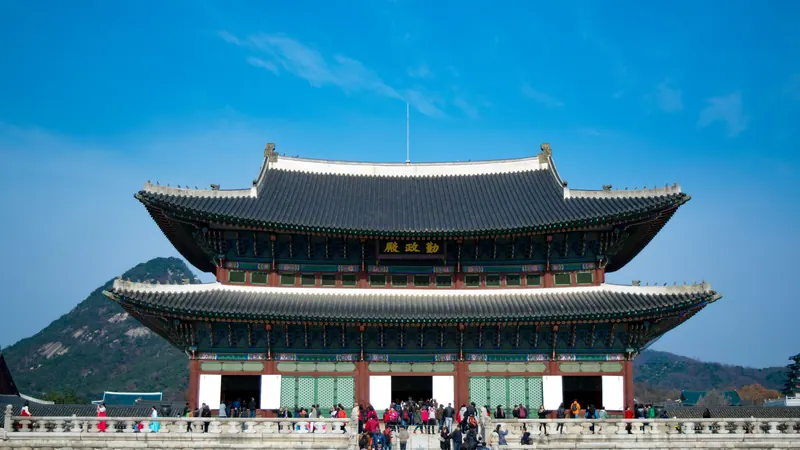
Working Holiday South Korea
By Gus · Viaja con GusOur guide's data
Working Holiday · Work and Holiday Visa (Working Holiday, H-1)

200
Age
18 to 34 years old
Duration
Up to 12 months
Visa cost
Free
Annual quota
1,000 visas per year for each party
Age
18 to 30 years old, both ages included, at…
Duration
Up to 12 months
Visa cost
Free
Annual quota
The official 2026-2027 brochure of the Over…
Age
18 to 30
Duration
Up to 12 months
Visa cost
Free
Annual quota
100 visas per year
Age
Ages 18 to 34
Duration
Up to 12 months
Visa cost
Free
Annual quota
Maximum 300 visas per year
Age
18 to 34 years old
Duration
Up to 12 months
Visa cost
Free
🛂 You are viewing the requirements for citizenship 🇦🇷 Argentina 🇪🇸 Spain 🇮🇹 Italy 🇨🇱 Chile 🇧🇷 Brazil. If you have another one, change it here:
🇦🇷 Argentina🇪🇸 Spain🇮🇹 Italy🇨🇱 Chile🇧🇷 Brazil
📌 At a glance✅ Requirements, quotas and dates🌎 Quotas by citizenship🪜 Step-by-step procedure📝 The form / the…💳 Costs⏱️ Processing times🖐️ Biometrics and interview🏥 Health insurance💼 Work and study allowed🔁 Extension / second year💵 Cost of living💼 Job market and salaries🏙️ Where to live💸 How much money you need🏠 Where you will live and how much…✅ Your first days💼 How to find work💼 What work there is🗣️ Teaching Spanish and…🍽️ Cafés, restaurants and…🏨 Hostels and tourism🌾 Countryside and rural work🏭 Production and logistics💬 Content, translation and…🧾 Impuestos🏥 Salud🚆 Transport and driver's license…🚧 Errores comunes📖 Glossary☀️ Climate and best season🌎 Latino community🏡 Daily life and culture🔮 And afterwards📱 Useful information📶 SIM and phone💡 Tips🔗 Official links❓ Frequently asked questions
The Working Holiday Visa (category H-1) is the programme South Korea offers young Argentines to live in the country for up to 12 months, travel, experience Korean culture and work incidentally to help cover the costs of the trip. It is one of the most sought-after Working Holidays in Asia and, unlike Australia or Europe, it has a very small quota: only 200 visas per year for Argentines.
The application is NOT online: it is done 100% in person at the Embassy of the Republic of Korea in Buenos Aires (consular section), with an appointment requested by email and a personal interview held in English. The visa itself is free, but it requires you to prepare quite a lot of documentation: a criminal record check, proof of funds of USD 3,000, health insurance with USD 30,000 of coverage, a return ticket (or funds to buy one), a motivation letter and an activity plan / itinerary for your stay.
The quota of 200 visas is granted on a first-come, first-served basis, with no way to reserve a place, so it is best to have your whole file ready and request the appointment as soon as you can. Meeting all the requirements does not guarantee you will get the visa: the final decision rests exclusively with the Korean State and depends on the consular interview. Once in Korea, within 90 days of your entry you must register as a foreigner and get the Residence Card (formerly ARC) at an immigration office, with an appointment through HiKorea.
🧳 See the South Korea travel guide (what to see, transport, prices) →
📌 At a glance
This program has agreements with several countries and the data changes depending on your citizenship. Choose your citizenship: the whole page adjusts, and your choice is saved.
🇦🇷 Argentina🇪🇸 Spain🇮🇹 Italy🇨🇱 Chile🇧🇷 Brazil
Data for 🇦🇷 Argentina.
Programme
Work and Holiday Visa (Working Holiday, H-1)
Age
18 to 34 years old inclusive at the time of applying
Annual quota (Argentina)
200 visas per year, first come first served, no reserving a place
Duration
Up to 12 months of stay
Required funds
USD 3,000 (bank statements for the last 3 full months)
Health insurance
Minimum coverage of USD 30,000 for 12 months, including medical and remains repatriation
Visa cost
Free
Where to apply
In person, at the Korean Embassy in Buenos Aires (appointment by email + interview in English)
Return ticket
Return ticket reservation or sufficient funds to buy one (approx. USD 1,500)
Registration on arrival
Residence Card (formerly ARC) within 90 days, via HiKorea
👥 Annual quota
200
🎂 Age
18 to 34 years old
Data for 🇪🇸 Spain.
Programme
Work and Holiday Visa (Working Holiday, H-1)
Age
18 to 34 years old inclusive at the time of applying
Annual quota (Argentina)
200 visas per year, first come first served, no reserving a place
Duration
Up to 12 months of stay
Required funds
USD 3,000 (bank statements for the last 3 full months)
Health insurance
Minimum coverage of USD 30,000 for 12 months, including medical and remains repatriation
Visa cost
Free
Where to apply
In person, at the Korean Embassy in Buenos Aires (appointment by email + interview in English)
Return ticket
Return ticket reservation or sufficient funds to buy one (approx. USD 1,500)
Registration on arrival
Residence Card (formerly ARC) within 90 days, via HiKorea
👥 Annual quota
1,000 visas per year for each party (Embassy of the Republic of Korea in Spain)
🎂 Age
18 to 30 years old, both ages included, at the time of application
💰 Funds required
Own bank balance certificate of more than USD 3,000, or EUR 4,000 if the certificate includes ticket and general expenses
🗣️ Language
No language certificate required
🎓 Education
No degree required; a certificate of your most recent education is requested
🧭 Where the application is made
In-person process with a mandatory appointment at the Embassy of Korea in Madrid, the Consulate General in Barcelona (Catalonia, the Valencian Community and the Balearic Islands) or the Consulate in Las Palmas (Canary Islands), depending on your home address. Under the bilateral fee-exemption agreement between Spain and Korea, the process is free of charge for Spanish citizens.
Data for 🇮🇹 Italy.
Programme
Work and Holiday Visa (Working Holiday, H-1)
Age
18 to 34 years old inclusive at the time of applying
Annual quota (Argentina)
200 visas per year, first come first served, no reserving a place
Duration
Up to 12 months of stay
Required funds
USD 3,000 (bank statements for the last 3 full months)
Health insurance
Minimum coverage of USD 30,000 for 12 months, including medical and remains repatriation
Visa cost
Free
Where to apply
In person, at the Korean Embassy in Buenos Aires (appointment by email + interview in English)
Return ticket
Return ticket reservation or sufficient funds to buy one (approx. USD 1,500)
Registration on arrival
Residence Card (formerly ARC) within 90 days, via HiKorea
👥 Annual quota
The official 2026-2027 brochure of the Overseas Koreans Agency does not publish a specific quota number for Italy; it only states that the programme is global with 30 participating countries. Confirm the exact quota at whic.mofa.go.kr.
🎂 Age
18 to 30 inclusive at the time of application
💰 Funds required
Minimum KRW 3,000,000 (funds for support during the initial period), plus a return ticket or funds to buy one
🗣️ Language
No language certificate required
🎓 Education
A tertiary degree is not required, but the official 2026-2027 brochure asks you to include proof of your student status or other academic credentials among your documents.
🧭 Where the application is made
The form and documents are submitted exclusively at the Korean Embassy in Rome or the Consulate General of Korea in Milan; you must get the visa before arriving in Korea, as it is not processed on arrival. For Italy, the limit on employment with the same employer is 6 months, with no limit on academic activity.
Data for 🇨🇱 Chile.
Programme
Work and Holiday Visa (Working Holiday, H-1)
Age
18 to 34 years old inclusive at the time of applying
Annual quota (Argentina)
200 visas per year, first come first served, no reserving a place
Duration
Up to 12 months of stay
Required funds
USD 3,000 (bank statements for the last 3 full months)
Health insurance
Minimum coverage of USD 30,000 for 12 months, including medical and remains repatriation
Visa cost
Free
Where to apply
In person, at the Korean Embassy in Buenos Aires (appointment by email + interview in English)
Return ticket
Return ticket reservation or sufficient funds to buy one (approx. USD 1,500)
Registration on arrival
Residence Card (formerly ARC) within 90 days, via HiKorea
👥 Annual quota
100 visas per year
🎂 Age
Ages 18 to 34 (age extended from 30 to 34 in the March 2025 renewal of the agreement)
💰 Funds required
Bank document certifying more than USD 3,000 available (checking, demand or savings account), in addition to the return ticket
🗣️ Language
No language certificate required
🎓 Education
No degree required
🧭 Where the application is made
You apply in person in Santiago, at the South Korean Consulate (Alcántara 74, Las Condes), Monday to Friday from 9:00 to 17:00. Processing can take up to four weeks. The quota is only 100, so it is worth keeping an eye on the opening date.
Data for 🇧🇷 Brazil.
Programme
Work and Holiday Visa (Working Holiday, H-1)
Age
18 to 34 years old inclusive at the time of applying
Annual quota (Argentina)
200 visas per year, first come first served, no reserving a place
Duration
Up to 12 months of stay
Required funds
USD 3,000 (bank statements for the last 3 full months)
Health insurance
Minimum coverage of USD 30,000 for 12 months, including medical and remains repatriation
Visa cost
Free
Where to apply
In person, at the Korean Embassy in Buenos Aires (appointment by email + interview in English)
Return ticket
Return ticket reservation or sufficient funds to buy one (approx. USD 1,500)
Registration on arrival
Residence Card (formerly ARC) within 90 days, via HiKorea
👥 Annual quota
Maximum 300 visas per year
🎂 Age
18 to 34 years old (for the reference date of 25 September 2026: born between 26/09/1991 and 25/09/2008)
💰 Funds required
More than BRL 12,000 if you present a return ticket; more than BRL 24,000 if you only have a one-way ticket or no ticket. It must be immediately available money (checking account, savings account); a credit card limit or a bank slip is not accepted.
🗣️ Language
No language certificate required (studying Korean is not mandatory)
🎓 Education
No degree required
🧭 Where the application is made
The application is in person and must be made in Brazil: Korean Consulate General in São Paulo (Av. Paulista 37, 8º andar, cj. 81) for residents of SP, PR, SC, RS, MT, MS and RJ; Korean Embassy in Brasília for all other states. The appointment is requested ONLY by e-mail (wkyoon25@mofa.go.kr in São Paulo) and must be confirmed within 24 hours. Applications by mail, online or through third parties are not accepted. The passport is collected 14 business days later.
✅ Requirements, quotas and dates — choose your citizenship
The requirements, the quota and the opening date change depending on your citizenship. Choose your country and this whole page adjusts to you:
🇦🇷 Argentina🇪🇸 Spain🇮🇹 Italy🇨🇱 Chile🇧🇷 Brazil
📅 Quotas and opening dates
Korea grants Argentina a quota of 200 Working Holiday (H-1) visas per year. They are allocated strictly on a first-come, first-served basis and you CANNOT reserve a place in advance. Since the quota is small and in high demand, it is best to have all your documentation ready and scanned so you can request the appointment as early as possible. Meeting the requirements alone does not guarantee the visa: granting it is an exclusive power of the Korean State and depends on the evaluation and the consular interview. Check availability and current dates on the embassy's website before you start.
✅ Requirements
Citizenship and passport
Be an Argentine citizen with a valid passport of the Argentine Republic, with at least 6 months of validity (ideally with 2 blank pages). The visa is tied to that passport.
Age
Be between 18 and 34 years old inclusive at the time of submitting the application (information from the official page of the Korean Embassy).
Reside in Argentina
Be residing in Argentina at the time of applying for the visa; the application is made at the consular section of the embassy in Buenos Aires.
Not have used the programme before
Not have previously taken part in the Korean Working Holiday. It is a benefit that can be used only once in a lifetime.
Sufficient funds
Show a minimum of USD 3,000 for initial expenses, with statements of transactions and balance for your bank accounts for the last three full months. The accounts must be in your name (not a third party's) and maintain the minimum balance throughout the period.
Health insurance
Take out medical and accident insurance with minimum coverage of USD 30,000, valid for the 12 months of your stay, including hospitalisation and medical and remains repatriation.
Return ticket
Present a return ticket reservation or show sufficient funds to buy one (the reference sources mention around USD 1,500).
No criminal record
Have no criminal record. This is shown with the Argentine criminal record check (covering the last 3 years) plus a sworn statement of no criminal record in other countries.
Physical fitness
Be physically fit for the activities of the stay. Dependent children cannot come along unless they obtain their own visa.
📄 Documentation
- Valid Argentine passport (original and photocopy of the data page), with at least 6 months of validity and blank pages.
- Completed and signed visa application form.
- One colour photo, 3.5 x 4.5 cm, front-facing, white background, taken within the last 6 months.
- Argentine criminal record check (covering the last 3 years).
- Sworn statement of no criminal record in other countries.
- Proof of funds: statements and balance for bank accounts in your name for the last three full months, for a minimum of USD 3,000.
- Return ticket reservation (or proof of funds, approx. USD 1,500, to buy one).
- Medical and accident insurance policy with USD 30,000 of coverage for 12 months, including medical and remains repatriation.
- Motivation letter explaining why you want to do the Working Holiday in Korea (with a focus on the tourism/cultural purpose).
- Activity plan / itinerary for your stay (what you want to do, where you plan to live, how you will spread out the year).
🏥 Health insurance: They require medical and accident insurance with minimum coverage of USD 30,000, valid for the full 12 months of your stay, including hospitalisation and medical repatriation and repatriation of remains. It is a mandatory requirement for the visa: bring the printed policy, with the coverage amount and validity clearly shown. Korea has a good health system, but the insurance covers you from day one, before you can access the local insurance.
🔗 Official source for Argentines →
👥 Annual quota
1,000 visas per year for each party
See details
1,000 visas per year for each party (Embassy of the Republic of Korea in Spain)
🎂 Age
18 to 30 years old, both ages included, at the time of application
💰 Fondos
Own bank balance certificate of more than USD 3,000, or EUR 4,000 if the cert…
See details
Own bank balance certificate of more than USD 3,000, or EUR 4,000 if the certificate includes ticket and general expenses
🗣️ Language
No language certificate required
🎓 Education
No degree required; a certificate of your most recent education is requested
📅 Quotas and opening dates
There is no single annual opening window: you can request an appointment all year round until the quota is filled; confirm current availability directly with the Embassy. The Embassy of Korea in Madrid states that you can apply for the visa from 6 months before the start date of your activities in Korea.
✅ Requirements
Age
Be between 18 and 30 years old, both ages included, at the time of application.
Citizenship
Hold Spanish citizenship.
No dependants
Not be accompanied by dependants.
Sufficient funds
Own bank balance certificate of more than USD 3,000 (or EUR 4,000 if it includes ticket and general expenses), with the bank's stamp and date of consultation, submitted within the following 10 working days.
Health insurance
Insurance with coverage of more than EUR 30,000 that includes medical care, hospitalisation and repatriation for 1 year in Korea.
No criminal record
Provide a criminal record check.
Good health
Official medical certificate stating that you do not have any of the diseases listed in the International Health Regulations of 2005.
Ticket
Return plane ticket reservation.
📄 Documentation
- Application form completed in capital letters, signed, with a recent colour photo attached (no photocopies or scans).
- Spanish passport valid for at least 6 months, with no alterations or damage.
- Photocopy of the passport's biographical page.
- Certificate of your most recent education (original or photocopy).
- Return plane ticket reservation.
- Bank balance certificate (USD 3,000 or EUR 4,000).
- Criminal record check.
- Insurance certificate (coverage of EUR 30,000 or more, including repatriation).
- Official medical certificate.
- General travel plan (reason, interests and planned activities, in a document of about 20 lines).
🏥 Health insurance: Insurance with coverage of more than EUR 30,000 (medical care, hospitalisation and repatriation) valid for 1 year in Korea
🧭 How the application is made: In-person process with a mandatory appointment at the Embassy of Korea in Madrid, the Consulate General in Barcelona (Catalonia, the Valencian Community and the Balearic Islands) or the Consulate in Las Palmas (Canary Islands), depending on your home address. Under the bilateral fee-exemption agreement between Spain and Korea, the process is free of charge for Spanish citizens.
ℹ️ The visa is free for Spanish citizens under the bilateral fee-exemption agreement between Spain and the Republic of Korea (source: Embassy of Korea in Spain). The visa has a maximum duration of 1 year from the date of entry; you cannot travel with dependants. The process takes 2 to 3 weeks, except in high season (June-August and December-February), when it can take more than a month.
🔗 Official source for Spaniards →
📄 See the full guide for Spaniards →
👥 Annual quota
The official 2026-2027 brochure of the Overseas Koreans Agency does not publi…
See details
The official 2026-2027 brochure of the Overseas Koreans Agency does not publish a specific quota number for Italy; it only states that the programme is global with 30 participating countries. Confirm the exact quota at whic.mofa.go.kr.
🎂 Age
18 to 30 inclusive at the time of application
💰 Fondos
Minimum KRW 3,000,000
See details
Minimum KRW 3,000,000 (funds for support during the initial period), plus a return ticket or funds to buy one
🗣️ Language
No language certificate required
🎓 Education
A tertiary degree is not required, but the official 2026-2027 brochure asks…
See details
A tertiary degree is not required, but the official 2026-2027 brochure asks you to include proof of your student status or other academic credentials among your documents.
✅ Requirements
Age
Be between 18 and 30 years old inclusive when you apply.
Citizenship and passport
Be in Italy when you apply and hold a valid Italian passport when you receive the visa.
No dependants
Not be accompanied by dependents at any time during the stay.
Health insurance
Have valid health insurance for the whole stay in Korea (minimum coverage KRW 40,000,000).
Sufficient funds
Show at least KRW 3,000,000 for initial support.
Return ticket
Have a return ticket or enough funds to buy one.
First time and no record
Have not previously entered Korea on a Vacanza-Lavoro visa and have no criminal record.
Holiday purpose
The main goal must be to holiday; anyone who wants to work or study for longer must apply for a different type of visa.
📄 Documentation
- Valid Italian passport and one passport-size photo (fototessera) of 3.5x4.5 cm.
- Visa application form.
- Return ticket or proof of funds to buy one.
- Financial documentation (copy of bank statement).
- Health insurance valid for the whole stay (minimum coverage KRW 40,000,000).
- Travel plan.
- Criminal record check.
- Note: a medical certificate is NOT required for Italians (an express exception in the official brochure).
🏥 Health insurance: Mandatory health insurance for the whole stay in Korea, with minimum coverage of KRW 40,000,000
🧭 How the application is made: The form and documents are submitted exclusively at the Korean Embassy in Rome or the Consulate General of Korea in Milan; you must get the visa before arriving in Korea, as it is not processed on arrival. For Italy, the limit on employment with the same employer is 6 months, with no limit on academic activity.
ℹ️ Source: official brochure 'Vacanza-Lavoro in Corea 2026-2027' of the Overseas Koreans Agency / Korean Ministry of Foreign Affairs (whic.mofa.go.kr). The maximum weekly working hours for the H-1 visa are 25 hours, except for bilateral exceptions (Canada and the US have different rules; Italy is not among the exceptions). You cannot apply for the visa again if you have already held one (unlike Canada and Japan, which allow 2 participations).
🔗 Official source for Italians →
📄 See the full guide for Italians →
👥 Annual quota
100 visas per year
🎂 Age
Ages 18 to 34
See details
Ages 18 to 34 (age extended from 30 to 34 in the March 2025 renewal of the agreement)
💰 Fondos
Bank document certifying more than USD 3,000 available
See details
Bank document certifying more than USD 3,000 available (checking, demand or savings account), in addition to the return ticket
🗣️ Language
No language certificate required
🎓 Education
No degree required
📅 Quotas and opening dates
One-time participation; the Korean Embassy in Santiago reports that 2026 applications are full; the next opening is the 2027 one (confirm with the embassy)
✅ Requirements
Age
Be between 18 and 34 years old when you apply. The renewal of the agreement (March 2025) extended the range from 30 to 34 years.
Residence and passport
Live in Chile when you apply and hold a valid Chilean passport.
Sufficient funds
Bank certificate for more than USD 3,000 available, in addition to the return ticket (or funds to buy it).
Health insurance
Have health insurance and liability insurance covering your whole stay, including hospitalisation and repatriation.
No criminal record
Have no criminal record and be in good health.
First time
Have never taken part in the Working Holiday programme with Korea before.
Holiday purpose
The main purpose of the trip must be a holiday; work is secondary. You travel without a spouse or dependent children.
📄 Documentation
- Valid Chilean passport.
- Visa application form and photo.
- Bank certificate for more than USD 3,000 (in addition to the ticket).
- Comprehensive health insurance for the entire stay.
- Criminal record check.
- Return ticket or proof of funds to buy one.
- Itinerary or travel plan.
🏥 Health insurance: Health insurance valid for at least six months from the start of your stay, with minimum coverage of 40,000,000 won (about USD 35,000), according to the Korean Embassy in Chile.
🧭 How the application is made: You apply in person in Santiago, at the South Korean Consulate (Alcántara 74, Las Condes), Monday to Friday from 9:00 to 17:00. Processing can take up to four weeks. The quota is only 100, so it is worth keeping an eye on the opening date.
ℹ️ The March 2025 renewal of the agreement extended the age limit from 30 to 34 (announcement by the Chilean foreign ministry). Small quota (100 per year) that runs out quickly.
🔗 Official source for Chileans →
📄 See the full guide for Chileans →
👥 Annual quota
Maximum 300 visas per year
🎂 Age
18 to 34 years old
See details
18 to 34 years old (for the reference date of 25 September 2026: born between 26/09/1991 and 25/09/2008)
💰 Fondos
More than BRL 12,000 if you present a return ticket
See details
More than BRL 12,000 if you present a return ticket; more than BRL 24,000 if you only have a one-way ticket or no ticket. It must be immediately available money (checking account, savings account); a credit card limit or a bank slip is not accepted.
🗣️ Language
No language certificate required (studying Korean is not mandatory)
🎓 Education
No degree required
📅 Quotas and opening dates
The programme came into force on 25 September 2025 and applications are open all year until the 300 visas run out. The bottleneck is appointments: check current availability directly with the relevant consulate or embassy. Working Holiday appointments are only given on Mondays and Tuesdays.
✅ Requirements
Age
Be between 18 and 34 years old. This is the widest age range Brazilians have among all their Working Holiday destinations.
Citizenship, residence and passport
Hold Brazilian citizenship, live in Brazil and have a Brazilian passport valid for at least 6 months from the date of application. Brazilians with dual Brazil/Korea citizenship are NOT eligible.
Sufficient funds
Show more than BRL 12,000 if you have a return ticket, or more than BRL 24,000 if you don't. The proofs must be from the last month and in your name (or your parents' or spouse's, adding a birth or marriage certificate).
Travel insurance for 1 year
Policy with minimum coverage of BRL 160,000 and for the full year of the visa, regardless of how long you plan to stay.
Criminal record check and health
Brazilian criminal record check less than 3 months old (and from the foreign country where you have lived for more than 1 continuous year in the last 5), plus an original medical certificate less than 6 months old showing good physical and mental condition.
Activity plan
Submit a Plano de Atividade de Working Holiday explaining the objectives of your stay (the consulate publishes a template and an example).
First time
One-time participation: you cannot apply for the Korean Working Holiday more than once. You can apply even if you have already done a Working Holiday in another country.
Limited work
With the H-1 you can work up to 25 hours per week; the main purpose of the visa is tourism.
📄 Documentation
- Completed visa application form.
- Valid Brazilian passport (original and copy).
- RG or CIN original and certified copy (CNH or protocol not accepted).
- One 3.5 x 4.5 cm photo taken within the last 6 months.
- Proof of residence in Brazil.
- Round-trip air tickets (or proof of the equivalent value).
- Financial proof from the last month: more than BRL 12,000 with a return ticket, or more than BRL 24,000 without one.
- Brazilian criminal record check (less than 3 months old).
- Original medical certificate (less than 6 months old).
- Travel insurance policy for 1 year with minimum coverage of BRL 160,000.
- Working Holiday activity plan.
🏥 Health insurance: Travel insurance policy with minimum coverage of BRL 160,000 (about KRW 40 million) and for 1 full year, even if you plan to stay less time
🧭 How the application is made: The application is in person and must be made in Brazil: Korean Consulate General in São Paulo (Av. Paulista 37, 8º andar, cj. 81) for residents of SP, PR, SC, RS, MT, MS and RJ; Korean Embassy in Brasília for all other states. The appointment is requested ONLY by e-mail (wkyoon25@mofa.go.kr in São Paulo) and must be confirmed within 24 hours. Applications by mail, online or through third parties are not accepted. The passport is collected 14 business days later.
ℹ️ The application fee is FREE (“isenta”), which is unusual. The visa is valid for 1 year and is multiple-entry; you must enter Korea within a year of its issue or it is lost, with no possibility of applying again. If you stay more than 90 days you must get the Cartão de Registro de Estrangeiro (ARC) within the first 90 days. If you are missing documents at the appointment, you have to book again and the place is not guaranteed. Brazilians with dual Brazilian-Korean citizenship are not eligible, and the Korean Consulate in São Paulo also publishes the weekly working-hours limit for this visa.
🔗 Official source for Brazilians →
📄 See the full guide for Brazilians →
We verify the official sources of each country and, as of today, this program has no Working Holiday agreement in force for: 🇺🇾 Uruguay · 🇵🇪 Peru · 🇲🇽 Mexico · 🇨🇴 Colombia · 🇪🇨 Ecuador · 🇨🇷 Costa Rica · 🇧🇴 Bolivia · 🇵🇾 Paraguay · 🇻🇪 Venezuela · 🇬🇾 Guyana · 🇸🇷 Suriname. If you hold dual citizenship, check which one is best to apply with.
See why, country by country
🇺🇾 Uruguay Uruguay has no Working Holiday agreement with South Korea (according to the official list of Uruguay's foreign ministry). 🇵🇪 Peru In Latin America, South Korea only has a Working Holiday agreement (H-1 visa) with Argentina and Chile; there is no agreement in force with Peru. 🇲🇽 Mexico No agreement has been signed. The Working Holiday Info Center (Overseas Koreans Agency, Korean MOFA) lists 30 partner countries/regions with their annual quotas; Mexico is not among them. In Latin America, only Argentina (200), Brazil (300) and Chile (100) appear. 🇨🇴 Colombia Colombia has no Working Holiday (H-1 visa) agreement with South Korea. The official Working Holiday Info Center of the Korean Ministry of Foreign Affairs publishes the list of partner countries/regions with their annual quotas (Andorra, Argentina, Australia, Austria, Belgium, Brazil, Canada, Chile, Czech Republic, Denmark, Finland, France, Germany, Hong Kong, Hungary, Ireland, Israel, Italy, Japan, Latvia, Luxembourg, the Netherlands, New Zealand, Poland, Portugal, Spain, Sweden, Taiwan, the United Kingdom and the United States) and Colombia is not on it. Source: whic.mofa.go.kr. 🇪🇨 Ecuador Ecuador does NOT have a Working Holiday (H-1 visa) agreement with South Korea. The official list of partner countries and quotas from Korea's Working Holiday Info Center (whic.mofa.go.kr) does not include Ecuador; in Latin America it lists Argentina, Brazil and Chile. Ecuador's Ministry of Foreign Affairs and Human Mobility recognises only three Working Holiday agreements in force for Ecuadorians: Australia, France and Hungary. 🇨🇷 Costa Rica Costa Rica has NO Working Holiday (H-1 visa) agreement with South Korea. Korea has bilateral agreements with about 30 countries/regions (including Chile, Argentina, Uruguay, Peru and Ecuador in Latin America), but Costa Rica is not on the list of eligible countries of Korea's Ministry of Foreign Affairs (MOFA). 🇧🇴 Bolivia Bolivia is not among South Korea's Working Holiday partners. The official Working Holiday Info Center (whic.mofa.go.kr, the Overseas Koreans Agency of the Korean Ministry of Foreign Affairs) lists 28 countries and regions with an agreement plus the YMS with the United Kingdom; of Latin America, only Argentina, Brazil and Chile appear. Bolivia is not there. 🇵🇾 Paraguay Paraguay does NOT have a Working Holiday agreement with South Korea. The Working Holiday Info Center of the Overseas Koreans Agency (Korean MOFA) publishes the 30 partner countries/regions with their quotas: Andorra (50), Argentina (200), Australia (no cap), Austria (300), Belgium (200), Brazil (300), Canada (12,000), Chile (100), Czechia (300), Denmark (no cap), Finland, France (2,000), Germany (no cap), Hong Kong (1,000), Hungary (100), Ireland (800), Israel (200), Italy (500), Japan (10,000), Latvia (100), Luxembourg (100), Netherlands (200), New Zealand (3,000), Poland (200), Portugal (200), Spain (1,000), Sweden (no cap), Taiwan (800), United Kingdom (5,000) and United States (2,000). Paraguay does not appear. Source: whic.mofa.go.kr. 🇻🇪 Venezuela Venezuela is not among South Korea's Working Holiday partners. The official Working Holiday Info Center (whic.mofa.go.kr, Overseas Koreans Agency of the Korean Ministry of Foreign Affairs) lists 30 countries and regions with a bilateral agreement; from Latin America, only Argentina, Brazil and Chile. Venezuela is not on it. 🇬🇾 Guyana Guyana has no Working Holiday (H-1 visa) agreement with South Korea. Korea has around 30 bilateral agreements in force (Australia, Canada, New Zealand, Japan, United Kingdom, France, Germany, Belgium, Netherlands, Sweden, Denmark, Italy, Spain, Portugal, Czechia, Hungary, Poland, Austria, Ireland, Israel, Argentina, Chile, Hong Kong, Taiwan and others) and Guyana is not on the list. Source: Korea's MOFA (overseas.mofa.go.kr) and the Working Holiday Info Center. 🇸🇷 Suriname Suriname has no Working Holiday agreement (H-1 visa) with South Korea. Korea has around 30 bilateral agreements (Australia, Canada, New Zealand, Japan, the United Kingdom, France, Germany, Belgium, the Netherlands, Sweden, Denmark, Italy, Spain, Portugal, Czechia, Hungary, Poland, Austria, Ireland, Israel, Argentina, Chile, Hong Kong, Taiwan and others) and Suriname is not one of them. The Netherlands IS on the list, so with a Dutch passport you can apply. Source: Korea's MOFA (overseas.mofa.go.kr).
🌎 Quotas by citizenship (summary)
In Latin America, South Korea has a bilateral Working Holiday agreement (H-1 visa) with Argentina, Chile and Brazil. The Brazilian one is the newest: the agreement was signed on 26 August 2025 and came into force on 25 September 2025, so applications can only be submitted from that date. There is no agreement in force with Uruguay, Peru, Colombia, Mexico or Ecuador, so citizens of those countries cannot access the Korean programme. All three agreements use small annual quotas, charge no visa fee and require your own funds and health insurance.at the Korean consulates in each country.
Quota: 200 Age: 18 to 34 years old Non-renewable; one-time participation (only once in a lifetime)
See my requirements ↑
Quota: 1,000 visas per year for each party Age: 18 to 30 years old, both ages included, at th…
Working Holiday South Korea for Spaniards →
Quota: The official 2026-2027 brochure of the Overseas Koreans Age… Age: 18 to 30 inclusive at the time of application
Working Holiday South Korea for Italians →
Quota: 100 visas per year Age: Ages 18 to 34 Non-renewable; one-time participation
Working Holiday South Korea for Chileans →
Quota: Maximum 300 visas per year Age: 18 to 34 years old
Working Holiday South Korea for Brazilians →
No agreement with South Korea (11)
🇺🇾 Uruguay 🇵🇪 Peru 🇲🇽 Mexico 🇨🇴 Colombia 🇪🇨 Ecuador 🇨🇷 Costa Rica 🇧🇴 Bolivia 🇵🇾 Paraguay 🇻🇪 Venezuela 🇬🇾 Guyana 🇸🇷 Suriname
See the reason, country by country
🇺🇾 Uruguay Uruguay has no Working Holiday agreement with South Korea (according to the official list of Uruguay's foreign ministry). 🇵🇪 Peru In Latin America, South Korea only has a Working Holiday agreement (H-1 visa) with Argentina and Chile; there is no agreement in force with Peru. 🇲🇽 Mexico No agreement has been signed. The Working Holiday Info Center (Overseas Koreans Agency, Korean MOFA) lists 30 partner countries/regions with their annual quotas; Mexico is not among them. In Latin America, only Argentina (200), Brazil (300) and Chile (100) appear. 🇨🇴 Colombia Colombia has no Working Holiday (H-1 visa) agreement with South Korea. The official Working Holiday Info Center of the Korean Ministry of Foreign Affairs publishes the list of partner countries/regions with their annual quotas (Andorra, Argentina, Australia, Austria, Belgium, Brazil, Canada, Chile, Czech Republic, Denmark, Finland, France, Germany, Hong Kong, Hungary, Ireland, Israel, Italy, Japan, Latvia, Luxembourg, the Netherlands, New Zealand, Poland, Portugal, Spain, Sweden, Taiwan, the United Kingdom and the United States) and Colombia is not on it. Source: whic.mofa.go.kr. 🇪🇨 Ecuador Ecuador does NOT have a Working Holiday (H-1 visa) agreement with South Korea. The official list of partner countries and quotas from Korea's Working Holiday Info Center (whic.mofa.go.kr) does not include Ecuador; in Latin America it lists Argentina, Brazil and Chile. Ecuador's Ministry of Foreign Affairs and Human Mobility recognises only three Working Holiday agreements in force for Ecuadorians: Australia, France and Hungary. 🇨🇷 Costa Rica Costa Rica has NO Working Holiday (H-1 visa) agreement with South Korea. Korea has bilateral agreements with about 30 countries/regions (including Chile, Argentina, Uruguay, Peru and Ecuador in Latin America), but Costa Rica is not on the list of eligible countries of Korea's Ministry of Foreign Affairs (MOFA). 🇧🇴 Bolivia Bolivia is not among South Korea's Working Holiday partners. The official Working Holiday Info Center (whic.mofa.go.kr, the Overseas Koreans Agency of the Korean Ministry of Foreign Affairs) lists 28 countries and regions with an agreement plus the YMS with the United Kingdom; of Latin America, only Argentina, Brazil and Chile appear. Bolivia is not there. 🇵🇾 Paraguay Paraguay does NOT have a Working Holiday agreement with South Korea. The Working Holiday Info Center of the Overseas Koreans Agency (Korean MOFA) publishes the 30 partner countries/regions with their quotas: Andorra (50), Argentina (200), Australia (no cap), Austria (300), Belgium (200), Brazil (300), Canada (12,000), Chile (100), Czechia (300), Denmark (no cap), Finland, France (2,000), Germany (no cap), Hong Kong (1,000), Hungary (100), Ireland (800), Israel (200), Italy (500), Japan (10,000), Latvia (100), Luxembourg (100), Netherlands (200), New Zealand (3,000), Poland (200), Portugal (200), Spain (1,000), Sweden (no cap), Taiwan (800), United Kingdom (5,000) and United States (2,000). Paraguay does not appear. Source: whic.mofa.go.kr. 🇻🇪 Venezuela Venezuela is not among South Korea's Working Holiday partners. The official Working Holiday Info Center (whic.mofa.go.kr, Overseas Koreans Agency of the Korean Ministry of Foreign Affairs) lists 30 countries and regions with a bilateral agreement; from Latin America, only Argentina, Brazil and Chile. Venezuela is not on it. 🇬🇾 Guyana Guyana has no Working Holiday (H-1 visa) agreement with South Korea. Korea has around 30 bilateral agreements in force (Australia, Canada, New Zealand, Japan, United Kingdom, France, Germany, Belgium, Netherlands, Sweden, Denmark, Italy, Spain, Portugal, Czechia, Hungary, Poland, Austria, Ireland, Israel, Argentina, Chile, Hong Kong, Taiwan and others) and Guyana is not on the list. Source: Korea's MOFA (overseas.mofa.go.kr) and the Working Holiday Info Center. 🇸🇷 Suriname Suriname has no Working Holiday agreement (H-1 visa) with South Korea. Korea has around 30 bilateral agreements (Australia, Canada, New Zealand, Japan, the United Kingdom, France, Germany, Belgium, the Netherlands, Sweden, Denmark, Italy, Spain, Portugal, Czechia, Hungary, Poland, Austria, Ireland, Israel, Argentina, Chile, Hong Kong, Taiwan and others) and Suriname is not one of them. The Netherlands IS on the list, so with a Dutch passport you can apply. Source: Korea's MOFA (overseas.mofa.go.kr).
Data from our guide, based on each country's official sources. Quotas and dates change every year: always confirm at the official link for your citizenship.
🪜 Step-by-step procedure
🇦🇷 If your citizenship is Argentina
🇪🇸 If your citizenship is Spain
In-person process with a mandatory appointment at the Embassy of Korea in Madrid, the Consulate General in Barcelona (Catalonia, the Valencian Community and the Balearic Islands) or the Consulate in Las Palmas (Canary Islands), depending on your home address. Under the bilateral fee-exemption agreement between Spain and Korea, the process is free of charge for Spanish citizens.
🇮🇹 If your citizenship is Italy
The form and documents are submitted exclusively at the Korean Embassy in Rome or the Consulate General of Korea in Milan; you must get the visa before arriving in Korea, as it is not processed on arrival. For Italy, the limit on employment with the same employer is 6 months, with no limit on academic activity.
🇨🇱 If your citizenship is Chile
You apply in person in Santiago, at the South Korean Consulate (Alcántara 74, Las Condes), Monday to Friday from 9:00 to 17:00. Processing can take up to four weeks. The quota is only 100, so it is worth keeping an eye on the opening date.
🇧🇷 If your citizenship is Brazil
The application is in person and must be made in Brazil: Korean Consulate General in São Paulo (Av. Paulista 37, 8º andar, cj. 81) for residents of SP, PR, SC, RS, MT, MS and RJ; Korean Embassy in Brasília for all other states. The appointment is requested ONLY by e-mail (wkyoon25@mofa.go.kr in São Paulo) and must be confirmed within 24 hours. Applications by mail, online or through third parties are not accepted. The passport is collected 14 business days later.
🇦🇷 Argentina🇪🇸 Spain🇮🇹 Italy🇨🇱 Chile🇧🇷 Brazil
The steps that follow are common to all citizenships; what changes is where you submit and what documentation each consulate asks for.
1
Check that you meet the requirements
Check your age (18-34), valid passport, that you haven't used the programme before, and that you can gather the USD 3,000 and take out the insurance. Confirm that there is quota available on the embassy's website.
2
Put together and scan the whole file
Gather your passport, the form, the photo, the criminal record check, the sworn statement, the bank statements, the ticket reservation, the insurance policy, the motivation letter and the activity plan. Scan everything in good quality.
3
Request an appointment by email
Write to consulado@mofa.go.kr requesting an appointment for the Working Holiday, with all the requirements already prepared and scanned and attached. The consulate reviews the documentation and assigns you an interview date.
4
Prepare for the interview in English
The consular interview is held in English. Practise explaining your reasons for the trip, your activity plan, where you plan to live, your work plans and, if you know any Korean, mention it. Bring ALL the documentation printed, in original and copy.
5
Go to the consulate on the day of your appointment
Arrive on time with the complete printed file. You hand in the documents and have the personal interview. Remember: meeting the requirements does not guarantee the visa; the decision is the consulate's.
6
Wait for the decision
According to applicants' accounts, the decision usually comes about a week after the interview. The consulate notifies you and, if approved, you collect the printed visa/authorization you need for immigration.
7
Travel to Korea within the deadline
Once the H-1 visa is issued, organise your trip and entry into Korea. Keep your documentation (insurance, funds, ticket) at hand in case it is requested at immigration control.
8
Register as a foreigner on arrival (Residence Card)
Within 90 days of your entry you must complete the foreigner registration and apply for the Residence Card (formerly ARC) at the immigration office for your jurisdiction. Book an appointment on HiKorea (hikorea.go.kr): the process can take between 3 and 6 weeks.
📝 The form / the application
In-person application at the Korean Embassy/Consulate in Buenos Aires (appointment by email consulado@mofa.go.kr). There is no 100% online form: the visa application form is completed on paper and submitted in person. Form / application: https://overseas.mofa.go.kr/ar-es/brd/m_6300/view.do?seq=754261&page=1
💳 Costs
| Item | Amount (verified) |
|---|---|
| Working Holiday (H-1) visa fee | Free |
| Criminal record check | Variable (fee of the Registro Nacional de Reincidencia / Ministry of Justice) |
| Health and accident insurance (12 months, USD 30,000) | Varies by coverage and age |
| Funds to show | USD 3,000 (not an expense: it is a balance you must maintain and prove) |
| Return ticket or funds to buy one | Approx. USD 1,500 (according to reference sources) |
| Residence Card (formerly ARC) on arrival in Korea | Local immigration fee (paid in Korea) |
⏱️ Processing times
The process is in person and how long it takes depends on appointment availability and the quota. According to applicants' accounts, once the interview is done the decision usually comes out in about a week. Once in Korea, the Residence Card (formerly ARC) can take between 3 and 6 weeks from when you complete the foreigner registration. Confirm the current timeframes with the consulate before buying tickets.
🖐️ Biometrics and interview
Yes, the process includes a MANDATORY in-person interview at the consular section of the Korean Embassy in Buenos Aires, held in English. First you request an appointment by email (consulado@mofa.go.kr) sending the scanned documents; on the day of the appointment you show up with the whole folder printed (original and copy) and do the interview, where they may ask you about your motives, your activity plan, where you will live, your work plans and your knowledge (if any) of the Korean language. The final approval is at the discretion of the Korean state.
🏥 Health insurance
They require medical and accident insurance with minimum coverage of USD 30,000, valid for the full 12 months of your stay, including hospitalisation and medical repatriation and repatriation of remains. It is a mandatory requirement for the visa: bring the printed policy, with the coverage amount and validity clearly shown. Korea has a good health system, but the insurance covers you from day one, before you can access the local insurance.
50% + 20% OFF
50% OFF from GO! plus an extra 20% OFF from Viaja con Gus
Affiliate link: we earn a commission.
💼 Work and study allowed
The Korean Working Holiday allows you to work, but as an INCIDENTAL aspect of your holiday: the main purpose of the programme is tourism and culture, not work. Some reference sources mention indicative limits (on the order of 25 hours a week or around 1,300 hours in the year), but you should confirm the exact limits and permitted activities with the consulate, as some sectors are restricted (for example, certain jobs considered not in keeping with the spirit of the programme). You can also take courses and study Korean during your stay.
🔁 Extension / second year
The H-1 visa is granted for up to 12 months and, in general, the Working Holiday cannot be renewed or extended as such. If you want to stay longer in Korea, you have to change to another visa category (for example, study or work), meeting its own requirements, and process it at an immigration office via HiKorea. Always confirm the current options with Korean immigration.
💵 Cost of living
South Korea is cheaper than people imagine for transport and street food, but rent in Seoul hits hard. The currency is the won (KRW); in July 2026 the dollar was around ₩1,500, so divide by 1,500 to convert to USD. On the Working Holiday the key is how much you pay in rent: outside Seoul the budget drops considerably.
Rent (room in a goshiwon, includes electricity/internet and sometimes rice and kimchi)
₩300,000 to ₩500,000/month (approx. USD 200-330); with a private bathroom add ₩50,000-100,000
Rent (one-room / your own studio with kitchen and bathroom)
₩400,000 to ₩700,000/month in Seoul (approx. USD 270-470); in Busan it drops to almost half. Watch out for the deposit (보증금), which can range from ₩3,000,000 to ₩10,000,000
Food (supermarket, monthly)
₩300,000 to ₩450,000/month cooking at home (approx. USD 200-300); fruit and meat are expensive, vegetables and rice are more affordable
Public transport (monthly)
₩60,000 to ₩70,000/month (approx. USD 40-47); in Seoul there is the Climate Card (기후동행카드) with unlimited rides for about ₩62,000/month. Single metro/bus ride: ₩1,400-1,550
Mobile phone + internet
Prepaid SIM with data ₩30,000 to ₩50,000/month (approx. USD 20-33); home internet usually comes included in the goshiwon
Eating out / coffee
Korean dish at a simple restaurant ₩8,000-12,000 (approx. USD 5-8); coffee ₩4,500-5,500 (approx. USD 3-4)
Estimated monthly budget: Living in a goshiwon and cooking, one person spends comfortably ₩1,200,000 to ₩1,600,000/month (approx. USD 800-1,070). In Busan or smaller cities you can get down to ₩1,000,000-1,300,000; in Seoul with your own one-room you easily reach ₩1,800,000 or more.
💼 Job market and salaries
The legal minimum wage in 2026 is ₩10,320 per hour (up from ₩10,030 in 2025), which equals about ₩2,156,880 a month on a full-time schedule of 209 hours (approx. USD 1,440). It is paid by bank transfer (you need your Residence Card to open an account). Remember that the Korean Working Holiday treats work as INCIDENTAL: there are indicative limits (on the order of 25 hours a week) and restricted sectors, so confirm with the consulate. In typical working holiday jobs you will earn around the hourly minimum; teaching Spanish or English privately you can earn more per hour.
Spanish and English teaching (private/academies)
It is the most natural option for an Argentine: there is growing demand for Spanish and you can give private lessons or teach at institutes. Formal academies (hagwon) usually ask for an apostilled university degree and sometimes a specific visa, but private lessons and language exchanges can be found through groups and apps. English pays well if you have a good level.
Hospitality and restaurants
Cafés, bars, restaurants (including Latin American and international ones in Itaewon, Hongdae and Gangnam) and kitchens hire people. It is the most accessible sector without fluent Korean, although having the basics of the language opens many more doors and better shifts.
Retail, factories and manual jobs
Convenience stores, logistics, factories and agricultural/fishing work in rural areas. They usually pay hourly rates close to the minimum; in factories and on farms you earn more through the volume of hours, but it is tougher and often requires some Korean and being willing to move outside the city.
🏙️ Where to live: recommended cities
Seoul
The capital has the most job opportunities, the Latin American community, the nightlife and the most complete transport network. It is the most expensive (especially rent), but also where you settle in fastest. Ideal if you want to teach, work in international hospitality and stay well connected. Key neighbourhoods: Hongdae (young/student), Itaewon (international), Gangnam (expensive/business), Sillim/Gwanak (cheap goshiwons near Seoul National University).
Busan
Korea's second city, on the sea and with beaches. Rent is almost half what it is in Seoul and the vibe is more relaxed. Good value for quality of life, with tourism and hospitality creating temporary jobs. Fewer job openings and a smaller Latin American community than Seoul, but excellent if you want to save money and live more calmly.
Incheon / Daegu
Incheon is right next to Seoul (with the international airport and good metro connections), so you can live more cheaply and work in the metropolitan area. Daegu is a large inland city, cheaper and with demand for language teachers; a good option to escape Seoul prices without giving up city size.
🏙️ Complete city guide: choose where to land or move to →
🌡️ See ALL the cities of South Korea: climate, cost of living and what work there is in each one →
💸 How much money you need (real budget)
South Korea has a reputation as an expensive country, and it isn't really: what truly weighs on your budget is accommodation in Seoul, and that is the decision that defines everything else. Eating, getting around and using your phone are cheap by the standards of a developed country (a full meal for ₩9,000, a whole month of unlimited metro and bus for ₩62,000), but the Korean rental system runs on huge deposits that don't exist in Argentina and that can leave you without money in the first week if you haven't planned for them. That is why almost everyone who arrives on the H-1 starts out in a goshiwon: it is the only housing option in the country that is paid month by month with a small deposit or no deposit at all. The honest number is this: the visa requires you to show USD 3,000, and that happens to be a realistic budget to arrive and last two to three months while you find work and collect your first pay. If you arrive with less and take a while to land temporary jobs, your margin disappears quickly; if you arrive with USD 4,000 and go straight to a goshiwon in Gwanak or Sillim, you can live comfortably. All the amounts below come from our guide's data, with the won at roughly ₩1,500 per dollar.
Before you travel
Working Holiday visa (H-1)
How much ₩0 / USD 0
Details
The consular fee is free. It is one of the few programmes in the world with no visa fee.
Buenos Aires–Seoul flight (round trip)
How much USD 1,400 to 1,900
Details
There is no direct flight: you connect through the United States, Europe, Doha or Istanbul. Book flexibly until your visa is approved; the consulate accepts a reservation and does not require a purchased ticket.
Health insurance, 12 months (USD 30,000 coverage)
How much USD 350 to 650
Details
A visa requirement. It must include hospitalisation and medical and remains repatriation, or your application will be rejected.
Criminal record check + apostille
How much Fee for the National Registry of Recidivism (varies)
Details
Get it with plenty of time: it is the document that takes longest in the whole application.
Funds to show
How much USD 3,000 (not an expense)
Details
It is a balance you must have and keep in your account during the three previous months, in your name.
Proper winter clothing
How much USD 150 to 300
Details
If you arrive between November and March. Seoul drops below -10 °C and the north wind is dry and biting. You can buy it cheaply there at Uniqlo or in the markets, but you don't want to land in short sleeves.
Plug adapter + arrival eSIM
How much USD 15 to 40
Details
Korea uses 220V with type C/F plugs (two round pins). A data eSIM for the first few days saves you the hassle at the airport.
The first month
Hostel or Airbnb for the first 7-10 days
How much ₩180,000 to ₩350,000 (USD 120-235)
Details
You need a physical base to go and see goshiwons in person. Don't rent anything remotely without having seen the room.
First month of goshiwon
How much ₩300,000 to ₩550,000 (USD 200-365)
Details
Paid in advance. With an outside window and private bathroom, expect the top of the range; interior room and shared bathroom, the bottom.
Goshiwon deposit (보증금)
How much ₩0 to ₩500,000 (USD 0-335)
Details
Many goshiwons don't ask for a deposit, and that is exactly their appeal. If they ask for more than one month's deposit, look elsewhere.
Residence Card / ARC
How much ₩30,000 + ₩3,000 if you want it by mail (USD 22)
Details
Paid at the immigration office on the day of your HiKorea appointment.
T-money card + first top-up
How much ₩2,500 to ₩4,000 for the card + ₩50,000 top-up (USD 36)
Details
Bought at any convenience store (CU, GS25, 7-Eleven) without any documents.
Prepaid SIM with data
How much ₩30,000 to ₩55,000 (USD 20-37)
Details
You can get a prepaid SIM with your passport; for a postpaid contract plan you absolutely need the ARC.
Basic move-in kit (bedding, towel, small pot, hangers)
How much ₩80,000 to ₩180,000 (USD 55-120)
Details
Daiso is the Korean equivalent of a dollar store and solves almost everything for ₩1,000-5,000 per item.
Health certificate for hospitality work (보건증)
How much ₩3,000 to ₩6,000 (USD 2-4)
Details
Issued at the local public health centre (보건소). It is mandatory for working with food: without it no café or restaurant will hire you.
Food and expenses for the first month
How much ₩400,000 to ₩550,000 (USD 265-365)
Details
Budget more than for a normal month: you don't have your own fridge yet and you don't know where the cheap places are.
Monthly spending
Accommodation (goshiwon, all included)
How much ₩300,000 to ₩550,000 (USD 200-365)
Details
Includes electricity, gas, internet, washing machine and, in most places, free rice, kimchi, eggs and instant noodles. It is the big hidden saving of the goshiwon.
Accommodation (your own one-room, alternative)
How much ₩450,000 to ₩750,000 + maintenance fees ₩50,000-100,000 (USD 335-565)
Details
Requires a deposit (보증금) of ₩5,000,000 to ₩20,000,000. It only makes sense if you arrived with that capital or are staying more than a year.
Food (supermarket + some meals out)
How much ₩350,000 to ₩500,000 (USD 235-335)
Details
Fruit and beef are expensive (an apple can cost ₩3,000); rice, noodles, tofu, pork and seasonal vegetables are cheap.
Transport
How much
₩62,000 with the Climate Card, or ₩60,000-80,000 paying per trip (USD 41-53)
Details
The Climate Card (기후동행카드) gives unlimited metro and bus for 30 days within Seoul. If you travel twice a day, it already pays off.
Mobile phone
How much ₩30,000 to ₩50,000 (USD 20-33)
Details
The budget sub-brands (알뜰폰) of SKT, KT and LG U+ are quite a bit cheaper than the main brands for the same service.
National health insurance (NHIS)
How much
₩158,630/month as an individual member, or 3.545% of your salary if a company employs you (USD 106 / variable)
Details
Mandatory after 6 months of residence. It is the fixed expense that surprises people most: see the health section, where it is explained in detail.
Leisure and going out
How much ₩150,000 to ₩350,000 (USD 100-235)
Details
Coffee ₩4,500-5,500, beer at a bar ₩5,000-7,000, cinema ₩14,000-15,000, karaoke (노래방) per hour ₩10,000-15,000, entry to a jjimjilbang ₩10,000-15,000.
Korean classes (optional)
How much ₩0 to ₩250,000 (USD 0-165)
Details
Municipal Global Centers and several community centres offer free or almost free courses for foreigners. University language institutes charge much more.
💰 How much to arrive with
To arrive with peace of mind in Korea you need between USD 3,000 and USD 4,000: about USD 1,700 on flight and insurance before leaving, about USD 1,000 for the first month on the ground (hostel, goshiwon, ARC, SIM, T-money, health certificate and food) and a cushion of USD 1,200 to 1,500 to last until your first pay. Numerical example: if you find work after three weeks and do 25 hours a week at the minimum wage of ₩10,320, you take home around ₩1,100,000 a month (about USD 730), which in a goshiwon is enough to live on but not to save. That is the programme's realistic break-even point: the H-1 pays for your year, it doesn't let you save.
All amounts come from our guide's data, with an approximate exchange rate of ₩1,500 = USD 1. The won moves quite a bit against the dollar, so use the won figures as a firm reference and the dollar equivalent as a guide. Goshiwon rents in Seoul have been rising by ₩40,000 to ₩60,000 per year since 2022 for an equivalent room.
🏠 Where you will live and how much it costs
The Korean rental system is nothing like what you know, and understanding it before you travel saves you the worst surprise of the programme. Korea has two classic contracts. The jeonse (전세) is the strangest in the world: you don't pay monthly rent, but you hand the landlord a huge deposit —between 50% and 80% of the property's value, that is, tens of millions of won— which they invest for two years and return to you in full when you leave. The wolse (월세) is the one that resembles the rent we know, except that it still asks for a substantial deposit (보증금, boseunggeum): for a one-room in Seoul it ranges from ₩5,000,000 to ₩20,000,000 (USD 3,300 to 13,300) and, the bigger the deposit, the lower the monthly payment. Neither is a realistic option for someone arriving on a twelve-month H-1. What does work: the goshiwon (고시원), a tiny but private, furnished room with electricity, gas, internet and washing machine included, with no deposit or a small one, and with free rice, kimchi and instant noodles in the shared kitchen; the hasukjib (하숙집), a traditional family boarding house where for a bit more you get two home-cooked meals a day; share houses designed for foreigners; and, if you have capital, your own one-room. The arrival strategy that works: book a hostel for a week, and during those days walk the neighbourhoods you're interested in, looking at rooms in person. In Korea, 90% of goshiwons are secured with a visit and a phone call, not online.
Goshiwon (interior room, shared bathroom)
Price ₩300,000 to ₩380,000/month (USD 200-255)
Details
No outside window, between 4 and 6 m². Deposit of ₩0 to ₩300,000. Includes all utilities, wifi, washing machine and free basic food. Gwanak-gu (Sillim) is the cheapest district in Seoul for this.
Goshitel / premium goshiwon (window and private bathroom)
Price ₩420,000 to ₩550,000/month (USD 280-365)
Details
The step up that almost everyone ends up paying after the first month. Gangdong and Gangnam hit the top of the range; Gwanak, Dongdaemun and Seongbuk the bottom.
Hasukjib (family boarding house with meals)
Price ₩450,000 to ₩650,000/month (USD 300-435)
Details
Includes home-cooked breakfast and dinner made by the landlady (하숙 아줌마). It is declining compared with the goshiwon, but you can still find one near the universities, and it is the best cultural immersion for the price.
Share house for foreigners
Price ₩450,000 to ₩700,000/month (USD 300-465) + deposit of 1 to 2 months
Details
Private or shared room, with a shared kitchen and living room. The usual minimum contract is 3 months. It is the most expensive per square metre, but the best option if you arrive without knowing anyone.
One-room on wolse (your own studio)
Price
₩450,000 to ₩750,000/month + maintenance fees ₩50,000-100,000 (USD 335-565)
Details
Deposit (보증금) of ₩5,000,000 to ₩20,000,000. Private kitchen and bathroom. It only makes sense if you arrived with that capital: it is money tied up for a whole year.
Officetel (modern studio in a building with security)
Price ₩700,000 to ₩1,100,000/month (USD 465-735)
Details
Deposit of ₩10,000,000 and up. This is what young Korean professionals rent; it is out of reach on a working holiday budget unless you share.
Jeonse (rent with no monthly payment)
Price
Deposit of ₩100,000,000 to ₩400,000,000 (USD 66,000 to 266,000), with no monthly rent
Details
We mention it so you understand what people are talking about, not because it is useful to you: it is not viable with a 12-month visa, and it is also where the country's worst real estate frauds happen.
Outside Seoul (Busan, Daegu, Gwangju)
Price Subtract 30% to 45% from all the values above
Details
In Busan, a decent one-room can be found for ₩350,000-450,000/month and a goshiwon for ₩250,000-350,000.
Where to look
The most widely used rental app in the country, with real photos and filters by deposit and monthly rent. It is in Korean: use the browser translator or Papago. Good for one-rooms and officetels, weak for goshiwons.
Zigbang's direct competitor, with similar inventory. It's worth checking both: agents list on one or the other, not always on both.
The portal with the most real listings in Korea, because it is where neighbourhood agencies post. Everything is in Korean and there is no version designed for foreigners, but it is the one Koreans use.
Goshiwon aggregators with prices by district and service in English. They tend to be somewhat more expensive than knocking on the goshiwon's door directly, but they handle the language and the booking from outside the country.
Mixed share houses of Koreans and foreigners, designed for cultural exchange. More expensive than a goshiwon and with a minimum contract of 3 months, but it is the fastest way to build a social network and practise Korean from day one.
It began as a Naver café for renting directly between individuals, with no agency commission. There are very good prices and also the biggest risks: this is where you most need to verify who the owner really is.
Facebook and KakaoTalk groups of Latin Americans and foreigners in Korea ↗
Mainly useful for subletting and contract transfers (someone who is leaving passes you the room with the deposit already paid). Cheap and quick, but nothing is regulated: verify everything.
Seoul city government office for foreigners. It offers free advice in Spanish and English on rental contracts and even reviews contracts before you sign. If you are going to put down a large deposit, stop by here first.
- Book a hostel or Airbnb for the first week only and search in person. In Korea you choose a goshiwon by walking in, looking at the real size of the room, smelling the hallway and checking whether any light gets in. Photos always deceive with wide-angle lenses.
- Always ask whether the room has an exterior window (외창) or faces an interior corridor (내창). The price difference is ₩50,000-80,000, and the difference for your mental health during a Korean winter is enormous.
- Check what the shared kitchen includes: almost all goshiwons provide unlimited rice, kimchi, eggs and ramen. That easily adds up to ₩100,000 a month in food, and you should factor it in when comparing prices.
- Choose the neighbourhood by metro line, not by the map. Sillim and Gwanak (line 2) are the classic cheap area; Hongdae and Sinchon (lines 2 and 6) have the youth scene and the hospitality jobs; Itaewon (line 6) is international but expensive; Dongdaemun and Seongbuk are cheap, well-connected options.
- If you rent something with a real deposit (one-room or officetel), be sure to do the 전입신고 (address registration) at the neighbourhood 주민센터 and ask for the 확정일자 (certified date) on the day you move in. This is what gives your deposit legal priority if the owner goes bankrupt or the property is auctioned off. Without it, nothing protects your deposit.
- Before signing any contract with a deposit, ask for the 등기부등본 (property title certificate, available online for ₩700) and check three things: that the person signing is the registered owner, how much mortgage is on the property, and whether other tenants already have priority over you.
- Negotiate the goshiwon price if you are going to stay 6 months or more: it is normal to get ₩20,000-30,000 off per month in exchange for a long-stay commitment, especially in January-February, which is low season.
- The Seoul Global Center and the municipal global centers review rental contracts for free, in Spanish or English. If the contract is in Korean and you don't understand it, don't sign it: take it there first.
⚠️ Rental scams: how not to fall for them
- Jeonse fraud (전세사기) is a serious national problem in Korea, with thousands of victims in recent years: the owner rents out a property mortgaged to the hilt, collects deposits worth millions, and when the bank forecloses, the tenant loses everything. A simple rule for a working holiday: don't put down deposits of millions of won. With a goshiwon or share house, this scam simply can't happen to you.
- If the person showing you the property is not the owner named on the 등기부등본, stop. It could be an illegal sublet or someone who doesn't even live there. Ask to see the signer's ID and make sure it matches the title certificate.
- Be wary of anyone who asks you to transfer the deposit before you see the room in person, or who pressures you with "there are three other people interested." This is the most common scam against foreigners who book from abroad.
- Never transfer money to a bank account that is not in the name of the registered owner. If the account holder is "the wife," "the real estate agency" or "my brother," that is red flag number one.
- Watch out for listings in Facebook groups with beautiful photos, a price far below market, and a contact who only writes on WhatsApp or KakaoTalk and never does a video call. If the price of a one-room in Gangnam looks like a goshiwon price in Gwanak, it's fake.
- Check that the goshiwon is registered and has emergency exits and smoke detectors. There have been serious fires in old, unlicensed goshiwons; registered buildings are inspected and are noticeably safer.
- Always ask for a written contract, even for a goshiwon room, and take a photo of it. Without paperwork, you have no way to claim your deposit back or to do the address registration.
- If something goes wrong, the Immigration Service line 1345 and 1330 (tourism) answer in Spanish and English and can point you to where to go. The Seoul Global Center also provides free legal assistance to foreigners.
✅ Your first days: the checklist
Learn to read hangul before you board the plane
When before you travel
How
This isn't poetic advice: the Korean alphabet can be learned in two or three days because it is phonetic and was designed in the 15th century precisely to be easy. With that alone you can read metro signs, street names, menus and the job notices taped to shop windows. The difference between seeing scribbles and being able to read 'ka-pe' (카페, café) or 'a-reu-ba-i-teu' (아르바이트, part-time job) is literally the difference between being lost and managing on your own.
Get a SIM and a physical base for the first few days
When day 1
How
Buy a data eSIM before you leave or a prepaid SIM at Incheon airport (KT, SKT and LG U+ counters in the arrivals hall, ₩30,000-55,000 with your passport). Download Naver Map or KakaoMap (Google Maps only half works in Korea because of restrictions on mapping data), KakaoTalk and Papago. Without internet you can't get anything done, because the whole country runs from your phone.
Lock in your accommodation by visiting in person
When first week
How
Stay in a hostel the first week and walk around neighbourhoods looking at goshiwons. Ask whether the room has an exterior window, what the shared kitchen includes and how much the deposit is. When you decide, you pay the first month in advance and they give you the key or the code. You need a fixed address for the next step, so this step comes before the ARC.
Book an appointment on HiKorea and apply for the Alien Registration Card (ARC)
When within the first 90 days (the sooner, the better)
How
Go to hikorea.go.kr, 'Reserve Visit', choose the immigration office for your jurisdiction and book. You bring your passport, an application form, a 3.5 x 4.5 cm photo, proof of address (rental contract or goshiwon certificate) and ₩30,000 (plus ₩3,000 if you want it mailed to you). The legal deadline is 90 days from your arrival, and the fine for going over ranges from ₩100,000 to ₩1,000,000 depending on how long you delay. The card takes 3 to 6 weeks to arrive. Book the appointment as soon as you have an address: in Seoul the slots go fast.
Do the address registration (전입신고)
When within 14 days of moving in
How
At the neighbourhood community centre (주민센터 or 행정복지센터) you declare where you live. If you rented something with a deposit, also ask for the 확정일자 (certified date) on the contract: this is what gives your deposit legal priority over the owner's creditors. It is free or nearly free, and takes fifteen minutes.
Open a Korean bank account
When as soon as you have the ARC
How
Without an account you don't get paid: in Korea salaries are always paid by transfer. You need the ARC already issued (with the foreigner registration number), your passport and an address. The banks with the most experience with foreigners are KEB Hana, Woori, KB Kookmin, Shinhan and NH Nonghyup; several branches have a 'global desk' with service in English (those in Itaewon, Gangnam and near the universities). Note: the first account usually comes with a low daily transfer limit (₩1,000,000) until you prove an employment link. Also ask for the mobile banking app, which is where everything happens.
Move your SIM to a postpaid or alttle-phone plan
When second month
How
With the ARC you can now sign up for a monthly plan. The budget sub-brands (알뜰폰, alttlpon) use the same network as SKT, KT and LG U+ and charge half: ₩15,000-30,000 a month with plenty of data. You can sign up online or at any convenience store with your residence card.
Get the health certificate for hospitality work (보건증)
When before you start looking for work
How
It is mandatory for working with food, which means most of the jobs you will find: cafés, restaurants, bakeries, kitchens. You get it at the district public health centre (보건소), it costs between ₩3,000 and ₩6,000, they do a quick test (tuberculosis and intestinal test) and the certificate is ready in a few days. It is valid for one year. Having it ready BEFORE you start looking for work gives you a concrete advantage over other candidates.
Buy and top up a T-money card
When first week
How
You can buy it at any convenience store (CU, GS25, 7-Eleven, Emart24) for ₩2,500-4,000, with no documents, and top it up with cash right there or at the metro machines. It works for metro, bus, taxi and even for paying at a kiosk. If you will live in Seoul and travel every day, consider the Climate Card (기후동행카드) at ₩62,000 a month with unlimited rides.
Sign up for a free Korean course and for the Global Center in your city
When first month
How
The municipal Global Centers (Seoul Global Center, Busan Global Village, etc.) offer free or very cheap Korean classes, legal and employment advice in several languages, and workshops for foreigners. There are also free programmes at community centres (주민센터) and in churches. Besides the language, it is where you meet people in the same situation as you.
Enrol in the national health insurance when the time comes
When when you reach 6 months of residence
How
If you live in Korea for six months or more, enrolment in the NHIS is mandatory and automatic: the system registers you as an individual member (지역가입자) and starts sending you the bill. If instead a company hires you and pays contributions, you join as an employee member and pay considerably less. Don't ignore it: the debt accumulates and can complicate your departure or a future immigration application.
Demand a written employment contract (근로계약서)
When the day you start work
How
Korean law requires the employer to give you a written contract with the salary, hours, days off and duties, even for a weekend part-time job. Not signing anything is illegal for the employer, and for you it means having no tools if they later don't pay you. Take a photo of it and keep it.
💼 How to find work (and how much it pays)
Before talking about where to look, we need to talk about what you CAN'T do, because this is the main cause of problems for working holidaymakers in Korea. The H-1 has restrictions on types of work written into the immigration rules and published by the Korean consulates themselves: you can't work as a receptionist, dancer, singer, musician or acrobat in entertainment venues 'that may offend good morals' — this includes the whole circuit of hostess bars, room salons and adult entertainment (유흥업소) —, you can't work in gambling and betting, and you can't practise any profession that requires a licence in Korea: doctor, lawyer, university professor, pilot and, very importantly, LANGUAGE INSTRUCTOR. Teaching English (and in general teaching any language professionally, Spanish included) requires an E-2 visa, not the H-1: even if a hagwon offers you a job and tells you it's no problem, if you get caught it means immigration sanctions, a fine and, in the worst case, deportation with a re-entry ban. Plenty of people arrive convinced they will make a living giving Spanish classes and run into this in the first week. On top of all that there is the hours limit: the visa was designed for work to be incidental, and official sources mention caps of around 25 hours a week and about 1,300 hours a year, so don't use it as if it were a full-time work visa. That said, what is allowed is broad and you can find it. Cafés, restaurants, bakeries, convenience stores, hotels and hostels, logistics and warehouses, factories, farms and seasonal fishing, ski resorts in winter and beach resorts in summer, events and fairs, and one-off extra work for television or advertising where they specifically look for foreign faces. The Korean way of finding temporary jobs is more analogue than you imagine: shop windows have 아르바이트 (alba, part-time job) signs taped up, and walking in to ask with your 보건증 in hand works better than sending a hundred emails.
Cafés, restaurants and bakeries
What you pay ₩10,320 to ₩13,000/hour (USD 6.9-8.7)
Details
The most accessible sector. Foreign and international food venues (Itaewon, Hongdae, Gangnam, Haebangchon) hire people without fluent Korean; traditional Korean places ask you to manage the language. You absolutely need the 보건증.
Hotels and hostels
What you pay ₩10,500 to ₩14,000/hour (USD 7-9.3)
Details
Hostel reception is one of the few places where speaking Spanish and English is the main advantage. Many hostels in Seoul and Busan offer accommodation in exchange for shifts, which solves the biggest expense in your budget.
Convenience stores and retail
What you pay ₩10,320 to ₩11,500/hour (USD 6.9-7.7)
Details
Night shifts pay a 50% premium at companies with 5 or more employees. It requires basic Korean for the till and numbers, but it is stable, in-demand work.
Logistics, warehouses and factories
What you pay ₩11,000 to ₩15,000/hour (USD 7.3-10)
Details
Coupang and the big e-commerce platforms hire people by the day at their logistics centres in the metropolitan area. It is physical and has long shifts, but pays above the minimum and requires almost no language.
Farms, fishing and rural seasonal work
What you pay ₩10,320 to ₩14,000/hour, often with accommodation and meals included
Details
In Jeju, Gangwon and the farming areas there is a harvest and seafood season. You earn less per hour than in the city but spend far less; this is where you save the most in the whole Korean working holiday.
Ski resorts (winter) and beach resorts (summer)
What you pay ₩10,500 to ₩13,500/hour, usually with staff accommodation
Details
Yongpyong, High1 and Alpensia in Gangwon hire seasonal staff between December and March. It is the Korean equivalent of European seasonal work: you live at the resort and you save money.
TV, film and advertising extras
What you pay ₩80,000 to ₩150,000 per day (USD 53-100)
Details
Korean production companies are constantly looking for foreign faces for dramas, films and ads. You find them through casting agencies and foreigners' groups. It is sporadic and not a steady income, but the day rate is good and it makes a story for life.
Events, fairs and promotions
What you pay ₩12,000 to ₩18,000/hour (USD 8-12)
Details
International fairs at COEX and KINTEX, conventions and stands look for people who speak languages for a few days. Very well paid per hour, but very irregular in the calendar.
One-off Spanish–English translation and interpreting
What you pay ₩20,000 to ₩50,000/hour depending on complexity
Details
Freelance work on commission (subtitling, text review, accompanying delegations). You invoice with a 3.3% withholding. Not to be confused with teaching languages, which is what the H-1 does not allow.
Where to look for work
The number one portal for hourly work in Korea. Everything is in Korean, but the filters are geographic and can be navigated with a translator. Search by neighbourhood and by hospitality, retail or logistics 'alba'. This is where the chains post.
The other big portal for temporary jobs, with similar listings to Albamon. It's worth checking both because many small businesses post on only one.
Formal job portals, more oriented to office positions and large companies. They are useful if you are looking for something in customer service in Spanish or English, although many of those listings require a work visa: read the visa requirement carefully before applying.
Still a classic of the foreign community for casual jobs, moving help, TV extra work and translations. Be careful: it is also where most fake listings appear, and a good share of the 'teaching' ads there are not legal with an H-1.
KakaoTalk and Facebook groups of Latinos and foreigners in Korea ↗
This is where the real day-to-day temporary jobs circulate: shifts in Latin kitchens, moving helpers, event promoters, hostel replacements. You find them by recommendation, which is how almost everything works in Korea.
The Seoul government offers free employment consulting, guidance on what you can and can't do with your visa, and assistance if you have a dispute with an employer. They serve you in several languages, Spanish included.
The Korean state's official employment portal. It is less user-friendly, but it is the formal reference, and from there you can access public employment services and information on labour rights.
It isn't a job portal, but it is where you check which activities your visa allows and where you apply for any special permit. If in doubt about whether a job is allowed, call 1345 (information centre for foreigners, with Spanish service).
What a CV looks like there
- For temporary hospitality and retail jobs, there is often no CV: you walk into the venue, ask if they are hiring and leave your phone number, or send a message on KakaoTalk to the number on the sign in the window. That is the real channel.
- When they do ask for a CV, the Korean format is called 이력서 (iryeokseo) and it is not like the Argentine one: it is a standardised form, with an ID-style photo at the top right (in Korea a photo on your CV is the norm, not an oddity), personal details, education and experience in chronological order.
- The 이력서 is usually accompanied by a 자기소개서 (jagisogaeseo), a short cover letter where you say who you are, why you want that position and what you bring. For hourly jobs five lines is enough; for office positions it is taken far more seriously.
- Put your visa type (H-1 Working Holiday) and how long it is valid right at the top, clearly visible. A Korean employer cares a lot about whether they can legally hire you and for how long they will have you; hiding it only wastes both your times.
- Explicitly mention that you have the 보건증 (health certificate for handling food) if you do: for a café or restaurant, that means you can start tomorrow instead of in two weeks.
- Write your CV in Korean if you can (ask for help at a language exchange or at the Global Center) and bring an English version too. One page, two at most.
- A Korean phone number and a KakaoTalk account are almost mandatory: in Korea nobody will contact you by email about a temporary job; they message you on Kakao.
- Present yourself well. In Korean work culture, neatness and punctuality weigh far more than in Argentina, and arriving five minutes early is taken for granted.
⚖️ Your rights
The legal minimum wage in force is ₩10,320 per hour in 2026 (up 2.9% from ₩10,030 in 2025), which works out to ₩2,156,880 per month for full-time work of 209 hours. It applies to ALL workers, regardless of citizenship, visa type, industry or company size. You are also entitled to a written contract (근로계약서) from day one (the employer is required to give you one), to a 50% premium for overtime, night work (10 pm to 6 am) and public holidays at companies with 5 or more employees, and to the 주휴수당 (juhyu sudang), an extra payment equivalent to one day's work per week if you work 15 hours a week or more. Almost no foreigners know about this right, and many employers don't pay it unless you ask for it. If you aren't paid, are paid less than the minimum, or have strange deductions taken from your pay, the body to complain to is the Ministry of Employment and Labor (고용노동부): the enquiry line is 1350, and a complaint about unpaid wages can be filed online at https://www.moel.go.kr/ or in person at the regional labor office, free of charge and without a lawyer. For guidance in Spanish, call 1345 (the Immigration Service's Foreigner Information Center) or visit the Seoul Global Center (https://global.seoul.go.kr/), which offers free labor and legal assistance for foreigners. Always keep your contract, your payslips and your own record of the hours you worked: it is what makes the difference in a claim.
💼 What work there is: industry by industry
South Korea has a single national minimum wage of 10,320 won per hour in 2026, which applies equally across the whole country (unlike Japan, where it changes by prefecture). For a standard working week it equals about 2,156,880 won per month. There is a local concept worth knowing because it adds quite a lot: the juhyu sudang, an additional weekly payment due to anyone who works at least 15 hours a week and meets the attendance requirement, and which in practice raises real income above the simple multiplication of hours by rate. It is a right, not a discretionary bonus.
🧮 The ARC and what the visa lets you do
The first thing is the Alien Registration Card, the foreigner registration card, which is applied for within 90 days of arriving and without which you cannot open a bank account or get a phone contract. On work: the Korean Working Holiday allows you to work, but with explicit restrictions. It does not cover employment in the nightlife entertainment sector or in activities that require a specific professional licence, nor is it meant for full-time teaching, which in Korea has its own visa. It is worth being clear on this before accepting an offer, because working outside what is permitted puts your visa at risk.
🗣️ Teaching Spanish and English
Korea has a very strong culture of language study and Spanish has grown quite a bit as a second foreign language. On a Working Holiday this works mainly as private lessons, tutoring and paid exchanges, not as a full-time teaching post, which requires another visa.
💰 What it pays
Paid by the hour, with good rates for private lessons in Seoul compared with ordinary hourly work.
🎫 What certificate they ask for
For private lessons, being a native speaker is enough. Formal institutes (hagwon) usually require a university degree and the corresponding visa, which is not the Working Holiday.
📅 When there is work
All year round, with more demand at the start of the semesters.
🔎 How to get it
Tutoring platforms, language exchange cafés (very popular in Seoul) and university groups. Word of mouth works very well once you have two or three students.
⚠️ Watch out for this
This is the most delicate point in the country: full-time teaching at institutes requires an E-2 visa, and doing it on a Working Holiday is working outside what is permitted. Private lessons and tutoring are a different matter, but it is worth finding out the limits well before committing to an institute.
🍽️ Cafés, restaurants and hospitality
Seoul has an impressive density of cafés and restaurants and the sector employs a lot of people by the hour. In addition, hostels and guesthouses in tourist areas hire staff with languages for reception.
💰 What it pays
The national minimum as a floor, plus the juhyu sudang if the 15 weekly hours are met. The night loading is also due by law.
🎫 What certificate they ask for
None. Your level of Korean determines the position: without the language, kitchen and cleaning; with functional Korean, customer-facing roles.
📅 When there is work
All year round, with peaks in the spring tourist season (cherry blossoms) and autumn.
🔎 How to get it
Hourly-work apps are the main channel, although they are in Korean. The hostels of Hongdae and Itaewon hire foreigners more often, and Seoul's expat groups post vacancies.
⚠️ Watch out for this
Check that they pay you the juhyu sudang if you work 15 hours or more a week: it is a right and it is what is most often left out for foreign workers who do not know about it. And confirm that you get a written contract, which is compulsory.
🏨 Hostels and tourism
Tourism in Korea has grown a lot with the cultural wave of K-pop and TV series, and there is demand for staff with languages in hostels, guesthouses and tourist services, especially in Seoul and Busan.
💰 What it pays
National minimum as a floor. Many hostels offer schemes of accommodation in exchange for reception hours, which should be looked at carefully: if there is real work, a wage is due.
🎫 What certificate they ask for
None. English is the main credential and Spanish adds value with Spanish-speaking groups, which are increasingly common.
📅 When there is work
All year round, with peaks in spring and autumn, which are the best seasons in the country.
🔎 How to get it
Direct contact with hostels and guesthouses, hostel work platforms and groups of foreigners in Korea.
⚠️ Watch out for this
Beware of work-for-accommodation arrangements without a contract: if you do reception shifts, that is work and the legal minimum is due. An exchange of a few hours is a different thing, but the line is crossed often.
🌾 Countryside and rural work
The Korean countryside has a labour shortage because of the ageing of the rural population. There is seasonal work in harvests and on farms, often with accommodation and meals included, in areas where almost nobody speaks English.
💰 What it pays
The national minimum when it is formal employment. In exchange schemes there is no wage and that must be clear beforehand.
🎫 What certificate they ask for
None. It is the best way to really learn Korean, through total immersion.
📅 When there is work
It varies by crop: autumn harvests, citrus in winter on Jeju island, vegetables in summer.
🔎 How to get it
Farm exchange programmes and regional agricultural support centres. Jeju is the area that receives the most foreigners.
⚠️ Watch out for this
Distinguish between paid employment with a contract and a work-for-accommodation exchange, which is not a job. And keep the isolation in mind: in the Korean countryside, without the language and without a car, the experience can be very hard if you are not prepared.
🏭 Production and logistics
Factories, food processing plants and logistics centres hire workers by season and by the hour. It is the sector that requires the least language and where it is quickest to find work, although the work is physical and repetitive.
💰 What it pays
The national minimum as a floor, with significant loadings for night shifts, which is where income goes up.
🎫 What certificate they ask for
None.
📅 When there is work
All year round, with peaks depending on production cycles.
🔎 How to get it
Temporary employment agencies and hourly-work apps. Groups of foreigners in Korea usually have information on which companies hire Working Holiday holders.
⚠️ Watch out for this
Check that the company hires you legally and that the work is within what your visa allows. This is the sector where informal intermediaries appear most, and working without a contract leaves you without cover and at immigration risk.
💬 Content, translation and offices
With the international expansion of Korean culture there is demand for translation, subtitling, content review and localisation into Spanish, as well as positions at companies with Latin American markets. It is a small niche but well paid.
💰 What it pays
By project or by the hour, with good rates when the work is specialised. Office positions generally require another visa, so this works more as freelance work.
🎫 What certificate they ask for
None formal, but experience in translation or writing and good command of English as a bridge are valued.
📅 When there is work
All year round.
🔎 How to get it
Freelance work platforms, localisation agencies and contacts in the entertainment industry, where word of mouth carries a lot of weight.
⚠️ Watch out for this
Find out about the limits of your visa for self-employed work and about how to declare that income. The Korean Working Holiday is designed for employment, and independent work has its own rules.
🧾 Taxes: what is deducted and what you get back
In Korea the tax system is simple to understand, and with the typical income of a working holiday you end up paying very little or even getting back what was withheld. The key is tax residence: if you live in Korea for 183 days or more within the calendar year, you are a tax resident and you pay under the progressive scale on your Korean-source income, with a tax-free minimum and deductions that leave you with almost no tax on low salaries. If you stay for less time, you are a non-resident and you pay only on what you earned in Korea. If a company hires you as an employee, you don't have to do anything during the year: the employer withholds tax month by month and in January-February carries out the 연말정산 (yeonmaljeongsan, year-end adjustment), which settles any over- or under-withholding, and with part-time salaries you usually get money back. If you work as a freelancer or are paid for services, 3.3% is withheld on each payment (3% national tax plus 0.3% local tax) and in May of the following year you file the annual comprehensive income tax return (종합소득세) on Hometax; there too you usually get a refund, because the 3.3% withheld is more than you owe on a low income. One more thing: in Korea VAT (부가가치세) is 10% and is included in the price you see on the tag, so there are no surprises at the checkout. And the VAT refund for tourists (tax refund) does not apply to you once you are a resident registered with an ARC.
Tax residence
Staying in Korea for 183 days or more within the calendar year makes you a tax resident. As a resident you pay under the progressive scale on Korean-source income; the first bracket is 6% on the first ₩14,000,000 a year, and with personal deductions a typical working holiday income ends up very low on the scale.
Employee with an employment contract
The employer withholds tax from each salary payment according to an official table and carries out the annual adjustment (연말정산) between January and February for the previous year. You don't file anything yourself: you just hand over the receipts for deductible expenses that the company asks for. With low salaries, the adjustment almost always comes out in your favor.
3.3% withholding for freelance work
If you are paid for services (translation, TV extra work, events, invoiced temporary jobs), the person paying you withholds 3.3%. That withholding is an advance payment, not the final tax: by filing the May return (종합소득세) on Hometax you will normally get most of it back.
Optional 19% flat rate for foreigners
Korea allows foreign workers to opt for a flat rate of 19% (20.9% including local tax) instead of the progressive scale. It is a benefit designed for executives with high salaries: with a working holiday income, the progressive scale is better for you than the flat rate.
Social security contributions (4대보험)
If you are formally hired, the following are deducted from your gross salary: health insurance (3.545% paid by you, with the company paying the same amount), workplace accident insurance (paid entirely by the employer) and, depending on the case, employment insurance and a pension contribution. With contracts of only a few hours a week, many of these contributions don't apply: ask your employer for a breakdown of your payslip.
Hometax (홈택스)
This is the Korean tax agency's portal (https://www.hometax.go.kr/), where you check withholdings, file the May return and download certificates. It has a partial English version. The National Tax Service (NTS) also has an English-language help line, 126.
10% VAT
The 부가가치세 is always included in the displayed price, including at restaurants and supermarkets. Tipping is also not customary in Korea: you don't leave a tip, either in bars or in taxis, and offering one can be awkward.
Double taxation agreement
Korea has double taxation agreements with several countries in the region, including Chile and Brazil. There is no general agreement in force with Argentina, so if you keep income or assets in Argentina, check with an accountant before you leave so you don't pay tax twice on the same thing.
↩️ Tax refund when you leave
Yes, and generally in your favor. If you worked as an employee and you leave before the end of the year, ask your employer to carry out the adjustment (연말정산) at the time of your final pay: they refund what was over-withheld right there. If you worked as a freelancer with 3.3% withholding, the refund comes when you file the comprehensive income tax return in May of the following year through Hometax (https://www.hometax.go.kr/); you can do it from abroad if you leave a Korean bank account open and your access credentials, or by designating someone you trust. Separately, if you contributed to the Korean pension system (국민연금), foreigners from countries with reciprocity can request a refund of their contributions when they leave permanently (반환일시금): it is processed at the National Pension Service (https://www.nps.or.kr/), can be started up to one month before departure by presenting your ticket, and the money is transferred to your account. Check your specific case with the NPS line (1355) or at the nearest office, because eligibility depends on your citizenship and the type of visa you contributed under. Keep your receipts, contract and withholding certificates: without paperwork there is no refund.
🏥 Health: how you get care
Healthcare is one of the big points in Korea's favor as a destination: the system is fast, cheap and of very high quality, with modern hospitals and appointments without waiting lists. You will go through two stages. The first is your first six months, covered by the travel insurance you were required to have for the visa (minimum coverage of USD 30,000 including hospitalization and repatriation): keep the policy on your phone and note down the assistance phone number, because in Korea hospitals charge first and reimburse afterward. The second begins when you reach six months of residence, when enrollment in the National Health Insurance (국민건강보험, NHIS) becomes MANDATORY by law for all resident foreigners: it is not optional, you can't decline it, and the bill is sent to your address. Here is the expense that surprises newcomers most: if you don't have a formal job that enrolls you, you join as an individual member (지역가입자) and the state charges you the national average premium, which in 2026 is ₩158,630 per month (₩140,210 for health plus ₩18,420 for long-term care insurance), regardless of whether you have no income or property. If a company hires you instead, you pay 3.545% of your salary and the employer pays the other 3.545%, which with a part-time salary is considerably less. In return, the NHIS covers around 70% of almost everything, and a doctor's visit ends up costing ₩5,000-10,000.
Travel insurance (first months)
Mandatory to obtain the visa: minimum coverage of USD 30,000, including hospitalization and medical and remains repatriation, valid for the full 12 months. It covers you from day one until you enter the Korean system. Check that it covers sports, motorbikes and work if you are going to do any of those things.
Mandatory NHIS at 6 months
Every foreigner who resides in Korea for 6 months or more must be enrolled in the National Health Insurance. Enrollment as an individual member is automatic and the premium starts running on its own. If you don't pay, the debt accumulates and can block your immigration procedures and the renewal or change of your visa.
Premium as an individual member (지역가입자)
₩158,630 per month in 2026 for foreigners (₩140,210 for health + ₩18,420 for 장기요양보험, long-term care insurance), 3.8% more than in 2025. It is a fixed floor: even if you have no income, you pay that. Check the current amount at https://www.nhis.or.kr/ or by calling 1577-1000.
Premium as an employee member (직장가입자)
If a company hires you and pays contributions, the total health rate is 7.09% of the salary and it is split half and half: 3.545% is deducted from you and 3.545% is paid by the employer. With a salary of ₩1,200,000 that is about ₩42,500 per month at your expense, far less than the individual premium. Another reason to look for formal employment.
What you pay when you see a doctor
With the NHIS active, a visit to a neighborhood clinic (의원) costs between ₩5,000 and ₩10,000, a visit to a large hospital between ₩15,000 and ₩30,000, and prescription medication is cheap. Without coverage, the same visit can go up to ₩50,000-80,000. Cosmetic dentistry, corrective ophthalmology and plastic surgery are not covered.
Pharmacies and medication
Pharmacies (약국) are marked with a green cross and are usually right next to clinics. In Korea, many medications that you can buy without a prescription in Argentina require one here, including some antibiotics and anti-inflammatories. If you take something on a regular basis, bring a translated prescription and an initial supply.
Emergencies
119 for ambulance and fire brigade, 112 for police. The 1339 line is for health emergencies and medical advice. The 1330 (tourism) line is open 24 hours in several languages, including Spanish, and works as a phone interpreter if you are in an emergency room and can't understand the staff.
Hospitals with international services
Severance, Asan Medical Center, Samsung Medical Center and Seoul National University Hospital have international patient centers with English-speaking staff. They are the option when the matter is serious and you don't want to rely on a phone translator.
Mental health
Adjusting to Korea is hard: a difficult language, long working days, harsh winters and a demanding work culture. There is a national psychological support line (1577-0199) and the municipal Global Centers offer counseling for foreigners, sometimes in Spanish. Asking for help early is part of making the year go well.
Vaccines and health requirements
Korea does not require any mandatory vaccines for entry from Argentina or from the rest of Latin America. Even so, it is a good idea to arrive with your vaccination schedule up to date and, if you are going to work in hospitality, to have the 보건증 (health certificate), which you can get at the public health center in your district for ₩3,000-6,000.
🚆 Transport and driver's license
Korean public transport is, without exaggeration, among the best and cheapest in the world, and it is one of the reasons you don't need a car at all in Korea. The Seoul metro has more than twenty lines, reaches the whole metropolitan area, runs with clockwork precision, has wifi and mobile signal in all the tunnels, platform safety doors, heating in winter and air conditioning in summer, and announcements in Korean, English, Japanese and Chinese. Everything is paid with a rechargeable card, the T-money, which you buy at any kiosk for ₩2,500-4,000 without showing any ID and which works for the metro, bus, taxi and even for paying in convenience stores. The base fare in Seoul is ₩1,550 with the card (₩1,650 if you buy a paper ticket), and most importantly: transfers between metro and bus are free within 30 minutes, so a trip with two connections costs the same as a direct one. If you live in Seoul and travel every day, the Climate Card (기후동행카드) gives unlimited travel for 30 days at ₩62,000, or ₩65,000 with the Ttareungi public bikes included. To get around the country there are the KTX and the SRT, the high-speed trains that cross Korea from end to end in just over two hours, and a cheap and comfortable network of intercity buses. The only catch: Google Maps works only partially in Korea because of legal restrictions on mapping data, so download Naver Map or KakaoMap on the first day.
T-money (교통카드)
The universal transport card. It is bought for ₩2,500-4,000 at any CU, GS25, 7-Eleven or Emart24 and topped up with cash right there or at the metro machines. It works across the country (Seoul, Busan, Daegu, Jeju), on buses, metros, taxis and even as a wallet at kiosks. The alternative is the Cashbee, which works the same way.
Seoul fares
Metro: ₩1,550 with the card / ₩1,650 paper ticket. Blue trunk bus and green neighborhood bus: ₩1,550; yellow circular bus: ₩1,200; red long-distance bus: ₩3,000. Free transfers within 30 minutes using the same card.
Climate Card (기후동행카드)
Seoul monthly pass with unlimited metro and bus for 30 days: ₩62,000, or ₩65,000 with the Ttareungi public bikes included. It is worth it from about 40 trips a month, that is, if you commute to work every day. It is bought and topped up at metro stations.
Ttareungi public bikes (따릉이)
Seoul's public bike system: about ₩1,000 for one hour, ₩5,000 for the weekly pass and ₩30,000 for the annual one. There are stations all over the city and spectacular bike paths along the Han River. It is the cheapest way to get around over short distances.
Taxis
Cheap compared with the West: the starting fare in Seoul is around ₩4,800 and a short trip comes to ₩6,000-9,000. A surcharge applies between midnight and 4 am. You order them with the Kakao T app, which also lets you type the destination in Korean without having to pronounce it. You pay with T-money or a card; you don't tip.
KTX and SRT (high-speed)
Seoul–Busan in about 2 h 15 min for ₩50,000-60,000, Seoul–Daegu in 1 h 45 min for ₩40,000-45,000. You get tickets through the Korail app or at the station. There are discounts for buying in advance and tourist passes such as the Korail Pass, although the latter usually require tourist status.
Intercity and express buses
The bus network (고속버스 and 시외버스) reaches where the train doesn't and costs quite a bit less: Seoul–Busan for ₩35,000-50,000. The premium 'uduk' buses have three seats per row, reclining, and are genuinely comfortable. You book through Kobus or Bustago.
Airports and arrival
From Incheon (ICN) to Seoul: the AREX express train reaches Seoul Station in 43 minutes for about ₩11,000, the regular AREX costs ₩4,500-5,000 with T-money, and limousine buses cost ₩17,000-18,000 but drop you near your hotel. Gimpo airport (GMP) is the domestic one and is right next to the city.
Driver's license: international permit
Argentina, Chile, Uruguay and most countries in the region are parties to the 1949 Geneva Convention, so the International Driving Permit (which you get from the ACA or the automobile club in your country before you travel) is valid in Korea for up to 1 year from your entry, always together with your national license and your passport. Get it before you leave: it can't be arranged from Korea.
Driver's license: exchange for a Korean one
Korea allows foreign licenses to be exchanged (면허 교환) at the offices of the Korea Road Traffic Authority (도로교통공단, https://web.archive.org/web/20220305191610/https://dl.koroad.or.kr/), but the conditions depend on the reciprocity agreement with each country and some require you to take the theory exam. You bring your original license, a translation certified by your embassy or consulate, your ARC, your passport and a photo. Confirm your specific case with KoROAD before taking the exchange for granted.
Is it worth having a car?
No. In Seoul and in the big cities, a car is a problem: very expensive parking, heavy traffic and automatic fines everywhere, with public transport that takes you anywhere for less than ₩2,000. It only makes sense if you are going to work in a rural area or at a resort, and there the employer often arranges transportation.
Apps you need
Naver Map or KakaoMap for everything (Google Maps doesn't give full directions inside Korea because of legal restrictions on mapping data), Kakao T for taxis and bikes, Korail Talk for trains, and the Climate Card app for the pass. They all work in English.
🚧 Common mistakes (and how to avoid them)
❌ Teaching Spanish or English on the H-1
This is mistake number one. Many people arrive convinced they will make a living giving private lessons or working at a hagwon, because that is what appears in any YouTube video about 'working in Korea'. But Korean immigration rules classify language teaching as a regulated professional activity, reserved for the E-2 visa: the H-1 expressly prohibits it, just like medicine, law or piloting.
Do this: Get the idea out of your head before you buy your ticket and build your budget around hospitality, hotels, logistics or rural seasonal work. If you are offered lessons 'under the table', remember that the hagwon doesn't pay the penalty: you do, with a fine, cancellation of your visa and a re-entry ban. If you are unsure whether a job is allowed, call Immigration's 1345 line for free, which is answered in Spanish.
❌ Arriving without understanding the deposit system and running out of money in the first week
Rent in Korea doesn't work like back home. Jeonse requires a huge deposit (tens of thousands of dollars) and wolse requires a deposit of several million won plus the month's rent. Anyone who arrives expecting 'one month's deposit and one month in advance' finds they are asked for ₩5,000,000 or more for a modest one-room.
Do this: Plan your arrival in two stages: first a goshiwon or a hostel by the month (paid month by month, with a small deposit or none), and only when you have a stable income and understand the neighborhoods, consider a wolse. Never sign a rental contract in the first week, when you still don't know how much you will earn or where you will work.
❌ Leaving the foreigner registration until the last minute
The legal deadline is 90 days from entry, and because that sounds like plenty of time, people put it off. The problem is that HiKorea appointments go fast (in Seoul they can be booked up weeks in advance) and the card itself can take another three to six weeks to be issued.
Do this: Book your appointment at hikorea.go.kr as soon as you land, even before you have a permanent address. Without a Residence Card you can't open a bank account, take out a phone contract or be enrolled in national health insurance, so everything else is stuck behind that process.
❌ Choosing a neighborhood based on what you see in dramas and not on the metro
Gangnam, Hongdae and Seongsu are the neighborhoods you know from before, and they are also the most expensive in Seoul. You end up paying double for the same room, or living very far from where the job actually is.
Do this: Choose by metro line and travel time, not by name. Gwanak, Sillim, Sinchon, Hoegi or Dongdaemun have much cheaper goshiwon and one-rooms and are still 20-30 minutes from the center. In Seoul, living near a major station matters more than living in a famous neighborhood.
❌ Starting work in hospitality without the 보건증
The health certificate for handling food is mandatory in Korea and is the first thing any cafe or restaurant asks you. Since there is no exact equivalent in Argentina, many people don't even know it is needed and lose the temporary job for not having it.
Do this: Get it as soon as you have your Residence Card: it is done at a public health center (보건소) in your district, costs about ₩3,000, is a quick checkup (tuberculosis and parasites) and you have it in two or three days. Showing up to ask about work with the certificate in hand puts you ahead of the line.
❌ Looking for work only online
In Argentina, you send your CV by email or through a job portal. In Korea, a good share of casual neighborhood jobs are advertised with an 아르바이트 sign stuck in the shop window and arranged over KakaoTalk or face to face. If you just keep refreshing Albamon, you can go weeks without finding anything while the places on your own block are hiring.
Do this: Combine the two: check Albamon and Alba Cheonguk every day, but also walk around the hospitality areas with your health certificate and your KakaoTalk number ready. And ask the people in the Latin American groups to let you know when a shift opens up: in Korea, almost everything moves by recommendation.
❌ Getting paid in cash with no contract and no receipt
It sounds convenient until you don't get paid. Without a written contract it is much harder to make a claim, and you are also left outside the work-accident insurance, which in Korea is mandatory and covers everyone from day one, even part-time workers.
Do this: Ask for a written contract (근로계약서): giving it to you is a legal obligation of the employer, and not handing it over is an offence in itself. If you don't get paid, you can file a complaint for free at the regional office of the Ministry of Employment and Labor (moel.go.kr) or by calling 1350; you don't need a lawyer and the process is available to foreigners.
❌ Underestimating the language because "I'll get by with English"
Korea has far less everyday English than people assume. Outside Itaewon, hostels and big companies, daily life — the bank, the real estate agent, the delivery app, your café employer — happens entirely in Korean.
Do this: Learn hangul before you travel: it is a phonetic alphabet designed to be learned quickly, and after just a few days of practice you can already read signs, menus and station names, which completely changes the experience. Add fifty work phrases and use Papago (it works better than Google Translate for Korean). Seoul's global centers offer free or nearly free classes.
❌ Treating the H-1 as if it were a full-time work visa
The programme is designed with work as an incidental activity of a cultural trip, and official sources mention limits of around 25 hours a week and about 1,300 hours a year. Anyone who arrives and works 50 hours to save in dollars is outside the conditions of their visa.
Do this: Plan your year with realistic expectations: the Korean working holiday is good for living in Korea while supporting yourself, not for going home with a nest egg. If your goal is purely to save money, Australia or New Zealand are in a different category. And if you want to confirm the exact limit currently in force, ask at the consulate or call 1345 before signing a contract with more hours.
❌ Losing your deposit by not reading the contract or checking the property
In a wolse, the deposit is several million won, and getting it back depends on the property not being over-mortgaged and on you having completed the fixed-date registration process. Newly arrived foreigners are the favorite target for fake contracts and for subletting without the owner's permission.
Do this: Before signing, ask for the 등기부등본 (property registry report) and check that the person signing is the owner; after the contract, get the 확정일자 (fixed date) at the district office and register your address: that gives you priority for recovering the deposit. If the deal is only over chat, with no licensed real estate agent and a rush to transfer money, it is a scam.
📖 Glossary: the words you will hear
ARC / Residence Card (외국인등록증)
The Alien Registration Card, now officially called the Residence Card. It is your ID document in Korea and comes with a foreigner registration number that works like the local national ID number. You apply for it at the immigration office within 90 days of your arrival, with an appointment booked through HiKorea. Without it you can't open a bank account, sign a mobile phone contract or join the national health insurance.
Goshiwon (고시원)
A tiny room — between 3 and 7 m² — with a bed, a desk and sometimes a private bathroom, in a building with a shared kitchen and laundry. It started as cheap accommodation for students preparing for state exams (고시). It is the entry point for almost every working holidaymaker: you pay month to month, with a small deposit or none at all, and no long contract is required.
Hasukjib (하숙집)
A traditional family boarding house: a room in a home where the landlady (아주머니) cooks breakfast and dinner and sometimes does your laundry. It costs somewhat more than a goshiwon, is mostly found in university neighborhoods, and is the fastest way to practice Korean and eat home-cooked food every day.
Jeonse (전세)
Korea's most unusual rental system: instead of paying monthly rent, the tenant gives the owner a huge deposit — historically between 50% and 80% of the property's value — which is returned in full when the contract ends. The owner finances themselves with that money. It is out of reach for a working holidaymaker, but it is worth understanding because it explains the whole Korean property market.
Wolse (월세)
Monthly rent, the system you will actually use if you leave the goshiwon. It combines a deposit of several million won (typically ₩5,000,000 or more) with a monthly payment. The higher the deposit, the lower the monthly payment: it is negotiable, and the balance between the two is something you discuss with the owner.
One-room (원룸)
A studio apartment: a single room with its own kitchen and bathroom. It is the next step after the goshiwon and what most single young Koreans rent. It is found as a wolse, so you need to have saved up the deposit.
Hagwon (학원)
A private academy, mostly for languages but also for math, music or art. It is a gigantic industry in Korea. Important: teaching at a hagwon requires an E-2 visa; with the H-1 you can't do it, even if they offer you the job.
Alba (알바 / 아르바이트)
Hourly or temporary work, from the German Arbeit via Japanese. It is the word you will see on shop-window signs and on the Albamon and Alba Cheonguk portals. Doing alba is exactly what the H-1 allows.
T-money (티머니)
The rechargeable transport card, which you can buy at any convenience store for about ₩2,500-4,000 and which works on the metro, buses and taxis across the country, as well as for payments at kiosks. It is the first thing you get when you arrive; with it, transfers between metro and bus are free or nearly free.
Bogeonjeung (보건증)
A health certificate required to work handling food. You get it at the district health center (보건소) for about ₩3,000, with a quick check-up, and it is ready in two or three days. Without it, no café or restaurant will hire you.
Hoesik (회식)
The team dinner with your coworkers, often with alcohol and in several "rounds" (1차, 2차, 3차). It is an institution of Korean working life and works as part of the job, not as an optional outing. In a hospitality part-time job it is more relaxed, but if you are invited, going counts in your favor; these days, pressuring someone to drink is also very frowned upon.
Nunchi (눈치)
Literally "eye measure": the ability to read the mood of a situation and act without anyone telling you. It is a core social skill in Korea, and having "good nunchi" is a real compliment. At work it translates into anticipating needs, not interrupting someone more senior and adjusting your tone to the setting.
Sunbae / hoobae (선배 / 후배)
The one who came first and the one who came after, at school or at work. Korea organizes how people treat each other around that hierarchy: you speak to the sunbae more formally, and they usually pick up the bill. Understanding this pair explains a good part of the dynamics at your workplace.
Hangul (한글)
The Korean alphabet, created in the 15th century. It is not ideograms: it is letters grouped into syllables, and it is a system deliberately designed to be easy. With just a few days of practice you can already read signs, menus and station names, and that completely changes daily life.
1345 / 1350
Two free numbers worth writing down: 1345 is the information center for foreigners of the Immigration Service (it answers in Spanish and tells you what your visa allows) and 1350 is the Ministry of Employment and Labor line for labor inquiries and complaints.
☀️ Climate and best season
Korea is in the northern hemisphere and has four distinct seasons. Winter (December-February) is cold and dry, with snow and sub-zero temperatures, especially in Seoul. Spring (March-May) is mild, with the famous cherry blossoms: the best time to arrive. Summer (June-August) is hot, very humid and has the rainy season (jangma) and the odd typhoon. Autumn (September-November) is cool, dry and has red leaves: the other great time to settle in. To look for work it is best to arrive in spring or early autumn, when the weather helps and there is more going on; avoid landing in the middle of winter if you don't want to start in extreme cold.
🌎 Latino community
The Argentine community in Korea is small but active, concentrated almost entirely in Seoul and tied to the academic and cultural scene and to K-pop/Korean-language students. There are quite a few Spaniards and Latin Americans in the capital, with Facebook groups, WhatsApp/KakaoTalk groups and communities such as 'Latinos en Corea' where temporary jobs, accommodation and tips are shared. You will find shops selling Latin American products in Itaewon and some Latin American restaurants in Hongdae and Gangnam. Don't expect a huge community like in Australia or Spain, but you will find a supportive network that helps you get started. Taken as a whole, the bulk of the Latin American community in Korea is made up of Peruvians, Mexicans, Colombians and Chileans, with a strong presence of exchange students, KGSP scholarship holders and people from the K-pop and Korean-language scene. The traditional meeting point is Itaewon and the neighbouring district of Haebangchon, where the Mexican and Peruvian restaurants are, and where you can find products that are not available elsewhere: corn flour, beans, chilli, dulce de leche, yerba mate. For yerba mate and Argentine products, the practical options are Coupang and iHerb, or bringing a couple of kilos in your suitcase. Latin American embassies organise events for national holidays that work as an annual get-together for each community, and there are parish groups holding Mass in Spanish in Seoul. On KakaoTalk — not WhatsApp, which is hardly used in Korea — are the most active chats: 'Latinos en Corea', groups by city (Seoul, Busan, Daegu) and working-holiday-specific groups where temporary jobs, moves and rooms that become available are posted. Downloading KakaoTalk on the first day and joining those groups is, in practice, the fastest way to find work and accommodation.
🏡 Daily life and culture
Day-to-day life is safe (Korea is one of the safest countries in the world), orderly and ultra-connected: you pay for almost everything by card or phone, and public transport is punctual and cheap. The big challenge is the language: outside tourist areas many people do not speak English and the signs are in hangul, so learning to read the Korean alphabet (which takes a few days) changes your life. The culture is respectful of hierarchy and age, very hard-working and fast-paced ('pali pali'). The food is spicy and varied, you can eat really well and cheaply on the street, and social life revolves a lot around eating and going out. You will rely on your phone all the time: maps, translator, delivery and transport.
🔮 And then? Paths to stay
The H-1 lasts up to 12 months and cannot be renewed or extended as a Working Holiday, so to stay you have to change visa category by applying through immigration via HiKorea, always from inside the country and meeting the requirements. The most common routes: a student visa (D-2/D-4) if you enrol at a university or in a Korean language programme; a work visa (for example E-2 for teaching English, or E-7 for skilled employment) if you find an employer who will sponsor you, which usually requires an apostilled university degree. Be honest with yourself: without solid Korean and without a company willing to sponsor you, moving from the WH to a stable work visa is difficult, and studying is the most realistic way to extend your stay. Always confirm the current options with Korean immigration.
📱 Useful information
- Mobile/SIM: the big carriers are SKT, KT and LG U+. To start out, a prepaid SIM (KT, or budget sub-brands such as prepaid plans) is the best option, and you can get one at the airport or in stores; for a postpaid contract plan you will need the Residence Card.
- Useful apps: Naver Map and KakaoMap for getting around (Google Maps only half works in Korea), KakaoTalk for messaging (everyone uses it), Papago for translating, Coupang/Baemin for shopping and delivery, and Facebook/KakaoTalk groups of Latin Americans for work and accommodation.
- Emergencies: 112 for police and 119 for fire and ambulance. There is also the 1330 line (tourism), which answers in several languages and offers help 24 hours a day.
- Plugs/voltage: 220V, 60Hz, with type C and F plugs (two round pins, the same European style). Bring an adapter from your home country.
- Transport: get a T-money card (you can buy and top it up at any convenience store and at stations); it works for the metro, buses and even taxis. In Seoul, look into the Climate Card for unlimited monthly travel. For immigration procedures and appointments use HiKorea (hikorea.go.kr).
📶 SIM and phone: what to get and when
Comparison with data from each carrier's official websites. We have no agreement with any of them: we do not sell or earn commission on these plans.
You need a local number, and you need it now.
See the details
And in Korea a local number is the key to practical life: KT publishes that each person can have only one prepaid line and one postpaid line in their name, and the two big operators tie the line to your identity with a document, because in Korea the phone is part of the identity verification system. Verified evidence of what that means in practice: in Chingu Mobile's FAQ one of the frequently asked questions they themselves list is «Can I use my phone number for identity verification?» — that is, it is the doubt every new arrival has. NOT VERIFIED: we did not read the answer to that question nor an official page explaining the Korean identity verification system, so we do not claim on our own that without a Korean number you cannot use this or that service. What is verified, and it is the good news from Korea, is that the number can be obtained WITH A PASSPORT the same day you land: the SK Telecom and KT prepaid plans accept it and they publish it themselves.
⏳ What holds you back from the monthly contract plan
🧾
WHAT THEY ASK FOR
🕒
HOW LONG IT TAKES
See the details
We do not estimate it. What IS published, and it is official from the Korean State, is the LEGAL DEADLINE for starting the procedure: HiKorea (the official portal of the Korea Immigration Service) says in its English guide: «Long-term stay and Permanent residency must register as a foreigner or file Domestic Residency Report within 90 days of arrival.» Be careful not to read that as «it takes 90 days»: it is 90 days to APPLY, not the issuing delay. The issuing delay remains a gap.
📄
WHAT PLAN IT IS FOR
See the details
or Overseas Korean Resident Card»; and in brackets, separately, «(Pre-paid Services: Alien Registration Card or Passport)». KT says the same in other words on its «What You'll Need» page: the «Foreign Nationals» column asks for «Certificate of Alien Registration», and below it the note «※ Prepaid lines of service can also be signed up with a standard passport.» And on the page for its postpaid plan for foreigners it closes it off: «This plan is only available to long-term foreign residents in Korea who possess an Alien Registration Card.»
🔄
THE CATCH
See the details
SK Telecom, in the FAQ of its own PPS page: «Q. Can foreigners sign up without an ARC(Alien Registration Card)/Resident Card? A. Yes, foreigners may sign up with their unexpired passport». KT: «Sign up easily with just your passport!» on the LTE Welcome_Prepaid page. That solves day one.
Until then you go with prepaid.
SK Telecom (the largest operator in Korea; its prepaid is called PPS)
See the details
That table is the most valuable document in all of Korea and it is on its own website. Also its prepaid (PPS) charges per second and per day, not per package: if you are going to use the phone only so that employers and landlords can call you, it is the spending floor of the country. And it is the operator that lets you see the size of the problem: it has postpaid plans built for foreigners and the Working Holiday visa does not qualify for them.
📶 Prepaid, from day 1
Rate It is not a monthly fee: it is a DAILY charge plus usage, all with VAT included. See the details Basic charge per day and price per second of voice: PPS Smartphone Premium ₩500/day and ₩2,3/sec · Regular ₩350/day and ₩2,7/sec · Plus ₩266/day and ₩2,9/sec · Friends ₩300/day, ₩2,2/sec to 3 designated numbers and ₩4,4/sec to the rest · Lite ₩166/day and ₩3,3/sec · General no daily charge and ₩4/sec. SMS: ₩22 per message sent. Data is bought separately, as cards, and is valid for one year from loading: 100 MB ₩2.000 · 500 MB ₩10.000 · 1 GB ₩15.000 · 2 GB ₩19.000 · 5 GB ₩33.000. Maximum top-up: ₩1.000.000 per line. Quick sum for someone who only wants the number: the Lite plan is ₩166 per day, that is about ₩4.980 for 30 days, without a single megabyte.
Data Whatever you buy: from ₩2.000 for 100 MB to ₩33.000 for 5 GB, valid for one year. See the details No data is included in the daily charge. After the prepaid expires you are allowed to RECEIVE calls for 10 more days: «The subscriber can receive phone calls for an extra 10 days after the expiration date of the pre-paid card.»
What they ask for A valid passport, and they state it themselves. See the details Document table: «(Pre-paid Services: Alien Registration Card or Passport)». FAQ on the plan page: «Q. Can foreigners sign up without an ARC(Alien Registration Card)/Resident Card? A. Yes, foreigners may sign up with their unexpired passport». Limit: only one prepaid line per foreigner («1 per foreign resident»). If you cancel you cannot sign up for the same plan again for a month («The subscriber may not sign up for this plan again within 1 month of cancelling the plan»). The plan can be changed once a month, and not by ARS or on the web: «The plan cannot be changed via ARS/mobile customer center/online T world».
Where to buy At SK Telecom stores and service centres. See the details Top-ups: «Top-ups can be made with PPS cards/cash/credit cards at online T world/ARS/service centers/SK Telecom stores». There is an automatic ARS for balance and top-ups at 010-5200-4949, and a call centre for foreigners at 080-252-5011 (it answers in English, Chinese and Japanese).
📄 Monthly plan, further on
Rate Regular LITE plans, price per month with VAT included and, in brackets, the price «with Flexible Plan Contract» (the commitment discount): LITE 39… See the details ₩39.000 (₩29.250) for 6 GB · LITE 45 ₩45.000 (₩33.750) for 8 GB · LITE 49 ₩49.000 (₩36.750) for 11 GB · LITE 55 ₩55.000 (₩41.250) for 15 GB · LITE 59 ₩59.000 (₩44.250) for 24 GB · LITE 69 ₩69.000 (₩51.750) for 110 GB · LITE 79 ₩79.000 (₩59.250) for 250 GB. For comparison, the Easy plans that you are NOT eligible for with an H-1: Easy S ₩39.000 (₩29.250) for 1 GB, Easy M ₩49.000 (₩36.750) for 3 GB, Easy L ₩59.000 (₩44.250) for 10 GB, Easy XL ₩69.000 (₩51.750) for 110 GB — with only 200 minutes and 200 messages, against the unlimited ones of the LITE plans.
Data LITE: from 6 GB to 250 GB depending on the plan, and when the allowance runs out they do not cut you off, they lower the speed (400 kbps on the lower ones, 1 Mbps on the 55 and 59, 5 Mbps on the 69 and 79). See the details Unlimited calls to landlines and mobiles on all LITE plans, plus 300 minutes of video calls or premium numbers and messages included. Once the video/premium allowance is used: ₩1,98/sec and ₩3,3/sec. SMS outside the allowance ₩22, text MMS ₩33, multimedia MMS ₩110.
What they ask for ARC required. Official document table, «General» sign-up, account holder in person: «Alien Registration Card, Residence Card or Overseas Korean… See the details Resident Card (Ethnic Koreans with foreign citizenship)». The passport does NOT appear for postpaid: it only appears for diplomats («Diplomat: Passport, Diplomatic ID»). ALSO, and this is what you need to know if you are going on Working Holiday: the postpaid plans designed for foreigners («Easy plans», cheaper for the same gigabytes) are limited to D and E series visas, and the Working Holiday is H-1, so you are left out. For an H-1 the route is a regular plan.
Length of stay NOT PUBLISHED on the English site, and it is an important gap because the price depends on it. See the details The tables show the price «with Flexible Plan Contract» —which is between 24 % and 25 % cheaper— and only say «The Flexible Plan Contract Discount benefit is available», without explaining anywhere on the English site how many months it commits you for or what they charge you if you leave early. We do not deduce it: if the discounted price is going to be recommended, the term has to be obtained from an SK Telecom page.
KT (the second operator; its own global shop in English)
See the details
must have left, how many lines you can have, what the postpaid is paid with and —the fact that decides Korea— that a prepaid activated with a PASSPORT lasts 90 days, while the same prepaid activated with an ARC lasts until the card expires. It also has a prepaid plan designed and labelled for foreigners (LTE Welcome_Prepaid) with a single 30-day price, and a multilingual call centre (English, Chinese, Vietnamese and Russian) at 080-448-0100.
📶 Prepaid, from day 1
Rate LTE Welcome_Prepaid, total price with VAT included, 30-day cycle: Welcome 1_Prepaid ₩35.000 · Welcome 3_Prepaid ₩45.000 · Welcome 5_Prepaid ₩55.000. See the details Overage: voice ₩1,98/sec, SMS ₩22, LMS ₩33, MMS ₩220, video call ₩3,3/sec. No refunds: «There are no refunds for the charged amount, and any remaining balance will not be returned upon cancellation.»
Data Welcome 1 = 1 GB and then speed limited to 1 Mbps without cut-off · Welcome 3 = 3 GB and then 3 Mbps · Welcome 5 = 5 GB and then 5 Mbps. See the details All three bring 200 minutes and 200 messages, plus 30 minutes of video calls or additional calls. The expiry clock is hard and is published step by step: if the balance runs out or the validity ends, first your outgoing calls are cut (incoming ones still come in), after 14 days incoming ones are cut as well, and after 44 days the plan ends on its own.
What they ask for Passport, and they put it as a sales headline: «Unlimited Prepaid Data for Foreigners — Sign up easily with just your passport!». See the details In «What You'll Need» the formal note is «※ Prepaid lines of service can also be signed up with a standard passport.» Two published conditions: you must have at least 90 days of visa left («At least 90 days must be left on your visa to subscribe for KT mobile services») and only one prepaid line per person. The plan «is available for only foreign customers». Plan changes: only within the Welcome Prepaid family, and once a month.
Where to buy At KT stores and official retailers (the global shop has a «Find a store» locator), and by phone with the Global Call Center 080-448-0100, which is… See the details open Monday to Friday from 9 to 18 Korea time in English, Chinese, Vietnamese and Russian.
📄 Monthly plan, further on
Rate «Welcome» plan (5G, for foreigners), price per month with VAT included, in three columns: list price / with commitment discount / with the Friendship Bundle discount. See the details Welcome 1: ₩39.000 / ₩29.250 / ₩25.950 · Welcome 3: ₩49.000 / ₩36.750 / ₩33.450 · Welcome 5: ₩59.000 / ₩44.250 / ₩38.750. They include the «001 Free» benefit: up to 200 minutes of international calls per month.
Data Welcome 1 = 1 GB and then unlimited at 1 Mbps · Welcome 3 = 3 GB and then unlimited at 3 Mbps · Welcome 5 = 5 GB and then unlimited at 5 Mbps. See the details Voice and messages: 200 minutes and 200 messages. Overage: ₩1,98/sec of voice, ₩3,3/sec of video, ₩22 per SMS, ₩33 per LMS, ₩220 per MMS.
What they ask for ARC, verbatim from the plan page: «This plan is only available to long-term foreign residents in Korea who possess an Alien Registration Card.» And… See the details payment only with a Korean instrument: «Monthly charges can be paid though auto-debit via a Korean bank account or a Korean credit card.» A third party's account can be registered, but in person: «Registration of a third party's bank account can be done at a KT store, or through KT's Global Call Center (080-448-0100).» Cancellations are in person: «Service cancelations must be carried out in person by visiting a KT store.»
Length of stay NOT PUBLISHED. The Welcome plan page never says how many months the «contract discount» that lowers ₩39.000 to ₩29.250 commits you for, or what… See the details happens if you leave early. It also does not publish a minimum term or a penalty. We do not deduce it. What it does publish, and it is an odd fact worth looking at, is that the plan itself is labelled as a promotion with a validity date ALREADY EXPIRED: «The Welcome plans are promotional rate plans available from April 29, 2024, to October 31, 2024» — and it was still published and offered on 30/09/2026 (see _pendiente).
Chingu Mobile (RESELLER, not an operator with its own network)
See the details
A 30-day plan with unlimited calls, messages and data (at 3 Mbps) costs ₩30.000 — less than KT's 1 GB prepaid, which costs ₩35.000. And it publishes in its FAQ that you can sign up with a passport. It comes with a big and honest warning: it is NOT an operator, it is a line reseller, its website does not publish company details and does not publish a commercial channel, so everything here is prices and conditions from its own website and nothing more.
📶 Prepaid, from day 1
Rate Basic Plan [C] (unlimited calls, SMS and data at 3 Mbps): 7 days ₩20.000 · 14 days ₩25.000 · 30 days ₩30.000 · 60 days ₩40.000 · 90 days ₩50.000 · 120 days ₩80.000. See the details Basic Plan [A] (same content, any phone, with hotspot): 14 days ₩28.000 · 60 days ₩55.000 · 90 days ₩70.000. Basic PRO Plan [C] (10 GB at high speed and then unlimited at 3 Mbps): 14 days ₩26.000 · 60 days ₩50.000 · 90 days ₩60.000.
Data Unlimited with speed capped at 3 Mbps on the Basic plans, or 10 GB fast and then 3 Mbps on the PRO. See the details Unlimited national calls and SMS (excluding commercial calls). The [C] plans do not allow internet sharing (hotspot).
What they ask for Passport. Official FAQ in English: «Is it able to get a SIM card with passport? — Yes, it is. We offer different plans to fulfil customer's need.» On… See the details the plan page the 90-day limit appears just as with the big operators: «A phone number has been used for over 90 days with an ARC bound can be extended», that is, to go beyond 90 days you have to bind the ARC. There are [C] type plans (Samsung and iPhone only, they support eSIM, they do not support hotspot) and [A] type plans (any smartphone, physical SIM only, they do support hotspot).
Where to buy Online at chingumobile.com, with airport pickup (its own website offers a pickup point) or free shipping. Support by chat.
📄 Monthly plan, further on
What they ask for NOT PUBLISHED. Chingu Mobile does not offer a monthly postpaid contract plan on its website: everything it sells is prepaid packages by days. There… See the details is no postpaid requirements page because there is no postpaid. For a postpaid plan you have to go to SK Telecom or KT.
Is it worth stretching the eSIM?
See the details
The absolute floor for having a Korean number and nothing else is SK Telecom's PPS Smartphone Lite: ₩166 per day of basic charge, without a single megabyte included. Thirty days of that is ₩4.980. Against that, KT's prepaid with 1 GB, 200 minutes and 200 messages costs ₩35.000 for 30 days. The difference is ₩30.020 per month, which is a lot of money: here there IS room for the «minimal prepaid just for the number + eSIM for data» play, and it is the only one of the three countries in this batch where that room really exists. But the calculation flips as soon as the third name comes in. Chingu Mobile's Basic Plan is ₩30.000 for 30 days with calls, messages AND UNLIMITED data at 3 Mbps. That is FIVE THOUSAND WON LESS than KT's 1 GB prepaid, and it is unlimited. That is: if 3 Mbps is enough for you —and it is more than enough for WhatsApp, maps, music and low-definition video—, there is no eSIM worth having, because Korean data costs you practically the same as the number alone. The closed calculation is: number alone ₩4.980/month (SKT Lite), number + 1 GB ₩35.000/month (KT), number + unlimited data at 3 Mbps ₩30.000/month (Chingu). The middle one is the worst deal of the three. And there is a longer calculation that nobody does and that is worth looking at if you stay 6 or 12 months: the 90 days. KT publishes it in a table: prepaid activated with a passport, 90 days and it ends; activated with an ARC, until the card expires. SK Telecom says the same and offers to extend three more months by presenting the passport at a store. Chingu asks you to bind the ARC to go past 90 days. So Korea's real calendar is not monthly, it is quarterly: prepaid with a passport covers your first quarter, and in that quarter you have to get the ARC — the Korean State gives you 90 days from arrival to go and register, according to HiKorea. It fits exactly, but with no margin. Practical rule that comes out of this: Korean prepaid with your passport the day you arrive, to have a number from day one (Chingu at ₩30.000 for 30 days if 3 Mbps is enough for you; KT at ₩35.000 if you want the backing of a big operator with an English-language call centre; SKT PPS Lite at ₩166 per day if you only want the number and will sort out data with an eSIM). The ARC is processed in that same quarter, without leaving it for later, because at 90 days the prepaid with a passport lapses. And with the ARC in hand, BEFORE signing a postpaid, look at two things: that postpaid is paid only with a Korean account or card, and that if your visa is H-1 (Working Holiday) SK Telecom's cheap plans for foreigners are not for you — you have to go to a LITE, which starts at ₩39.000 for 6 GB. With those numbers, for six months Chingu's prepaid (₩50.000 for 90 days) beats postpaid without question. NOT VERIFIED: we did not check eSIM prices on any eSIM provider's website; all the calculations above are made with the ₩166/day, ₩4.980, ₩30.000, ₩35.000, ₩50.000 and ₩39.000 that are verified.
Rates on each carrier's website and reviewed every week. Phone prices change often: confirm before signing up.
💡 Tips
- Since there are only 200 places per year and they are assigned on a first-come, first-served basis, have the WHOLE folder ready and request the appointment as soon as possible.
- Prepare for the interview in English: practise explaining your motives, your activity plan and where you will live.
- Take care with your proof of funds: keep the USD 3,000 in your account for the three previous months and bring recent, legible statements.
- Take out insurance that really meets the USD 30,000 with medical repatriation and repatriation of remains; not all travel insurance includes that coverage.
- Write a concrete, credible motivation letter and activity plan: that is what they assess in the interview.
- As soon as you arrive in Korea, book an appointment through HiKorea for the foreigner registration: you have 90 days, and the Residence Card (formerly ARC) lets you open a bank account, get a mobile plan and work.
- Learn Hangul before you board the plane: it is a phonetic alphabet designed to be easy, and after a few days of practice you can already read signs, menus and station names. It is the best-return investment of time of the whole trip.
- Don't sign any rental in the first week. Start in a goshiwon or a hostel, which are paid month to month without a big deposit, and only once you know where you work and how much you earn consider a one-room on wolse.
- Rule out right away the idea of making a living teaching languages: teaching requires an E-2 visa and on an H-1 it is an immigration offence. Build your budget around hospitality, logistics, farms or seasonal resorts, which is what you can do.
- As soon as you have the Residence Card, get the 보건증 (health certificate) at the district health centre for about ₩3,000: without that certificate no café or restaurant will hire you, and with it in hand you get interviews much faster.
- Buy the T-money card at the first convenience store you see and, if you stay in Seoul, look at the Climate Card pass at ₩62,000 a month with unlimited rides: transport is among the cheapest in the country and you don't need a car at all.
- Look for work on foot, not only from the computer: in Korea temporary jobs are advertised with 아르바이트 signs in shop windows and arranged over KakaoTalk. Combine Albamon and Alba Cheonguk with walking around the hospitality neighbourhoods.
🔗 Official links
🏛️ Visa Vacaciones y Trabajo (H-1) — Embajada de Corea en Argentina https://overseas.mofa.go.kr/ar-es/brd/m_6300/view.do?seq=754261&pa🛂 Solicitud de Visado — Embajada de Corea en Argentina https://overseas.mofa.go.kr/ar-es/wpge/m_6297/contents.doℹ️ Working Holiday Info Center (Overseas Koreans Agency) https://whic.mofa.go.kr/contents.do?menuNo=114&contentsNo=51📋 HiKorea — Korea Immigration Service (appointments and registration) https://www.hikorea.go.kr/📋 Cancillería argentina — República de Corea https://cancilleria.gob.ar/es/servicios/extranjeros/republica-de-corea📋 Argentine Foreign Ministry — Vacations and Work Programs https://www.cancilleria.gob.ar/es/servicios/servicios/programas-de-vac🛂 Working Holiday (H-1) — Consulado General de Corea en São Paulo https://overseas.mofa.go.kr/br-saopaulo-pt/wpge/m_28845/contents.do📋 Minimum Wage Council — salario mínimo vigente en Corea https://www.minimumwage.go.kr/📋 Ministerio de Empleo y Trabajo de Corea (MOEL) — denuncias laborales https://www.moel.go.kr/🔗 National Tax Service (NTS) — taxes and refunds https://www.nts.go.kr/🔗 National Health Insurance Service (NHIS) https://www.nhis.or.kr/ℹ️ Seoul Global Center — free assistance for foreigners https://global.seoul.go.kr/
❓ Frequently asked questions
How old do I have to be for the Korean Working Holiday?
Between 18 and 34 inclusive at the time of submitting the application, according to the official page of the Korean Embassy.
How many places are there per year?
Only 200 visas per year for Argentines. They are granted first come, first served and you can't reserve a place, so it's best to apply as soon as you can.
How much does the visa cost?
The Working Holiday (H-1) visa is free. You will still have costs for the criminal record check, health insurance and the flight, and you have to show USD 3,000 in funds.
Is the process online?
No. It is 100% in person at the Korean Embassy/Consulate in Buenos Aires. You request an appointment by email at consulado@mofa.go.kr sending the scanned documents, and then there is a personal interview in English.
How much money do I have to show?
A minimum of USD 3,000, with statements and balances of your bank accounts in your name for the last three full months, plus a return ticket reservation or funds (approx. USD 1,500) to buy one.
Can I work as much as I want?
No. Work is an incidental aspect of your holiday; the aim of the programme is tourism/culture. There are indicative limits (on the order of 25 hours a week) and restricted sectors: confirm the exact limits with the consulate.
What do I have to do when I arrive in Korea?
Within 90 days of your entry you have to register as a foreigner and get the Residence Card (formerly ARC) at the immigration office in your area, with an appointment booked through HiKorea (hikorea.go.kr). The process can take 3 to 6 weeks.
Can I teach Spanish or English on the Working Holiday?
No. The H-1 rules expressly exclude professional activities that require a licence, and language instructor is one of them: teaching a language in Korea falls under the E-2 visa. This also applies to informal private lessons given "under the table". If you are caught, the penalty falls on you: a fine, visa cancellation and a possible re-entry ban. It is the most common mistake of people who arrive on the H-1.
What other jobs are banned on the H-1?
Korean consulates publish the list: receptionist, dancer, singer, musician or acrobat in entertainment venues that could harm public morals — that is, the whole adult entertainment circuit and room salons —, the gambling and betting sector, and any licensed profession (medicine, law, university teaching, pilot, language instructor). Everything else — hospitality, retail, logistics, farms, resorts, events — is allowed. If in doubt, call 1345, which has Spanish-speaking staff.
How much does it cost to live in Seoul with a room?
A goshiwon — the minimal room with shared kitchen that almost every working holidaymaker uses on arrival — costs ₩350,000 to ₩600,000 a month (USD 233-400) depending on the neighbourhood and whether it has a private bathroom, and is paid month to month with a small deposit or none. A one-room already requires the wolse system: a deposit of ₩5,000,000 or more and monthly rent of ₩500,000 to ₩800,000. Add ₩62,000 for an unlimited transport pass and about ₩400,000 for food if you cook something.
What is the difference between jeonse and wolse?
They are the two Korean rental systems. With jeonse you don't pay monthly rent: you hand over a huge deposit, historically between 50% and 80% of the value of the property, which is returned to you when the contract ends. With wolse you pay a smaller deposit (though still several million won) and monthly rent. For a working holidaymaker, jeonse is out of reach and wolse only makes sense once you have an income: that is why you start in a goshiwon.
What is the hourly minimum wage in Korea?
The legal minimum wage for 2026 is ₩10,320 per hour (about USD 6.9), set by the Minimum Wage Council and applicable to all workers, including foreigners and part-timers. In hospitality and retail you are paid that or a little more; logistics, events and night shifts pay above it. Confirm the current value at minimumwage.go.kr, which is updated every year.
Which Latin Americans can do the Working Holiday in Korea?
As of July 2026, Argentina, Chile and Brazil. The agreement with Brazil came into force on 25 September 2025, for Brazilians aged 18 to 34, with no visa fee. There is no agreement in force with Uruguay, Peru, Colombia, Mexico or Ecuador, so their citizens cannot access the Korean programme. Each country has its own quota and its own amounts of funds: check the page for your citizenship.
Can I do the Korean Working Holiday twice?
No. Participation is once in a lifetime, for all citizenships with an agreement. If you want to stay longer in Korea, the way is to change visa before your H-1 expires: study (D-2 or D-4) or work, if you find an employer who will sponsor you. That change is processed at Immigration and it's best to start it two or three months in advance.
What do I do if an employer doesn't pay me?
You make a claim, and the system works. The minimum wage, night-shift premium and work-accident insurance apply equally to foreigners and part-timers. The complaint for non-payment is made free of charge at the regional office of the Ministry of Employment and Labor (moel.go.kr) or by calling 1350, with no need for a lawyer. Always keep the written contract (근로계약서), the pay slips and screenshots of your shifts: giving you the contract is a legal obligation of the employer.
📚 Sources
- Embajada de la República de Corea en Argentina — Visa Vacaciones y Trabajo (H-1): https://overseas.mofa.go.kr/ar-es/brd/m_6300/view.do?seq=754261&page=1
- Embajada de la República de Corea en Argentina — Solicitud de Visado: https://overseas.mofa.go.kr/ar-es/wpge/m_6297/contents.do
- Working Holiday Info Center (Overseas Koreans Agency, Gobierno de Corea): https://whic.mofa.go.kr/contents.do?menuNo=114&contentsNo=51
- HiKorea — Servicio de Inmigración de Corea: https://www.hikorea.go.kr/
- Cancillería argentina — República de Corea: https://cancilleria.gob.ar/es/servicios/extranjeros/republica-de-corea
- Cancillería argentina — Programas de Vacaciones y Trabajo: https://www.cancilleria.gob.ar/es/servicios/servicios/programas-de-vacaciones-y-trabajo
🧰 Tools that will help you
🏙️ Which city should I move to? See which city in South Korea you will fit into best. Open →📋 What documents do I need? The exact list for South Korea according to your citizenship, so you can tick items off. Open →🎯 Which country suits me? Filter by age, language, degree and cost, and find your best destination. Open →📢 What opened and what closed? The quotas that opened, ran out or were paused, with the date and the official source. Open →🤝 Pacific Alliance The agreement between Chile, Colombia, Mexico and Peru, and what it entitles you to. Open →🗓️ When does the quota open? Month by month, when each country opens or renews. Several run out within hours. Open →🚗 Is my license valid there? Whether you can drive with your country's license, for how long and whether they exchange it without a test. Open →🗣️ How do they speak there? The real slang of each country, so you can get by like a local from day one. Open →
← Back to all Working Holiday programs
50% + 20% OFF
50% OFF from GO! plus an extra 20% OFF from Viaja con Gus
Affiliate link: we earn a commission.
Photos from Wikimedia Commons, each under its own licence: Panoramic view of Hyangwonjeong Pavilion in its pond at Gy
