
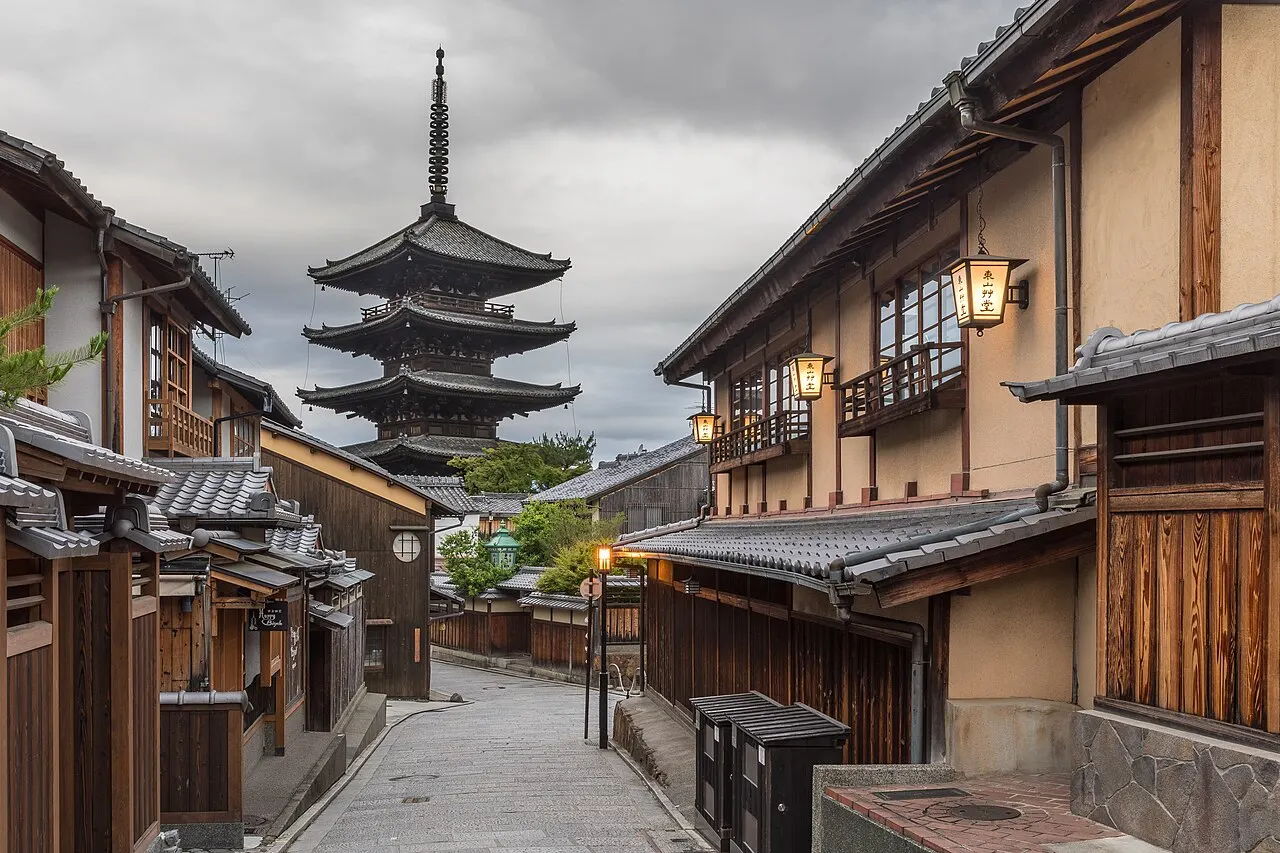
What is it like to live in Kyoto on a Working Holiday?
Kyoto is Japan's former imperial capital, a medium-sized, walkable city where tourism provides work all year in hotels, ryokan, hostels, cafés and shops. The minimum wage is ¥1,180 per hour. Work comes up faster before March-April and early December. The average August high is 33.7 °C, according to the Japan Meteorological Agency.
- How many days are there to register your address in Kyoto?
- 14 days from when you have a place to live.
- What is the minimum wage in Kyoto?
- ¥1,180 per hour.
- When is the best time to look for work in Kyoto?
- Before the high seasons: March-April (cherry blossoms) and early December (maples: in 2025, the JMA recorded the Kyoto reference maple as red on December 10).
- What is the temperature like in Kyoto?
- Average high of 33.7 °C in August and 9.1 °C in January.
⛩️ What is it like to live in Kyoto on a Working Holiday?
Kyoto is Japan's former imperial capital and its most traditional city: temples, gardens, wooden houses and a slower pace than Osaka or Tokyo, with steady work thanks to tourism. It is medium-sized and can be explored on foot or by bicycle.
How is the city of Kyoto laid out? Kyoto is laid out on a grid: Kyoto Station to the south, the shopping district of Shijo-Kawaramachi, Gion and Higashiyama to the east, with the temples, and Arashiyama to the west, with the bamboo forest. Around it are residential neighborhoods connected by train.
What is surprising about living in Kyoto? In Kyoto, the number of tourists is surprising, and that is what creates the work. In return, the temples and the walks among cherry blossoms or maples are right at hand.
🎯 Who should live in Kyoto on a Working Holiday?
Kyoto suits someone interested in traditional Japanese culture who wants to work in tourism in a manageable city; it doesn't suit someone looking for an intense nightlife or the cheapest rent.
| Kyoto is a good fit for you if… | Kyoto is not a good fit for you if… |
|---|---|
| You are interested in traditional Japanese culture | You are looking for an intense nightlife |
| You want to work in hotels, ryokan or hostels | You are looking for the cheapest rent |
| You speak English and Spanish | You can't stand the humid, windless heat of summer |
| You want to get around by bicycle | You are looking for factory or warehouse work |
🌡️ What is Kyoto's climate like, month by month?
Kyoto sits in a closed valley and has a heavy summer: an average high of 33.7 °C in August and high humidity. In winter, the average low in January is 1.5 °C, with the occasional snowfall. For people from the southern hemisphere, the seasons are reversed.
| Month | Average high | Average low | Rain | Humidity |
|---|---|---|---|---|
| January | 9.1 °C | 1.5 °C | 53.3 mm | 67% |
| February | 10 °C | 1.6 °C | 65.1 mm | 65% |
| March | 14.1 °C | 4.3 °C | 106.2 mm | 61% |
| April | 20.1 °C | 9.2 °C | 117 mm | 59% |
| May | 25.1 °C | 14.5 °C | 151.4 mm | 60% |
| June | 28.1 °C | 19.2 °C | 199.7 mm | 66% |
| July | 32 °C | 23.6 °C | 223.6 mm | 69% |
| August | 33.7 °C | 24.7 °C | 153.8 mm | 66% |
| September | 29.2 °C | 20.7 °C | 178.5 mm | 67% |
| October | 23.4 °C | 14.4 °C | 143.2 mm | 68% |
| November | 17.3 °C | 8.4 °C | 73.9 mm | 68% |
| December | 11.6 °C | 3.5 °C | 57.3 mm | 68% |
🧭 What is the weather in Kyoto in the month you arrive?
Source: the climate normals of the Japan Meteorological Agency for the Kyoto station.
🗓️ What is the best month to arrive in Kyoto on a Working Holiday?
The best months to arrive in Kyoto are spring and autumn: April and May, with highs of 20.1 to 25.1 °C, and October and November, with 17.3 to 23.4 °C. July is the rainiest month (223.6 mm) and January the driest (53.3 mm).
- Spring (March to May): from 14.1 to 25.1 °C high, with the cherry blossoms.
- Summer (June to September): rain in June and July and 33.7 °C in August.
- Autumn (October and November): 17.3 to 23.4 °C high. The maples turn red later: in 2025, the JMA recorded the Kyoto reference maple as red on December 10.
- Winter (December to February): lows of 1.5 to 3.5 °C, with the occasional snowfall.
💼 What kind of work is there in Kyoto on a Working Holiday?
In Kyoto, on a Working Holiday you can work in tourism: hotels, ryokan (traditional inns), hostels, cafés, souvenir shops, restaurants and tea houses hire all year round. Employers value people who speak English and Spanish to serve foreign guests.
| Sector | Where | Japanese |
|---|---|---|
| Hotels and ryokan | Reception and cleaning | Basic; English and Spanish add value |
| Hostels | Reception and cleaning, sometimes with accommodation | Basic or English |
| Cafés, restaurants and tea houses | Kawaramachi, Gion and the areas around the temples | Basic, for serving customers |
| Souvenir shops | Tourist areas | Basic; English and Spanish add value |
| Cleaning and kitchen work | Hotels and restaurants | None |
🧭 What work is there in Kyoto according to your level of Japanese?
Source: the Viaja con Gus Kyoto guide.
What if no work comes up in Kyoto? Osaka and Kobe they are in the same region, so the search can be widened to all of Kansai.
🌸 When is there the most work in Kyoto on a Working Holiday?
In Kyoto there is more work in the two tourist high seasons: the cherry blossoms, in March and April, and the red maples, in early December. In 2025, the Japan Meteorological Agency recorded the Kyoto reference maple as red on December 10, 5 days after its average. The first hotel or cleaning job comes up quickly if you look before those dates.
| Season | When | Average high |
|---|---|---|
| Cherry blossoms (sakura) | March and April | 14.1 °C in March and 20.1 °C in April |
| Red maples | Early December: December 10 in 2025, according to the Japan Meteorological Agency | 11.6 °C in December |
🛏️ Is there work with accommodation included in Kyoto?
Yes: hostels and ryokan in Kyoto often hire foreign receptionists and cleaning staff, sometimes with accommodation included. It is worth asking at the hostel where you spend your first nights: it greatly lowers spending in the first month.
💴 What is the minimum wage in Kyoto and how much is paid per hour?
The minimum wage in Kyoto is ¥1,180 per hour as of November 16, 2026. Night shifts carry a 25% surcharge.
| Work | Hourly pay |
|---|---|
| Minimum wage in Kyoto | ¥1.180 |
| Night shifts | 25% more |
🔎 Where to look for work in Kyoto on a Working Holiday?
In Kyoto, work is searched for on the Townwork, Baitoru and Indeed Japan portals, on GaijinPot for listings in English, and on Hello Work. In high season, walking around Kawaramachi, Gion and the areas around the temples and handing out your CV works.
- Townwork, Baitoru and Indeed Japan: the part-time job portals, in Japanese.
- GaijinPot: listings in English.
- Hello Work: the public employment agency, free of charge.
- Hostels and ryokan: ask in person.
What do you need to get hired in Kyoto? To be paid legally in Kyoto you need a bank account (Japan Post Bank is the easiest for someone who has just arrived) and the My Number.
🗣️ Which Japanese phrases help when looking for work and a room in Kyoto?
To look for work and a room in Kyoto, five Japanese phrases are enough: saying you are looking for work, asking if there is work with accommodation, saying you speak English and Spanish, asking to see the room and asking about the rent.
| In English | In Japanese | How it sounds | Copy |
|---|---|---|---|
| I am looking for part-time work | アルバイトを探しています | Arubaito o sagashite imasu | |
| Is there work with accommodation? | 住み込みの仕事はありますか | Sumikomi no shigoto wa arimasu ka | |
| I speak English and Spanish | 英語とスペイン語が話せます | Eigo to supeingo ga hanasemasu | |
| Can I see the room? | 部屋を見てもいいですか | Heya o mite mo ii desu ka | |
| How much is the rent per month? | 家賃は月いくらですか | Yachin wa tsuki ikura desu ka |
📍 Which neighborhood in Kyoto is best to live in on a Working Holiday?
In Kyoto, the most practical neighborhoods to live in on a Working Holiday are Shijo-Kawaramachi, the Kyoto Station area, Demachiyanagi, Fushimi and Yamashina. The price of a room is checked at each share house.
| Neighborhood | How it is | Who it suits |
|---|---|---|
| Shijo-Kawaramachi (center) | The shopping and nightlife district, with lots of food and shop work. | Those who want to live without depending on transport |
| Kyoto Station / Minami-ku (south) | Around the central station, with the best train and bus connections. | Those looking for good connections |
| Demachiyanagi / Sakyo-ku (northeast) | The area around Kyoto University, young and quiet, with cafés and close to the Kamo River. | Students and those looking for an international atmosphere |
| Fushimi (south) | A sake district with the Inari shrine, residential and connected to the center by train. | Those who prioritize calm |
| Yamashina (east) | On the other side of the mountain, connected by subway and train. | Those looking for a residential neighborhood close to the center |
🏠 How much does it cost to rent in Kyoto on a Working Holiday?
In Kyoto, a private room in a share house comes furnished with wifi and bills included; the price is checked at each share house. In high season it fills up: it's best to book early.
🔑 Can you rent your own apartment in Kyoto as a newcomer?
Renting a traditional apartment in Kyoto as a newcomer is not viable: when you move in you pay several charges on top of the rent, and they require a guarantor. Also, Kyoto's supply is small and touristy, and good apartments fill up fast.
| Item | Amount | Returned |
|---|---|---|
| Deposit (敷金, shikikin) | As set in the contract | Yes |
| Thank-you money (礼金, reikin) | As set in the contract | No |
| Real estate agency commission | Separate | No |
| Guarantor or guarantor company | Separate | No |
| Insurance | Separate | No |
🚲 How to get around Kyoto and how much transport costs
The best way to get around Kyoto is by bicycle: the city is flat and compact. Buses and the subway charge by route: check the current fare on the operator's website. There is subway, city buses and trains, all with the ICOCA card. You don't need a car.
Is the bus worth it in Kyoto? Kyoto's buses fill up with tourists in high season, which is why people who live in the city prefer the bicycle or the train.
⚖️ Is it better to live in Kyoto or Osaka on a Working Holiday?
Kyoto is quieter and more traditional; Osaka is livelier. Both are in Kansai, and many people live in one and work or go out in the other.
| Kyoto | Osaka | |
|---|---|---|
| Minimum wage per hour | ¥1.180 | ¥1.231 |
| Work | Tourism: hotels, ryokan and hostels | Hospitality and tourism |
| Atmosphere | Quiet and traditional | Casual and lively |
🪪 What procedures do you have to complete on arriving in Kyoto on a Working Holiday?
When you arrive in Kyoto you have to register your address at the municipal office of your neighborhood within 14 days of having a place to live, enroll in the national health insurance and open a bank account.
- 1Address registrationAt the municipal office of your neighborhood, with your residence card, or with your passport if it says «Residence card to be issued later» (Immigration Services Agency).
- 2National health insuranceAt the municipal office.
- 3Bank accountJapan Post Bank is the easiest for someone who has just arrived.
- 4SIM card or mobile lineThe bank and employers ask for it.
🛡️ How is traveler insurance (travel insurance) priced for living in Kyoto on a Working Holiday?
Traveler insurance (travel insurance) for living in Kyoto on a Working Holiday is priced according to your country of residence and the length of the trip, with 50% off GO! + an extra 20% off from Viaja con Gus.
🌎 Is there a Latin American community in Kyoto?
The Latin American community in Kyoto is small, but the one in all of Kansai is close by, with Osaka in the same region; there is also a large international community because of the universities.
- Food from home: in imported-goods shops, in Tsuruhashi (Osaka) or online.
- Meetups: get-togethers and language exchanges.
- International students: the university scene adds an international community.
🎏 What is social life like in Kyoto and what is free?
Kyoto's social life is calmer than Osaka: cafés, izakayas and the banks of the Kamo River in summer, with a lot that is free, such as the temples you can walk around the outside of, the Arashiyama bamboo forest, the cherry blossoms and the maples.
🧭 Which cities are near Kyoto to look for work?
The cities closest to Kyoto are Osaka and Kobe, in the same Kansai region; farther away are Nagoya, Kanazawa, Hiroshima and Fukuoka.
| City | Region | Climate |
|---|---|---|
| Osaka | Kansai | Humid subtropical |
| Kobe | Kansai | Humid subtropical |
| Nagoya | Chūbu | Humid subtropical |
| Kanazawa | Chūbu | Humid subtropical |
| Hiroshima | Chūgoku | Humid subtropical |
| Fukuoka | Kyūshū | Humid subtropical |
🌦️ Which city in Argentina or Uruguay does Kyoto's climate resemble?
Kyoto's climate resembles that of Santa Rosa, in La Pampa, and that of Bahía Blanca, according to the month-by-month comparison in the Viaja con Gus tool.
| City | Country and province or department |
|---|---|
| Santa Rosa | Argentina · La Pampa |
| Bahía Blanca | Argentina · Buenos Aires |
| Pergamino | Argentina · Buenos Aires |
| Mercedes | Uruguay · Soriano |
| Rosario | Argentina · Santa Fe |
| La Plata | Argentina · Buenos Aires |
📂 What do you need to have ready before traveling to Kyoto on a Working Holiday?
Before traveling to Kyoto on a Working Holiday you need seven things: traveler insurance (travel insurance), savings for the first month, a hostel for the first nights, the share house booked, your arrival date before high season, a Japanese résumé and the ICOCA.
✅ Checklist to tick off before traveling to Kyoto on a Working Holiday
🪜 How do you settle in Kyoto on a Working Holiday, step by step?
Settling in Kyoto on a Working Holiday takes seven steps: the hostel, asking about work with accommodation, the share house, address registration, the bank account, work before high season and the bicycle.
- 1Book your first nights in a hostelNear Kyoto Station or in Kawaramachi.
- 2Ask the hostels if they hire staff with accommodationIt is a common way to live in Kyoto without paying for a roof.
- 3Book the share house in advanceKyoto's supply is limited and it fills up in high season.
- 4Register your address at the municipal office of your neighborhoodWithin 14 days of having a place to live. You also sign up for the national health insurance.
- 5Open a bank accountJapan Post Bank is the easiest bank for someone who has just arrived.
- 6Look for work before high seasonThe cherry blossoms, in March and April, and the maples, in early December: in 2025, the JMA recorded the reference maple in Kyoto as red on December 10.
- 7Buy a used bicycleSave on the bus.
⚠️ What mistakes should you avoid when settling in Kyoto?
The four most common mistakes when settling in Kyoto are: not booking the share house in advance, arriving after high season, depending on the bus and transferring a deposit without seeing the room.
- Not booking the share house in advance: supply is limited and it fills up in high season.
- Arriving after high season: hiring happens before late March-April and early December.
- Depending on the bus: it fills up with tourists; the bicycle solves almost everything.
- Transferring a deposit without seeing the room: is never done.
📖 What do ryokan, sumikomi and kōyō mean when you live in Kyoto?
To live in Kyoto it helps to know thirteen Japanese terms: those for tourism work, those for renting and the two high seasons.
- Part-time work (アルバイト)
- Arubaito or baito. Hourly work that is paid by the hour.
- Traditional inn (旅館)
- Ryokan. Hires cleaning and reception staff.
- Share house (シェアハウス)
- Shea hausu. Furnished room with a shared kitchen and bathroom, no guarantor required.
- Traditional rental (賃貸)
- Chintai. An apartment rented through a real estate agency.
- Deposit (敷金)
- Shikikin. Security deposit, refundable.
- Thank-you money (礼金)
- Reikin. A payment to the landlord that is not refunded.
- Guarantor (保証人)
- Hoshōnin. The person who is responsible for the rent; it can be replaced by a guarantor company.
- With accommodation (住み込み)
- Sumikomi. Work that includes a place to live.
- Bicycle (自転車)
- Jitensha. The best way to get around Kyoto.
- Cherry blossoms (桜)
- Sakura. They bloom in March and April: high season.
- Autumn leaves (紅葉)
- Kōyō. The red maples of early December (in 2025, the JMA recorded the Kyoto reference tree on December 10): high season.
- Set meal (定食)
- Teishoku. Main dish with rice and soup.
- Izakaya (居酒屋)
- A pub serving food, the meeting place after work.
➡️ What to do after choosing Kyoto for the Working Holiday?
With Kyoto chosen, the next steps are to book where you will live, prepare your job search and draw up a budget.
🛂 How does the Japan Working Holiday work according to your citizenship?
The Working Holiday for Japan has a quota and procedures that differ according to your citizenship, according to the Ministry of Foreign Affairs of Japan: choose yours to see the requirements.
🧭 What guides are there for doing the Working Holiday in Japan?
The Viaja con Gus guides to the Working Holiday in Japan cover the full path: the form, the first procedures, where to live, work, money and daily life.
📶 How do you get internet, use a VPN and send money from Japan on the Working Holiday?
When you arrive you will need data to let people know you arrived, find accommodation and start looking for work. And when you work in another country, sooner or later you will want to send money home. This is what I use myself.
 Maya eSIMESIM
You land and your phone already has data, without changing SIM or looking for wifi. With the code VIAJACONGUS you get a 10% discount.
See Maya Mobile plans → SurfsharkVPN
Connecting to hostel and airport wifi is not safe. With a VPN you protect your data, your passwords and your banking apps.
Learn about Surfshark → RemitlyTRANSFERS
Send money home in minutes and with low fees. With the code AMB6M8 you get USD 20 off your first transfer.
See discounts →Affiliate links: we earn a commission. Ad - paid Remitly Ambassador. The Remitly code applies to transfers from the countries where it operates: confirm in the app whether it applies in yours.
What is an eSIM and is it useful for the Working Holiday in Japan? It is a virtual SIM that is installed from an app or a QR code, with no physical card. It gives you data as soon as you land, before you get a local number; afterwards many switch to a prepaid plan in the country to have their own number.
Is my phone compatible with an eSIM for traveling to Japan? Most iPhones from the XS onward and many recent Android phones are. Check it in your phone's settings before traveling and confirm that it is unlocked.
Do you need a local number on the Working Holiday in Japan? Yes, in the long run: the bank, employers and procedures ask for it. The eSIM covers you for the first days; afterwards get a SIM or a plan in the country.
What is a VPN for on the Working Holiday in Japan? To protect your data and your banking apps when you use wifi in hostels, airports or cafés, where anyone on the same network could see your traffic.
What is the cheapest way to send money home from Japan on the Working Holiday? A transfer service that shows the fee and the final amount before sending, generally cheaper than an international bank transfer.
❓ Frequently asked questions about living in Kyoto on a Working Holiday
Is it easy to find work in Kyoto on a Working Holiday?
Yes, finding work in Kyoto on a Working Holiday is easy, thanks to tourism: hotels, ryokan, hostels, cafés and shops hire all year round.
What kind of work there is →Do you need to speak Japanese to work in Kyoto?
With basic Japanese you find work quickly; without Japanese there is cleaning and kitchen work.
Work by your Japanese level →Is it useful to speak Spanish to work in Kyoto?
Yes: speaking Spanish helps you work in Kyoto, because tourism employers value people who speak English and Spanish.
What kind of work there is →When is the best time to look for work in Kyoto?
In Kyoto it is best to look for work before the high seasons: March-April, for the cherry blossoms, and early December, for the maples: in 2025, the Japan Meteorological Agency recorded the Kyoto reference maple as red on December 10.
High seasons →Is there work with accommodation included in Kyoto?
Yes, there is work with accommodation included in Kyoto: hostels and ryokan hire reception and cleaning staff, sometimes with accommodation.
Work with accommodation →What is the minimum wage in Kyoto?
The minimum wage in Kyoto is ¥1,180 per hour.
Minimum wage and salaries →How much is paid per hour for hourly work in Kyoto?
In Kyoto, hourly work pays at least the prefectural minimum wage, ¥1,180 per hour; night shifts carry a 25% surcharge.
Minimum wage and salaries →Where do you look for work in Kyoto?
In Kyoto, work is searched for on Townwork, Baitoru, Indeed Japan and GaijinPot, at Hello Work, and by handing out your CV in Kawaramachi and Gion.
Where to look for work →Is it better to live in Kyoto or Osaka?
Kyoto is quieter and more traditional; Osaka is livelier. Both are in Kansai, and many people live in one and work or go out in the other.
Kyoto or Osaka →Can you rent an apartment in Kyoto as a newcomer?
Renting an apartment in Kyoto as a newcomer is difficult: they ask for a guarantor, and when you move in you pay a deposit, reikin, commission and insurance on top of the rent.
Your own apartment →Where do students live in Kyoto?
Students live in Kyoto in Demachiyanagi, in Sakyo-ku, near Kyoto University.
Neighborhoods →Where to stay the first few days in Kyoto?
For the first few days in Kyoto it is best to stay in a hostel near Kyoto Station or in Kawaramachi.
Step by step →Do you need a bicycle in Kyoto?
Yes: the bicycle is the best way to get around Kyoto, because the city is flat and compact.
How to get around →Is summer very hot in Kyoto?
Yes: summer in Kyoto is hot, with an average high of 33.7 °C in August and high humidity, because the city sits in a closed valley.
The climate, month by month →Is it cold in Kyoto in winter?
Yes: in Kyoto, in January the average high is 9.1 °C and the average low is 1.5 °C.
The climate, month by month →What is the rainiest month in Kyoto?
The rainiest month in Kyoto is July, with 223.6 mm.
The climate, month by month →What is the best time to arrive in Kyoto?
The best time to arrive in Kyoto is spring and autumn.
When to arrive →Is there a Latin American community in Kyoto?
The Latin American community in Kyoto is small, but the one in Kansai is close by, since Osaka is in the same region.
Latin American community →How much does traveler insurance (travel insurance) cost for living in Kyoto on a Working Holiday?
Traveler insurance (travel insurance) for living in Kyoto on a Working Holiday is priced according to your country and the length of stay, with 50% off GO! + an extra 20% off from Viaja con Gus.
Traveler assistance (travel insurance) →What procedures do you have to complete when you arrive in Kyoto?
When you arrive in Kyoto you have to register your address within 14 days, enroll in the national health insurance and open a bank account.
Procedures on arrival →
💬 Comments and questions: Living in Kyoto on a Working Holiday
There are no comments yet. Be the first.
Do you have any doubts? Leave your question down here and I will answer you personally. And if you have already been through this, tell us how it went: your experience helps the next traveler.
🛠️ Working Holiday tools
📚 More Working Holiday guides
📑 Sources on living in Kyoto on a Working Holiday
See sources ▾
- Japan Meteorological Agency (JMA): Kyoto climate normals
- Ministry of Health, Labour and Welfare (MHLW): minimum wage by prefecture
- Viaja con Gus: the guides to each city in Japan
Last verification: November 2026. Rules, quotas and amounts change often: always confirm with the official source before starting any procedure. How we verify →

I worked in tourism in Argentina, Brazil, Paraguay, Croatia and the United States. I verify every fact in this guide against the official source and update it when it changes.
