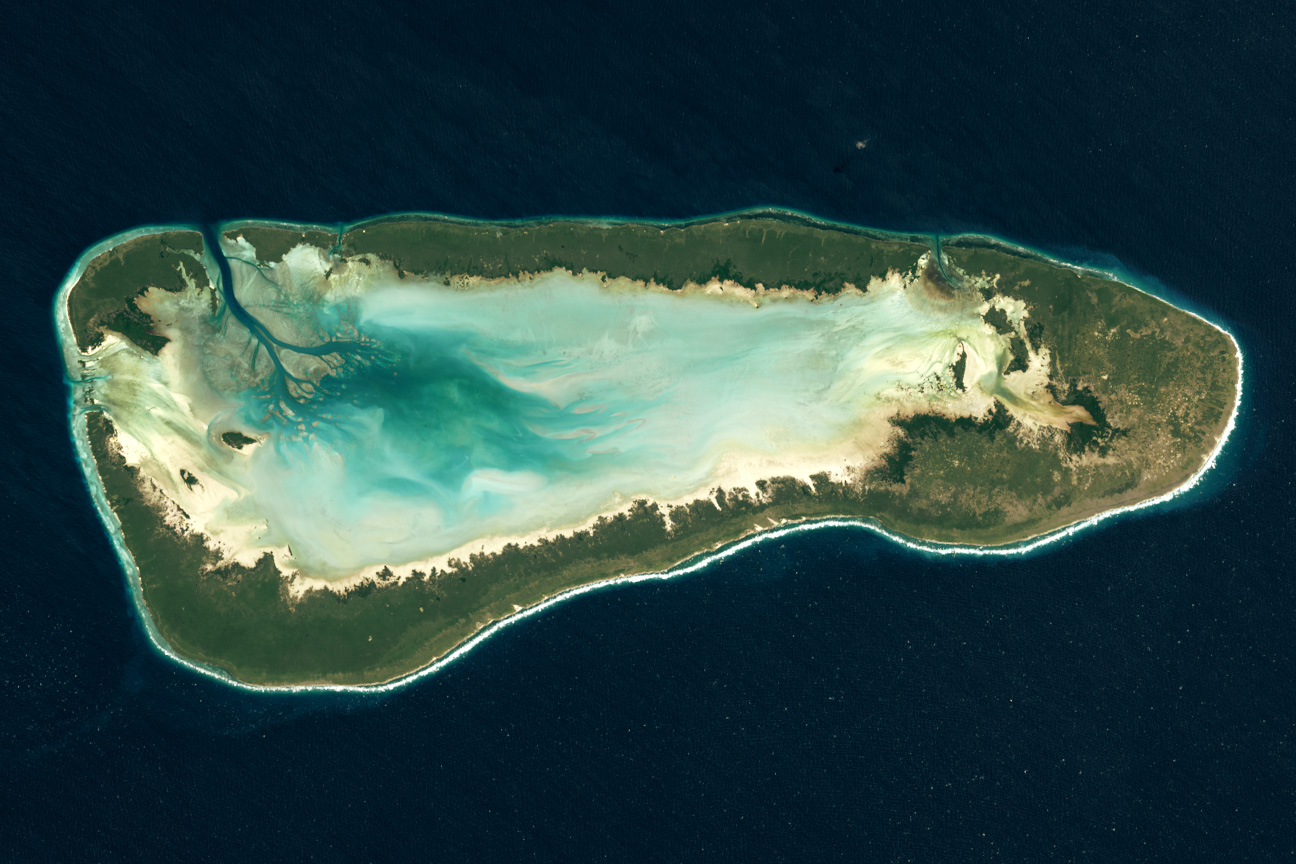
Aldabra is the great secret sanctuary of Seychelles: the largest raised coral atoll in the world, so remote and protected that very few travellers ever set foot on it. More than a thousand kilometres from the tourist islands, at the country's far south-western edge, it is an almost untouched place, a 'Galápagos of the Indian Ocean' where nature has survived as it has in few corners of the planet. UNESCO declared it a World Heritage Site in 1982.
Its symbol is the giant tortoise: Aldabra is home to around 100,000 Aldabra giant tortoises, more than anywhere else on Earth, including the Galápagos Islands. Add to that huge seabird colonies, the Aldabra rail (the last flightless bird in the Indian Ocean), manta rays, sharks, dugongs and a spectacular inner lagoon that empties and fills with the tides. It is a biodiversity treasure of global importance.
This practical guide tells you honestly what visiting Aldabra is like (and what it isn't): a destination that is very hard and expensive to reach, open only to expeditions authorised by the Seychelles Islands Foundation, with no tourist infrastructure. For the vast majority, Aldabra is 'visited' through documentaries and a fascination with its wildlife; for a lucky few, it is the trip of a lifetime.
Aldabra escaped the exploitation that ravaged other islands precisely because of its remoteness and lack of fresh water, which prevented permanent settlements. In the 19th and 20th centuries it was threatened by tortoise hunting and exploitation schemes, and in the 1960s it narrowly avoided becoming a British-American military base, thanks to a famous international scientific campaign. Protected ever since and declared a World Heritage Site in 1982, it is now managed by the Seychelles Islands Foundation. Its full story is told on our history page.
Read the full history ↓From the untouched Eden of Silhouette to the bird colonies of Bird Island and the far-flung Aldabra atoll, a World Heritage Site with more giant tortoises than the Galápagos.
Read the history of Remote islands and nature sanctuaries →No exact prices: a scale from $ (budget) to $$$$$ (luxury), with 2-3 options per category.
Origins, formation and what the sources say.
Unlike the granitic islands at the heart of the Seychelles, Aldabra belongs to the coralline Outer Islands, and it is geologically extraordinary: the largest raised coral atoll in the world. It formed over hundreds of thousands of years as coral built up on a submerged volcanic base. Rises and falls in sea level over successive ice ages left its old coral platform above water, and today it is sharp, pitted limestone.
The result is four large islands of coral rock (Grande Terre, Malabar, Picard and Polymnie) enclosing a huge inner lagoon, so big that the island of Mahé would fit inside it. With every tide, a colossal volume of water flows in and out through the channels between the islands, and that flow governs all life on the atoll. It is a unique landscape, wild and tough, very different from the postcard beaches of the rest of the Seychelles.
That harsh terrain, with its razor-sharp rock, scarce fresh water and extreme isolation, turned out to be a blessing. It made Aldabra practically impossible to settle permanently and unappealing for intensive exploitation, and that preserved its nature. Over time the atoll became a refuge where species survived after dying out across almost all of the rest of the Indian Ocean.
Many islands in the western Indian Ocean were once home to giant tortoises. Then humans arrived, hunting them for meat and oil and bringing in other animals, and the tortoises were wiped out one after another. In Madagascar, Mauritius, Réunion and the granitic islands of the Seychelles themselves, the giant tortoises vanished. Aldabra was the great exception: its remoteness and hostile terrain saved its population from being wiped out.
Even so, Aldabra was at risk. During the 18th and 19th centuries, whaling and trading ships stopped there to load live giant tortoises as a supply of fresh meat for their voyages, and the species came under heavy pressure. On top of that, people tried to exploit the atoll for its resources (timber, guano, fish) and set up temporary workers' settlements.
Thanks to its isolation and some early protection measures, Aldabra's tortoise population held on. Today it numbers around 100,000 giant tortoises (Aldabrachelys gigantea), the largest population in the world and far more than in the Galápagos. Aldabra is also the source of the giant tortoises now living again on other Seychelles islands, such as Curieuse, Cousin and Bird Island. The atoll is, quite literally, the ark that saved the species.
The most dramatic chapter in Aldabra's modern history came in the 1960s. At the height of the Cold War, the governments of the United Kingdom and the United States seriously considered turning the atoll into a military base with a large airstrip. The project would have been an ecological disaster: destroyed habitat, introduced species and the end of the tortoise and bird sanctuary.
The international scientific community responded with an unprecedented campaign. Scientific bodies such as the UK's Royal Society organised expeditions and lobbied the governments. They argued that Aldabra was irreplaceable for evolutionary biology and conservation and compared it to the Galápagos. The scientists and naturalists did what had seemed impossible, and the military project was finally dropped in the late 1960s.
That victory was a milestone in the history of conservation and settled Aldabra's future. Instead of becoming an air base, the atoll moved towards full protection. It was one of the first major cases of science halting a military project for the sake of nature, and it paved the way for its worldwide recognition as an ecological treasure.
After escaping the military project, and with Seychelles independence in 1976, Aldabra was placed under strict protection. In 1982, UNESCO declared it a World Heritage Site in recognition of its outstanding universal value. It is the largest raised coral atoll in the world and a nearly untouched ecosystem, home to the giant tortoises, the Aldabra rail (the last flightless bird in the Indian Ocean) and biodiversity comparable to that of the Galápagos.
Management of the atoll went to the Seychelles Islands Foundation (SIF), a foundation set up to protect and study Aldabra (and the Vallée de Mai on Praslin). The SIF runs a small permanent research station on Picard island. There, scientists and rangers watch over the atoll, monitor the wildlife, tackle illegal fishing and invasive species, and manage the few visits through quotas, permits and conservation fees.
Today Aldabra remains one of the most untouched and best-protected places on the planet. It is a model of conservation, funded in part by tourism that is very limited and very expensive. Its story sums up the fight to preserve the last wild corners of the Earth: a remote refuge, then a coveted military base that never happened, and finally a sanctuary for humanity. For the world, Aldabra is a symbol of what nature can still be when it is left alone.