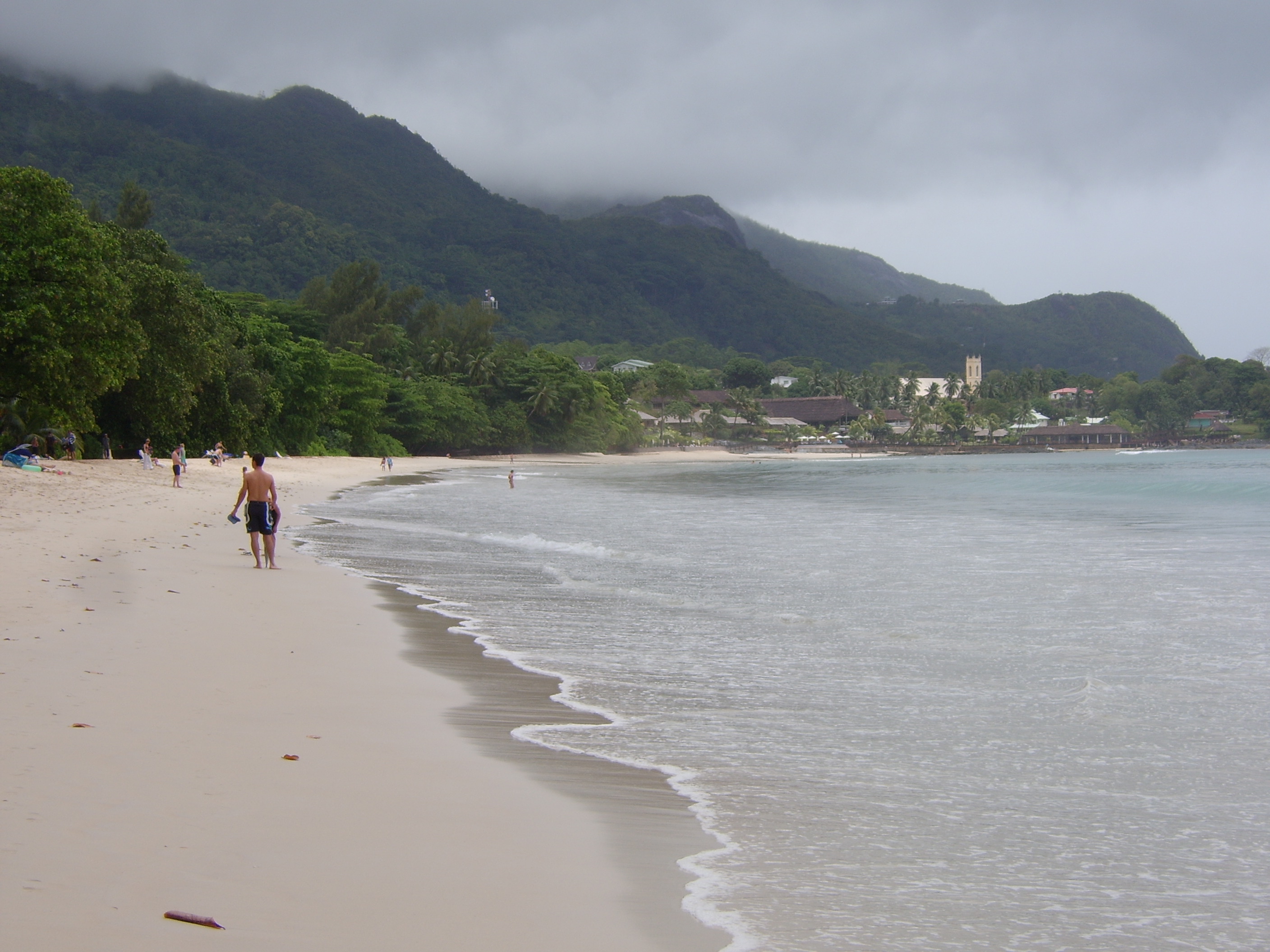
Beau Vallon is Seychelles' favourite beach: a wide crescent of golden sand in northwest Mahé, with generally calm water, green hills behind it and some of the most celebrated sunsets in the Indian Ocean. Unlike the deserted, wild beaches the country is famous for, Beau Vallon is sociable and practical: there are hotels, restaurants, water sports and a steady coming and going of local swimmers and travellers that make it the tourist heart of the main island.
Its big advantage is that it combines beauty with services. It is the best place on Mahé for diving and snorkelling —it has several dive centres and access to wrecks, reefs and the nearby Baie Ternay Marine Park— and it is also a beach where you can swim comfortably almost all year, which is rare in Seychelles. As evening falls, the sand fills with people who come to watch the sun sink into the sea in front of the distant outline of Silhouette island.
This guide covers Beau Vallon from a practical angle: how to enjoy the beach and its water sports, where to dive and snorkel, when the Creole night market and its street food are on, where to eat a good fish curry and how to use the bay as a base for exploring the rest of Mahé. It is the ideal starting point for anyone who wants to combine beach, diving and comfort on the largest island in Seychelles.
Beau Vallon —'beautiful valley' in French— was for centuries a quiet bay of fishermen and coconut palms on the northwest coast of Mahé, the island France began to colonise in 1770. When Seychelles opened up to tourism after its international airport opened in 1971, this wide, safe beach close to Victoria was one of the first to be developed, with the pioneering hotels of the 1970s. Today it is the biggest tourist hub on the main island, though it keeps its beach-village feel. The wider history of Seychelles and Mahé is told on our history page.
Read the full history ↓The largest island and the heart of the country: this is where France set its Stone of Possession in 1756, where Victoria grew into Africa's smallest capital, and where the Morne Seychellois, the archipelago's highest peak, rises.
Read the history of Mahé and Victoria →They depart from Praslin, 48 km away. If you book from this link we earn a commission and you pay no more.
No exact prices: a scale from $ (budget) to $$$$$ (luxury), with 2-3 options per category.
Origins, formation and what the sources say.
Before becoming the most touristy beach in Seychelles, Beau Vallon was for centuries a quiet bay on the north-west coast of Mahé, devoted to fishing and coconut growing. Its French name ('beautiful valley') describes the amphitheatre of green hills around the sand, a particularly sheltered and fertile corner of the island. When the French began colonising Mahé from 1770, they divided this land into plantation concessions, and the coast filled with coconut palms. Their copra (dried coconut flesh) was for a long time one of the archipelago's main exports.
Life in Beau Vallon revolved around the sea and the land. Creole fishing families went out in their pirogues for tuna, snapper and octopus, and labourers worked the coconut, cinnamon and vanilla plantations that covered the slopes. The bay was wide and calm, so it made a natural anchorage and a good landing point, sheltered from the swell that pounds other parts of the island's coast. Wooden Creole houses with palm-thatched roofs were dotted along the shore and up the valley.
That rural, isolated Seychelles changed little for almost two centuries. With no airport and no tourism, the islands lived off plantation farming and fishing, and Victoria, a few kilometres away, was the only town. Beau Vallon was simply the beach near the capital. People from Mahé came to swim and fishermen came to work, and nothing hinted that it would one day become the country's tourist showcase.
The north-west coast of Mahé, and especially the neighbouring village of Bel Ombre, is wrapped in one of the most famous legends of the Indian Ocean: the treasure of the French corsair Olivier Levasseur, nicknamed 'La Buse', the buzzard. In the 18th century the waters of Seychelles were uninhabited and lawless. Pirates and corsairs hid there and attacked the rich ships sailing to and from India. Levasseur was one of the most feared, famous for capturing a Portuguese galleon loaded with fabulous loot in 1721.
La Buse was captured years later and hanged on Réunion island in 1730. Legend has it that on the gallows he threw a necklace bearing a 17-line cryptogram into the crowd and shouted: 'My treasure to whoever can understand it!'. Ever since, generations of treasure hunters have tried to decipher the message. They are convinced the loot is buried somewhere on the coast of Mahé, most likely on the beaches of Bel Ombre, right next to Beau Vallon.
The most famous of these treasure hunters was the Briton Reginald Cruise-Wilkins. From the 1940s onwards he spent decades digging and studying the rock formations of Bel Ombre, following Masonic and mythological clues. He died without finding anything, and his son carried on the search. La Buse's treasure has never turned up (if it ever existed), but the legend lives on. It gives this quiet coast an air of mystery that is part of its charm.
The big turning point in Beau Vallon's history came in 1971, when Seychelles International Airport opened on land reclaimed from the sea near Victoria. Until then, reaching the islands meant days at sea, and there was almost no tourism. The air link with the rest of the world transformed the country's economy almost overnight. It brought the first international visitors, drawn by beaches that magazines were starting to call the ultimate paradise.
Beau Vallon was close to Victoria, wide, safe for swimming and beautiful, so it was one of the first beaches to be developed. The pioneering hotels of Seychelles tourism opened there in the 1970s, the Coral Strand among them, and the bay became the showcase of the new industry. Golden sand, calm water and spectacular sunsets made Beau Vallon the postcard image Seychelles first used to sell itself to the world.
Tourism grew alongside local life. The fishermen kept going out to sea and Creole families held on to their homes, while hotels, restaurants and dive centres went up around them. Other beaches in the country stayed wild or ended up inside exclusive resorts. Beau Vallon instead became a 'public and lively' beach where tourists and Seychellois mix, and it still has that character today. It is what sets it apart from the rest.
Today Beau Vallon is the biggest tourist hub on Mahé and one of the best-known beaches in the whole Indian Ocean. It has large resorts, mid-sized hotels, Creole guesthouses, restaurants, pizzerias and several dive centres, which have made it the diving capital of the main island. From here you can dive on reefs and wrecks, snorkel in the nearby Baie Ternay Marine Park and go out on the sport-fishing trips Seychelles is famous for.
Despite all this development, Beau Vallon is still a popular, sociable beach. Seychellois still come down to swim and watch the sunset. Twice a week the sand fills up with the 'Bazar Labrin', a night market of Creole food, crafts and music that is one of the best things to do on Mahé. That mix of international tourism and local life gives it a different feel from the country's more exclusive and secluded beaches.
Like the rest of Seychelles, Beau Vallon depends on the health of its natural environment. The coral reefs suffered bleaching in 1998 and 2016 as the sea warmed, the beach is eroding, and development has to be balanced with conservation. Even so, it is still where many travellers first discover the sea in Seychelles and where they set up base to explore Mahé. It has been the gateway to the archipelago since tourism began here, and it still plays that role.