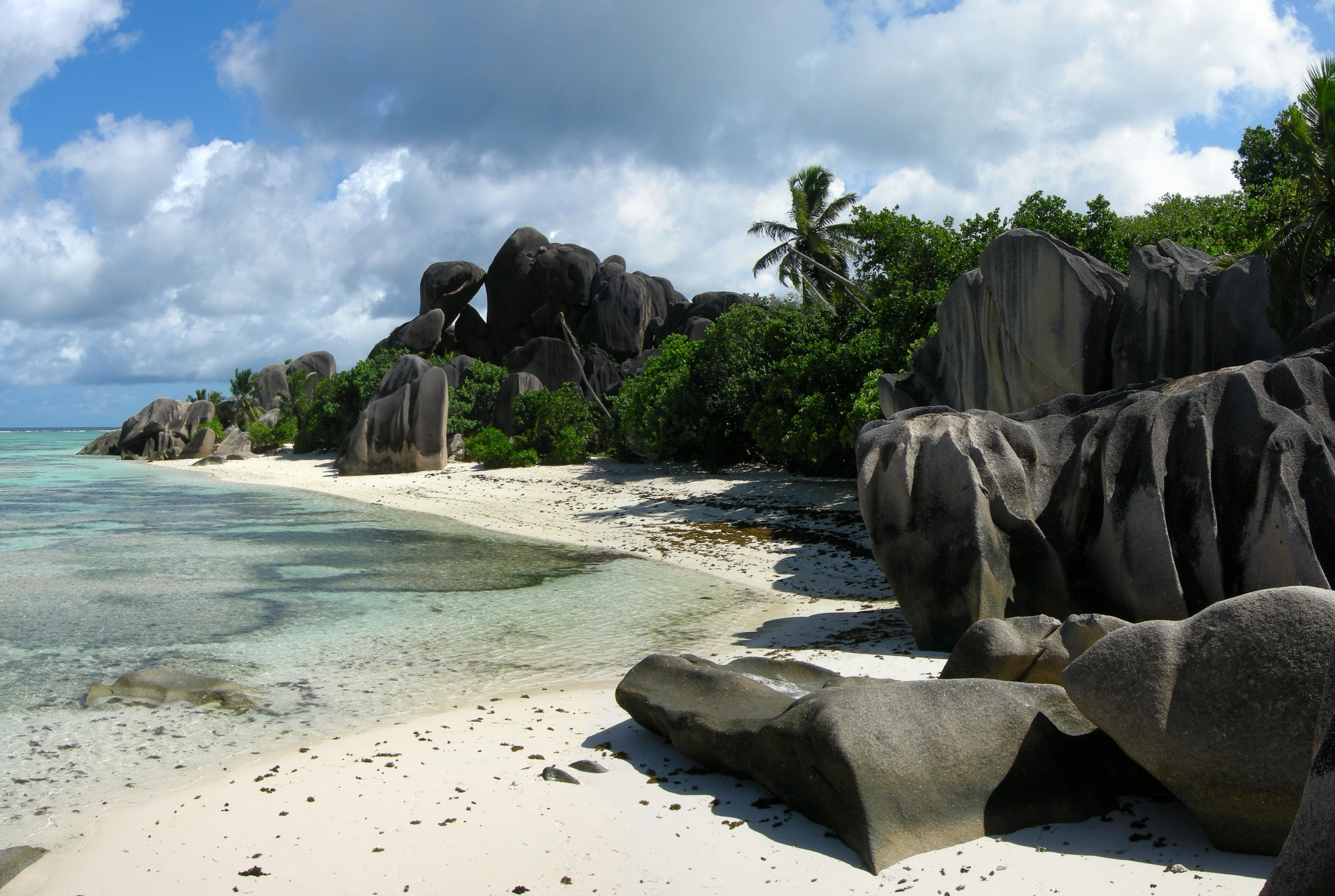
Anse Source d'Argent is, quite simply, the most famous beach in the Seychelles and one of the most photographed on the planet. Its image —coves of white sand, clear turquoise water and huge pink granite boulders rounded over millions of years— is the one that appears on most of the country's postcards, campaigns and adverts. It is on the island of La Digue, within the old L'Union Estate, and it is the only beach on the island with a paid admission.
What makes it so special is not just the beauty of the sand and water, but the granite scenery: giant boulders sculpted by erosion that form secluded nooks, arches and natural pools. Sheltered by the reef, the sea is usually calm and shallow, perfect for paddling, gentle snorkelling and, above all, photos, especially in the golden light of sunset.
This practical guide tells you how to get to Anse Source d'Argent, how much admission through L'Union Estate costs, the best time and tide to visit, what to keep in mind when swimming and how to combine it with the rest of La Digue. It is a place that almost always exceeds expectations: give yourself time and go without rushing to really enjoy it.
Anse Source d'Argent is part of L'Union Estate, a former coconut and vanilla plantation on La Digue whose past goes back to the French colonial era and the copra economy. Its spectacular granite rocks are in fact fragments of the ancient continent of Gondwana, among the oldest granite formations in the world rising above the sea. With the arrival of tourism in the Seychelles, the beach became the visual icon of the archipelago. Its history —geological, colonial and tourist— is told on the La Digue history page.
Read the full history ↓The island where time stands still: with hardly any cars and beaches of sculpted granite like Anse Source d'Argent, it keeps the most authentic Creole Seychelles.
Read the history of La Digue →They depart from La Digue, 2 km away. If you book from this link we earn a commission and you pay no more.
No exact prices: a scale from $ (budget) to $$$$$ (luxury), with 2-3 options per category.
Origins, formation and what the sources say.
The iconic image of Anse Source d'Argent, those huge rounded boulders that look as if a giant placed them there, is no accident of chance. It is the record of a geological history hundreds of millions of years long. The Inner Islands of the Seychelles, including La Digue, are the only fragments of continental granite rising in the open Indian Ocean, far from any continent. They are remnants of the ancient supercontinent of Gondwana, which began to break apart more than 150 million years ago.
When the block that is now India split from Africa and Madagascar and began its slow journey north, it left this small splinter of granite crust behind. That granite, around 750 million years old, was left stranded in the middle of the sea. Over geological eras, wind, rain and waves wore its blocks down and rounded them into the sculpted shapes we admire today at Anse Source d'Argent.
That combination is what makes the beach unique, and the Seychelles as a whole, compared with the coral atolls of the rest of the Indian Ocean. Here the landscape comes from the oldest continental rock standing above the ocean, set off by white coral sand and palm trees. No other tropical coast in the world has quite this setting.
Anse Source d'Argent lies within L'Union Estate, and its human history is the history of that old plantation. As French settlers and, after 1814, the British developed La Digue's economy, the coconut palm became the island's main crop. L'Union Estate produced copra, the dried coconut flesh that oil is extracted from. It also grew vanilla, a delicate and very profitable crop that had to be pollinated by hand.
The heart of the estate was the ox-driven copra mill, which still survives and is shown working to visitors. The animals walked in a circle, turning a large wheel that pressed the coconut. Around the mill stood the Plantation House, the storehouses, the vanilla plantations and the cemetery of the first settlers. For generations all that work depended on the labour of enslaved people and, after abolition, of Creole farm workers.
When the copra trade declined in the 20th century and tourism took off, L'Union Estate stopped being a farm and became a heritage park. Today it keeps giant Aldabra tortoises in an enclosure, as well as the mill, the colonial house and the imposing Union Rock. It is also, quite literally, the gateway to the country's most famous beach.
The history of Anse Source d'Argent cannot be separated from that of La Digue, the most traditional of the large Seychelles islands. La Digue was settled from the late 18th century by French colonists and by enslaved people brought from Africa and Madagascar. It developed a strong Creole identity, with its own language, cuisine and customs, and for centuries it lived in isolation from coconuts and the sea.
For generations that isolation meant poverty, but it also preserved the landscape and the way of life. There are hardly any cars, people get around by bicycle and ox cart, and the Creole architecture and natural surroundings stayed almost untouched. When tourism discovered the island, it found more than extraordinary beaches. It found a human and natural setting preserved as in few other places in the Indian Ocean.
Anse Source d'Argent, protected within L'Union Estate, benefited from that preservation. Instead of being built up, the beach stayed wild, with its rocks, coconut palms and shallow waters, and the only change was that access came to be regulated through the historic estate. So a visit here is also a glimpse into La Digue's farming and Creole past.
For most of its history Anse Source d'Argent was a remote, almost secret beach, known only to the people of La Digue and a handful of travellers. Everything changed with the opening of Mahé's international airport in 1971 and Seychelles independence in 1976. The archipelago opened up to international tourism, and its beaches started appearing in magazines, brochures and travel campaigns.
With its one-of-a-kind mix of pink granite, white sand and turquoise water, Anse Source d'Argent soon became the defining image of the Seychelles. Its outline featured in advertisements, guidebook covers, documentaries and tourism campaigns around the world, and it regularly topped lists of 'the most beautiful beaches on the planet'. Few beaches have been photographed so often.
That fame also brought challenges. Rising visitor numbers made it necessary to manage access through L'Union Estate and to look after a fragile environment. Today Anse Source d'Argent embodies the tension found across the Seychelles between showing its treasures to the world and protecting them. Even so, it can still exceed the expectations of anyone who arrives with the postcard in mind. The reality, with the sunset light on the granite, is often even more beautiful.