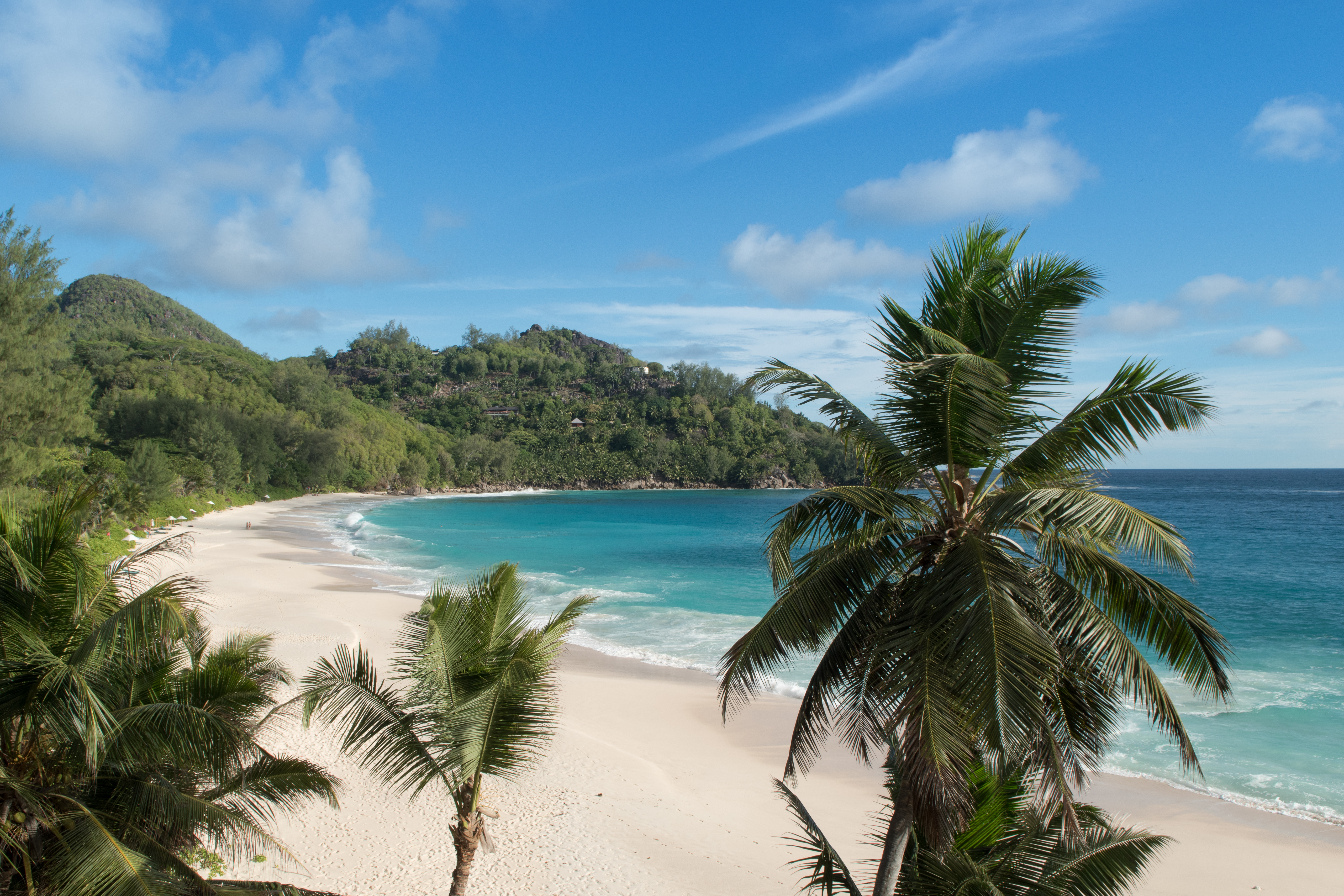
Anse Intendance is the quintessential wild beach of the Seychelles: a wide crescent of fine white sand in the south of Mahé island, wide open to the Indian Ocean. Lacking the coral reef that shelters other beaches in the country, here the sea breaks hard in big, foamy waves that make it spectacular for photos and sought after by surfers, though they demand respect when you go into the water.
It is the picture of untamed paradise, with no buildings in sight and a backdrop of palm trees and takamaka trees leaning over the sand. Very different from the calm, service-packed beaches of northern Mahé, Anse Intendance wins you over with its raw beauty and relative solitude. It is also an important nesting site for sea turtles, which in season come ashore at night to lay their eggs in this sand.
This guide covers Anse Intendance from a practical angle: when the sea is calmest for swimming and when it brings the best waves, how to get there along the south coast of Mahé, what precautions to take with the currents, what other spectacular beaches are nearby and why this is one of the must-stop photo spots in the country. For anyone looking for the wild, less touristy Seychelles, Anse Intendance is a must.
The name 'Anse Intendance' recalls the French colonial era of the Seychelles: 'anse' means 'cove' or 'inlet' in French, and 'intendance' refers to the colonial administration (the intendant who managed the land). Like the whole of Mahé island, this south coast was coconut and spice plantation land from the late 18th century, and remained remote and sparsely populated for generations. With no harbour and no protective reef, it was left out of development, which kept it wild until tourism arrived. The general history of the Seychelles and Mahé is told on our history page.
Read the full history ↓The largest island and the heart of the country: this is where France set its Stone of Possession in 1756, where Victoria grew into Africa's smallest capital, and where the Morne Seychellois, the archipelago's highest peak, rises.
Read the history of Mahé and Victoria →They depart from Praslin, 57 km away. If you book from this link we earn a commission and you pay no more.
No exact prices: a scale from $ (budget) to $$$$$ (luxury), with 2-3 options per category.
Origins, formation and what the sources say.
There's a geographical reason behind the wild beauty of Anse Intendance. Most beaches in the Seychelles are sheltered by coral reefs that grow offshore and break the swell, creating lagoons of calm turquoise water. Anse Intendance, by contrast, faces the Indian Ocean directly with no such barrier: the sea rolls in unchecked from open water and crashes hard onto the sand, carving out a wide beach with powerful waves and demanding currents.
The island of Mahé, like the rest of the Seychelles' inner islands, is made of granite: a fragment of the ancient supercontinent of Gondwana that was left stranded in the middle of the ocean when India split away from Africa and Madagascar tens of millions of years ago. The rounded granite boulders scattered along this southern coast, together with the white sand formed by the erosion of coral and of the granite itself, give Anse Intendance its signature landscape: a broad beach framed by tropical vegetation and blocks of stone.
That exposure to the open sea, which today makes it so photogenic and so prized by surfers, was for centuries the reason it stayed isolated. With no reef and no sheltered cove, it was useless as an anchorage or a harbour, so it remained on the sidelines of settlement and maritime activity. The south of Mahé, more rugged and pounded by the surf, thus stayed less populated and more natural than the north, something that holds true to this day.
The name 'Anse Intendance' is a direct testament to the Seychelles' French colonial past. 'Anse' means 'cove' or 'inlet' in French, and it appears in dozens of beach names across the archipelago (Anse Lazio, Anse Georgette, Anse Source d'Argent…), a reminder that it was the French who mapped and named these shores. 'Intendance' refers to the 'intendancy', the colonial administration: the intendant was the official in charge of managing the colony's land and economic affairs. The place name therefore suggests land linked to that administration.
France began colonising Mahé from 1770, dividing the island into plantation concessions worked by enslaved people brought from Africa and Madagascar. The southern coast, Anse Intendance included, was part of that world of coconut, cinnamon, vanilla and other plantations, although its relative distance from the administrative centre in Victoria and its lack of a harbour kept it a remote, thinly populated area. The Creole families who settled here lived off the land and the sea, in a rugged setting.
For almost two centuries, this southern part of Mahé changed little. The coconut plantations produced copra for export, cinnamon ran wild across the hillsides and life moved at a slow, isolated, rural pace. Back then, the beauty of beaches like Anse Intendance had no economic value: they were simply rough coastlines, good for fishing and not much else. It wasn't until the second half of the 20th century that the world began to see these sands differently.
The big change came with tourism, after Seychelles International Airport opened in 1971 and the country gained independence in 1976. Suddenly, the wild, remote beaches that had been left out of development became the archipelago's greatest treasure. Anse Intendance, with its wide sand, spectacular waves and unspoilt surroundings, became one of the iconic images of the Seychelles, reproduced on postcards, in brochures and in campaigns promoting an 'untamed paradise'.
Unlike other stretches of coast, Anse Intendance kept its natural character: the few places to stay that opened in the south — luxury resorts tucked away in the vegetation — were designed to blend into the landscape without spoiling it, and the beach itself remained public, with nothing built on the sand. That mix of wild beauty and low-key exclusivity has made it especially popular with travellers looking for nature and peace and quiet rather than facilities and crowds.
The beach also gained recognised ecological value: it is one of Mahé's sea turtle nesting sites, particularly for the endangered hawksbill turtle, which comes ashore to lay its eggs in the sand. The Seychelles, a world pioneer in conservation, strictly protects these turtles, and organisations and resorts monitor the nests. Anse Intendance thus embodies the dual role of the country's beaches: a first-class tourist destination and a refuge for fragile nature that must be preserved.
Today Anse Intendance represents the wildest, most authentic face of the Seychelles' beaches, a counterpoint to the calm lagoons and the beaches with facilities in the north of Mahé. It's a must for photographers, surfers and nature lovers, drawn by its waves, its pristine sand and the absence of any buildings in sight. It regularly appears on lists of the world's most beautiful beaches, precisely because of that raw, barely tamed beauty.
Its lack of infrastructure — no stalls, no beach bars, no sunbeds or umbrellas for hire — is an essential part of its appeal, although it means visitors need to come prepared and be careful in the water. The same ocean power that makes it so spectacular demands respect: rip currents have caused some scares, and swimming calls for caution, especially during the season of heavy swell. It's a beach to admire and enjoy mindfully rather than a natural swimming pool.
Anse Intendance is part of the great tour of Mahé's southern coast, a string of beaches — Baie Lazare, Anse Takamaka, Anse Soleil, Petite Anse — that many travellers explore by car in a single day. Taken together, this coast shows the less touristy, more natural Seychelles: sands battered by the open sea and tropical vegetation running right down to the shore. Anse Intendance, with its endless surf breaking on the white sand, is the symbol of that wild island that lives on alongside the postcard paradise.