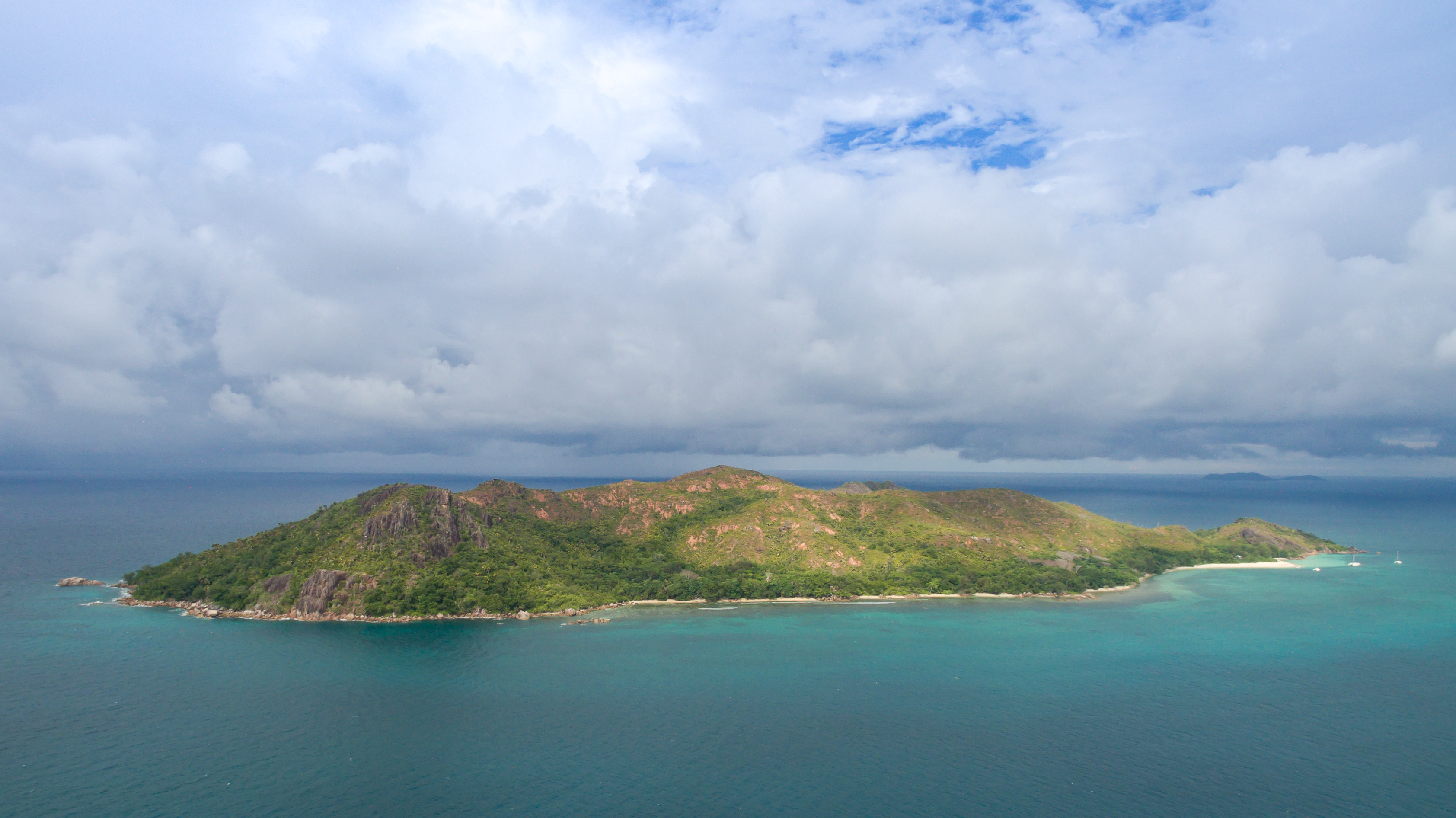
Curieuse is one of the most recommended nature trips in the Seychelles and Praslin's perfect neighbour. On this small, uninhabited granite island, protected as a national marine park, hundreds of Aldabra giant tortoises roam freely along the beach and through the forest, so you can see and photograph them up close in an almost wild setting, something rare anywhere in the world.
But Curieuse is much more than its tortoises: it has a splendid mangrove forest crossed by a wooden boardwalk, beaches with sand sometimes tinted red by the lateritic soils, good snorkelling in the marine reserve and a unique history. It was a source of coco de mer, burned in the 18th century and served as a leper colony for decades; from that era the Maison du Médecin, the doctor's house, survives, now a small museum.
This practical guide tells you how to visit Curieuse from Praslin, how much the park admission costs, what to see on the island —tortoises, mangroves, the doctor's house and the beaches—, and how to combine it with snorkelling at St. Pierre or with neighbouring Cousin. It is an ideal day out, mixing wildlife, history and great swimming in protected waters.
Curieuse was named by Marion Dufresne's French expedition in 1768 and soon drew attention for its coco de mer palms, the same unique species found in the nearby Vallée de Mai. A great fire destroyed much of its forest in 1771. In the 19th century and until 1965 the island served as a leper colony, and the Maison du Médecin, the doctor's house, dates from that period. Today it is a national marine park and a sanctuary for Aldabra giant tortoises. Its full history —from coco de mer to leprosy and conservation— is told on our history page.
Read the full history ↓The country's second island and its cluster of reserves: here, in the Vallée de Mai, grows the coco de mer, and on the neighbouring islands pioneering conservation in the Indian Ocean was born.
Read the history of Praslin and the nearby islands →They depart from Praslin, 4 km away. If you book from this link we earn a commission and you pay no more.
No exact prices: a scale from $ (budget) to $$$$$ (luxury), with 2-3 options per category.
Origins, formation and what the sources say.
Like the rest of the Inner Islands of the Seychelles, Curieuse is a granite island: a fragment of the ancient supercontinent of Gondwana that was left stranded in the middle of the Indian Ocean when India split from Africa and Madagascar more than 150 million years ago. That continental origin, extremely rare for an oceanic island, explains its massive boulders and its unusual soils, including the iron-rich lateritic earth that gives some of its beaches a distinctive reddish tint.
Before the Europeans arrived, Curieuse was an untouched Eden. Its greatest botanical treasure was, and still is, the coco de mer palm (Lodoicea maldivica), the same unique species that made the Vallée de Mai on neighbouring Praslin famous and that produces the largest seed in the world. Curieuse is one of the very few places on the planet where this palm grows naturally.
The island was originally called 'Île Rouge' ('Red Island') because of the colour of its soil. Its current name, Curieuse, comes from the French expedition of Marc-Joseph Marion Dufresne, which explored the archipelago in 1768. One of its ships was called La Curieuse, and the name stuck to the island that is now a sanctuary for giant tortoises.
When the French began colonising the Seychelles in 1770, the coco de mer stirred up enormous greed. For centuries its seeds, carried by the sea to distant shores, had fuelled legends and sold for very high prices in Asia and the Middle East as a rare object and supposed aphrodisiac, without anyone knowing which tree they came from. Once it was discovered that they grew on Praslin and Curieuse, merchants feared that abundance would make prices collapse.
Curiouse soon suffered a disaster: in 1771, just as colonisation was getting under way, a great fire swept through much of its forest, including many of its valuable coco de mer palms. People have argued over whether it was accidental or deliberate. Either way, the fire marked the island's ecological history and drastically reduced its population of this species, which has only partly recovered over time and with the help of reforestation programmes.
Over the following decades, Curieuse had a variety of uses and very few inhabitants. Its poor soil and small size made it unsuitable for large plantations, unlike other islands given over to coconuts and copra. That somewhat marginal fate, however, set it up for a very different and unusual chapter in its history.
The most unusual chapter in the history of Curieuse is its use as a leper colony. At a time when leprosy was deeply feared and stigmatised and there was no cure, the colonial authorities looked for isolated places to confine the sick. Curieuse, close to Praslin but separated from it by the sea, was ideal for the purpose. Throughout the 19th century and up to 1965, the island housed people affected by the disease, kept apart from the rest of society.
From that period survives the Maison du Médecin, the doctor's house, built in the 19th century for the physician who looked after the colony. Now restored, it serves as a small interpretation centre that tells the island's story. It is a moving reminder of a time when isolation was the only response to a feared disease, and it gives Curieuse a human and historical dimension that goes beyond its natural beauty.
The closure of the colony around 1965 coincided with advances in medicine and with a new way of looking at these islands: once places of confinement, they came to be valued as nature reserves. That was the start of Curieuse's transformation into the sanctuary it is today.
After the leper colony closed, Curieuse took a completely new direction. With Seychelles' independence in 1976 and the country's growing environmental awareness, the island and its waters were protected as a marine and national park. The goal became conserving its nature: the mangrove, the reefs, the endemic flora and, above all, an ambitious programme to reintroduce Aldabra giant tortoises.
These tortoises, native to the remote Aldabra atoll at the far end of the archipelago, were brought to Curieuse to create a back-up population away from their natural home and for ecotourism. The programme has thrived: today hundreds of giant tortoises roam the island in semi-freedom, with a breeding centre at Baie Laraie, and they have become the island's star attraction. Watching these long-lived animals wander freely along beaches and through mangroves is an unforgettable experience.
Curiouse is a striking example of transformation: from a fire-ravaged island and a colony for the sick to a model of conservation and ecotourism. Its mangrove, one of the best in the Seychelles, its reddish beaches, its coco de mer and its tortoises make it one of the most complete nature excursions in the country, managed by the parks authority to balance visitors and protection.