Viajá con Gus
HomeUnited StatesJackson Hole
Jackson Hole
🇺🇸 United States · Rocky Mountains

Jackson Hole

Jump to what you need
📌State
Wyoming
📌Best time to go
December to March (skiing); June to September (summer and the parks)
📌Suggested days
3 to 5 days
📌Currency
US dollar (USD)
💱 USD exchange rate
Loading rate…
🌤️ Weather in Jackson Hole
Loading weather…

Jackson Hole is the name of the great valley in northwestern Wyoming flanked by the towering Teton range, and by extension it is used for the whole tourist area around it, whose hub is the town of Jackson. It is one of the most spectacular mountain destinations in the United States: a blend of the authentic West —with its square of arches built from elk antlers and its saloons— and raw wilderness at the doorstep of two jewels, Grand Teton National Park and, further north, Yellowstone.

The valley is famous for Jackson Hole Mountain Resort, in Teton Village, celebrated for its steep, extreme terrain that draws expert skiers from all over the world. In summer, Jackson becomes the gateway to the great parks, with rivers for rafting, wildlife everywhere (bison, elk, bears, wolves) and postcard alpine scenery.

This guide walks you through the essentials of Jackson Hole with a practical eye: the town of Jackson and its famous Town Square, skiing in Teton Village, the closeness of Grand Teton and Yellowstone, the wildlife of the National Elk Refuge, how to get there and get around, and where to sleep and eat. It is the ideal base for combining mountains, Western life and the country's most emblematic national parks.

📖 History of Jackson Hole

The Jackson Hole valley was the territory of Indigenous tribes such as the Shoshone and, in the early 19th century, the stomping ground of the fur trappers ('mountain men') who roamed the Rockies; the name recalls David Jackson, one of those fur traders. Too cold and isolated for intensive farming, the valley was settled late, by ranchers and the first tourist ranches ('dude ranches'). The creation of Grand Teton National Park in 1929, expanded in 1950 with land donated by John D. Rockefeller Jr., and the growth of skiing turned the area into the destination it is today. The full story is on our history page.

Read the full history ↓

🏛️ Jackson Hole is in Wyoming

The least populated state in the country: Shoshone, Cheyenne and Arapaho land, of the Old West and the ranches, the first place in the world to recognize women's right to vote, cradle of the planet's first national park —Yellowstone— and of the sharp peaks of the Grand Teton.

Read the history of Wyoming →

🗺️ What to see

1
Jackson's Town Square and the antler arches
The town's central square, with its four arches made of elk antlers and a Western atmosphere.
The heart of the town of Jackson is its central square, the Town Square (officially George Washington Memorial Park), famous for the four big arches marking its corners, built entirely from elk antlers gathered in the nearby National Elk Refuge (elk shed their antlers every year, so no animal is harmed). It is one of the most photographed corners of Wyoming. Around the square you find the 'Old West' atmosphere that defines Jackson: wooden boardwalks, art galleries, shops, restaurants and historic saloons such as the Million Dollar Cowboy Bar, with its famous saddle-shaped bar stools. In summer, the square hosts staged shootouts and a lively scene. It is the natural starting point for exploring the town on foot. Getting there: in the center of Jackson. Best time: all year; very lively in summer. Tips: the antlers are auctioned every spring for charity; the square is lit up at night.
ℹ️ Access: Free and open; in the center of Jackson · The arches: Four, made from shed elk antlers (no animals are harmed) · In summer: Staged shootout shows; check the dates · Around it: Galleries, shops and saloons such as the Million Dollar Cowboy Bar
2
Jackson Hole Mountain Resort (Teton Village)
A ski resort world-famous for its steep, extreme terrain, with its iconic aerial tram.
Jackson Hole Mountain Resort, in Teton Village (some 20 km from town), is one of the most legendary ski areas in North America, celebrated for its huge vertical drop and for its steep, technical and often extreme terrain, which makes it a mecca for advanced skiers and snowboarders. Its icon is the Aerial Tram, which climbs in a few minutes to the top of Rendezvous Mountain, above 3,000 meters, and the famous 'Corbet's Couloir', one of the most feared descents in the country. It is not all for experts: there are good areas for intermediates and beginners, and a lively scene in Teton Village. In summer the tram runs for hikers and there are mountain activities, with a summit restaurant famous for its waffles. Getting there: buses and transfers run from Jackson to Teton Village. Best time: December to March for skiing; summer for hiking. Tips: hire a guide or stick to your level on the extreme terrain; the lift ticket is far cheaper bought online in advance than at the window.
ℹ️ Day lift ticket: US$ 175-225 at the window depending on the date; cheaper with advance online purchase (verified July 2026) · Icon: Aerial Tram to Rendezvous Mountain (>3,000 m) and the dreaded Corbet's Couloir · Level: A mecca for experts, but there are also areas for intermediates and beginners · In summer: Open for hiking, with a separate summer fare
3
National Elk Refuge
A wildlife refuge where thousands of elk spend the winter, with sleigh rides.
The National Elk Refuge, just north of the town of Jackson, is one of the great elk refuges in North America. Every winter, thousands of these animals come down from the mountains to spend the cold season on its meadows, an impressive natural spectacle. In summer, the refuge shelters other species and birds. The classic way to visit in winter is aboard the horse-drawn sleigh rides, which get close to the herds for a good look, a very popular and family-friendly experience. The refuge is also important for the collection of the antlers which, once shed, are used for the Town Square arches and are auctioned off. Next to the refuge is the National Museum of Wildlife Art, with a remarkable collection of wildlife art. Getting there: on the outskirts of Jackson. Best time: winter (December to early April) for the elk and the sleigh rides. Tips: book the sleigh ride in advance; dress very warmly; tickets are bought at the refuge visitor center.
ℹ️ Sleigh ride: US$ 42 adults, US$ 27 children 5-12, free up to age 4 (plus tip); ~45 min-1 h (verified July 2026) · Best time: Winter (December to early April), when thousands of elk come down · Combine with: National Museum of Wildlife Art (separate admission, ~US$ 18 adults) · Tips: Book in advance; dress very warmly; tickets at the visitor center
4
Gateway to Grand Teton and Yellowstone
Jackson is the southern base for visiting Grand Teton and Yellowstone national parks.
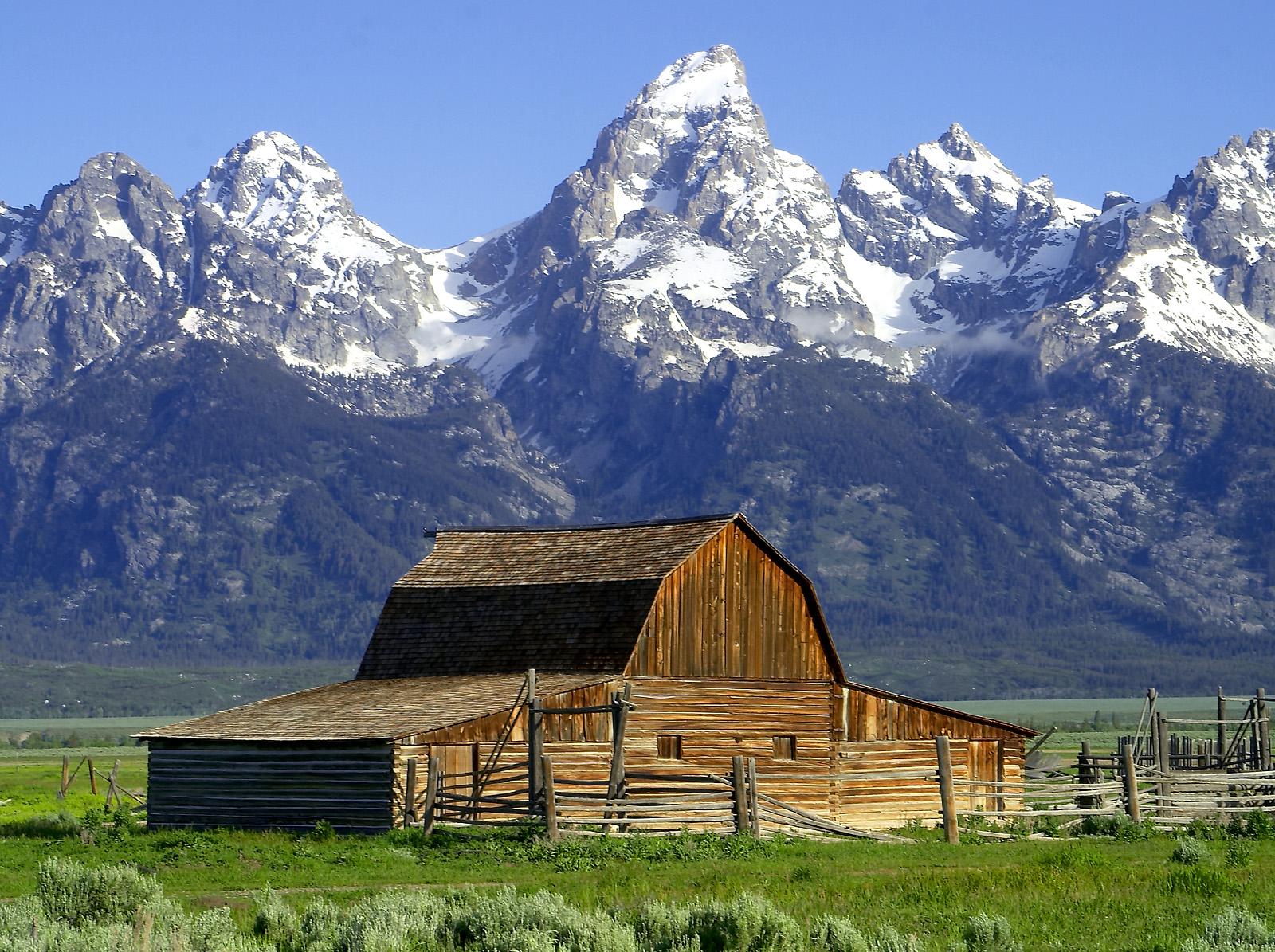
One of the great reasons to stay in Jackson Hole is its position as the gateway to two of the most famous national parks in the world. Grand Teton National Park begins practically on the edge of the valley, with the spectacular jagged silhouette of the Tetons rising above lakes such as Jenny Lake and the Snake River. It is a park of mountains, hiking, wildlife and alpine landscapes. Further north, via the John D. Rockefeller Jr. Memorial Parkway, you reach the south entrance of Yellowstone National Park, the first national park in the world, famous for its geysers (such as Old Faithful), hot springs, canyons and abundant wildlife. Many visitors combine both on one trip using Jackson as a base. Getting there: by car, Grand Teton is a few minutes away and Yellowstone's south entrance about 1.5-2 hours. Best time: late May to September/October (much of Yellowstone's road network closes in winter). Tips: allow several days; get up early to see wildlife; the same 7-day pass covers both parks if you buy the combined one.
ℹ️ Grand Teton entrance: US$ 35 per vehicle, 7 days; motorcycle US$ 30 (verified July 2026) · Yellowstone entrance: US$ 35 per vehicle, 7 days; combined Grand Teton + Yellowstone US$ 50 (verified July 2026) · Non-resident surcharge: From 1 January 2026, US$ 100 per person (16+) extra for NON-US visitors at Grand Teton, Yellowstone and 9 other parks; it is added on top of the normal entrance fee (verified July 2026) · Season: Late May to Sep/Oct; in winter much of Yellowstone's road network closes
5
Rafting and activities on the Snake River
Raft trips down the Snake River, from calm stretches to rapids, with views of the Tetons.
The Snake River crosses the Jackson Hole valley and is one of the great settings for summer activities. There are two classic experiences: the calm stretches ('scenic float trips'), ideal for families and for watching wildlife and birds in the shadow of the Tetons, inside Grand Teton; and the whitewater stretches further south, in the Snake River Canyon, with rapids of various grades for those after a shot of adrenaline. Plenty of operators run guided half-day trips with all the gear included. It is one of the best ways to enjoy the scenery and, on the calm stretches, to spot ospreys, beavers, moose and, with luck, bears on the banks. Getting there: the launch points are in the valley and in the canyon, reachable from Jackson. Best time: summer (June to September). Tips: pick the stretch to match the level you want; book ahead in high season; the scenic stretches take 3-4 hours including the transfer.
ℹ️ Scenic float trip: ~US$ 50-85 per person; private raft for up to 10 people from US$ 900 (verified July 2026) · Whitewater: Rafting in the Snake River Canyon from US$ 99 per person (verified July 2026) · Season: June to September; book ahead in high season · Operators: Mad River Boat Trips, Dornan's, Teton Whitewater and others
6
Million Dollar Cowboy Bar and the National Museum of Wildlife Art
The legendary saloon on the Town Square and the town's great wildlife art museum.
The Million Dollar Cowboy Bar, right on the Town Square, is one of the most famous saloons in the American West: open since 1937, with its neon sign of a cowboy riding a bucking bronco, saddle-shaped bar stools, carved woodwork and even a stuffed bear in the decor. Everyone from Clint Eastwood (who shot scenes for a film there) to Willie Nelson has passed through; today it programs live country music almost every night and has a steak and burger restaurant on the ground floor. It is a compulsory stop for a taste of Jackson's 'honky-tonk' atmosphere. A few minutes away, on a bluff overlooking the National Elk Refuge, the National Museum of Wildlife Art gathers more than 5,000 works of art devoted to wildlife, with pieces by artists such as Carl Rungius and even Georgia O'Keeffe and Andy Warhol. It is the perfect cultural counterpoint to round out the valley's nature experience. Getting there: both in the center of Jackson or a few minutes away by car. Best time: the bar, any night; the museum, any day (closed on some holidays). Tips: no reservation is needed at the Cowboy Bar but there can be a line at weekends; the museum offers combined discounts with the National Elk Refuge during sleigh season.
ℹ️ Million Dollar Cowboy Bar: Free entry (drinks separate); open since 1937, live country music almost every night · National Museum of Wildlife Art: Admission ~US$ 18 adults, discounts for children and seniors (verified July 2026) · Location: Both in the center of Jackson or a few minutes away by car · Tip: The museum offers combined discounts with the Elk Refuge sleigh rides in season
Advertisements
What nobody tells you

💵 Prices

Tickets

TypePrice
Day lift ticket, Jackson Hole Mountain Resort (2025-26 season)US$ 175-225 at the window depending on the date; cheaper with advance online purchase (check at jacksonhole.com)
National Elk Refuge sleigh rideUS$ 42 adults, US$ 27 children 5-12, free up to age 4 (2025-26 season; check when you visit)
Grand Teton National Park entrance (vehicle, 7 days)US$ 35 (NPS 2025; check when you visit)
Yellowstone National Park entrance (vehicle, 7 days)US$ 35 (NPS 2025; check when you visit)
Combined Grand Teton + Yellowstone pass (7 days)US$ 50 (NPS 2025; check when you visit)
America the Beautiful annual passUS$ 80 (valid in every national park for one year)
Snake River float trip / raftingUS$ 50-85 scenic; from US$ 99 whitewater (2025, per person; check when you visit)
🔄 updated monthlyOfficial / reference values · double-check when buying

Activities and tours

ActivityPriceDurationOperator
Skiing and snowboardingDay lift ticket US$ 175-225 (2025-26 season)1 day or moreJackson Hole Mountain Resort
Wildlife safari in Grand Teton/YellowstoneAbout US$ 150-300 per person (2025)Half day to full dayLocal wildlife tour operators
Rafting and float trips on the Snake RiverUS$ 50-85 scenic; from US$ 99 whitewater (2025)Half dayMad River Boat Trips, Dornan's, Teton Whitewater
Sleigh ride among the elkUS$ 42 adults / US$ 27 children (2025-26)45 min-1 hNational Elk Refuge / concessionaire
Hiking in the TetonsFree (park entrance separate, US$ 35)Half day to full dayOn your own / guides
🔄 updated monthlyOfficial / reference values · double-check when buying
Advertisements

🚌 How to get there and distances

Getting around

ModePriceDurationNotes
START Bus (valley bus)Free within Jackson; US$ 3 per ride to Teton Village (2025)VariablePublic bus system connecting Jackson with Teton Village and the valley
Rental carFrom US$ 55-90 a day depending on the season (2025)VariableHighly advisable for visiting the national parks and getting around the valley
Aerial Tram (Teton Village)Included with a ski lift ticket; summer ticket about US$ 55 adults (2025)A few minutesCable car up to Rendezvous Mountain
Taxi / ride-hailing appsAbout US$ 15-30 for a short ride in the valley (2025)VariableAvailable in town and for airport transfers
🔄 updated monthlyOfficial / reference values · double-check when buying

How to get there

RouteAirlines / operatorsAvg. priceDuration
Jackson Hole Airport (JAC) → JacksonRental car, shuttle, taxiTaxi/shuttle about US$ 30-45; rental from US$ 55/day (2025)Around 15-20 minutes (the airport is inside Grand Teton)
Salt Lake City (SLC) → JacksonCar; regional flightsRental from US$ 55/day; regional flight variesAbout 4.5-5 h by car or a short flight
Denver (Colorado) → JacksonFlights; car (long distance)Flight + transfer varies, or rental from US$ 55/dayFlight + transfer, or about 8-9 h by car
🔄 updated monthlyOfficial / reference values · double-check when buying

🏨 Where to stay

No exact prices: a scale from $ (budget) to $$$$$ (luxury), with 2-3 options per category.

CategoryPriceRecommended options
Luxury and exclusive ranches$$$$$US$ 700-1,500 a night; Four Seasons Resort Jackson Hole (Teton Village), Amangani, Hotel Jackson in high season
Boutique hotels in town$$$$$US$ 350-600 a night; The Cloudveil, Anvil Hotel, The Wort Hotel
Mid-range hotels$$$$$US$ 200-380 a night; The Lexington at Jackson Hole, Elk Country Inn, 49'er Inn & Suites
Budget$$$$$US$ 45-70 a bed at The Hostel (Teton Village); motels in Jackson from US$ 130-200 a night in high season

🍴 Where to eat

TypePriceOptions / signature dish
Fine dining$$$$$US$ 60-120 per person; Glorietta, The Kitchen, Snake River Grill
Western cooking and steaks$$$$$US$ 35-65 per person; Local Restaurant & Bar, Gun Barrel Steak & Game House, Million Dollar Cowboy Steakhouse
Casual and pubs$$$$$US$ 18-35 per person; Snake River Brewing, Bubba's Bar-B-Que, Hand Fire Pizza
Cafés and breakfast$$$$$US$ 10-20 per person; Persephone Bakery, Cowboy Coffee Co., Café Genevieve
Advertisements

📖 History of Jackson Hole

Origins, formation and what the sources say.

Indigenous peoples, trappers and the origin of the name

Long before the Europeans arrived, the Jackson Hole valley was the seasonal territory of Indigenous peoples. Tribes such as the Shoshone, the Crow, the Gros Ventre and the Blackfeet moved through the valley in summer to hunt and gather, though the harsh winters at more than 1,900 meters of altitude made permanent settlement inhospitable. Archaeological remains confirm thousands of years of human presence in the area.

In the early 19th century came the fur trappers, the legendary 'mountain men', drawn by the abundance of beaver. It was one of them, David E. Jackson, a partner in the Rocky Mountain Fur Company, who gave the valley its name: his companions began calling that mountain-ringed depression 'Jackson's Hole', because in trapper slang a 'hole' was precisely a valley enclosed by ranges, a good place to spend the winter and trap beaver.

The mythical explorer John Colter, who split off from the Lewis and Clark expedition, may have been the first American of European descent to travel through the area around 1807, on a winter journey near the Tetons and Yellowstone that for years sounded like an unbelievable tall tale.

Settlers, ranchers and the first dude ranches

Permanent settlement of the valley came late and hard. Only from the 1880s did the first permanent settlers arrive, drawn by the land-distribution laws (the Homestead Act), even though the extreme climate severely limited farming. They devoted themselves above all to cattle and horse raising, in an isolated setting where winter could cut the valley off for months.

The town of Jackson took shape in the early 20th century and starred in a singular episode: in 1920 it elected an all-female town government, with a woman mayor and councilwomen, a landmark in American political history, only a few years after women won the vote nationally.

In those same decades an activity emerged that would shape the future: the 'dude ranches', ranches that took in visitors from the East eager to live the Western experience, ride horses and enjoy the scenery. Nature tourism was beginning to look like the valley's true calling, more profitable and more durable than a cattle economy forever at the mercy of the weather.

Grand Teton, Rockefeller and the rise of skiing

Jackson Hole's destiny was sealed by the protection of its wilderness. In 1929 Grand Teton National Park was created, initially limited to the mountain range and the lakes at its foot. Conservation found a powerful ally in the philanthropist John D. Rockefeller Jr., who for years quietly bought valley land through a front company with the intention of donating it to expand the park and prevent uncontrolled development.

The operation set off a bitter local dispute between conservationists and ranchers who feared losing land and autonomy. After decades of tension, in 1950 Rockefeller's lands were incorporated and the park reached its present extent, taking in a good part of the valley. The road linking Grand Teton with Yellowstone bears the philanthropist's name today.

In parallel, from the 1960s on, the valley developed its skiing side. The opening of Jackson Hole Mountain Resort in Teton Village in 1965, with its impressive vertical drop and extreme terrain, turned it into a mecca for advanced skiers. Ever since, the combination of legendary national parks, world-class skiing and Western aesthetics has made Jackson Hole one of the most coveted mountain destinations in the United States.

Jackson Hole in the 21st century: tourism, conservation and real estate pressure

In recent decades, Jackson Hole has established itself as one of the richest and most coveted valleys in the United States. The combination of spectacular scenery, two national parks on the doorstep, a world-class ski resort and Wyoming's lack of a state income tax attracted fortunes from all over the country, which bought ranches and built second homes, driving land values to levels comparable with those of major capitals.

That boom brought with it a tension that defines Jackson Hole today: on one side, a prosperous economy based on mountain and nature tourism, with luxury hotels and resorts such as the Four Seasons and Amangani; on the other, a crisis of affordable housing for local workers, many of whom have to travel long distances from Idaho or from valley towns in order to work in Jackson.

At the same time, the valley keeps a strong conservationist commitment, inherited from Rockefeller's generation: much of the surrounding land is protected between the national park, the Bridger-Teton National Forest and refuges such as the National Elk Refuge, which has held back uncontrolled urban development. Jackson Hole thus symbolizes, better than almost anywhere else in the country, the tug-of-war between protected nature, high-end tourism and the social strains that economic success generates in a valley with limited room.

📚 Bibliography

  • Wikipedia (EN) — «Jackson Hole»: https://en.wikipedia.org/wiki/Jackson_Hole
  • Wikipedia (EN) — «Jackson, Wyoming»: https://en.wikipedia.org/wiki/Jackson,_Wyoming
  • Wikipedia (EN) — «Grand Teton National Park»: https://en.wikipedia.org/wiki/Grand_Teton_National_Park
  • National Park Service — Grand Teton: https://www.nps.gov/grte/
  • Wikipedia (EN) — «Jackson Hole Mountain Resort»: https://en.wikipedia.org/wiki/Jackson_Hole_Mountain_Resort
  • Visit Jackson Hole (official): https://www.visitjacksonhole.com/
  • National Elk Refuge (U.S. Fish & Wildlife Service): https://www.fws.gov/refuge/national-elk
  • Jackson Hole Mountain Resort (official): https://www.jacksonhole.com/

❓ Frequently asked questions

Jackson, Jackson Hole or Teton Village?+
Jackson Hole is the name of the valley. Jackson is the main town, with the Town Square, hotels and restaurants. Teton Village is the hub at the foot of the Jackson Hole Mountain Resort ski area, some 20 km from town. Many visitors stay in Jackson and head up to ski at Teton Village.
When is the best time to visit?+
It depends on the plan. For skiing, December to March. For visiting Grand Teton and Yellowstone, late May to September or October, when the park roads are open. Fall is spectacular for the colors and the elk rut. Winter closes much of Yellowstone.
Can you visit Yellowstone from Jackson?+
Yes. Yellowstone's south entrance is about 1.5-2 hours from Jackson along the John D. Rockefeller Jr. Parkway, crossing Grand Teton. The combined 7-day pass (US$ 50) covers both parks. Many visitors use Jackson as a base for both, though for Yellowstone it is worth starting early given the distances and devoting a full day or more.
Do I need a car?+
For the town and getting up to ski at Teton Village there is the public START bus (free in Jackson, US$ 3 to Teton Village), but for visiting Grand Teton and Yellowstone and enjoying the valley at your own pace, a car is highly advisable. Jackson Hole Airport is inside Grand Teton park itself, a few minutes from town.
Why are the arches on the square made of antlers?+
The four arches on the Town Square are built from elk antlers gathered in the National Elk Refuge. Elk shed their antlers every spring, so no animal is harmed; scouts collect them and part of the haul is auctioned for charity. It is one of the most photographed symbols of Jackson.
Is it an expensive destination?+
Jackson Hole is one of the most exclusive and expensive mountain destinations in the US, both for lodging (from US$ 130-200 a night in motels to more than US$ 700 in luxury resorts) and for restaurants, above all in peak ski season and in summer. There are cheaper options (the hostel in Teton Village, motels, camping in the parks) and you save by booking ahead and traveling in the shoulder seasons.
Sources consulted (9)
Still planning?
Explore more destinations in United States
See all destinations →
Advertisements
Image credits
Photos from Wikimedia Commons, each under its own licence (CC BY, CC BY-SA or public domain). Open each file to see its author and licence.
Barns grand tetons