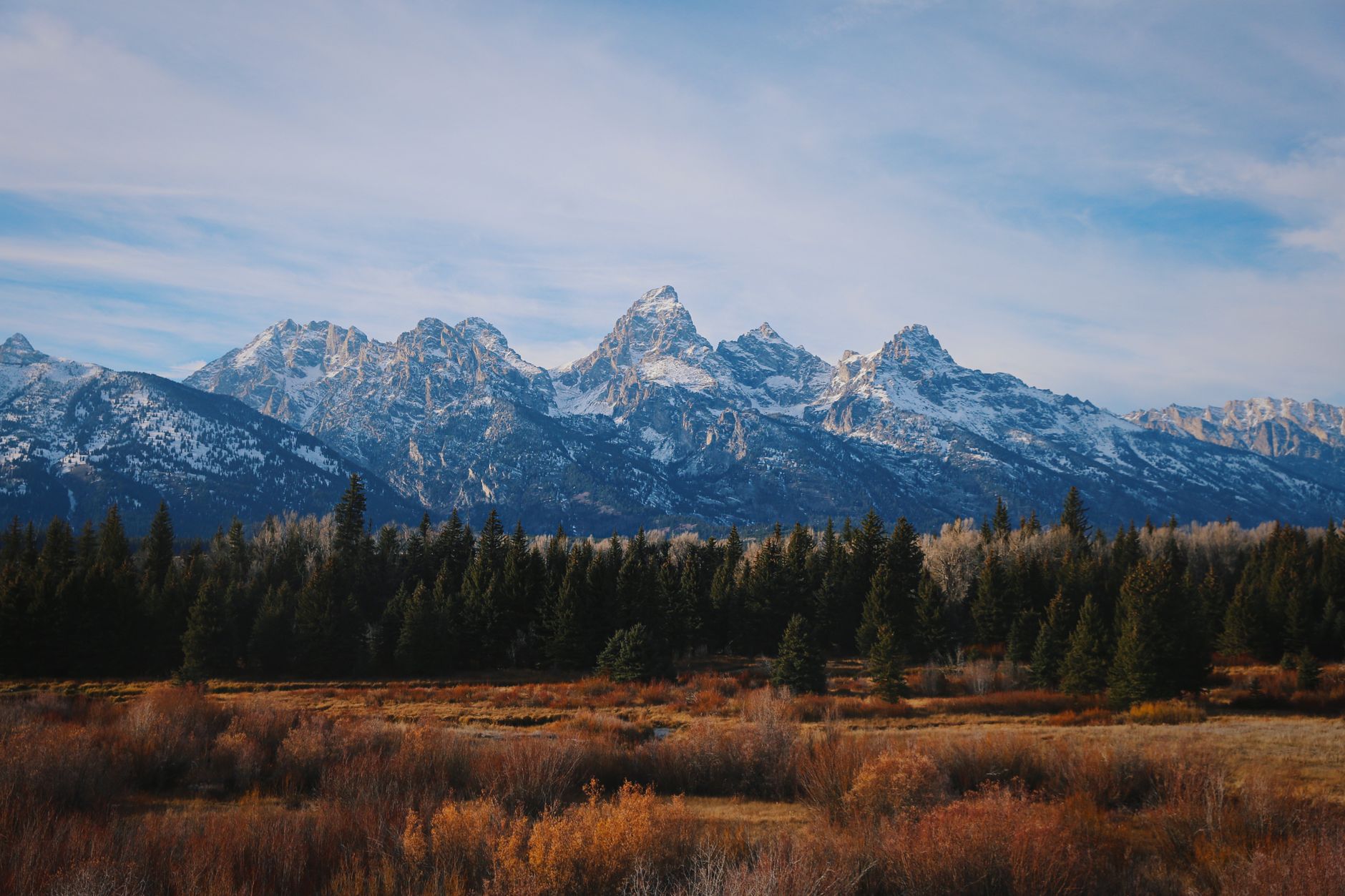
Grand Teton National Park, in northwestern Wyoming, protects one of the most spectacular mountain ranges in the United States: the Teton Range, a wall of jagged peaks that rise abruptly more than 2,000 metres above the Jackson Hole valley, with no foothills to soften their outline. Crowned by the Grand Teton (4,199 m), it is one of the most photographed alpine landscapes in the country.
At the foot of the mountains stretches a valley of crystalline lakes — Jenny Lake, Jackson Lake, String Lake — crossed by the Snake River, dotted with meadows where bison, moose and elk graze, and home to bears, wolves and eagles. The park, adjoining Yellowstone to the north via the Rockefeller Parkway, combines first-rate hiking, abundant wildlife, boating and a historic heritage of Western ranches and barns, such as the iconic Mormon Row.
This guide covers the essentials of Grand Teton with a practical eye: the viewpoints and the scenic drive, the lakes and their trails, the wildlife, the classic photo spots such as Mormon Row and Snake River Overlook, how to get there from Jackson and how to combine it with Yellowstone. It is a more compact and manageable park than its neighbour, but of overwhelming alpine beauty.
The Teton Range owes its name to French-speaking trappers, who christened it 'les trois tétons' ('the three breasts') for the silhouette of its peaks. The valley was the territory of Indigenous tribes and, in the 19th century, of fur trappers and ranchers. The park was created in 1929 to protect the mountain range and was enlarged in 1950 with the valley lands that philanthropist John D. Rockefeller Jr. had bought and donated to prevent uncontrolled development. The full story is on our history page.
Read the full history ↓The least populated state in the country: Shoshone, Cheyenne and Arapaho land, of the Old West and the ranches, the first place in the world to recognize women's right to vote, cradle of the planet's first national park —Yellowstone— and of the sharp peaks of the Grand Teton.
Read the history of Wyoming →They depart from Gardiner, 138 km away. If you book from this link we earn a commission and you pay no more.
No exact prices: a scale from $ (budget) to $$$$$ (luxury), with 2-3 options per category.
Origins, formation and what the sources say.
The Teton Range is, geologically, one of the youngest ranges in the Rocky Mountains, and precisely for that reason one of the most spectacular. Its formation began some 6 to 10 million years ago, when a large fault (the Teton Fault) began to fracture the crust: the western block rose to form the mountains, while the eastern block dropped, creating the Jackson Hole valley. That movement is still going on, which makes the fault one of the most active in the region.
Unlike other ranges, the Tetons almost completely lack foothills or lesser hills to soften the transition between valley and peaks: the mountains rise abruptly and vertically more than 2,000 metres above the plain, which gives them their unmistakable silhouette and their overwhelming presence. Paradoxically, the rocks that make them up, granite and gneiss, are extremely ancient, around 2,700 million years old, among the oldest in North America.
Glaciers completed the work: during the ice ages, the ice masses carved the canyons, polished the peaks and gouged the basins now occupied by the lakes at the foot of the mountains, such as Jenny Lake and Jackson Lake. Small active glaciers still remain on the summits. The result is one of the most perfect and photogenic alpine landscapes on the planet.
The valley at the foot of the Tetons was frequented for thousands of years by Indigenous peoples, who came in the warm months to hunt and gather, though the harshness of winter made permanent settlement at that altitude unwise. Tribes such as the Shoshone left their mark on the area.
The range's name comes from the French-speaking fur trappers who roamed the Rockies in the early 19th century in search of beaver. Impressed — or amused — by the shape of the three main peaks, they christened them 'les trois tétons' ('the three breasts'), a name that, passing through Spanish and English, ended up giving 'Grand Teton' to the highest peak and 'Teton Range' to the whole chain. The valley itself, Jackson Hole, recalls David Jackson, another of those fur traders.
After the era of the trappers, the valley saw the arrival in the late 19th century of the first settlers and ranchers, who established themselves despite the extreme climate. Among them were the Mormon settlers who put down roots in the area known today as Mormon Row, where they raised the ranches and barns that have become one of the park's iconic images.
Protecting the Tetons and their valley was a long and contentious process. In 1929 Grand Teton National Park was created, but at first it covered only the mountain range and the lakes at its foot, leaving out the Jackson Hole valley, threatened by development, subdivision and the advertising billboards that were beginning to proliferate.
Conservation found a decisive ally in the philanthropist John D. Rockefeller Jr., who, after visiting the area and being horrified at its possible degradation, devised a discreet plan: through a front company, the Snake River Land Company, he bought thousands of hectares of the valley from the ranchers over a period of years, intending to donate them to enlarge the park. When the operation became known, it set off a bitter dispute with much of the local population, which viewed the expansion of federal control with suspicion.
After decades of tension and interim solutions — such as the creation in 1943 of the Jackson Hole National Monument by presidential decree — in 1950 the lands donated by Rockefeller were incorporated into the park, which thus reached its current extent, covering both mountains and valley. The road linking Grand Teton with Yellowstone today bears the philanthropist's name (John D. Rockefeller Jr. Memorial Parkway), in recognition of an effort that saved one of the most beautiful landscapes in the United States for good.
Grand Teton holds a special place in the history of American mountaineering. The first documented and widely accepted ascent of the Grand Teton (4,199 m) is attributed to William Owen, Franklin Spalding, Frank Petersen and John Shive in 1898, though a party led by Nathaniel Langford had claimed to reach the summit three decades earlier, in 1872, a claim that generated academic controversy for more than a century. From the 1930s on, the valley became a magnet for elite climbers, and in 1931 Glenn Exum opened a new route on the Grand Teton solo, a feat that gave rise to Exum Mountain Guides, today one of the oldest and most prestigious mountain guide schools in the United States, with an official National Park Service concession.
The Jackson Hole valley and the park itself were also decisive in the history of skiing and nature tourism in the American West: the growth of Jackson as a tourist town, driven in part by the same families and capital that supported the park's expansion, transformed a remote ranching region into one of the most coveted mountain destinations in the country, with the resulting rise in land values and real-estate pressure on the areas bordering the park.
Today, Grand Teton receives more than three million visitors a year, a figure comparable to Yellowstone's, and faces similar crowding challenges in high season, above all at Jenny Lake and Mormon Row at sunrise. The National Park Service jointly manages Grand Teton and the John D. Rockefeller Jr. Memorial Parkway that links it to Yellowstone, strengthening wildlife management programmes — especially for the elk and pronghorn migration corridors, among the longest in North America — and for preventing conflicts between bears and visitors, which have become more frequent as visitor numbers grow.
In the early 20th century, a group of Mormon settlers from Idaho put down roots on a strip of land in the east of the valley, grouping their farms together to share water, work and community life. That row of ranches came to be called Mormon Row. The settlers dug ditches to irrigate fields in an arid valley with brutal winters, planted trees and raised houses, corrals and barns. Two of those barns, the Moulton Barns (T.A. Moulton's and John Moulton's), built by two brothers of that community, became over time the most photographed rural buildings in the United States: their weathered wood set against the jagged wall of the Tetons is today a universal postcard of the American West.
Life on Mormon Row was hard and, as the park expanded and mountain farming stopped being profitable, most families sold or abandoned their land over the course of the 20th century. The National Park Service preserved the barns and several structures as a historic district, so that visitors today can walk among the remains of that settlement experiment and understand the enormous human effort that survival at the foot of the Tetons demanded.
Another singular chapter in the valley's history is the National Elk Refuge, created in 1912 north of the town of Jackson. Every winter, thousands of elk come down from the snowy mountains into the valley in one of the most visible wildlife migrations in North America, and the refuge was established precisely to protect them from starvation and from human encroachment. Today, in winter, you can take horse-drawn sleigh rides among the herds, and in summer the same territory forms part of the great ecosystem that makes Jackson Hole a wildlife sanctuary. The story of Grand Teton is, at bottom, the story of a handful of people — settlers, trappers, philanthropists and conservationists — who, each in their own way, shaped and saved one of the most beautiful corners of the planet.