Viajá con Gus
HomeUnited StatesJuneau
Juneau
🇺🇸 United States · Alaska

Juneau

Jump to what you need
📌Country
United States (state of Alaska). Juneau is the capital of the state of Alaska, in the southeast, in the 'Inside Passage' region (the maze of channels, islands and fjords of the Alaska Panhandle). It has about 32,000 inhabitants and one astonishing quirk: it is one of the few capitals in the world (and the only US state capital) that CANNOT be reached by road. It is wedged between the Gastineau Channel and steep coastal mountains, next to icefields and glaciers.
📌Service city
Juneau is the service city itself: it has an airport (JNU), an Alaska Marine Highway ferry terminal, a cruise port, a hospital and all the infrastructure of a capital. Because of its isolation, it is also the gateway to nearby southeast destinations such as the Mendenhall Glacier, Tracy Arm fjord, and towns such as Skagway, Haines or Sitka, reachable by air or sea.
📌Best time to go
May to September is the high season, matching the cruise season: long days, milder weather, whales in the channel and every tourist service open. Juneau is very rainy (one of the wettest cities in the country), so it is worth going prepared for rain at any time of year. Winter is quiet, cool and damp, with skiing at Eaglecrest.
📌Getting there
Only by air or sea. By plane to Juneau airport (JNU), with flights from Anchorage, Seattle and other cities. By sea, on the Alaska Marine Highway ferries (which connect southeast Alaska and run to Bellingham, in Washington) or, above all, on the cruise ships that ply the Inside Passage. There is NO road connecting Juneau with the rest of North America.
📌Language and currency
English. Currency: US dollar (US$). Alaska time zone (AKST/AKDT).
📌Suggested days
Many visitors arrive by cruise ship for a single day, enough for the Mendenhall Glacier and one excursion (whales or the Goldbelt tram). With 2 to 3 days you can take it more slowly: trails, the Juneau Icefield, Tracy Arm and life in the state capital.
💱 USD exchange rate
Loading rate…
🌤️ Weather in Juneau
Loading weather…

Juneau is one of the most singular capitals on the planet: the capital of the state of Alaska, wedged between sea and mountain, and unreachable by road. No highway connects it to the rest of the continent; you come and go only by air or by sea. That 'isolated city' status gives it a special character, somewhere between frontier town and political capital, with its streets climbing the slopes above the Gastineau Channel and glaciers looming around the corner.

Born of the gold rush in the late 19th century, Juneau keeps a charming historic downtown, lively in summer with the great Inside Passage cruise ships docking at its feet. But its greatest treasure is the nature around it: the Mendenhall Glacier, reachable a few minutes from downtown; the immense Juneau Icefield that feeds it; Tracy Arm fjord with its walls and icebergs; and waters where humpback whales are routinely seen feeding in summer.

This guide organizes the visit with real data: what to see in and around the city, how to get there (only by air or sea) and get around, which excursions are worth it —especially for anyone stepping off a cruise ship— where to sleep and eat, and when to go. Juneau combines gold-rush history, capital-city life and some of the most accessible glacial landscapes in Alaska.

📖 History of Juneau

The Gastineau Channel has been home for millennia to the Tlingit people, one of the great cultures of the northwest coast, famous for their totem poles, clan houses and rich ceremonial life. The modern city was born of the gold rush: in 1880, the prospectors Joe Juneau and Richard Harris, guided by the Tlingit chief Kowee, found gold in Gold Creek, and a mining camp sprang up around it that was soon named Juneau, the first settlement founded after the United States purchased Alaska. The mines (such as the Treadwell and the Alaska-Juneau) came to be among the largest in the world. In 1906, the capital of what was then the District (and later Territory) of Alaska moved from Sitka to Juneau, a status it kept when Alaska became a state in 1959. The full story is on our history page.

Read the full history ↓

🏛️ Juneau is in Alaska

The 'Last Frontier': the largest and wildest state in the country, land of the Iñupiat, Yup'ik, Aleuts and Tlingit, bought from Russia in 1867, forged by the gold rushes and by oil, crowned by Denali —the highest peak in North America—.

Read the history of Alaska →

🗺️ What to see

1
Mendenhall Glacier
Juneau's great icon: a glacier more than 20 km long that descends from the Juneau Icefield into a lake, only about 20 minutes from downtown. It has a visitor center, trails, the Nugget Falls waterfall and spectacular views. The most accessible and most visited glacier in Alaska.
2
Mount Roberts Tramway
A panoramic cable car that climbs from the cruise port, right downtown, up to 550 m on Mount Roberts, with views over the Gastineau Channel, high-country trails, a Tlingit cultural center and a nature center. An unbeatable view of the city and the fjords.
3
Whale watching in the channel
One of Juneau's finest experiences: boat trips to see humpback whales (and sometimes orcas) feeding in summer, including the spectacular group 'bubble-net feeding'. You also see sea lions, seals and eagles. Almost guaranteed in season.
4
Tracy Arm Fjord
A narrow, deep fjord south of Juneau, with sheer walls, waterfalls and the Sawyer glaciers, which calve icebergs into the water. Visited on full-day boat excursions; one of the most beautiful glacial landscapes in southeast Alaska.
5
Historic downtown and the State Capitol
Downtown Juneau, with its steep streets, historic gold-rush houses, shops and bars such as the Red Dog Saloon. You can visit the Alaska State Capitol (seat of the state government) and the picturesque Russian Orthodox church of St. Nicholas.
6
Alaska State Museum
The state museum, with excellent collections on Alaska's Native peoples (Tlingit, Haida, Yup'ik, etc.), the Russian era, the gold rush and natural history. The best introduction to the state's history and cultures.
7
Juneau Icefield (flightseeing and glacier walk)
An immense icefield that gives rise to dozens of glaciers, including the Mendenhall. You fly over it by helicopter, often with a landing to walk on the ice or see sled dogs at a glacier camp. An unforgettable experience (at a steep price).
8
Macaulay Salmon Hatchery
A salmon hatchery where, in summer, you can watch the fish climb the water ladders, along with aquariums of local marine life. A good educational, family-friendly stop near downtown.
9
Nugget Falls trail and the Mendenhall trails
Several trails start from the Mendenhall visitor center: the short, flat one to Nugget Falls (at the foot of the glacier), the East Glacier Loop and other more demanding routes to lookouts with privileged views of the ice.
10
Treadwell Mine and Sandy Beach (Douglas)
Across the channel, on Douglas Island, the remains of the old and enormous Treadwell mine, today turned into a historic trail through the forest, beside Sandy Beach. A quiet walk loaded with mining history.
Advertisements
What nobody tells you

💵 Prices

Tickets

TypePrice
Mendenhall Glacier — visitor center (Tongass National Forest, USFS)US$ 5 per person (16 and over; under 15s free); season pass US$ 15 (holder + 1 companion). Charged in season (1 May–30 Sep). The pass can be bought online in advance (source: USFS Tongass / mendenhallglacier.org, verified July 2026)
Mount Roberts Tramway / Goldbelt TramUS$ 65 per adult and US$ 50 per child (3-13 years), full-day round-trip ticket; under 2s free (source: Goldbelt Tram / alaska.org, verified July 2026). NOTE: check that it is operating when you travel, as the tram has had temporary closures for repairs
Alaska State Museum (admission)US$ 14 per adult in summer; under 18s free (source: Alaska State Museum, verified July 2026)
Alaska State Capitol (visit)Free (free guided tours in the summer season; source: Alaska State Legislature, verified July 2026)
Macaulay Salmon Hatchery (admission)About US$ 15 per adult, discounts for children (source: DIPAC Macaulay Hatchery, verified July 2026)
🔄 updated monthlyOfficial / reference values · double-check when buying

Activities and tours

ActivityPriceDurationOperator
Whale watching excursionUS$ 120-200 per adult (market range; usually includes transfer and sometimes a stop at the Mendenhall; source: Juneau operators —Harv & Marv's, Juneau Tours & Whale Watch— verified July 2026)3-4 hHarv & Marv's, Juneau Tours & Whale Watch and others
Boat excursion to Tracy Arm fjordUS$ 180-280 per adult (market range; source: Adventure Bound / Allen Marine, verified July 2026)Full day (8-9 h)Adventure Bound Alaska, Allen Marine Tours
Helicopter to the Juneau Icefield with a glacier walkFrom US$ 400-650+ per person (more with sled dogs; source: NorthStar/TEMSCO Helicopters, verified July 2026)2-3 hTEMSCO Helicopters, NorthStar Trekking, Coastal Helicopters
Mount Roberts tram + hikingUS$ 65 per adult (round-trip tram; source: Goldbelt Tram, verified July 2026)Half dayGoldbelt Mount Roberts Tramway
Sea kayaking and combined excursions (whales + Mendenhall)US$ 90-220 per person depending on the combo (source: local adventure operators, verified July 2026)Half day to full dayAbove & Beyond Alaska, Alaska Boat & Kayak and others
Fishing trip (salmon, halibut)From US$ 250-350+ per person (market range; source: Juneau fishing charters, verified July 2026)Half day to full dayJuneau fishing charters
🔄 updated monthlyOfficial / reference values · double-check when buying
Advertisements

🚌 How to get there and distances

Getting around

ModePriceDurationNotes
Capital Transit (Juneau's public city bus)US$ 2 adults (19+); US$ 1 youth up to 18; free for under 5s (source: juneaucapitaltransit.org/fares, verified July 2026)VariableThe municipal bus links downtown with the Mendenhall valley, Douglas and the airport. It is the cheapest option, but WATCH OUT for the glacier: the valley routes drop you at Dredge Lake Road, about 2.4 km (1.5 miles) from the Mendenhall visitor center, roughly a 30-minute walk. To go straight to the glacier, the tourist shuttle or a tour is the better bet
How you pay and track the bus (Capital Transit)Cash (coins or bills, US dollars only) or a mobile pass in the Token Transit app-You pay cash on board (exact fare in dollars) or with the Token Transit app, which also has fare-capping: once your rides for the month add up to the monthly pass, the rest of the month is free. For schedules and the bus location in real time use Google Maps or the Transit/Moovit app, which cover the Capital Transit routes (source: Capital Transit / Token Transit, verified July 2026)
Tourist shuttle to the Mendenhall Glacier (Blue Bus / Glacier Express)About US$ 45-55 round trip (source: M&M Tours / Mighty Great Trips, verified July 2026)20-25 min each legA direct tourist service from the cruise port/downtown to the Mendenhall visitor center, without the public bus's 1.5-mile walk; very handy for anyone off a cruise ship for only a few hours
Rental carFrom about US$ 70-120 a day + fuel (source: rental aggregators, verified July 2026)VariableUseful for exploring the local road network, which does NOT leave the Juneau area: the roads simply end, because the city connects to no external highway. Good for going to the Mendenhall, Douglas or the north end of the channel at your own pace
Taxis and Uber/LyftTaxi to the airport/glacier from about US$ 25-35; Uber and Lyft operate in Juneau (source: local operators, verified July 2026)VariableThere are taxis and also ride-hailing apps (Uber/Lyft) in the city; useful for one-off trips to the airport or the glacier
🔄 updated monthlyOfficial / reference values · double-check when buying

How to get there

RouteAirlines / operatorsAvg. priceDuration
Arriving by cruise ship (Inside Passage)The major Alaska cruise linesDepends on the cruise package (check)Typical one-day port call, right downtown
Anchorage or Seattle → Juneau (flight)Alaska Airlines and others (check)From US$ 150-400 each way depending on the season (check)Anchorage about 1.5 h; Seattle about 2.5-3 h
Alaska Marine Highway ferryAlaska Marine Highway System (AMHS)Depends on the origin and whether you take a car (check)Variable (connects southeast Alaska and runs to Bellingham, WA)
Juneau Airport (JNU) → downtownCapital Transit, taxi, Uber/Lyft or hotel shuttleCapital Transit bus US$ 2; taxi from about US$ 25-30 (source: Capital Transit / local operators, verified July 2026)15-20 min (the airport is in the Mendenhall valley)
🔄 updated monthlyOfficial / reference values · double-check when buying

🏨 Where to stay

No exact prices: a scale from $ (budget) to $$$$$ (luxury), with 2-3 options per category.

CategoryPriceRecommended options
Upper-tier hotels downtown$$$$$US$ 220-400+ a night in cruise season (summer). Historic and good-standard hotels downtown, next to the port; prices drop a good deal off season
Mid-range hotels (downtown and Mendenhall valley)$$$$$About US$ 150-280 a night in summer. Chain hotels and mid-range options near downtown or the airport/glacier; good value for comfort
B&Bs, inns and cabins$$$$$About US$ 130-240 a night. Charming guesthouses in Juneau and on Douglas Island, many with views of the channel or the forest; personal service and breakfast
Hostels and budget options$$$$$About US$ 40-110 a night. Hostels and simple rooms, chosen by backpackers; book ahead in the high cruise season

🍴 Where to eat

TypePriceOptions / signature dish
Fresh Alaska seafood$$$$$US$ 25-55 per dish. Wild salmon, halibut, crab and scallops from southeast Alaska; several downtown restaurants stand out for their catch of the day, often with a view of the channel
Breweries and historic pubs$$$$$US$ 15-30 per dish. The classic Red Dog Saloon (Old West in feel), the Alaskan Brewing Company and other pubs with local beer, burgers and fish and chips; very much the Juneau atmosphere
Cafés, bakeries and casual food$$$$$US$ 8-20. Specialty cafés, bakeries and international food downtown; ideal for a break between excursions, especially on rainy days
Food trucks and local fast food$$$$$US$ 6-15. Carts and stands near the port with fish tacos, soups, coffee and snacks; a cheap, quick option for anyone off a cruise ship
Advertisements

📖 History of Juneau

Origins, formation and what the sources say.

The Tlingit people and the Gastineau Channel

The only capital in the United States that no road reaches was born of a gold nugget and the knowledge of a Tlingit chief. But the story of the Gastineau Channel begins thousands of years before that gold appeared: long before the city existed, the area and the whole of southeast Alaska were the territory of the Tlingit people, one of the great cultures of the Pacific Northwest coast. The Tlingit had lived in the region for millennia, organized in clans and houses, with a complex society, a rich ceremonial life and a distinctive art that includes the famous totem poles, the Chilkat blankets and bentwood boxes.

Their economy was based on the extraordinary abundance of the sea and the rivers: salmon in its various species, halibut, shellfish, otters and the resources of the temperate rainforest that covers southeast Alaska. They were also great traders and navigators, with canoes that ranged the channels of the Inside Passage.

In the Juneau area, the Auke clan (Aak'w Kwáan) and other Tlingit groups had their territories and settlements. Their knowledge of the terrain was key to what came later: it was a Tlingit leader, Chief Kowee, who guided the gold prospectors toward the deposits that would give rise to the city. Tlingit culture remains very much alive today in Juneau and throughout southeast Alaska.

en.wikipedia.org · Tlingittraveljuneau.com · Alaska native culture

The gold rush and the founding of Juneau (1880)

The United States bought Alaska from Russia in 1867, but the southeast remained sparsely settled by colonists until gold was found. In 1880, two prospectors —Joe Juneau and Richard Harris—, encouraged by a merchant and guided by the Tlingit chief Kowee, found gold in abundance in Gold Creek and the area of present-day Juneau. A mining camp quickly sprang up around the strike, considered the first settlement founded in Alaska after the purchase from Russia.

The town changed names several times (Harrisburg, Rockwell) before settling on Juneau, in honor of Joe Juneau. Gold mining was industrialized early: along the Gastineau Channel and on Douglas Island large operations appeared, such as the Treadwell mine —which became one of the largest gold mines in the world at the end of the 19th century— and the Alaska-Juneau (A-J), which extracted gold from low-grade rock on an enormous scale.

These mines drew thousands of workers of many origins and gave Juneau an early prosperity. The Treadwell mine suffered a dramatic collapse and flooding in 1917, and the A-J closed during the Second World War, marking the end of the great gold cycle, but by then Juneau had already established itself as a city and a political center.

en.wikipedia.org · Juneau, Alaskanps.gov · Treadwell mine

From Sitka to Juneau: the capital of Alaska

During the Russian period and the early American years, the capital of the territory of Alaska had been Sitka, the old seat of Russian America. But Juneau's mining and economic boom shifted the territory's center of gravity toward the Gastineau Channel.

In 1900, Congress designated Juneau as the capital of the District of Alaska, and the actual transfer of the seat of government from Sitka took place in 1906. Juneau thus became the political center of the district, and later of the Territory of Alaska. When Alaska became the 49th state of the Union in 1959, Juneau was confirmed as the state capital.

Its status as a capital without road access generated, over the course of the 20th century, repeated debates and referendums on the possibility of moving the capital somewhere more accessible and closer to Anchorage (where most of the state's population lives). None of those proposals prospered, however, above all because of the enormous cost of building a new capital, and Juneau has kept its political role to this day.

en.wikipedia.org · Juneau, Alaskabritannica.com · Juneau

Glaciers, icefield and a unique setting

Juneau's geography is inseparable from ice. The city sits at the foot of the Juneau Icefield, a vast mass of ice covering thousands of square kilometers that stretches across the coastal mountains between Alaska and Canadian British Columbia. Dozens of glaciers descend from that icefield, the most famous of them the Mendenhall.

The Mendenhall Glacier, only a few minutes from downtown, is one of the most accessible glaciers in all of Alaska and Juneau's great natural emblem. Like almost every glacier in the world, it has retreated markedly in recent decades because of climate change: the lake you see today in front of its terminus was formed precisely by that retreat, and scientists study it as an indicator of global warming. The Juneau Icefield is, in fact, home to one of the longest continuous glacier monitoring programs in the world.

The marine setting completes the picture: the waters of the Gastineau Channel and the neighboring fjords, such as Tracy Arm, are habitat for humpback whales, orcas, sea lions and bald eagles. That combination of ice, temperate rainforest and wildlife-rich sea makes Juneau one of the most complete nature destinations in southeast Alaska.

fs.usda.gov · Mendenhall glacieren.wikipedia.org · Mendenhall Glacier

Juneau today: capital, cruise ships and challenges

Today Juneau is a city of about 32,000 inhabitants that combines three identities: state political capital, former mining town and major tourist destination of the Inside Passage. In summer, its economy turns in good part on the cruise ships: hundreds of thousands of passengers disembark each season, filling the historic downtown and feeding an enormous offering of excursions to glaciers, whales and fjords. Off season, the city recovers the quiet rhythm of a provincial capital.

Its condition as a city without access roads shapes daily life: everything —people, goods, vehicles— arrives by plane or by boat, which pushes prices up and reinforces the city's singular character. The presence of the state government provides economic stability, alongside tourism, fishing and services.

The current challenges are managing the impact of mass cruise tourism (congestion, environment, balance for residents), the effects of climate change on its glaciers —including the glacial outburst floods (jökulhlaups) from Mendenhall Lake, which in recent years have hit city neighborhoods— and the perennial debate over the capital's accessibility. With its blend of Tlingit history, gold heritage, political life and glacial nature, Juneau remains one of the most fascinating capitals in the world.

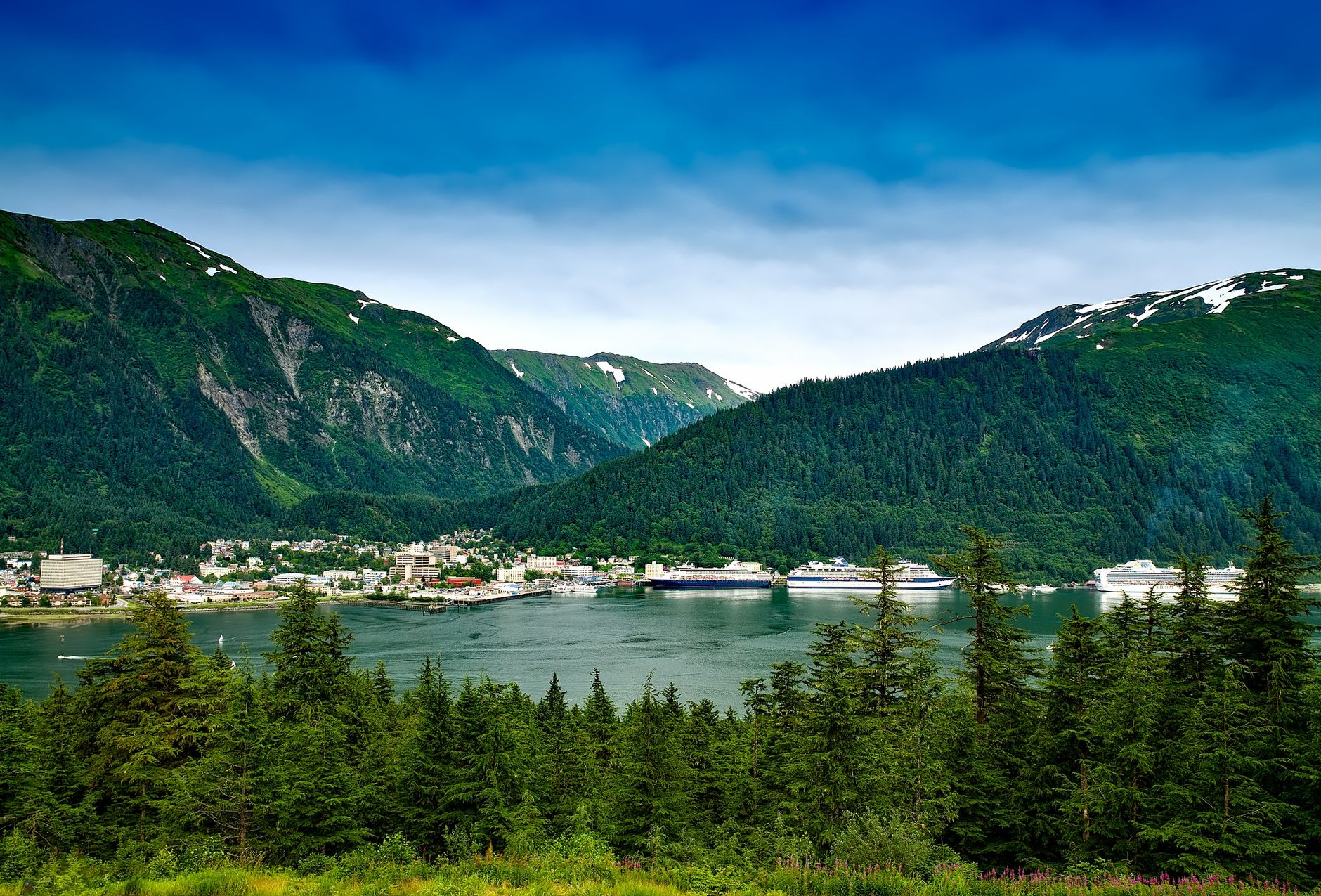
en.wikipedia.org · Juneau, Alaskatraveljuneau.com

📚 Bibliography

  • Travel Juneau (official tourism office) — https://www.traveljuneau.com/
  • Travel Alaska — Juneau — https://www.travelalaska.com/Destinations/Cities-Towns/Juneau
  • U.S. Forest Service — Mendenhall Glacier (Tongass National Forest) — https://www.fs.usda.gov/r10/tongass/recreation/mendenhall-glacier
  • National Park Service — Treadwell Mine — https://www.nps.gov/articles/treadwell-mine.htm
  • Alaska State Museum — https://museums.alaska.gov/
  • Wikipedia — Juneau, Alaska — https://en.wikipedia.org/wiki/Juneau,_Alaska
  • Wikipedia — Tlingit — https://en.wikipedia.org/wiki/Tlingit
  • Wikipedia — Mendenhall Glacier — https://en.wikipedia.org/wiki/Mendenhall_Glacier
  • Wikipedia — Juneau Icefield — https://en.wikipedia.org/wiki/Juneau_Icefield
  • Encyclopedia Britannica — Juneau — https://www.britannica.com/place/Juneau

❓ Frequently asked questions

Is it true you can't reach Juneau by car?+
Yes. Juneau is the only US state capital (and one of the few capitals in the world) with no road connection to the rest of the continent. It is surrounded by mountains, glaciers and water, so you come and go only by air (JNU airport) or by sea (cruise ships and Alaska Marine Highway ferries).
How much does it cost to visit the Mendenhall Glacier?+
The glacier area belongs to the Tongass National Forest (USFS): access to the visitor center costs US$ 5 per person (16 and over; under 15s free), or US$ 15 for the season pass covering the holder plus one companion. It is charged from May to September and the pass can be bought online. Add the transport: a tourist shuttle from downtown costs about US$ 45-55 round trip and drops you at the door, or you can take the public Capital Transit bus (US$ 2), which leaves you 1.5 miles away (about a 30-minute walk).
Is the whale watching worth it?+
Very much so. In summer, the waters near Juneau fill with humpback whales feeding, and sightings are almost certain (several operators even 'guarantee' them). It is one of the most recommended experiences, especially combined with a stop at the Mendenhall.
What can you do in Juneau if you arrive by cruise ship for one day?+
On a one-day call there is time to combine the Mendenhall Glacier (with Nugget Falls) and either a whale watching trip or the Mount Roberts tram. Anyone with an extra half day can add the historic downtown, the Red Dog Saloon and the Alaska State Museum.
When is the best time to visit?+
May to September, matching the cruise season: long days, whales in the channel and everything open. Important: Juneau is very rainy, so it is always worth packing waterproof clothing, whatever the month.
How does public transport work in Juneau and how do you pay?+
The municipal bus is Capital Transit: it costs US$ 2 for adults (19+), US$ 1 for youth up to 18 and is free for under 5s. You pay cash on board (exact fare, US dollars only) or with the Token Transit app, which has fare-capping (you never pay more than the monthly pass). It links downtown with the Mendenhall valley, Douglas and the airport. To see schedules and where the bus is in real time, use Google Maps or the Transit app. WATCH OUT: for the glacier, the bus leaves you 1.5 miles away; if you are short on time, a tourist shuttle or a tour is the better bet.
Sources consulted (9)
Still planning?
Explore more destinations in United States
See all destinations →
Advertisements