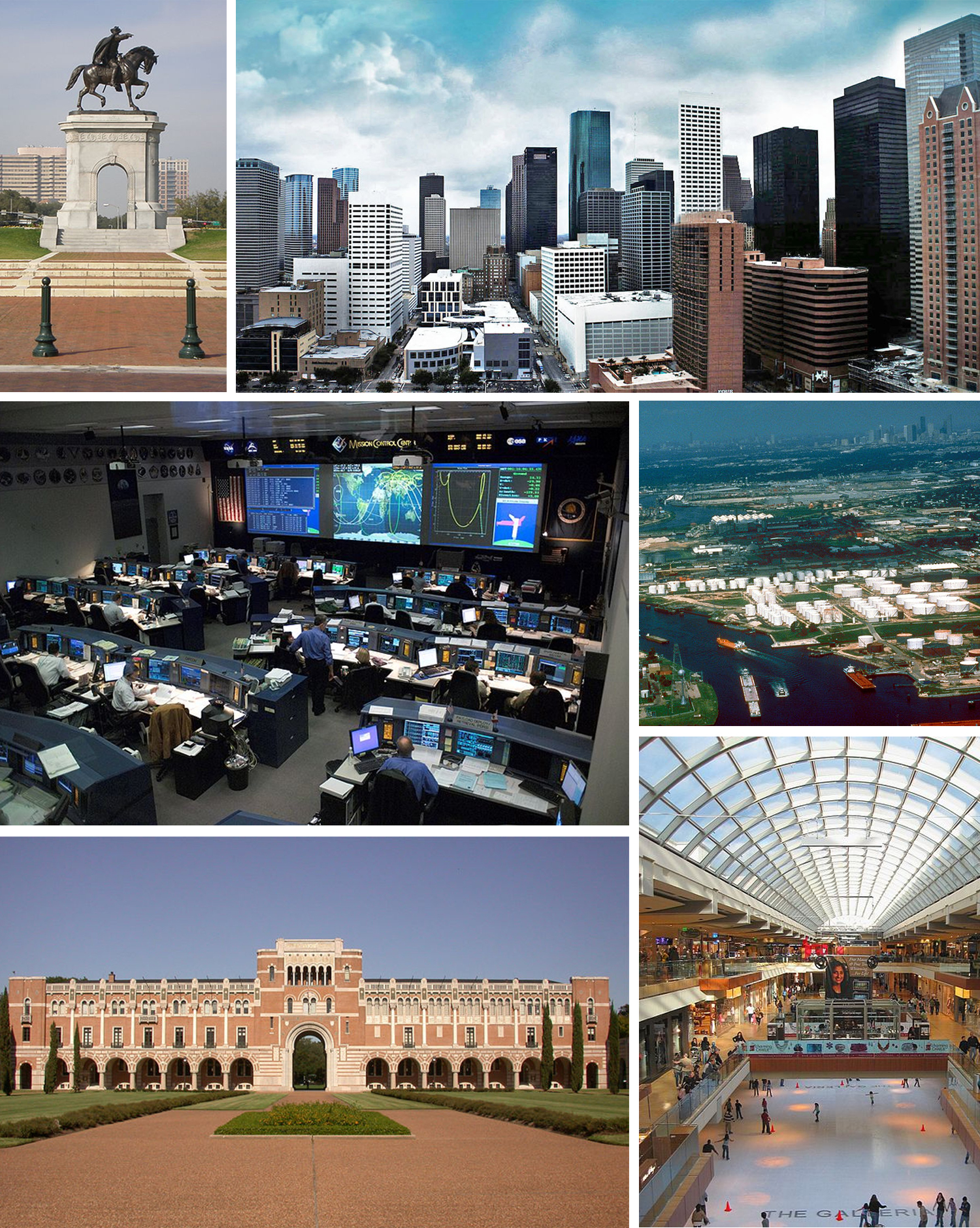
Houston is an enormous, modern and surprisingly diverse city: the fourth most populous in the United States and, by many measures, one of the most multicultural in the country, with communities from all over the world that show up in one of the most vibrant and varied food scenes anywhere. It is the 'energy capital of the world', with its skyscrapers and its oil economy, but also 'Space City', home to NASA's Johnson Space Center, from which crewed missions are controlled.
Unlike more compact cities, Houston is experienced by neighborhood and district, spread across a vast, flat metropolis: the Museum District, with nearly twenty top-tier museums; the Theater District; Montrose, bohemian and food-focused; the Mexican, Vietnamese, Indian and many other communities' neighborhoods. It is a city without the obvious postcard other places have, but with a huge amount to discover if you move around with curiosity.
This guide covers Houston with a practical eye: how to visit the Space Center, which museums not to miss (several are free), where to eat some of the best food in the world at reasonable prices, how to handle a city built around the car, and when to go to dodge the extreme heat and the hurricanes. Houston rewards the traveler who arrives with a plan, an appetite and an interest in seeing a diverse, futuristic America.
Houston was founded in 1836 by two real-estate speculator brothers from New York, Augustus and John Allen, who bought swampy land along Buffalo Bayou and named the town after Sam Houston, the general who had won Texan independence a few months earlier at the nearby Battle of San Jacinto. Houston was briefly the capital of the Republic of Texas (1837-1839). The city grew as a commercial and railroad center thanks to cotton and timber. Its great transformation came in 1901 with the discovery of oil at Spindletop, near Beaumont: Houston became the heart of the US oil industry. The opening of the Houston Ship Channel in 1914 linked it to the Gulf of Mexico and turned it into one of the country's largest ports despite being inland. In the 20th century, the city added two more pillars: medicine, with the vast Texas Medical Center, and space, with the installation in 1961 of NASA's control center (today's Johnson Space Center) — which is why the first word spoken from the Moon in 1969 was 'Houston'. With no zoning regulation, Houston grew in a sprawling and varied way, taking in enormous waves of immigration that made it one of the most multicultural cities in the country. The full history is on our history page.
Read the full history ↓The 'Lone Star State': Comanche and Apache land, Spanish mission, independent republic after the Alamo, giant of oil and of space, with an identity as big as its vast territory.
Read the history of Texas →If you book from here we earn a commission and you pay no more. Prices and availability come from Civitatis.
No exact prices: a scale from $ (budget) to $$$$$ (luxury), with 2-3 options per category.
Origins, formation and what the sources say.
Houston was born of a bold real-estate deal. In August 1836, barely a few months after Texas won its independence from Mexico, two brothers who had come from New York, Augustus Chapman Allen and John Kirby Allen, bought some swampy, waterlogged land on the banks of Buffalo Bayou, near where it joined another creek. Their plan was to found a new city and sell lots in it.
The Allens named the town after Sam Houston, the general who a few months earlier had defeated Santa Anna at the Battle of San Jacinto — fought very close by — securing the independence of Texas, and who was the hero of the moment. They promoted the place with exaggerated pamphlets promising a healthy climate and a great commercial future, hiding how inhospitable those mosquito-filled swamps were.
The gamble, however, paid off. In 1837, the young city was designated capital of the Republic of Texas, a status it held briefly until 1839, when the capital moved to Austin. Despite losing that rank, Houston kept growing as a trading point, making the most of its position on the navigable bayou, which connected it to the region's cotton and timber trade.
The city is named after one of the greatest and most contradictory figures in Texas history: Sam Houston. Born in Virginia in 1793 and raised on the Tennessee frontier, as a young man he went to live with the Cherokee, who adopted him and called him 'The Raven'; that closeness to Indigenous peoples would mark him for life. He was a soldier, lawyer, congressman and governor of Tennessee before a failed marriage and a scandal led him to give it all up and go back to living with the Cherokee.
Houston ended up in Texas, then Mexican territory in the middle of the Anglo-American settlers' rebellion. Appointed commander of the Texan army, on 21 April 1836 he led his troops at the Battle of San Jacinto — fought just east of today's city —, where in barely 18 minutes he defeated and captured the Mexican general and president Antonio López de Santa Anna, sealing the independence of Texas with the cry of 'Remember the Alamo!'. That lightning victory made him a national hero.
Sam Houston went on to be twice president of the Republic of Texas, then senator and governor of the state once it was inside the United States. Faithful to his principles to the end, he opposed secession and was removed as governor in 1861 for refusing to swear loyalty to the Confederacy during the Civil War. When the Allen brothers named their new city after him in 1836, they were betting on tying the town to the most celebrated name of the moment; time proved them right.
Through the 19th century, Houston established itself as a railroad and commercial center, tied to cotton and to the port of Galveston on the coast. But two events at the beginning of the 20th century changed its destiny forever.
The first was the discovery of oil. In January 1901, at Spindletop, a field near Beaumont (east of Houston), an enormous geyser of oil burst out and opened the era of black gold in Texas. Houston, well located and with commercial infrastructure, quickly became the nerve center of the nascent oil industry: refineries, companies and banks set up in the city, which came to be known as the 'energy capital of the world'.
The second was the opening of the Houston Ship Channel in 1914. After a devastating storm wiped out Galveston in 1900, Houston pushed for the dredging of a deep-water channel to connect its inland port with the Gulf of Mexico. The work turned an inland city into one of the main ports in the United States, an engine of the oil, chemical and freight trade. Oil and the port underpinned Houston's prosperity and rapid growth throughout the 20th century.
In the middle of the 20th century, Houston added two new pillars to its identity: space and medicine.
In 1961, NASA chose a donated site south of Houston to install its new manned spacecraft center, which would become the Lyndon B. Johnson Space Center. From there, astronauts were trained and the Apollo program missions that took people to the Moon were controlled. That is why, when Neil Armstrong set down on the lunar surface in July 1969, the first word he spoke as he made contact with Earth was 'Houston'. The city adopted the nickname 'Space City' and space became tied to its image forever.
Almost in parallel, Houston developed the Texas Medical Center, today the largest medical complex in the world, with dozens of hospitals, research institutions and universities concentrated in a single district. Pioneers of cardiac surgery such as Michael DeBakey and Denton Cooley worked there, and the center became a global magnet for patients, doctors and researchers.
Energy, space and medicine — along with the port — diversified Houston's economy and made it one of the most dynamic metropolises in the country, although its dependence on oil would leave it vulnerable to the sector's cyclical crises.
Houston is famous for one urban peculiarity: it is the only major city in the United States without a zoning code. That means that, historically, land use was barely regulated, which allowed sprawling, free and at times chaotic growth, with skyscrapers, residential neighborhoods, shops and industry all mixed together, and endless horizontal expansion out to the suburbs.
That growth drew enormous waves of migration through the 20th and 21st centuries. To the original Anglo, African American and Hispanic population were added large communities from Mexico and Central America, from Southeast Asia (one of the largest Vietnamese populations in the country, arriving after the Vietnam War), from India, from Nigeria, from the Middle East and from many other places. Today Houston is considered one of the most ethnically and culturally diverse cities in the United States, which shows above all in its extraordinary food scene.
The city has also faced serious challenges. Its flat, low-lying and flood-prone geography, combined with intense urbanization, made it very vulnerable to storms: Hurricane Harvey, in 2017, caused catastrophic flooding. Despite it all, Houston kept growing, consolidating its position as the fourth most populous city in the country and a global center of energy, medicine, space and trade.