GO! Assistance has 50% off in October and, with our link, you get an extra 20%.
Pick origin, destination, dates and ages and see the price of your travel assistance in a minute.
Affiliate link: we earn a commission.
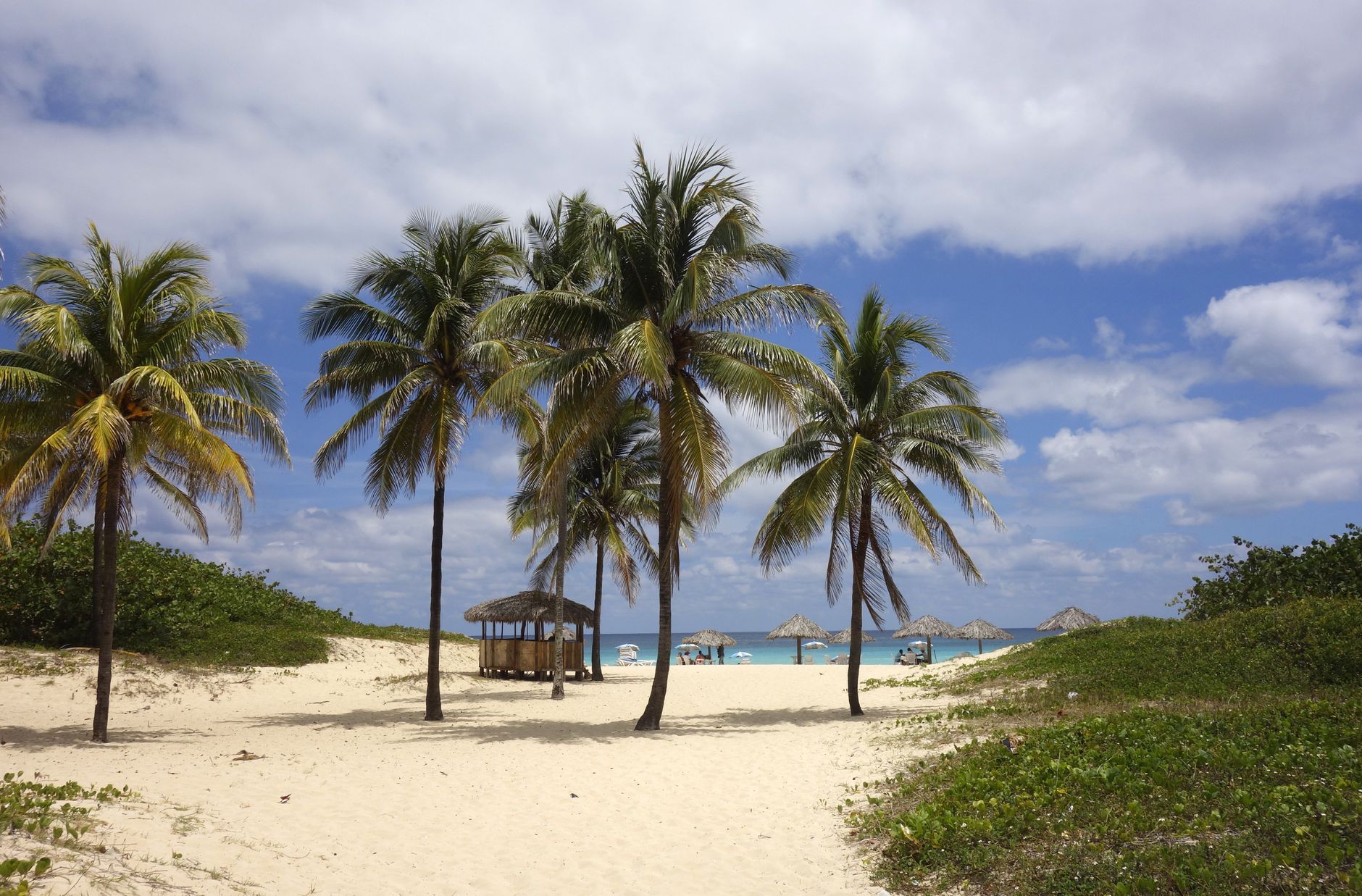
On the north coast of the province of Camagüey, far from Cuba's big tourist hubs, stretches one of the longest beaches in the country: Playa Santa Lucía. More than twenty kilometers of sand facing the Atlantic, protected by a nearby coral reef, make up a quiet and remote resort area, ideal for those looking for sea and rest without the crowds of Varadero or the cays.
Its great fame, however, comes from the bottom of the sea. Santa Lucía is one of the best-known diving destinations in Cuba, thanks to its coral barrier, its wrecks and, very especially, the chance to do the famous (and debated) bull shark dive, an experience that draws divers from all over the world. A few kilometers away, the beautiful Playa Los Cocos rounds out the appeal of the area.
This guide covers the practical side of Playa Santa Lucía with a realistic, warm eye: what to expect from the beach and the diving, how to get there from Camagüey, where to stay and eat, and how to combine it with the nearby colonial city. A destination for lovers of calm sea and scuba diving, on one of the least crowded coasts in Cuba.
Playa Santa Lucía has no urban history of its own: its story is tied to that of the Camagüey region and to the tourist development of Cuba's north coast. The province of Camagüey was one of the first areas settled by the Spanish —the town of Santa María del Puerto del Príncipe (today Camagüey) was founded in the 16th century— and its north coast, with the great Bay of Nuevitas, had port and commercial importance throughout colonial history, as well as episodes linked to the piracy and smuggling characteristic of the Caribbean. The coastal strip where Santa Lucía is today was historically an area of fishing and sparsely inhabited shoreline. With the push for tourism in Cuba in the second half of the 20th century, and taking advantage of the enormous length of its beach and the richness of its coral reef, Santa Lucía was equipped with hotels and dive centers, becoming one of the beach resorts of the eastern north coast and a recognized diving destination (famous for shark diving). Today it combines that tourist role with the life of the small settlements in the area and local fishing. The deeper history of the region —the founding of Camagüey, its colonial past and the importance of the Bay of Nuevitas— is told in detail on our history page.
Read the full history ↓Cuba's largest province: a land of savannas and cattle, of the labyrinthine town of Camagüey —a World Heritage Site, with its tinajones and baroque churches—, birthplace of Ignacio Agramonte, Gertrudis Gómez de Avellaneda, Nicolás Guillén and Carlos J. Finlay, and of remote Playa Santa Lucía.
Read the history of Camagüey →Some places make no sense on your own; with someone explaining them, they change completely. We look ours up on Civitatis: guided in Spanish and booked online with no fuss. There are not many in Santa Lucia, but the ones there are worth it. Tap the cards below and have a look.
Affiliate link: we earn a commission. Prices and availability come from Civitatis.
Abroad, getting sick is more than a bad day. In many destinations public healthcare depends on appointments, queues and availability, and private care is paid upfront. An emergency can cost thousands of USD, right when you are far from home and on a tight budget. That is why I recommend you never leave without travel assistance.
I recommend GO! Assistance because it covers what matters: medical care, emergencies, medication and hospitalization depending on the plan. It protects you 24 hours a day, anywhere in the world, with real-time solutions on the ground. GO! 365 ECO and GO! 365 give you USD 45,000 of global coverage: the first with a USD 100 deductible, the second with none.
If you quote from Argentina, in October GO! also offers 12 interest-free instalments on all its products.
GO! Assistance has 50% off in October and, with our link, you get an extra 20%.
Pick origin, destination, dates and ages and see the price of your travel assistance in a minute.
I have never been left without internet on a trip. I land and my phone connects to the strongest network in the country I am visiting: I can let people know I arrived, sort out transport, book tours and keep posting content at a super affordable price (really cheap!). I always use the Maya Mobile eSIM, check out its plans by clicking the banner. See Maya Mobile plans →
Affiliate link: we earn a commission.
No exact prices: a scale from $ (budget) to $$$$$ (luxury), with 2-3 options per category.
Origins, formation and what the sources say.
A diver drops into the water in the entrance channel of the Bay of Nuevitas and, a few meters away, the unmistakable silhouette of a bull shark over two meters long appears. The scene, which today draws divers from all over the world to Playa Santa Lucía, happens on a coast that for centuries was almost the opposite of a tourist destination: a lonely shoreline that the region's own founders preferred to move away from. Understanding how this remote beach on the north coast of Camagüey went from a fishermen's refuge to a mecca of shark diving means entering a story of pirates, strategic bays and a colonial city built to get lost in.
The history of Playa Santa Lucía can't be told apart from that of Camagüey, the region and the city it belongs to. Santa Lucía is a beach on the north coast of the province of Camagüey, in east-central Cuba, and its story is framed by that of one of the oldest and most singular regions of the Spanish colonization of the island.
The town of Santa María del Puerto del Príncipe —the origin of today's Camagüey— was one of the first founded by the Spanish in Cuba, in the 16th century. Initially tied to the coast, the town ended up moving inland, away from the shoreline. One of the reasons tradition gives for that move away from the sea was the need to protect itself from the attacks of pirates and corsairs, very frequent on the Caribbean coasts during the colonial centuries.
So, while the city grew inland (developing its famous labyrinthine layout, also associated with defense against attackers), the north coast —where Santa Lucía is today— remained a sparsely inhabited strip of shoreline, of fishing and of access to the sea through the region's great bays, such as Nuevitas.
The great historical protagonist of the north coast of Camagüey, near Santa Lucía, is the Bay of Nuevitas: one of the great pouch-shaped bays of the Cuban north coast, with a narrow entrance and a wide interior, which has had port and commercial importance throughout history. Nearby Playa Los Cocos looks out precisely onto its mouth.
During the colonial era, the bays and coasts of this region were the scene of trade (legal and illegal) and of the activity of pirates and corsairs who prowled the Caribbean in search of plunder. Defense against these threats shaped the organization of the territory, from the city's retreat inland to the fortification of strategic points.
Over time, Nuevitas consolidated itself as one of the important ports of northern Cuba, tied to trade and, later, to industry. The coastal strip where Santa Lucía stretches today, by contrast, long remained a natural and sparsely populated shoreline, devoted to fishing, until the development of tourism would give it a new destiny in the 20th century.
While the coast remained sparsely inhabited, the city of Camagüey, inland, developed as one of the most singular colonial cities in Cuba. Its most characteristic feature is its labyrinthine urban layout: unlike the regular grid of other Spanish American cities, Camagüey grew with irregular streets, alleys, squares and bends, a web that, according to tradition, sought to disorient pirates and attackers and hinder their advance.
Another symbol of the city are the tinajones, big clay jars historically used to collect and store rainwater, so present in Camagüey that they became the city's emblem. The historic center, with its many colonial churches and squares —such as the famous Plaza San Juan de Dios—, preserves exceptional heritage value.
That value was recognized when the historic center of Camagüey was declared a UNESCO World Heritage Site, consolidating the city as one of the great cultural destinations in Cuba. Today, Camagüey is the service city and the cultural base for those visiting Playa Santa Lucía, which makes it possible to combine colonial heritage with the beach of the north coast.
Santa Lucía's transformation from natural shoreline to beach resort came with the push for tourism in Cuba during the second half of the 20th century. Taking advantage of two great natural assets —the enormous length of its beach (one of the longest in the country) and the richness of its nearby coral reef—, the area was equipped with hotels and, above all, with dive centers, which turned it into one of the best-known diving destinations on the island.
The coral barrier off Santa Lucía, together with the wrecks in the area, offers highly attractive dive sites. But what gave the destination international fame was diving with bull sharks: a singular —and debated— experience in which divers can observe these great predators up close, which drew the attention of divers from all over the world and put Santa Lucía on the map of world diving.
Today, Santa Lucía combines that tourist and diving role with the life of the small coastal settlements in the area (such as La Boca, next to Playa Los Cocos) and local fishing. It's a quieter and more remote destination than Cuba's big tourist hubs, where nature —the long beach, the reef, the marine life and the nearby mouth of the Bay of Nuevitas— is still the great protagonist, in close relation with the colonial history of the Camagüey region.
If something put Playa Santa Lucía on the international diving map, it wasn't its hotels or its long stretch of sand, but what happens in the entrance channel of the Bay of Nuevitas. There, every season —above all between November and April—, bull sharks (Carcharhinus leucas) gather, one of the most imposing and respected species in the Caribbean. The Shark's Friends dive center, on the beach itself, turned that natural phenomenon into one of the most talked-about dives in Cuba: guided descents in which experienced instructors hand-feed the sharks while certified divers watch a few meters away.
The practice of hand-feeding is what gave Santa Lucía its fame —and also its controversy. For many divers it's a unique chance to come face to face with a great predator in its own environment; for part of the conservation community, feeding sharks raises objections about their natural behavior. That debate is, in itself, part of the destination's identity, and it's worth knowing about when choosing an operator. Sightings, moreover, are not guaranteed: sharks are wild animals and their presence depends on the season and the conditions.
But the sharks aren't the only treasure on the bottom. The coast of Santa Lucía and the mouth of Nuevitas hold more than thirty dive sites, among coral terraces, vertical walls and historic wrecks. The most famous is La Mortera, a ship that sank at the end of the 19th century and today works as an artificial reef teeming with life. These wrecks link directly with the seafaring and commercial past of the bay: the same seas that attracted pirates and merchants in colonial times are the ones that, centuries later, attract divers. So the underwater history of Santa Lucía closes the circle of a coast that was always defined by its relationship with the sea.