GO! Assistance has 50% off in October and, with our link, you get an extra 20%.
Pick origin, destination, dates and ages and see the price of your travel assistance in a minute.
Affiliate link: we earn a commission.
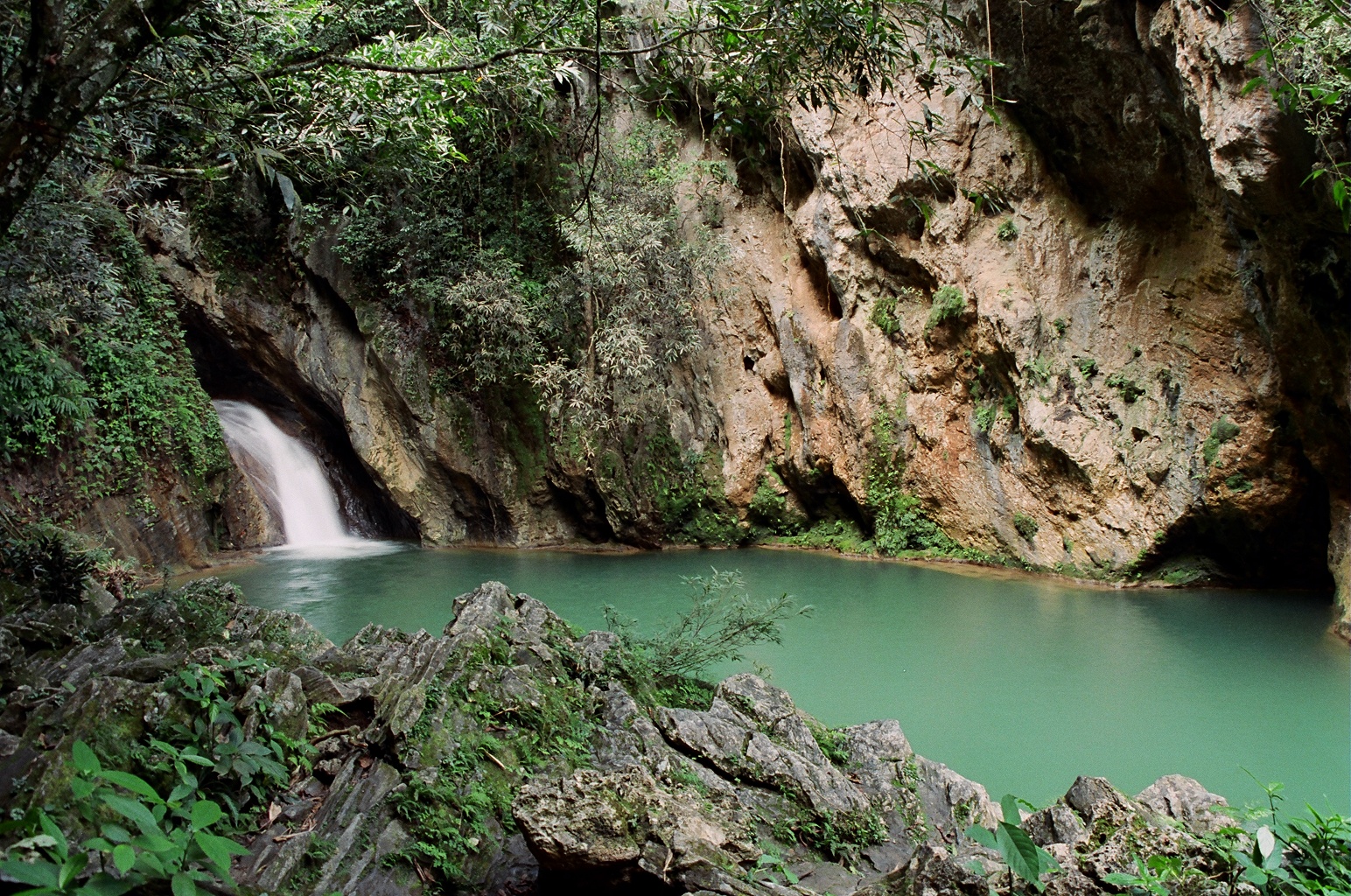
Topes de Collantes is central Cuba's great mountain breather: a natural park set in the Sierra del Escambray, at about 800 meters of altitude, where the landscape changes completely from the beaches and colonial quarters. Here what rules are the pine and eucalyptus forests, the giant ferns, the rivers of crystal-clear water and, above all, the waterfalls that plunge through the vegetation, such as the famous Salto del Caburní.
It's one of the country's main hiking and ecotourism destinations. Its trails, of different levels, lead to natural pools for a swim, to lookouts with views of the range and the distant sea, and to corners of lush nature populated by birds, butterflies and endemic flora. The cool, humid mountain air, the greenery and the sound of water make Topes a perfect contrast with the heat of the coast.
This guide covers the essentials of Topes de Collantes with a practical eye: which trails and waterfalls not to miss, how to get there from Trinidad, what to bear in mind for walking in the range, and where to sleep and eat. It's the ideal destination for anyone who wants to add nature, hiking and mountain air to a trip through central Cuba, a step away from Trinidad and the Valle de los Ingenios.
The Sierra del Escambray, where Topes de Collantes sits, is the second most important range in Cuba (after the Sierra Maestra) and a massif of great natural value in the center of the island. The name 'Topes de Collantes' is associated with the summit area of the range. The place has a singular history tied to health: the first stone of the great anti-tuberculosis sanatorium was laid on June 15, 1937 on the initiative of Fulgencio Batista, and the imposing eleven-story building —today the Kurhotel Escambray— finally opened on November 11, 1954, taking advantage of the cool climate and pure mountain air, considered beneficial for tuberculosis patients. That colossus still dominates the landscape. Later, the facilities were converted into health and rest centers and, finally, into a mountain tourism complex. The Sierra del Escambray was also the scene of historic events: during the revolutionary struggle and, especially, in the years after 1959, it was an operations zone for what is known as the 'fight against bandits'. In recent decades, Topes de Collantes has consolidated itself as one of Cuba's great nature and hiking destinations, declared a natural park and recognized for its biodiversity. The full history is on our history page.
Read the full history ↓The colonial heart of Cuba: home to Trinidad and the Valle de los Ingenios —a World Heritage Site—, to one of the island's first seven towns, to the Yayabo River and to the Escambray mountains with Topes de Collantes.
Read the history of Sancti Spíritus →A local guide tells you in half an hour what no sign at the site will ever explain. We look ours up on Civitatis: guided in Spanish and booked online with no fuss. They have 9 activities in Trinidad. And there are free tours here: you book without paying and tip the guide whatever you think at the end, so trying one costs you nothing. Have a look below: tap any of them to see them all.
They depart from Trinidad, 12 km away. Affiliate link: we earn a commission.
Abroad, getting sick is more than a bad day. In many destinations public healthcare depends on appointments, queues and availability, and private care is paid upfront. An emergency can cost thousands of USD, right when you are far from home and on a tight budget. That is why I recommend you never leave without travel assistance.
I recommend GO! Assistance because it covers what matters: medical care, emergencies, medication and hospitalization depending on the plan. It protects you 24 hours a day, anywhere in the world, with real-time solutions on the ground. GO! 365 ECO and GO! 365 give you USD 45,000 of global coverage: the first with a USD 100 deductible, the second with none.
If you quote from Argentina, in October GO! also offers 12 interest-free instalments on all its products.
GO! Assistance has 50% off in October and, with our link, you get an extra 20%.
Pick origin, destination, dates and ages and see the price of your travel assistance in a minute.
I have never been left without internet on a trip. I land and my phone connects to the strongest network in the country I am visiting: I can let people know I arrived, sort out transport, book tours and keep posting content at a super affordable price (really cheap!). I always use the Maya Mobile eSIM, check out its plans by clicking the banner. See Maya Mobile plans →
Affiliate link: we earn a commission.
No exact prices: a scale from $ (budget) to $$$$$ (luxury), with 2-3 options per category.
Origins, formation and what the sources say.
High in the Sierra del Escambray, 850 meters above sea level and surrounded by pine forests, stands an eleven-story hulk that seems out of place in the middle of so much nature: an immense, gray, massive building with room for a thousand people, dominating the mountain landscape like a sleeping giant. That colossus —today the Kurhotel Escambray— was not conceived as a hotel or as a refuge for mountaineers: it was born to cure tuberculosis patients, and its story is one of the strangest and most fascinating in Cuban tourism.
The first stone was laid on June 15, 1937. The initiative came from the then colonel Fulgencio Batista, head of the Army, who pushed for the construction of a great anti-tuberculosis sanatorium taking advantage of the cool, dry, airy microclimate of the Escambray summits, considered ideal for treating what was one of the most feared and deadly diseases of the era. The project was directed by the architect Cristóbal Díaz González, and putting up such a structure in such a remote and elevated spot meant opening roads, hauling materials up the range and overcoming the enormous difficulties of the mountain terrain.
The figures of the work are impressive: some six million bricks, more than 4,700 tons of cement, thousands of tons of steel and beams, and tens of thousands of cubic meters of stone and sand, for a building 183 meters wide, 63 deep and 36 high, on a surface of 32,000 square meters. But the construction dragged on for years: under the governments of Batista (1940-1944), Grau San Martín (1944-1948) and Prío Socarrás (1948-1952) the project barely advanced. Only when Batista returned to power after the 1952 coup did he order the work resumed and finished; it was finally opened on November 11, 1954 under the official name 'Sanatorio General Batista'.
The sanatorium wouldn't have existed but for the mountain that shelters it. Topes de Collantes sits in the heart of the Sierra del Escambray (also called the Guamuhaya massif), the second most important range in Cuba after the Sierra Maestra. This mountain system stretches across the south-center of the island, straddling the provinces of Sancti Spíritus, Cienfuegos and Villa Clara, and is one of the country's great natural treasures, with altitudes exceeding 1,000 meters at its highest peaks, such as Pico San Juan (or Pico de Potrerillo).
The Escambray is a massif of great biodiversity: pine and broadleaf forests, tree ferns that look like something from another era, abundant species of flora and fauna —many of them endemic— and a dense network of rivers and streams that, descending the slopes, form waterfalls and pools of cold, crystal-clear water. The mountain climate, cooler and more humid than that of the coast, and the pure air of the heights are exactly the traits that, in the first half of the 20th century, were considered beneficial for respiratory patients and that shaped the destiny of Topes de Collantes.
The name 'Topes de Collantes' itself is associated with the summit area ('topes') of this range. Located about 800 meters above sea level, the place combines that exceptional natural value with a strategic position near the historic town of Trinidad, on the southern slope of the range, facing the Caribbean Sea. From these heights, on clear days, the view reaches the valley, the forests of the range and even the glint of the Caribbean to the south.
Beyond the imposing building, the real wealth of Topes de Collantes is in the water and the green. The jewel is the Salto del Caburní, a waterfall where the river of the same name plunges from about 62 meters among rocks and vegetation, forming at its foot a string of natural pools where the visitor, after a demanding trail that drops and climbs along the slope, is rewarded with a swim in icy mountain water. The flow changes radically with the seasons: thunderous and spectacular after the summer rains, more modest in the middle of the dry season. It's not the only waterfall: the Salto Vegas Grande, wilder and less traveled, and the pools of the La Batata cave —where an underground river surfaces among the rocks— complete the range's water repertoire.
The vegetation of the Escambray is, in itself, a spectacle. In Parque Codina, an old estate turned into a garden, giant tree ferns, orchids and bamboo grow, alongside caves and mud pools with properties considered medicinal, heirs to the place's health vocation. The fauna is rich in birds —many endemic to Cuba—, butterflies and singular flora, which has made Topes one of the paradises of birding and hiking on the island.
These mountains also hold a deep coffee tradition. Like much of the ranges of central and eastern Cuba, the Escambray was coffee country, and high-altitude coffee is still one of the area's emblematic products: the Coffee House Museum, in the complex itself, recalls that historic bond between the mountain and the bean. Coffee, waterfalls and cloud forest sketch a Cuba very different from that of the beaches and the colonial quarters: the cool, humid, green Cuba of the heights.
The Sierra del Escambray, where Topes de Collantes is set, played a prominent —and often little-told— role in Cuba's revolutionary history. During the struggle against the Fulgencio Batista dictatorship, in the second half of the 1950s, the range was an operations zone for guerrilla fronts fighting in the center of the island, in parallel with the struggle Fidel Castro was waging in the Sierra Maestra, in the east. The mountain terrain, hard to reach, offered ideal conditions for irregular warfare, and different insurrectionary organizations moved through these hills, among them columns linked to Che Guevara in his advance toward Santa Clara at the end of 1958.
It is one of the great ironies of Cuban history: the same mountain where Batista ordered his pharaonic sanatorium built became, a few years later, a refuge for those who fought to overthrow him. And after the triumph of the Revolution in 1959, the Escambray was again the scene of combat, this time in the framework of what is known as the 'fight against bandits' (or 'cleanup of the Escambray'): during the early 1960s, armed groups opposed to the new government went into these mountains, and the State forces carried out long and harsh operations to fight them. These episodes left a deep mark on the region and on the memory of its inhabitants.
This historical dimension adds a layer of meaning to the massif: beyond its natural beauty and its value as a hiking destination, the Sierra del Escambray is a territory loaded with history, associated with key moments of the Cuban revolutionary process. Knowing this past —that of the sanatorium, that of the guerrillas and that of the civil aftermath of the sixties— helps you better understand the singular place this range holds in the country's history.
With advances in medicine and the appearance of more effective treatments against tuberculosis, the enormous sanatorium gradually lost its original function. The facilities were redirected toward other uses of health, rest and rehabilitation, keeping that vocation of well-being tied to the qualities of the mountain setting that had justified its construction. The eleven-story colossus was converted, over time, into today's Kurhotel Escambray, aimed at health tourism, and around it other mountain hotels emerged —Los Helechos, Villa Caburní, the rest complex— which today house the hikers.
The setting was protected and organized as a natural park, with a network of signposted trails leading to its main attractions: waterfalls such as the famous Salto del Caburní, natural pools, caves with underground rivers such as La Batata, gardens of ferns and orchids such as Parque Codina, and lookouts with views of the range and the sea. This infrastructure turned Topes into one of Cuba's great hiking and ecotourism destinations, much visited as a day excursion from nearby Trinidad, barely 20 kilometers away on a steep, winding mountain road.
Today, Topes de Collantes is the perfect natural complement to a visit to Trinidad and the Valle de los Ingenios, offering travelers a very different face of the country: that of mountain Cuba, cool and green, where the murmur of water and the coolness of the forest replace the heat of the Caribbean. Its history —from a sanatorium in the summits to a natural park, by way of the guerrillas— and its exceptional biodiversity make it a unique place within the Cuban tourism landscape. The history of this range is intertwined, on the map and in time, with that of Trinidad, Sancti Spíritus and all of central Cuba.