Viaja con Gus
Home › Ivory Coast › Grand-Lahou
Grand-Lahou
🇨🇮 Ivory Coast · The Atlantic coast

Grand-Lahou

🪪 What do I need to enter Ivory Coast?Pick your citizenship and we tell you the visa, the days and the paperwork, with the official source.

By leaving your email and citizenship you agree to receive the documents you asked for and weekly travel news. You can unsubscribe whenever you want. How we handle your data.
Jump to what you need
📍Region
Grand-Lahou is a lagoon town on the coast of Côte d'Ivoire, about 140 km west of Abidjan, where the great Bandama River meets the Atlantic Ocean. It is the 'town of three waters': the river, the lagoon and the sea. Home mainly to the Avikam people, it is famous for its old colonial settlement of Lahou-Kpanda, on a sand spit at the river mouth that erosion has swallowed, and as the gateway to Azagny National Park, with its mangroves and wildlife.
📌Best time
The best time is the dry season, from December to March, with good weather for pirogue trips, the beach and visits to the old settlement and the park. The long rainy season (May-July) makes the dirt roads difficult and raises the water levels. It is hot and tropical all year round, with high humidity. For trips on the lagoon and the river, pick a clear day in the dry season.
📌Suggested days
With 1 or 2 days you can enjoy the essentials: a pirogue trip on the lagoon and the mouth of the Bandama, a visit to old Grand-Lahou (Lahou-Kpanda), the colonial town swallowed by the sea, some time on the beach and, if time allows, a foray into Azagny National Park to see mangroves and birds. It works as a weekend getaway from Abidjan or combined with a coastal route.
📌Getting there
Grand-Lahou is about 140 km west of Abidjan, some 2,5 to 3 hours by road (motorway and then the road towards Dabou and Grand-Lahou). You can get there by car or hired taxi, or by intercity transport (buses and woro-woro) with changes. The new Grand-Lahou lies inland; to reach the old settlement of Lahou-Kpanda, on the sand spit at the river mouth, you have to cross the lagoon by pirogue. There is no airport; the nearest one is in Abidjan.
📌Getting around
Water is the main way to get around: trips between the new Grand-Lahou, the old settlement of Lahou-Kpanda and the fishing villages are made by pirogue across the lagoon and the river. On land, the new town can be explored on foot or by moto-taxi, and excursions are made by vehicle on dirt tracks. It is best to arrange boat transfers with local boatmen or through your accommodation, and to agree on prices in advance.
📌Language and currency
The language is French; the local population is mainly Avikam, fishing people of the lagoon and the sea. The currency is the West African CFA franc (XOF), pegged to the euro (655,957 XOF = 1 euro), about 600 XOF to the dollar in July 2026. It is a rural area where ATMs and card payments are scarce; bring enough cash from Abidjan for boatmen, meals, guides and the park.
💱 XOF exchange rate
Loading rate…
🌤️ Weather in Grand-Lahou
Loading weather…

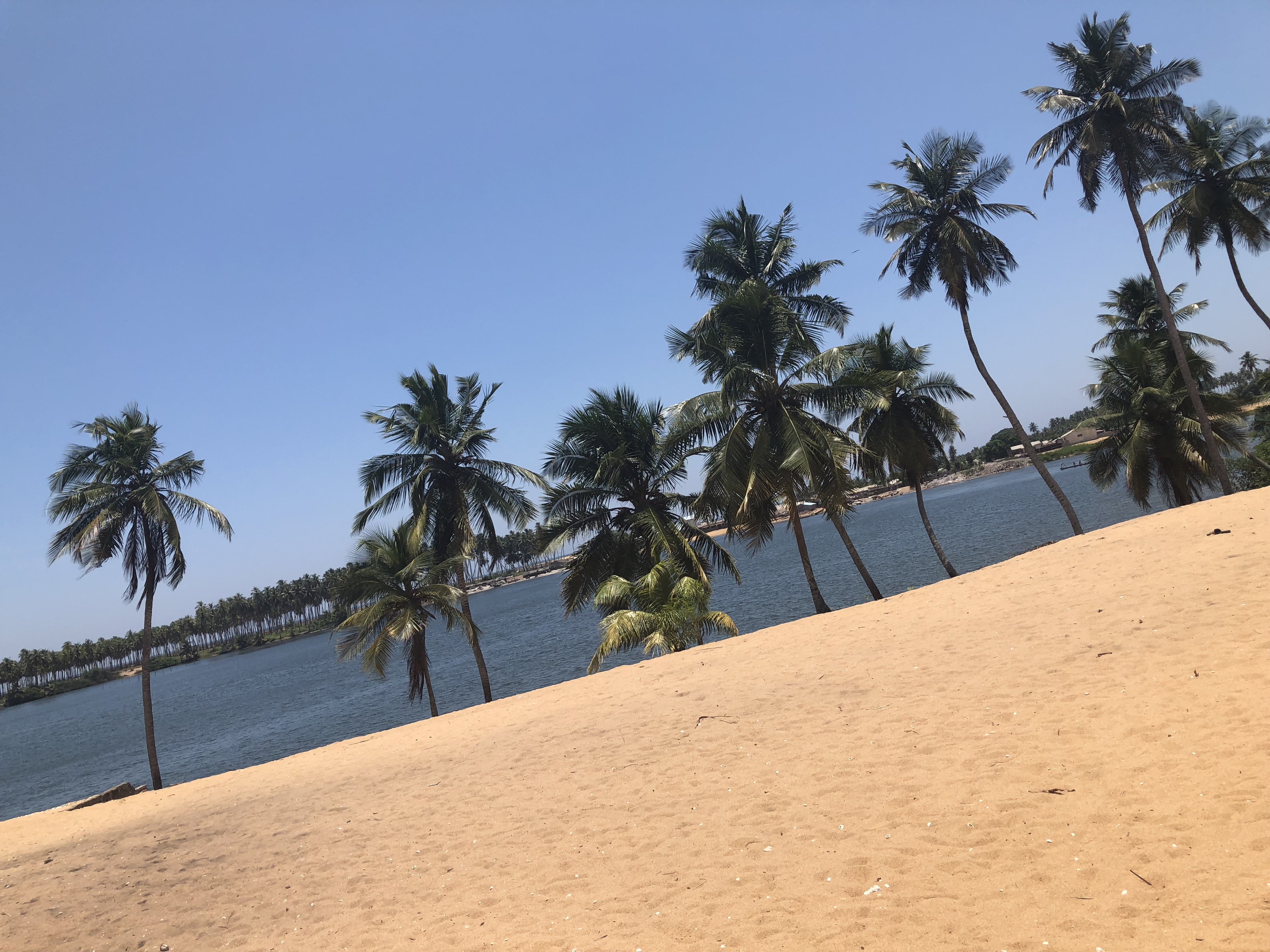
Grand-Lahou is one of the most unusual and moving places on the Ivorian coast: a lagoon town where the great Bandama River, after crossing half the country, meets the Atlantic Ocean. It is called 'the town of three waters', because the river, the lagoon and the sea come together here in a landscape of water, sand and coconut palms. Home to the Avikam people, it lives from fishing and from a close, and at times dramatic, relationship with the water.

Its history has a unique chapter: old Grand-Lahou, or Lahou-Kpanda, a colonial settlement built on a narrow sand spit at the river mouth, which the sea and the shifting river mouth have gradually swallowed. Houses, churches and entire buildings have been engulfed by the water, in a slow shipwreck that turned the place into a worldwide symbol of coastal erosion and climate change. Walking through its ruins facing the ocean is an unforgettable experience.

This practical guide covers Grand-Lahou: how to get there from Abidjan, how to visit the old settlement and the river mouth by pirogue, what to see in Azagny National Park with its mangroves and wildlife, where to stay and eat, and how to get around this world of water. A destination for curious travellers and lovers of nature and powerful stories, looking for an authentic Côte d'Ivoire off the usual circuits.

📖 History of Grand-Lahou

In the early 20th century, Grand-Lahou was an important colonial comptoir and one of the first economic centres of the Ivorian coast, home to the Avikam people at the mouth of the Bandama. The old settlement, Lahou-Kpanda, flourished on a sand spit between the river, the lagoon and the sea, but coastal erosion and the shifting river mouth —made worse by the construction of the Kossou dam in the 1970s— gradually swallowed it, forcing the town to move inland in 1973. That story, from thriving comptoir to a town engulfed by the water, is told on our history page.

Read the full history ↓

🏛️ Grand-Lahou is in the Atlantic coast

Where colonisation began and where cocoa's journey ends today: old colonial ports, the great cocoa port of San-Pédro, unspoilt beaches and the chic resort of Assinie.

Read the history of The Atlantic coast →

🗺️ What to see

1
Old Grand-Lahou (Lahou-Kpanda)
The ruins of the colonial settlement on the sand spit, swallowed by erosion: a unique and haunting place.
Leer más ↓
Old Grand-Lahou, now known as Lahou-Kpanda, is the main attraction here: a colonial settlement built in the early 20th century on a narrow sand spit between the Bandama River, the lagoon and the ocean. It was a thriving comptoir with trading houses, administrative buildings, churches and a busy life. But coastal erosion and the shifting river mouth have gradually swallowed it: entire buildings now lie underwater or have collapsed onto the sand. Today you explore, by pirogue and on foot, a landscape of ruins facing the sea: walls of old churches, remains of colonial houses, cemeteries threatened by the waves, all in a setting of melancholy beauty. Local guides tell the story of the settlement and show how far the town reached before the water took it. It is a living lesson on the power of the sea and on climate change. Getting there: cross by pirogue from the new Grand-Lahou or from the lagoon landings. Best time: dry season. Tips: hire a local guide who knows the history; bring water and sun protection; respect the cemeteries and the life of the fishing village that still holds on there.
ℹ️ Distance: Sand spit at the river mouth, by pirogue from the new Grand-Lahou · Best time: Dry season · Admission: no rate published in an official source: the pirogue crossing and the guide are agreed at the landing, in cash · Duration: Half a day
2
The mouth of the Bandama and the 'three waters'
Where the great Bandama River meets the lagoon and the ocean, the landscape that defines Grand-Lahou.
Leer más ↓
Grand-Lahou is 'the town of three waters' because of the geographical spectacle it offers: the point where the Bandama River —one of the largest in Côte d'Ivoire, crossing the country from north to south— meets Tagba Lagoon and the Atlantic Ocean. It is a rare meeting of fresh and salt water, with sandbanks, mangroves and a fascinating play of colours and currents. A pirogue trip around the river mouth lets you take in this meeting of waters, see the force of the river, the calm of the lagoon and the swell of the sea, and understand why this place is both so beautiful and so fragile. The river mouth has shifted over the decades, changing the landscape and affecting the villages, something the guides explain along the way. Getting there: by pirogue from the Grand-Lahou landings. Best time: dry season, when the water is calmer. Tips: agree on the price and length of the trip; bring a cap and sun protection; combine it with a visit to the old settlement.
ℹ️ Distance: Mouth of the Bandama, by pirogue · Best time: Dry season · Admission: Included in the pirogue trip on the lagoon (verified July 2026) · Duration: 1 to 2 hours
3
Azagny National Park
A national park of mangroves, wet savannah and forest near Grand-Lahou, with elephants, monkeys and birds.
Leer más ↓
Azagny National Park, near Grand-Lahou, is a protected area of great ecological value: a mosaic of mangroves, wet savannah, swamps and forest along the lagoon and the river, crossed by an old colonial canal (the Asagny canal). It is home to interesting wildlife that may include forest elephants, buffalo, several species of monkey, crocodiles, manatees and many waterbirds, making it a destination for nature lovers. The visit is made by pirogue and on foot, with a guide, heading into the maze of mangroves and channels. It is a quiet nature experience, very different from savannah safaris, focused on the lagoon and wetland ecosystem. Birdwatching is especially rich. The park is one of the country's wetlands of international importance (Ramsar). Getting there: near Grand-Lahou, by pirogue and vehicle, arranged with the OIPR or local guides. Best time: dry season. Tips: the visit must be organised with the OIPR or with operators; bring repellent, water and binoculars; respect the park rules and the wildlife.
ℹ️ Distance: Near Grand-Lahou, by pirogue/vehicle · Best time: Dry season · Admission: no rate published in an official source: the OIPR manages the park but does not publish its rates; check with the zone office before going (verified 08/08/2026) · Duration: Half a day to a full day
4
Pirogue trips on the lagoon
Sailing Tagba Lagoon among mangroves, Avikam fishing villages and landscapes of water and coconut palms.
Leer más ↓
The Grand-Lahou lagoon (Tagba Lagoon and its system) is the natural setting of local life and the best place for a pirogue trip. Gliding over its calm waters you discover mangroves, Avikam fishing villages, nets and fish traps, waterbirds and a landscape of great serenity. It is an unbeatable way to get to know the lagoon world that defines Grand-Lahou and to get close to the daily life of its people. Local boatmen take you to different spots depending on the time you have: the river mouth, the old settlement, the villages, the park's channels. It is a relaxed and very photogenic activity, ideal at sunrise or sunset, when the light is softer and the fishing is at its busiest. Getting there: from the Grand-Lahou landings, with local boatmen. Best time: dry season; sunrise or sunset. Tips: agree on price and route before setting off; bring water and sun protection; ask permission before photographing the fishermen.
ℹ️ Distance: Tagba Lagoon, from Grand-Lahou · Best time: Dry season; sunrise or sunset · Admission: no rate published in an official source: set by local pirogue operators · Duration: 1 to 3 hours
5
The beach and the fishing village
The Atlantic beach on the sand spit and the life of the Avikam fishermen, between the sea and the lagoon.
Leer más ↓
Beyond its history and nature, Grand-Lahou offers a wide, wild Atlantic beach on the sand spit and the authentic atmosphere of a fishing village. Watching the pirogues come in with the catch, the nets laid out, the fish being smoked and the daily life of the Avikam community is an essential part of the visit. The beach, pounded by the ocean, is beautiful but dangerous for swimming because of the currents, so it is better enjoyed for walking and taking in the view than for a swim. The contrast between the rough sea on one side and the calm lagoon on the other, with the village in between, sums up the essence of this place of 'three waters'. You can eat very fresh fish at the local maquis. Getting there: on the sand spit, crossing by pirogue. Best time: dry season. Tips: swim with great caution because of the currents; try the catch of the day; respect village life and ask permission for photos.
ℹ️ Distance: Sand spit at the river mouth · Best time: Dry season · Admission: Free access; pirogue and food and drink at the maquis extra · Duration: Half a day
📶I have never landed without internet. I arrive and my phone connects to the strongest network in the country I am visiting: I can say I landed, sort out transport, book tours and keep posting, at a seriously good price. I always use the Maya eSIM — check their plans by clicking the banner.See plans →Maya Mobile eSIM — connect before you land
What nobody tells you

💵 Prices

Tickets

TypePrice
Paseo en pirogua al viejo poblado de Lahou-Kpanda (con guía)no rate published in an official source: the pirogue transfer is charged by the village pirogue operators and no Ivorian authority publishes a fee; it is agreed at the landing, in cash
Paseo en pirogua por la laguna y la desembocadurano rate published in an official source: set by local pirogue operators; agreed before setting off, in cash
Parque Nacional de Azagny (entrada + guía + pirogua)no rate published in an official source: Azagny National Park is run by the OIPR (Office Ivoirien des Parcs et Réserves), which has a page for the park on its website but does not publish rates for admission, guides or pirogues. Check with the OIPR zone office before going (verified 08/08/2026)
PlayaFree access (verified July 2026)
🔄 updated monthlyOfficial / reference values · double-check when buying

Activities and tours

ActivityPriceDurationOperator
Excursion to old Grand-Lahou (Lahou-Kpanda)Pirogue + guide from about 10.000-25.000 XOF per group (USD 16-40, verified July 2026)Half a dayLocal boatmen and guides
Pirogue trip on the lagoon and to the villagesFrom about 5.000-15.000 XOF per group (USD 8-25, verified July 2026)1 to 3 hoursLocal boatmen
Visit to Azagny National ParkOIPR rates (admission + guide + pirogue); ask (verified July 2026)Half a day to a full dayOIPR / local operators
Beach and fishing day with the communityTo be agreed; food and drink at maquis from about 3.000-8.000 XOF (verified July 2026)Half a dayFishing community
🔄 updated monthlyOfficial / reference values · double-check when buying

🚌 How to get there and distances

Getting around

ModePriceDurationNotes
Pirogue on the lagoon and the riverTrips from about 5.000 XOF per group (verified July 2026)VariableThe main way to cross to the old settlement, the river mouth and the villages
Moto-taxi / local taxiShort trips from about 300-2.000 XOF (verified July 2026)VariableFor getting around the new Grand-Lahou and its surroundings
Vehicle on dirt tracksTo be agreed with local drivers (verified July 2026)VariableNeeded to reach the park and outlying spots, especially after the rains
🔄 updated monthlyOfficial / reference values · double-check when buying

How to get there

RouteAirlines / operatorsAvg. priceDuration
Abidjan → Grand-Lahou by road (via Dabou)Car/hired taxi, buses and woro-woro with changesPublic transport from about 3.000-6.000 XOF; private taxi more (verified July 2026)2,5 to 3 h (140 km)
New Grand-Lahou → old settlement (Lahou-Kpanda)Local piroguePirogue crossing from about 5.000-15.000 XOF per group (verified July 2026)Depending on route
Grand-Lahou → Azagny National ParkPirogue and vehicle, arranged with OIPR/guidesAccording to OIPR rates and transport (verified July 2026)Depending on excursion
🔄 updated monthlyOfficial / reference values · double-check when buying

🏨 Where to stay

No exact prices: a scale from $ (budget) to $$$$$ (luxury), with 2-3 options per category.

Comfort (lodges and camps)
Price$$$$$
Recommended options
From about 25.000-55.000 XOF per night (USD 40-90); lodges and camps facing the lagoon or the sea, the most comfortable in the area
Mid-range (simple hotels)
Price$$$$$
Recommended options
Approx. 15,000-30,000 XOF per night (USD 25-50); hotels and basic guesthouses in the new Grand-Lahou
Budget (rustic accommodation)
Price$$$$$
Recommended options
From around 8,000-20,000 XOF per night (USD 13-33); very simple rooms and camps; one option is to sleep near the lagoon

🍴 Where to eat

TypePriceOptions / signature dish
Maquis de pescado de laguna y mar$$$$$From around 3,000-8,000 XOF per person (USD 5-13); super-fresh fish, seafood, attiéké and alloco by the water
Comida local$$$$$From around 500-2,500 XOF (USD 1-4); popular dishes and street food in the town
Restaurantes de lodge$$$$$Around 6,000-15,000 XOF per person (USD 10-25); Ivorian cooking at the camps and lodges in the area

📖 History of Grand-Lahou

Origins, formation and what the sources say.

The Avikam people and the city of three waters

The land around Grand-Lahou has long been home to the Avikam people (also called the Brignan), a lagoon community of fishers and traders settled at the mouth of the Bandama River, where the river, the Tagba Lagoon and the Atlantic Ocean meet. This rare meeting of three waters (fresh, brackish and salt) shaped the community's life, economy and identity.

The Avikam lived from fishing in the lagoon and the sea, from gathering and from trade, making the most of their strategic position on the coast. Like other lagoon peoples of Côte d'Ivoire, they were in contact with the European sailors who travelled the Gulf of Guinea from the 15th century onwards, trading local goods for merchandise brought from Europe. The lagoon was at once a larder, a road and a border.

The mouth of the Bandama, one of the country's largest rivers, made this spot a link between the interior, whose goods and people came down the river, and the coast. That role as a meeting and trading point, along with the rich fishing in its waters, made Grand-Lahou an important settlement long before formal colonisation. It also laid the foundations for its later role as one of the first comptoirs on the Ivorian coast.

fr.wikipedia.org · Grand Lahoutourisme-ci.com · Grand Lahou

A thriving colonial comptoir

With French colonisation, made formal when the colony of Côte d'Ivoire was created in 1893, Grand-Lahou became an important comptoir (trading post) and one of the first economic centres on the coast. In the early 20th century the old town, known today as Lahou-Kpanda, flourished on the narrow sand spit at the river mouth, between the river, the lagoon and the sea.

French companies built trading houses there, along with administrative buildings, churches, colonial homes and everything else a busy port needed. Goods from the interior that came down the Bandama left through Grand-Lahou: palm oil, rubber, timber, and later coffee and cocoa. Imported goods came in the same way. The town went through a period of prosperity and became one of the busiest trading points on the Ivorian coast at the time.

As elsewhere on the coast, though, the rise of Abidjan drew trade away from the old coastal comptoirs, especially after the Vridi Canal opened in 1950 and gave the city its large deep-water port. Grand-Lahou began to lose its economic role, although it kept its fishing population and its beautiful setting between the three waters. The final blow, however, would come not from the economy but from nature itself.

fr.wikipedia.org · Grand Lahoujeuneafrique.com · Cote divoire village historique victime de…

When the sea began to swallow the town

The setting that had made Grand-Lahou's fortune, a narrow sand spit between the river, the lagoon and the ocean, also turned out to be its downfall. The mouth of the Bandama naturally shifts from east to west, and the coast suffers from strong marine erosion. Over the decades the sea and the river ate away the ground the old town stood on, at a rate of several metres a year.

Human activity made things worse. In the 1970s the large Kossou Dam was built upstream on the Bandama. It changed the river's flow and, above all, held back the sediment the river used to carry to the coast, which had helped replenish the sand on the spit. Without that supply, erosion sped up. Buildings, trading houses, churches and entire cemeteries of old Grand-Lahou ended up underwater or collapsed onto the beach.

As the water kept advancing, in 1973 the decision was taken to move the town inland to the site of present-day Grand-Lahou, some distance from the coast. The old town of Lahou-Kpanda was left half-abandoned, with a small community of fishers holding on among the ruins. It became one of the world's best-known symbols of coastal erosion and of what climate change does to coastal communities.

jeuneafrique.com · Cote divoire village historique victime de…fr.boell.org · En cote divoire la montee des eaux engloutit…

Azagny: protecting the wetlands

The Grand-Lahou area is more than a scene of erosion. It is also a natural treasure. Nearby lies Azagny National Park, a protected area of mangroves, wet savannah, swamps and forest along the lagoon and the Bandama. It was created to conserve one of the richest wetland ecosystems on the Ivorian coast.

Azagny is home to remarkable wildlife, including forest elephants, buffalo, monkeys, crocodiles, manatees and many waterbirds, and it is recognised as a wetland of international importance. An old colonial-era canal (the Asagny Canal) runs through the area, a reminder of efforts to link the lagoons by waterway. Today the park is an ecotourism destination and a reminder of the biodiversity found in the coast's lagoons and mangroves.

The park is managed by the Office Ivoirien des Parcs et Réserves (OIPR), and it gives Grand-Lahou another role: a gateway to a world of water and nature. Together with the drama of erosion and the beauty of the three waters, Azagny rounds out the picture of a region where the relationship between people and water is at the centre of everything. Sometimes that water gives life, and sometimes it is a threat.

en.wikipedia.org · Assagny National Parktourisme-ci.com · Grand Lahou

Grand-Lahou today: memory, resilience and hope

Today Grand-Lahou lives between memory and hope. The new town, inland, is home to most of the Avikam population, who still make their living from fishing and from the lagoon, the river and the sea. The old town of Lahou-Kpanda, on the sand spit, has become a deeply moving place to visit. Its ruins facing the ocean tell the story of a town swallowed by the water and have become a powerful symbol of climate change and of how vulnerable coastlines are.

In recent years major coastal stabilisation works have begun, partly through West African coastal management programmes (such as the WACA programme, backed by the World Bank). They aim to slow erosion, strengthen the sand barrier and stabilise the mouth of the Bandama. These works offer hope to communities that for decades watched the sea carry away their land and their history.

For travellers, Grand-Lahou is a unique destination. Nature shows both its beauty and its power here. You can sail between three waters, visit the ruins of a town swallowed by the sea, explore the mangroves of Azagny and share the daily life of a fishing community. This is Côte d'Ivoire at its most authentic and moving, a country lived facing the water, remembering what was lost and determined to hold on.

levoyageducalao.com · Lahou plage les derniers jours de la cite…fratmat.info · Stabilisation du cordon sableux de lahou…

📚 Bibliography

  • Wikipedia (FR) — «Grand-Lahou»: https://fr.wikipedia.org/wiki/Grand-Lahou
  • Wikipedia (EN) — «Grand-Lahou»: https://en.wikipedia.org/wiki/Grand-Lahou
  • Wikipedia (EN) — «Azagny National Park»: https://en.wikipedia.org/wiki/Assagny_National_Park
  • Jeune Afrique — «Grand-Lahou, village historique victime de la montée des eaux»: https://www.jeuneafrique.com/288312/societe/cote-divoire-village-historique-victime-de-montee-eaux/
  • Heinrich Böll Stiftung — «La montée des eaux engloutit le village de Lahou-Kpanda»: https://fr.boell.org/fr/2018/06/05/en-cote-divoire-la-montee-des-eaux-engloutit-peu-peu-le-village-de-pecheurs-de-lahou
  • Le voyage du Calao — «Lahou-Plage, la cité aux 3 eaux»: https://levoyageducalao.com/lahou-plage-les-derniers-jours-de-la-cite-aux-3-eaux
  • FratMat — «Stabilisation du cordon sableux de Lahou-Kpanda» (WACA programme): https://www.fratmat.info/article/2640840/economie/stabilisation-du-cordon-sableux-de-lahou-kpanda
  • Tourisme-ci — Grand-Lahou: https://www.tourisme-ci.com/Grand_Lahou.htm

❓ Frequently asked questions

What is 'the city of three waters'?+
It's the nickname of Grand-Lahou, after the rare geographical spectacle it offers: the point where the great Bandama River, after crossing Côte d'Ivoire from north to south, meets the Tagba Lagoon and the Atlantic Ocean. Three waters (river, lagoon and sea) sharing a single landscape of sand, mangroves and coconut palms. That meeting of fresh and salt water is both the greatest beauty and the greatest fragility of the place, because of erosion and the shifting mouth of the river.
Why is old Grand-Lahou under water?+
The original colonial settlement, Lahou-Kpanda, was built in the early 20th century on a narrow spit of sand at the mouth of the Bandama. Over time, coastal erosion and the natural shifting of the river mouth ate away at the land, a process made worse by the construction of the Kossou Dam in the 1970s, which altered the river's flow and sediment. Buildings, churches and entire cemeteries ended up under water, and the town had to move inland in 1973. Today the ruins facing the sea are a worldwide symbol of coastal erosion.
Can you visit the old settlement?+
Yes, and it's the big experience in Grand-Lahou. You cross by pirogue from the new town or from the lagoon landings, with a local guide who tells the story and shows you the ruins: walls of old churches, remains of colonial houses, cemeteries threatened by the waves. A small fishing community still holds on there. It's a moving and very photogenic trip; it's best to go with a guide, bring water and sun protection, and respect the cemeteries and village life.
What is Azagny National Park?+
It's a protected area near Grand-Lahou, an ecosystem of mangroves, wet savannahs, swamps and forest on the shores of the lagoon and the river, crossed by an old colonial canal. It is home to wildlife such as forest elephants, buffalo, monkeys, crocodiles, manatees and many waterbirds, and it is a wetland of international importance. Visits are made by pirogue and on foot, with a guide, and it's ideal for nature lovers and birdwatchers. You need to arrange it with the OIPR or with local operators.
How do I get to Grand-Lahou from Abidjan?+
It's about 140 km west of Abidjan, around 2.5 to 3 hours by road (motorway and then the road via Dabou). You can go by car or hired taxi, or by intercity transport (buses and woro-woro) with changes, which is cheaper but slow. The new Grand-Lahou is inland; to reach the old settlement of Lahou-Kpanda, at the river mouth, you have to cross the lagoon by pirogue. Bring enough cash, as ATMs are scarce.

More places in Ivory Coast

KorhogoLa Dent de ManManParque Nacional de la ComoéParque Nacional de TaïParque Nacional del Banco
See every place in Ivory Coast →The history of Ivory Coast →
Sources consulted (9)
Still planning?
Explore more destinations in Ivory Coast
See all destinations →
Image credits
Photos from Wikimedia Commons, each under its own licence (CC BY, CC BY-SA or public domain). Open each file to see its author and licence.
Une baie à Grand-Lahou