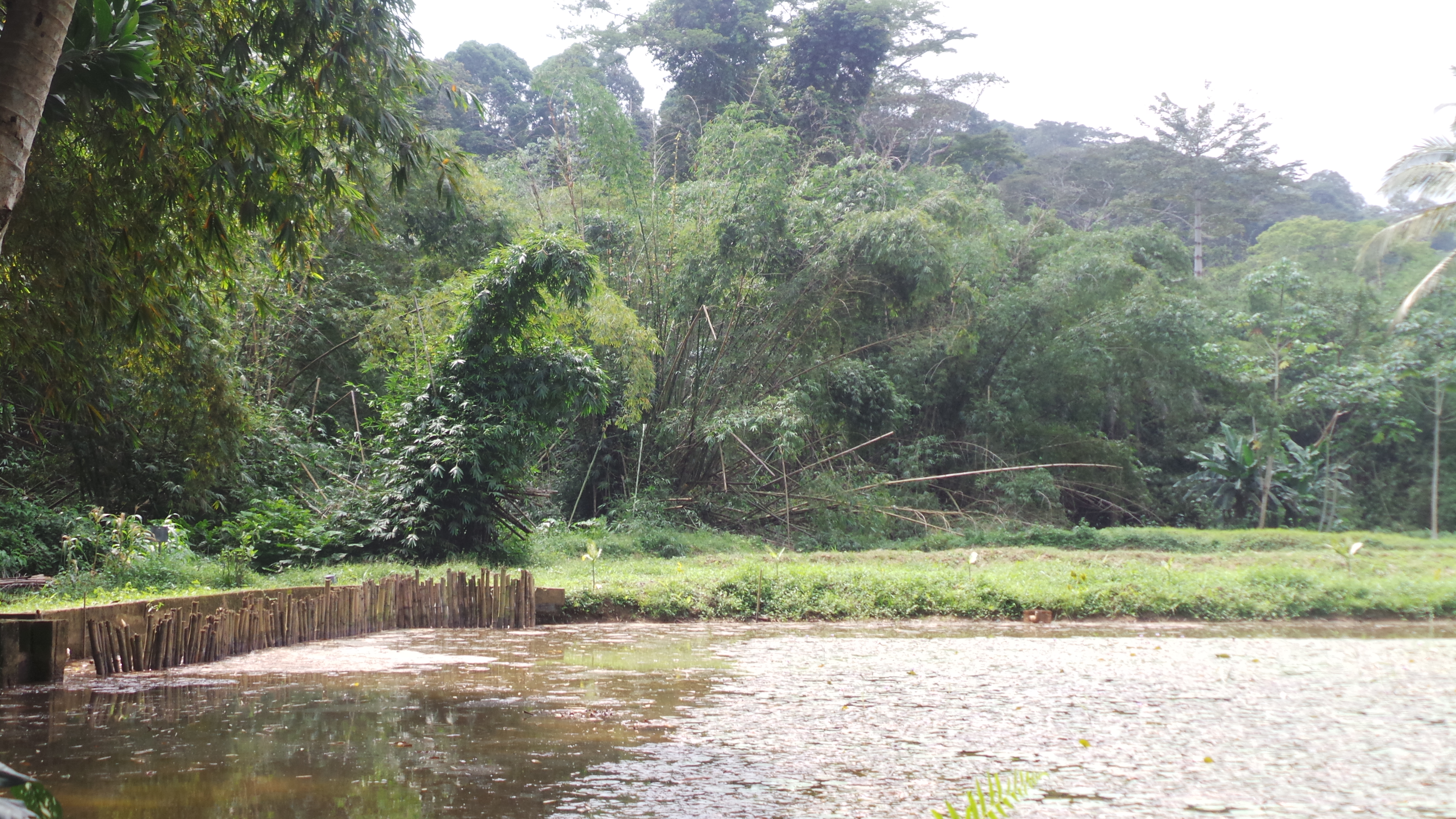
Banco National Park is one of the most unusual places in Africa: a primary rainforest of almost 3.500 hectares enclosed within a metropolis of more than six million people. Just minutes from the Plateau's skyscrapers in Abidjan, you can step into a humid forest of giant trees, ferns, lianas and streams, hear the songs of more than two hundred bird species and come across monkeys, flying squirrels or pangolins.
Established as a national park in 1953 on a former protected forest, Banco is at once a biodiversity reserve, the city's green lung and a space for recreation and research. Its trails, its arboretum with labelled species and its famous colonial 'laundry' —where the 'fanico' washermen still scrub clothes in the river, kneeling in old tyres— make the visit an experience somewhere between nature and Ivorian city life.
This practical guide explains how to visit Banco: when to go, how to get there from central Abidjan, which trails to walk, how much the entrance fee and guide cost, and what to bring. It's the perfect nature escape to add to a stay in Abidjan, and proof that even in the heart of a big African city an intact piece of the great Guinean forest can survive.
Banco is what remains of the vast rainforest that covered southern Côte d'Ivoire before agricultural and urban expansion. Protected as a classified forest in colonial times and made a national park in 1953, it survived despite the explosive growth of Abidjan, which now surrounds it on all sides. Its history —from primeval forest to threatened green island in the middle of the city— and its ecological importance are covered on our history page.
Read the full history ↓The economic heart of the country: from the first colonial capital at Grand-Bassam to the skyscrapers of the Plateau reflected in the Ébrié Lagoon, the "Manhattan of the tropics".
Read the history of Abidjan and the lagoon →No exact prices: a scale from $ (budget) to $$$$$ (luxury), with 2-3 options per category.
Origins, formation and what the sources say.
To understand the Banco, you have to picture the landscape of southern Côte d'Ivoire before the 20th century: a vast, humid tropical rainforest stretching unbroken from the coast inland, part of the great Upper Guinean forest block that ran from Sierra Leone and Liberia to Ghana. It was a dense forest of gigantic trees, with an extraordinary diversity of plants, birds, monkeys and other mammals.
Today's Banco National Park is a surviving fragment of that primary rainforest. Its value lies not in its size (it covers just over 3,400 hectares) but in being primary forest, meaning forest that has never been logged. That is increasingly rare across West Africa, where deforestation has been brutal. Côte d'Ivoire in particular lost the vast majority of its forest cover over the 20th century as cocoa, coffee and palm plantations expanded.
That this piece of ancient rainforest has survived to the present day, and in the middle of one of Africa's largest cities at that, is almost a miracle. In a way, the Banco is a time capsule: living evidence of what nature in this region looked like before agriculture and cities transformed it completely.
Protection of the Banco began in colonial times. In the early decades of the 20th century, the French administration classified the Banco forest as a 'forêt classée' (protected forest), recognising both its natural value and its importance for the water supply of fast-growing Abidjan, which drew part of its water from the Banco River. That early protection was key to keeping the forest from being swallowed up by the expanding city and its plantations.
In 1953, the Banco was raised to the status of national park, one of the first protected areas in the country to hold that rank. The aim was to preserve a representative example of Côte d'Ivoire's humid rainforest while also keeping a green space and a water source for Abidjan. The park was given trails, an arboretum and a station for forestry research.
Over the following decades, as Abidjan grew at a dizzying pace during the 'Ivorian miracle' and beyond, the Banco ended up literally surrounded by the city. Entire neighbourhoods (Attécoubé, Adjamé, Abobo, Yopougon) grew right up against its boundaries, until the park became an island of rainforest in a sea of concrete, a situation as exceptional as it is fragile.
The Banco River, which gives the park its name, has been tied to life in Abidjan since the city's early days. Its waters supplied drinking water to part of the population, and on its banks, at the entrance to the park, one of the capital's most distinctive social phenomena was born: the great open-air laundry of the 'fanicos'.
Since colonial times, men working as launderers have set up along the riverbank to wash the city's clothes by hand. Over time they developed a very particular method: each fanico works kneeling inside an old car tyre, which serves as both his workstation and his basin, scrubbing and beating the garments against stones and boards, then laying them out by the hundreds to dry on the grass and bushes nearby. The result is a multicoloured patchwork of clothing that has become one of Abidjan's iconic images.
The fanico trade, often passed down from father to son and linked to communities from the north of the country and neighbouring countries, is hard and poorly paid work, but it is part of the city's living heritage. Today the laundry is both a workplace and a tourist attraction, and it shows how the park and its river are woven into the everyday life of Abidjan's residents.
Despite its small size and the city all around it, the Banco still holds remarkable biodiversity. It is home to hundreds of plant species, including valuable hardwoods such as mahogany and iroko, and wildlife that includes several species of monkey, flying squirrels, pangolins, small forest antelopes, bats, reptiles, amphibians and more than 200 bird species. It is also a site for scientific study of rainforest ecology and of how a forest can survive in an urban setting.
But that survival is under constant threat. The pressure of an expanding city shows up as illegal settlement along the edges, illegal logging, hunting, plant collecting, dumping and pollution of the river, and the ever-present risk that its boundaries will be cut back to make room for development. The park needs active monitoring and management, handled by the Office Ivoirien des Parcs et Réserves (OIPR), to avoid degrading.
The Banco thus embodies a tension typical of Africa's fast-growing big cities: the one between urban development and nature conservation. Protecting this forest is not just about saving trees and animals; it also means preserving a regulator of the local climate, a water source and a green lung for the millions of people who live around it.
In the 21st century, Banco National Park has reaffirmed its place as one of Abidjan's great symbols and as a valuable resource for the city. It is at once a protected area, a place for recreation, an outdoor classroom for environmental education and a tourist attraction. Abidjan's residents use it to walk, run or cycle, schools visit it to learn about nature, and travellers discover it as one of the most original experiences the capital has to offer.
Its management, run by the OIPR, seeks to balance conservation with public use: waymarked trails, guides, access control and campaigns against deforestation and illegal settlement. The very existence of the park, in the heart of a metropolis of more than six million people, has become a powerful argument for protecting nature in African cities.
Visiting the Banco is, in the end, much more than a walk in the woods: it is a glimpse of the ancient rainforest that once covered this land, a way to understand the relationship between Abidjan and its natural surroundings, and proof that, with the will to do it, a piece of the great Guinean rainforest can stay alive, green and full of birdsong just a few minutes from the skyscrapers of the Plateau.