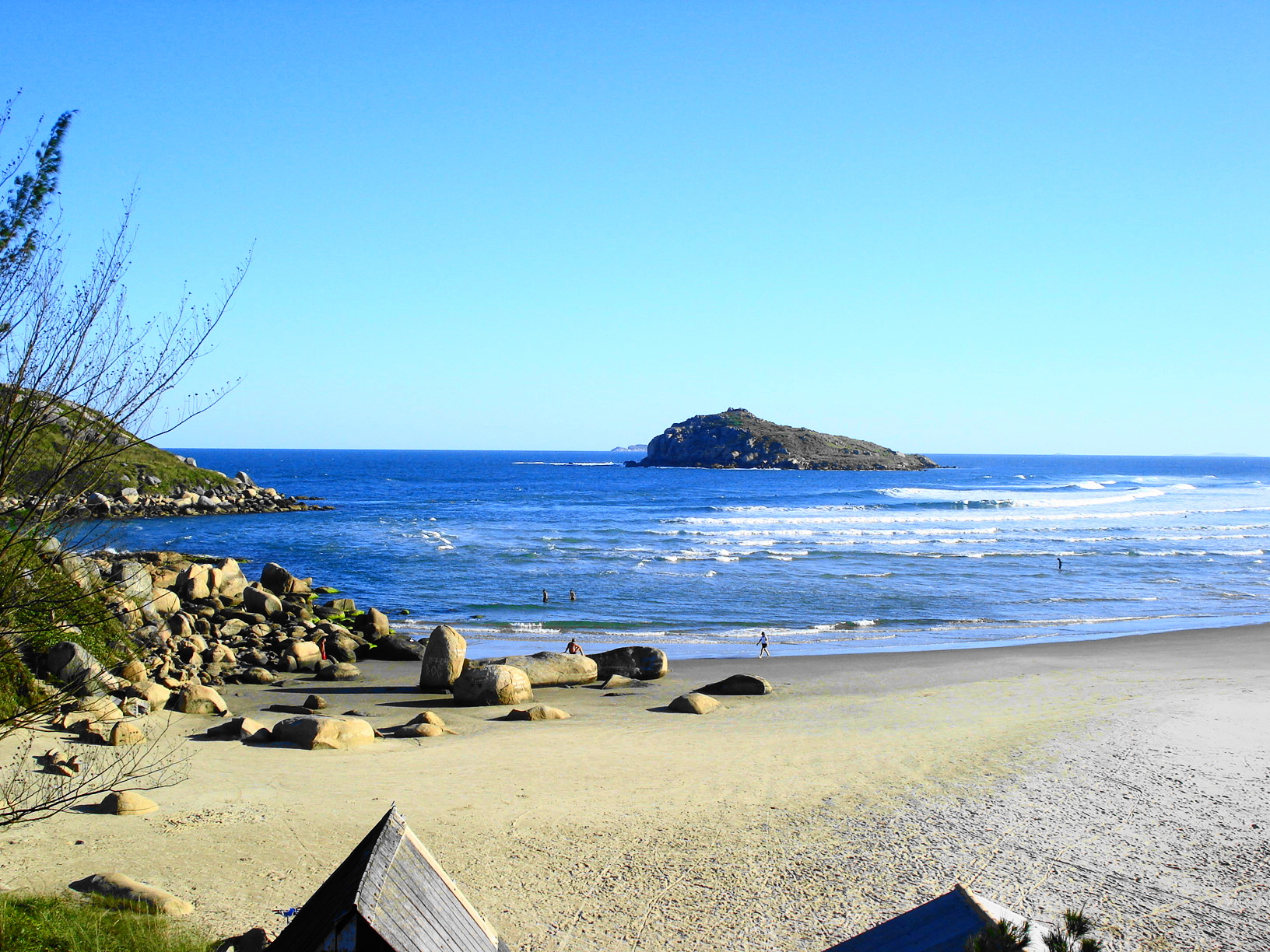
Praia do Rosa is one of the gems of the southern Santa Catarina coast: a curving beach of about 3 kilometres in the municipality of Imbituba, set between two green headlands that shelter it from the wind, with pale sand, water in shades of green and blue and a bohemian atmosphere that made it famous. The village, with its red dirt roads among eucalyptus trees, keeps a hippie-chic air, with pousadas tucked among the trees, restaurants overlooking the sea and an unhurried pace that draws surfers, artists and travellers after nature without show.
Its great singularity is being a sanctuary for the southern right whale (Eubalaena australis). Between July and November, peaking in August and September, these giants of up to 15 metres migrate from the South Atlantic to breed and raise their calves in the sheltered bays of the Santa Catarina coast. The Bahía de Rosa is one of the few places in the world where whales can be seen from dry land, with no need to board a boat. The whole region is protected by the Área de Proteção Ambiental da Baleia Franca, created in 2000.
This guide covers the essentials of Praia do Rosa with a practical eye: what to see and do (beaches, surfing, viewpoints, the Lagoa de Ibiraquera, whale watching), when to go depending on what you're after, how to get here from Florianópolis, how to get around, and where to sleep and eat. It's a destination that rewards anyone who appreciates the sea, the Atlantic forest and the quiet life of Brazil's southern coast.
Praia do Rosa was for centuries an area of small-scale fishermen of Azorean descent, on a coast that was hard to reach and lived on subsistence. From the 1970s and 1980s, surfers and bohemian travellers 'discovered' it for its unspoilt beaches and its waves, starting an alternative tourism that in time made it cosmopolitan. In 2000 the Área de Proteção Ambiental da Baleia Franca was created, consolidating its conservationist profile and tying its identity to the southern right whale, whose population is slowly recovering after centuries of hunting. The full story is on our history page.
Read the full history ↓The southern state of beaches, islands and cool highlands: settled by Azoreans, Germans and Italians, stage of Garibaldi's short-lived Juliana Republic and of the bloody Guerra do Contestado. Land of Florianópolis and its dozens of beaches, of the Blumenau Oktoberfest and of the only corner of Brazil where it regularly snows.
Read the history of Santa Catarina →They depart from Garopaba, 12 km away. If you book from this link we earn a commission and you pay no more.
No exact prices: a scale from $ (budget) to $$$$$ (luxury), with 2-3 options per category.
Origins, formation and what the sources say.
Long before surfers discovered its waves, the bay of Praia do Rosa already held a secret thousands of years old: the sambaquis, enormous mounds of shells and shellfish remains that the original peoples built up over millennia and that are still scattered along the Imbituba coast. They are the oldest trace of human presence on this shore. The southern coast of Santa Catarina, where present-day Praia do Rosa lies, was inhabited by indigenous groups of the Jê stock, especially the Xokleng and the Kaingang, who occupied the coastal and inland region in a pattern of seasonal movement, exploiting marine resources during part of the year and moving into the Atlantic forest in other seasons.
With the arrival of the Portuguese in Brazil in the 16th century, the Santa Catarina coast was explored but colonized late. The Ilha de Santa Catarina was charted by Iberian expeditions in the early 16th century, but effective colonization of the southern coast only began in the 18th century. Between 1748 and 1756, the Portuguese Crown organized the migration of families from the Azores archipelago and the island of Madeira to the Santa Catarina coast, in a process planned to settle and defend Brazil's southern territory. These Azorean settlers, known as 'manezinhos' in the local dialect, established themselves in Florianópolis and gradually spread south, founding fishing communities at various points along the coast.
The area of present-day Praia do Rosa was occupied in the 19th century by these families of small-scale fishermen of Azorean descent, who found in the sheltered bay an ideal place to anchor their boats and to fish with seine nets. The artisanal fishing techniques brought from the Azores —including a tarrafa (cast net), a rede de cerco (seine net) and a pesca da baleia (whaling)— were adapted to local conditions and shaped a coastal cultural identity that survives in fragments to this day in the memory of the area's oldest families.
Through the 19th century and the first half of the 20th, the Praia do Rosa area was a community of small-scale fishermen practically cut off from the rest of the state. The absence of paved roads and the distance from urban centres kept this community in a relative isolation that paradoxically preserved both the natural wealth of the place and the cultural traditions of Azorean origin. Families lived from fishing, from small vegetable plots and from trading produce with the neighbouring towns of Imbituba and Garopaba.
Whaling was practised on this coast from the colonial period well into the 20th century. The Armação da Lagoinha, near present-day Garopaba, was one of the main armações baleeiras (whale hunting and processing stations) on the Santa Catarina coast, active from the late 18th century until 1926, when the activity was banned in Brazil because whale populations had collapsed. The southern right whale, today the region's symbol and a key tourist draw, was driven almost to extinction by this trade.
The relative isolation of Praia do Rosa lasted until the 1960s-1970s, when the progressive paving of the BR-101 began to bring the southern coast of Santa Catarina closer to the rest of the country. The arrival of the first veranistas (summer visitors) from the big cities was gradual but steady, and coincided with the hippie and countercultural movement that in the 1970s led many young Brazilians to seek out natural paradises far from the city. Praia do Rosa, with its matchless beauty and its difficult access, became one of those chosen destinations.
The transformation of Praia do Rosa from fishing hamlet to tourist destination was a gradual process that began in the 1970s with the arrival of the first outsiders in search of unspoilt beaches and distance from civilization. These pioneers —mostly artists, university students and travellers influenced by the counterculture of the time— came along dirt roads off the BR-101, pitched tents on the beach and slowly built ties with the local community. Some stayed for good, opening small businesses or marrying local people.
By the 1980s, Praia do Rosa already had an established reputation among Brazil's alternative travellers. The first pousadas grew out of fishermen's houses adapted to take guests, keeping a rustic architecture in harmony with the landscape. The lack of reliable electricity, telephones and paved roads was part of the appeal for a clientele looking to switch off. The bars and restaurants that started opening in the 1980s had an informal, improvised character that reflected the spirit of the place.
This process of transformation was not without tension. As tourism grew, so did pressure on natural resources —the dunes began to erode, restinga vegetation was cleared for building, and the lagoon received untreated domestic effluent. The environmental awareness gaining ground in Brazil through the 1980s found in Praia do Rosa a local stage for the debate between tourist development and conservation. Those tensions foreshadowed the debates that would lead to the creation of the Environmental Protection Area in the following decade.
On 14 September 2000, under President Fernando Henrique Cardoso, the Área de Proteção Ambiental da Baleia Franca (APA da Baleia Franca) was created by federal decree, a conservation unit covering 156,100 hectares of the central-southern coast of Santa Catarina, from Florianópolis to Balneário Rincão, including the Praia do Rosa area. Creating this APA was a landmark in the region's history, formalizing the protection of the coastal ecosystems —dunes, restingas, lagoons, hillside Atlantic forest— and regulating human activity to make it compatible with conservation.
The main figure behind the creation of the APA was precisely the southern right whale, whose presence on the Santa Catarina coast had gone from being the target of industrial hunting to becoming the symbol of conservation and ecotourism. The biologist Karina Groch, research director of the Projeto Baleia Franca (today Projeto Franca Austral / ProFRANCA), documented, from monitoring flights begun in 1987, the recovery of the Eubalaena australis population on the southern coast of Brazil: her 2005 doctoral thesis estimated a population growth rate close to 14% a year. Groch identifies each animal by the callosities on its head —'like a fingerprint'— and the project has more than a thousand right whales catalogued. The recovery is attributed both to the end of hunting and to habitat protection measures. The southern right whale population in the southwestern Atlantic today runs to several thousand individuals, against the few hundred that were left in the critical decades of the mid-20th century.
Locally, the creation of the APA imposed restrictions on property development and on the clearing of vegetation which, though they met resistance in some quarters, in the long run preserved the natural character of Praia do Rosa and helped position it as a high-value ecotourism destination. The more selective, environmentally conscious tourism that characterizes Rosa today is largely a consequence of these conservation policies. The tension between conservation and development, however, is still present in community debates about tourism growth, property speculation and the preservation of the landscape and the cultural identity of the place.