Viajá con Gus
Home › Djibouti › Tadjoura
Tadjoura
🇩🇯 Djibouti · The Gulf of Tadjoura and the Goda Mountains

Tadjoura

🪪 What do I need to enter Djibouti?Pick your citizenship and we tell you the visa, the days and the paperwork, with the official source.

By leaving your email and citizenship you agree to receive the documents you asked for and weekly travel news. You can unsubscribe whenever you want. How we handle your data.
Jump to what you need
📍Region
Tadjoura is a port town on the northern shore of the gulf that bears its name, across the water from the capital. It is the oldest town in Djibouti and one of the most historic on the whole Red Sea coast. People call it 'the white city of the seven mosques' because of its whitewashed houses and its minarets. For centuries it was the seat of an Afar sultanate that controlled trade between the Ethiopian highlands and the sea. It sits at the foot of the Goda Mountains and is also the gateway to the Day Forest and the beaches of the northern gulf.
📌Best time to go
October to April, when temperatures are more bearable (25-32 °C) and the sea is good for the ferry crossing. It is also whale shark season in the gulf. Summer (June-September) is very hot. If you are using the town as a base for the Goda Mountains and the Day Forest, any time in the northern autumn or winter is ideal, since it is much cooler up high.
📌Suggested days
One day is enough to explore the white city, with its alleyways, its mosques, the port and the nearby Sables Blancs beach. With 2 or 3 days you can use Tadjoura as a base for trips up to Randa, the Day Forest and the Goda Mountains, and to enjoy the beaches of the gulf. Many travellers combine the ferry crossing with a night in Tadjoura or at Sables Blancs beach.
📌Getting there
The classic and most beautiful way is the ferry from Djibouti City, which crosses the gulf in about 2 hours (several days a week). You can also come by road around the head of the gulf (about 3-4 hours by 4x4, passing near Ghoubbet). Tadjoura also has a small airstrip. Routes to Randa, Day and Obock start from here.
📌Language and currency
Afar is the main language, alongside Arabic, Somali and French. The currency is the Djiboutian franc (FDJ), with a fixed rate of about 177.7 to the dollar. Bring cash in francs to Tadjoura, because tourist services are limited and there aren't many ATMs. It is a traditional, conservative town, and modest dress is appreciated.
📌Heritage
Tadjoura is a historic ensemble of great value for its age, its architecture of whitewashed houses and its seven historic mosques, the oldest of which dates back to the 16th century. Its old town is on the list of sites Djibouti considers for heritage protection, and it bears witness to centuries of Islamic trade in the gulf.
💱 DJF exchange rate
Loading rate…
🌤️ Weather in Tadjoura
Loading weather…

Tadjoura is the oldest town in Djibouti and one of the most history-laden places on the whole Red Sea coast. It is called 'the white city' for its whitewashed houses that gleam under the tropical sun, and 'the city of the seven mosques' for the minarets that rise among its alleyways. For centuries it was the capital of an Afar sultanate that controlled trade between the Ethiopian highlands and the sea. Salt, coffee and ivory passed through its port, and so did enslaved people.

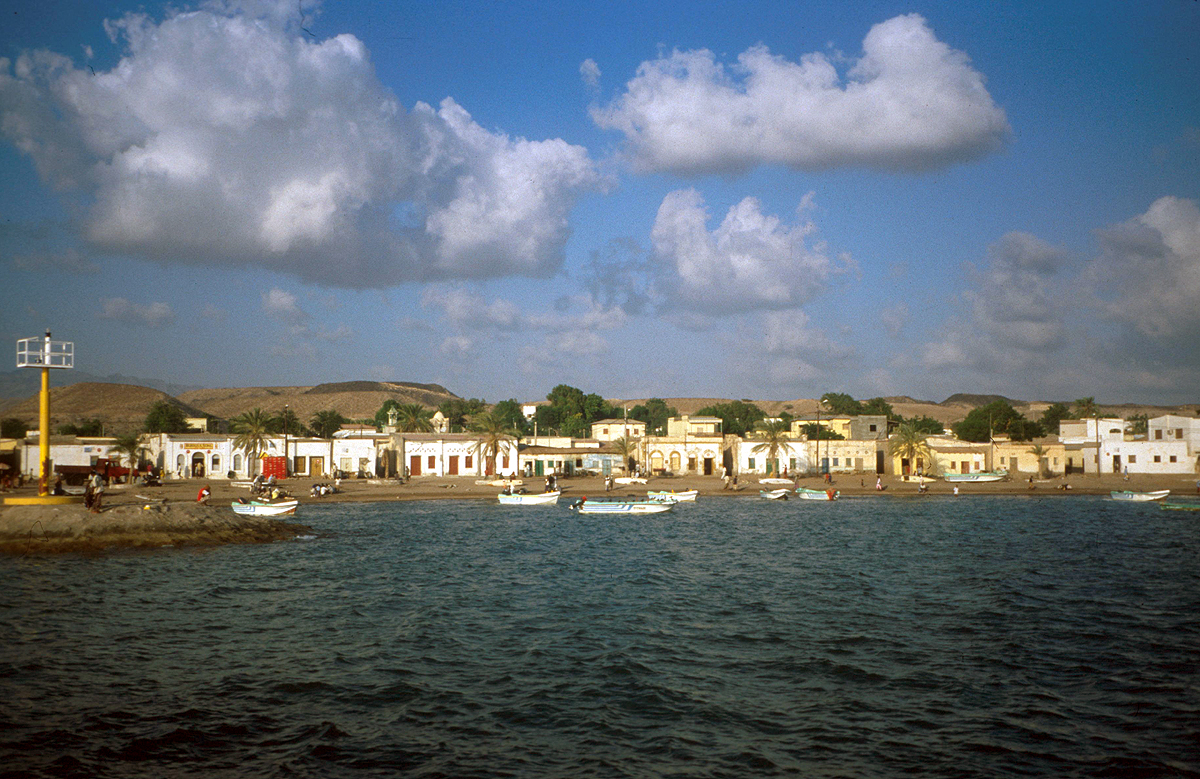
Set on the northern shore of the Gulf of Tadjoura, across from the capital, it moves at a different pace: white houses, turquoise sea, fishing boats and the murmur of prayer. Behind it rise the Goda Mountains, green and cool, home to the Day Forest and the villages of Randa and Bankoualé. A few kilometres away is Sables Blancs beach, the loveliest in the country. All of this makes Tadjoura the gateway to northern Djibouti.

The most beautiful way to arrive is to cross the gulf by ferry from the capital and watch the white city slowly appear over the water. This guide covers what to see in Tadjoura, how to get there, how to use it as a base for the mountains and the beaches, and why this small town of whitewashed houses is one of Djibouti's historical and human treasures.

📖 History of Tadjoura

Tadjoura is the oldest town in Djibouti, a port that has existed for many centuries and was mentioned by medieval Arab travellers. It belonged to the great Islamic states of the Horn of Africa, first the Ifat Sultanate and then the Adal Sultanate. Above all, it was the seat of the Sultanate of Tadjoura, an Afar state that controlled trade between Ethiopia and the Red Sea, including the slave trade. It passed through Ottoman, Egyptian and finally French hands before becoming part of independent Djibouti. Its full history is told on our history page.

Read the full history ↓

🏛️ Tadjoura is in the Gulf of Tadjoura and the Goda Mountains

On the northern shore of the gulf, the 'white city' of Tadjoura holds a thousand years of Islamic history, and behind it rise the cool Goda Mountains with the country's last forest.

Read the history of The Gulf of Tadjoura and the Goda Mountains →

🗺️ What to see

1
The white city and its alleyways
The old town of whitewashed houses, narrow alleyways and traditional Afar and Arab architecture that gives Tadjoura its nickname 'the white city'.
Leer más ↓
The heart of Tadjoura is its old town of whitewashed houses, a maze of narrow alleyways running down to the sea. The white façades are designed to reflect the sun and ease the heat, and they give the town its nickname 'the white city' (la ville blanche). It is a pleasure to wander on foot among the houses, small shops, courtyards and carved wooden doors, taking in the unhurried rhythm of a traditional gulf town. The architecture blends Afar, Arab and Swahili influences, the result of centuries of maritime trade with Arabia and the Indian Ocean coast. This is a conservative Muslim town, so explore it respectfully, dress modestly and ask before photographing people. It is best enjoyed early in the morning or at sunset, when the heat eases. Getting there: the old town runs down from the centre to the port. Best time: early morning or sunset. Tips: walk at a relaxed pace, greet people in Arabic or French and respect local customs.
2
The seven mosques
The historic places of worship that give Tadjoura its second nickname, with the 16th-century Great Mosque as a testament to its long Islamic past.
Leer más ↓
Tadjoura is known as 'the city of the seven mosques', and the minarets that rise among the white houses are the most visible sign of its very old Islamic past. The most important is the Great Mosque, whose origins go back to the 16th century. It shows that Tadjoura was a significant religious and trading centre on the Red Sea coast long before the modern capital existed. The mosques are simple and whitewashed like the rest of the town. They are not usually open to non-Muslims, but you can admire and photograph them from outside, and they are part of the old town's charm. They reflect the weight of Islam in Tadjoura's daily life and in Afar identity, and they help you understand how much history this port has. Getting there: scattered around the old town. Best time: outside prayer times. Tips: dress respectfully, don't interrupt prayers and ask before photographing worshippers.
3
The port and the ferry crossing
The small fishing port and the jetty for the ferry across the gulf, with boats coming and going on a turquoise sea.
Leer más ↓
Tadjoura's port is the living heart of the town. The fishing boats come in here with their catch from the gulf, the ferry from the capital docks here, and everyday life bustles around it. Arriving by ferry from Djibouti City and watching the white city slowly appear over the turquoise water is one of the most beautiful moments of the trip, and it is the classic way to arrive. From the port and the seafront you can enjoy the gulf, the sunsets and the seafaring atmosphere. It is also the starting point for boat trips around the gulf and for the ferry that continues north to Obock. Here the sea is everything, and Tadjoura has lived from it for centuries. Getting there: on the town's waterfront. Best time: at sunset; the ferry runs several days a week. Tips: check the ferry times in advance (they are limited) and arrive early.
4
Sables Blancs beach (nearby)
A beach of brilliant white sand a few kilometres to the east, the loveliest in the country, and an ideal base for combining sea and town.
Leer más ↓
Just 5-7 kilometres east of Tadjoura is Sables Blancs beach, a crescent of brilliant white sand and clear water considered the loveliest in Djibouti. Coral lies close to the shore, which makes it excellent for snorkelling and swimming, and it has the best permanent camp in the country for spending the night by the sea. It is the natural complement to a visit to the white city. Many travellers combine a day in Tadjoura's historic centre with an afternoon or a night at Sables Blancs. It is close enough to come and go easily by car or boat. (See our dedicated guide to Sables Blancs beach for more detail.) Getting there: 5-7 km east of Tadjoura, by car or boat. Best time: October-April. Tips: bring snorkelling gear; ideal for spending a night by the sea.
5
Gateway to the Goda Mountains and the Day Forest
Tadjoura is the base for trips up to Randa, the Day Forest and the cool Goda Mountains, a green world above the gulf.
Leer más ↓
Behind Tadjoura rise the Goda Mountains, a green and surprisingly cool massif that contrasts with the heat of the coast. Routes run from the town to the village of Randa and to Day Forest National Park (Forêt du Day), one of the country's last dense juniper forests and a refuge for endemic birds such as the Djibouti francolin. Heading up into the mountains shows you a different Djibouti, humid and wooded. On a day trip, or with one or two nights in the mountain camps, you can walk in the forest, visit Afar villages and enjoy much more pleasant temperatures. Tadjoura serves as base camp and supply stop for exploring the whole mountainous north of the country. Getting there: by 4x4 from Tadjoura to Randa and Day (mountain routes). Best time: October-April; cool at altitude. Tips: hire a 4x4 with a driver and a local guide for the walks; see our guides to Randa and the Day Forest.
📶I have never landed without internet. I arrive and my phone connects to the strongest network in the country I am visiting: I can say I landed, sort out transport, book tours and keep posting, at a seriously good price. I always use the Maya eSIM — check their plans by clicking the banner.See plans →Maya Mobile eSIM — download, install, go
What nobody tells you

💵 Prices

Tickets

TypePrice
Recorrido por la ciudad y las mezquitas (exterior)Free. The inside of the mosques is not usually open to non-Muslims; no admission fees or official rates are published (verified 07/08/2026)
Ferri Ciudad de Yibuti ↔ Tadjoura (por trayecto)No rate published in an official source: Djibouti's National Tourism Agency does not publish ferry times or fares, and the port authority (DPFZA) describes the port of Tadjoura as a cargo terminal (potash and RoRo), not a passenger one. Check at the jetty in Djibouti City before travelling (verified 07/08/2026)
Excursión a las montañas Goda / bosque de Day (4x4)Booked through agencies in Djibouti City, with no official rate published by the National Tourism Agency. Ask for a written quote (verified 07/08/2026)
🔄 updated monthlyOfficial / reference values · double-check when buying

Activities and tours

ActivityPriceDurationOperator
Guided walk through the white cityFrom about USD 20-40 per person with a local guide (verified July 2026)Half dayLocal guides
Beach and snorkelling day at Sables BlancsTransfer from about 3.000-6.000 FDJ (USD 17-34); food extra (verified July 2026)Half day / full daySables Blancs camp
Excursion to the Day Forest and the Goda MountainsFrom about USD 80-160 per person by 4x4 with a guide (verified July 2026)Full day or overnightAgencies / mountain camps
Crossing and boat trips on the gulfDepending on route and group size (verified July 2026)VariableLocal boatmen
🔄 updated monthlyOfficial / reference values · double-check when buying

🚌 How to get there and distances

Getting around

ModePriceDurationNotes
Ferry to/from the capitalAbout 700-1.000 FDJ (USD 4-6) per trip (verified July 2026)2 hLeaves from L'Escale pier in the capital; several days a week, limited times. The classic way to arrive
4x4 with driver (mountains and surroundings)From about 20.000-40.000 FDJ (USD 110-225) per day for the vehicle (verified July 2026)VariableNeeded to get up to Randa, Day and the Goda Mountains; price per vehicle
Gulf road from the capital (4x4)Depending on rental (verified July 2026)3-4 hAn alternative to the ferry, following the head of the gulf near Ghoubbet
🔄 updated monthlyOfficial / reference values · double-check when buying

How to get there

RouteAirlines / operatorsAvg. priceDuration
Djibouti City → Tadjoura by ferryGovernment ferry (L'Escale)About 700-1.000 FDJ (USD 4-6, verified July 2026)2 h, several days a week
Djibouti City → Tadjoura by road (4x4)4x4 with driver / rentalDepending on rental (verified July 2026)3-4 h around the gulf
Tadjoura → Obock (north) by ferryGovernment ferryDepending on route (verified July 2026)Limited service across the gulf
Tadjoura → Randa / Day Forest4x4 with driverDepending on excursion (verified July 2026)1-2 h climb into the mountains
🔄 updated monthlyOfficial / reference values · double-check when buying

🏨 Where to stay

No exact prices: a scale from $ (budget) to $$$$$ (luxury), with 2-3 options per category.

Tadjoura hotels (simple)
Price$$$$$
Recommended options
From about USD 40-90 a night; basic hotels and guesthouses in town, such as the Hôtel Le Golfe and simple lodgings, comfortable for one or two nights
Sables Blancs camp (nearby)
Price$$$$$
Recommended options
From about USD 40-80 per person; huts and camping by the loveliest beach in the country, 5-7 km away, with half board; the best option for sleeping by the sea
Goda / Day mountain camps
Price$$$$$
Recommended options
From about USD 40-70 per person; simple camps in Randa, Day and Bankoualé, with thatched huts, for sleeping in the cool mountain air

🍴 Where to eat

Pescado del golfo
Price$$$$$
Options / signature dish
From about 2.000-5.000 FDJ (USD 12-28) per person; fresh grilled fish in town and at Sables Blancs beach
Cocina afar y del Cuerno de África
Price$$$$$
Options / signature dish
USD 5-12 per person; spiced rice, goat, pasta, 'skoudehkaris' and tea in simple eateries in town
Comida en campamentos (media pensión)
Price$$$$$
Options / signature dish
Included with accommodation at Sables Blancs and in the mountain camps; mention any dietary needs when booking

📖 History of Tadjoura

Origins, formation and what the sources say.

The oldest port on the gulf

Tadjoura is the oldest town in Djibouti and one of the most important historic ports on the coast of the Red Sea and the Gulf of Aden. Its origins are lost in the Middle Ages: it is mentioned in the chronicles of Arab travellers who sailed these coasts centuries ago, when the modern capital, Djibouti City, did not even exist. Set on the northern shore of the gulf that bears its name, it was for a long time the urban centre of the whole region.

Its importance came from geography: Tadjoura was where the caravan routes coming down from the Ethiopian highlands reached the sea, and where goods were shipped to Arabia and the rest of the Islamic world. Salt from the interior, coffee, ivory and hides passed through its port, and so, for centuries, did slaves captured in the highlands of Abyssinia, a trade that left a sad mark on the town's history.

That role as a hinge between the African interior and the maritime world of the Indian Ocean and the Red Sea made Tadjoura a cosmopolitan town for its time, in constant contact with Yemen and the Swahili coast. Hence its whitewashed houses and its strong Islamic identity, which still define 'the white town of the seven mosques' today.

Among great Islamic sultanates

For centuries Tadjoura was part of the great Islamic states that dominated the medieval Horn of Africa. It fell within the orbit of the Ifat Sultanate and, later, of the powerful Adal Sultanate, which in the 15th and 16th centuries fought long wars with the Christian Ethiopian Empire for control of the region. In that world of trading and warrior sultanates, the coastal ports, Tadjoura among them, were key to trade and to the link with Arabia.

As Adal declined, the Sultanate of Tadjoura emerged in its own right, an Afar state centred on the town and its port. This sultanate controlled trade between the Ethiopian highlands and the sea, and its sultan was a figure of weight across the region. The town's Great Mosque, whose origins go back to the 16th century, bears witness to that era of commercial and religious splendour.

The Sultanate of Tadjoura kept up relations, sometimes alliances, sometimes tensions, with other powers in the area and with the empires that were reaching the Red Sea. Its prosperity rested on control of the trade routes, and its history is that of a small but influential Afar maritime state, one of the few that existed in what is now Djibouti.

Ottomans, Egyptians and the arrival of France

Like every strategic port on the Red Sea, Tadjoura was coveted by the great powers. Over the centuries it came under the influence or control of different powers: the Ottoman Empire, which ruled much of the Red Sea coast, and later Khedival Egypt in the 19th century, which in its expansion came to control points along this coast. These were the years when the Red Sea, above all after the opening of the Suez Canal in 1869, became a vital route for world trade.

In that era of imperial rivalries, France entered the scene. After acquiring Obock in 1862 and founding Djibouti City in 1888, the French gradually extended their influence around the gulf, signing treaties with the Afar chiefs and sultans, including the Sultan of Tadjoura, to secure control of the region. Tadjoura thus ended up part of the colony of French Somaliland, later the French Territory of the Afars and the Issas.

With the founding and rise of Djibouti City as a major colonial port and the terminus of the railway to Addis Ababa, Tadjoura lost economic importance to the new capital. The 'white town', once the great port of the region, remained a beautiful historic town on the northern shore, while power and trade were concentrated on the southern shore.

In independent Djibouti

With Djibouti's independence in 1977, Tadjoura became a town of the new republic and capital of the region that bears its name. Its population is mostly Afar, and the town has felt closely the tensions between the Afar and the Issa-Somali communities that shaped the country's politics. During the civil war of the 1990s, between the government and the Afar FRUD guerrillas, the north of the country, including the Tadjoura region, saw part of the fighting, until the peace agreements that ended it.

In recent decades, Tadjoura has been looking for a new role. Its port has been modernised, with a new quay intended partly for trade and for exporting goods (such as potash from the Assal area), as part of Djibouti's push to become a major regional logistics hub. At the same time, the town and its surroundings, the beaches of the gulf, the Goda Mountains and the Day Forest, have been emerging as a tourist destination.

Better connections, with the ferry to the capital and the roads heading north, have helped bring Tadjoura out of its isolation. The 'white town' keeps its traditional atmosphere and its rich historical weight, but it is also looking to the future, between maritime trade and a tourism that is slowly discovering its charms.

Tadjoura today: history, sea and mountains

Today, Tadjoura is one of Djibouti's great human and historical treasures. Its old town of whitewashed houses, its seven mosques, its fishing port and its unhurried atmosphere offer an experience very different from the capital: here you can feel the old Islamic coast of the Red Sea, with centuries of trade and faith etched into every white alleyway. It is a place to walk slowly, chat with people and let yourself fall into a different rhythm.

Its location also makes it the gateway to northern Djibouti. A few kilometres away is Sables Blancs beach, the most beautiful in the country; behind it rise the cool Goda Mountains, with the Day Forest and the villages of Randa and Bankoualé; and further north lies historic Obock. Tadjoura works as a base for exploring that whole world of sea and mountains, so different from the desert and salt lakes of the interior.

Arriving by ferry across the gulf, watching the white town appear above the turquoise water and then getting lost in its alleyways is one of the most memorable experiences of a trip to Djibouti. In the country's oldest town, history is not kept in museums: it is alive, in the whitewashed houses, in the minarets and in the people who keep making Tadjoura what it has always been, a port open to the sea and to the world.

📚 Bibliography

  • Wikipedia (EN) — «Tadjoura»: https://en.wikipedia.org/wiki/Tadjoura
  • Wikipedia (EN) — «Sultanate of Tadjoura»: https://en.wikipedia.org/wiki/Sultanate_of_Tadjoura
  • Wikipedia (EN) — «Adal Sultanate»: https://en.wikipedia.org/wiki/Adal_Sultanate
  • Wikipedia (EN) — «Ifat Sultanate»: https://en.wikipedia.org/wiki/Ifat_Sultanate
  • Wikipedia (EN) — «History of Djibouti»: https://en.wikipedia.org/wiki/History_of_Djibouti
  • Britannica — «History of Djibouti»: https://www.britannica.com/topic/history-of-Djibouti
  • Kempinski — Destination Tadjourah: https://www.kempinski.com/en/djibouti-palace/overview/destination/tadjourah
  • Exodus.Africa — The Complete History of Djibouti: https://exodus.africa/history/history-of-djibouti
  • Take Your Backpack — Tadjoura City Guide: https://www.takeyourbackpack.com/backpacking-in-djibouti/visit-tadjoura/

❓ Frequently asked questions

Why is Tadjoura called 'the white city of the seven mosques'?+
For two reasons. 'White city' (la ville blanche) comes from its whitewashed houses, painted white to reflect the sun and ease the heat, which give it a very distinctive bright look. 'Of the seven mosques' comes from the historic places of worship scattered through its old town, with minarets rising among the houses. The oldest, the Great Mosque, dates back to the 16th century, a sign of the town's long past as an Islamic and trading centre.
What is the best way to get to Tadjoura?+
The most beautiful and classic way is the ferry from Djibouti City, which crosses the gulf in about 2 hours (several days a week; check the times). Watching the white city appear over the sea is an experience in itself. You can also come by road around the head of the gulf by 4x4 (3-4 hours), passing near Ghoubbet Bay, or by light aircraft to its small airstrip.
What can you do using Tadjoura as a base?+
A lot. The town itself can be seen in a day (alleyways, mosques, port). A few kilometres away is Sables Blancs beach, the loveliest in the country, ideal for swimming and snorkelling. Behind the town rise the Goda Mountains, with the Day Forest, the village of Randa and walks through a green, cool world. With 2 or 3 days you can combine the white city, the beach and the mountains.
Is it a conservative town? How should I behave?+
Yes, Tadjoura is a traditional Muslim town. Modest dress is appreciated (shoulders and legs covered, especially for women). Greet people politely in Arabic or French, don't interrupt prayers and ask before photographing people and mosques. With respect and a friendly attitude, you'll find people hospitable and travellers are made welcome.
What should I bring and how do I pay in Tadjoura?+
Bring cash in Djiboutian francs (FDJ): ATMs are scarce and cards are hardly used outside the capital. Tourist services are limited, so book accommodation and excursions in advance, especially at the Sables Blancs camp and the mountain camps. Also bring sun protection, water and, for walks in the Goda, suitable footwear.

More places in Djibouti

Volcán ArdoukobaAli SabiehBahía de GhoubbetBosque de Day (Parque Nacional Forêt du Day)Ciudad de YibutiDesierto del Grand Bara
See every place in Djibouti →The history of Djibouti →
Sources consulted (7)
Still planning?
Explore more destinations in Djibouti
See all destinations →
Image credits
Photos from Wikimedia Commons, each under its own licence (CC BY, CC BY-SA or public domain). Open each file to see its author and licence.
Tagore