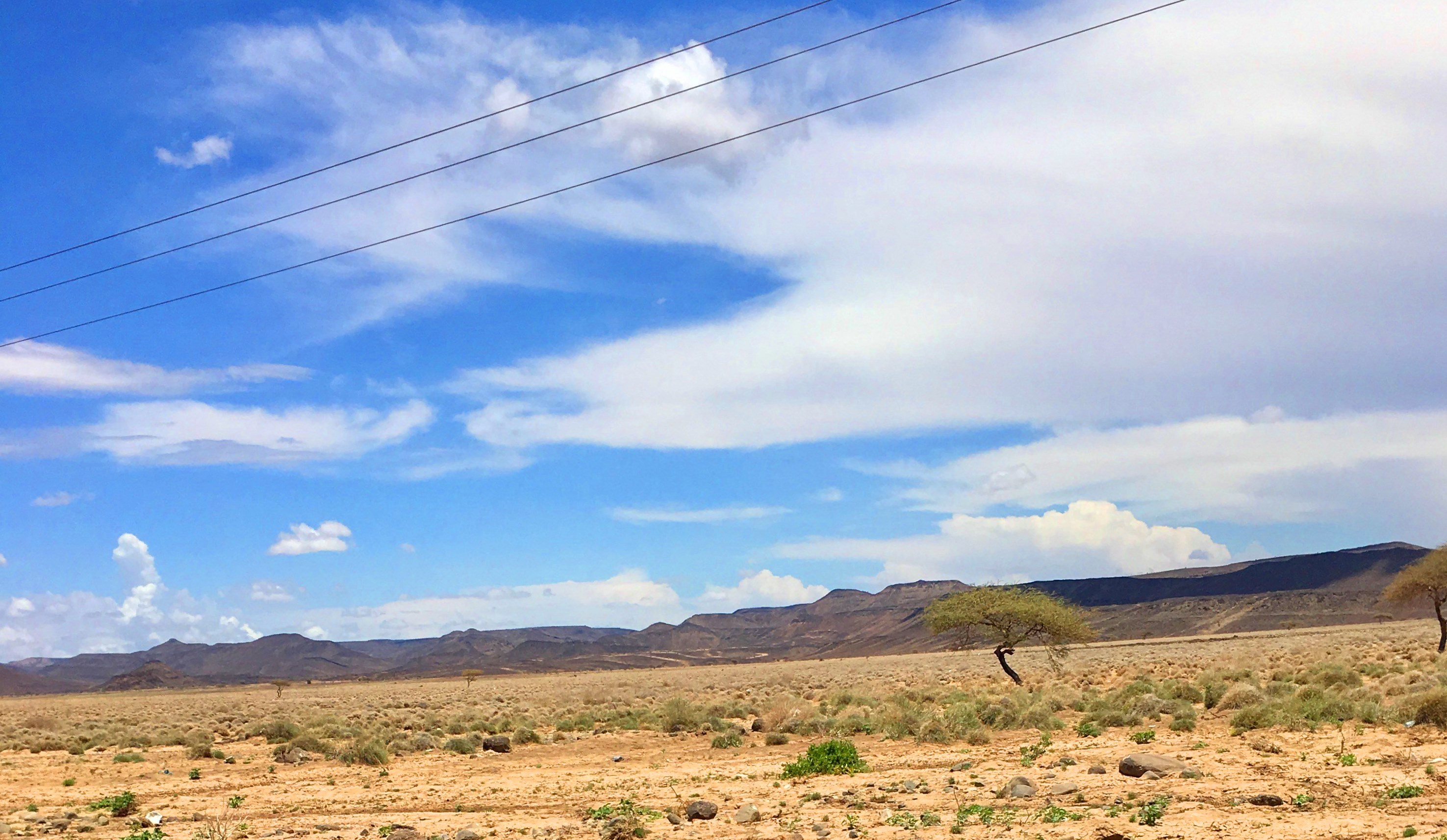
The Grand Bara is the very image of sublime emptiness: a desert plain so vast and so smooth that the horizon seems never to end. It is the dry bed of an ancient lake, now a flat expanse of sand and compacted clay where the sky takes up everything. Crossing it by road on the way to Lake Abbé or Ali Sabieh is one of those experiences that stays with you: kilometre after kilometre of dazzling nothingness under a relentless sun.
But the Grand Bara isn't just for looking at. Its perfectly flat surface and steady winds have made it a paradise for land-sailing —char à voile, those sail-powered carts that glide across the desert—, with a pioneering centre in the area. And every year the plain hosts the famous 15-kilometre race organised by the French army stationed in Djibouti, in which soldiers and civilians run across the desert.
This guide tells you how to enjoy the Grand Bara: how to cross it and where to stop, what land-sailing is and how it works, when to go for good wind and bearable temperatures, how it fits into the southern route along with Ali Sabieh, Dikhil and Lake Abbé, and what precautions to take on one of the most extreme and fascinating plains in Africa.
The Grand Bara is the dry floor of an ancient lake that, in wetter times, covered south-central Djibouti. As it dried out, it left this huge plain of clay and sand that marks the boundary between the volcanic and the sedimentary parts of the country. A crossing point for caravans and Afar and Issa herders, in modern times it became famous for two uses: land-sailing, which found an unbeatable natural track here, and the French army's annual 15-kilometre race. More geological and historical background on our history page.
Read the full history ↓Steam chimneys in a lunar landscape, endless plains and crossroads towns near Ethiopia: southern Djibouti is the country's most desert-like and cinematic corner.
Read the history of The desert south: Lake Abbé and the Grand Bara →No exact prices: a scale from $ (budget) to $$$$$ (luxury), with 2-3 options per category.
Origins, formation and what the sources say.
The Grand Bara wasn't always a desert. Its perfectly smooth surface of clay and compacted sand is actually the dry floor of an ancient lake that, in wetter geological periods, covered this part of south-central Djibouti. When the climate grew more arid and the water evaporated, this vast plain was left exposed, as flat as the sheet of water that once filled it, stretching for dozens of kilometres under the Horn of Africa sun.
The Grand Bara, together with its smaller neighbour the Petit Bara, is part of a group of ancient lake beds that are now desert plains in the heart of the country. Geologically, these plains mark a striking boundary: they separate the volcanic part of Djibouti (to the north, dominated by the rift, cones and lava flows) from the sedimentary part to the south. Crossing the Grand Bara is, in a way, passing from one geological world into another.
That extreme evenness of the terrain, a result of its lake origins, is exactly what gives the Grand Bara its unique character: an almost perfect horizon, with no relief, where your gaze gets lost and the sky dominates the landscape. It's a phenomenon related to other famous dry lake beds around the world, and the key to the uses people would find for it in modern times.
For centuries, the Grand Bara was a crossing ground for the nomadic peoples of southern Djibouti, above all the Afar and the Issa (Somali), who crossed it with their camel caravans and their herds along the routes linking the Ethiopian interior with the coast of the gulf. The immense plain, hard and waterless, was both an obstacle and a corridor: you had to cross it to get from the highlands to the sea, and travellers knew its landmarks and its dangers.
These caravan routes were part of the great trade network of the Horn of Africa, which carried salt (including salt from Lake Assal), livestock, coffee, hides and goods of every kind. The Grand Bara, lying on the axis between the present-day capital, Ali Sabieh, Dikhil and the Ethiopian border, was one piece of that web. Even today you can see herders crossing the plain with their animals, a scene that has barely changed in centuries.
The arrival of the Franco-Ethiopian railway in the early 20th century and, later, of paved roads transformed mobility in the region, but it didn't entirely erase the old ways of life. The Grand Bara remained a land of herders and of transit, and crossing it, once an epic and dangerous undertaking, became an easy paved route for the vehicles that now cross it on their way south and to Lake Abbé.
In modern times, the extraordinary plain of the Grand Bara found new and surprising uses. The first is land-sailing, or char à voile: light three-wheeled carts driven by a sail that glide at high speed over flat, windy surfaces. The dry bed of the Grand Bara, smooth as a track and swept by constant winds, turned out to be ideal terrain, and the area once hosted a pioneering land-sailing centre, drawing enthusiasts and some well-known names in the sport.
The second use, and the most famous, is both military and sporting: the Grand Bara race, a 15-kilometre run across the desert organised every year by the French army stationed in Djibouti, traditionally linked to the 13th Demi-Brigade of the Foreign Legion. It brings together soldiers of the different nationalities present in the country (Djibouti hosts bases of several powers) as well as civilians, in a crossing on foot under the sun that has become a landmark event in the Djiboutian calendar.
The foreign military presence is, incidentally, part of the recent history of this region and of the whole country. Thanks to its strategic position next to the Bab el-Mandeb strait and the Red Sea routes, Djibouti has become home to bases of France, the United States, China, Japan and other countries, and the Grand Bara, close to some of these installations, has been the setting for military exercises as well as sporting events.
For today's traveller, the Grand Bara is one of Djibouti's great landscapes and a natural stop on the route south. The road linking the capital with Dikhil and the Ethiopian border runs straight through it, so almost everyone heading to Lake Abbé or Ali Sabieh crosses it and stops to take in its endless horizon, photograph the mirages shimmering in the distance, or simply feel the crushing scale of the emptiness.
If you have more time, you can head out onto the plain by 4x4, try land-sailing when equipment is available, or time your visit to coincide with the annual race. The nearby towns of Ali Sabieh, with its reddish mountains, and Dikhil, the gateway to Lake Abbé, make the Grand Bara the hub of a circuit through Djibouti's desert south that combines desert, mountains, Somali and Afar culture, and unique geological landscapes.
Like all of inland Djibouti, the Grand Bara is an extreme environment that demands respect: deadly heat in summer, a total absence of water and services, and how easy it is to lose your bearings on such a uniform surface. Well prepared and in the right season, though, it offers one of the purest experiences a desert can give: feeling tiny before an endless horizon, on the bed of a lake that dried up thousands of years ago and is now pure light, wind and silence.