Viajá con Gus
Home › Djibouti › Ghoubbet Bay
Ghoubbet Bay
🇩🇯 Djibouti · Djibouti City and the Gulf

Ghoubbet Bay

🪪 What do I need to enter Djibouti?Pick your citizenship and we tell you the visa, the days and the paperwork, with the official source.

By leaving your email and citizenship you agree to receive the documents you asked for and weekly travel news. You can unsubscribe whenever you want. How we handle your data.
Jump to what you need
📍Region
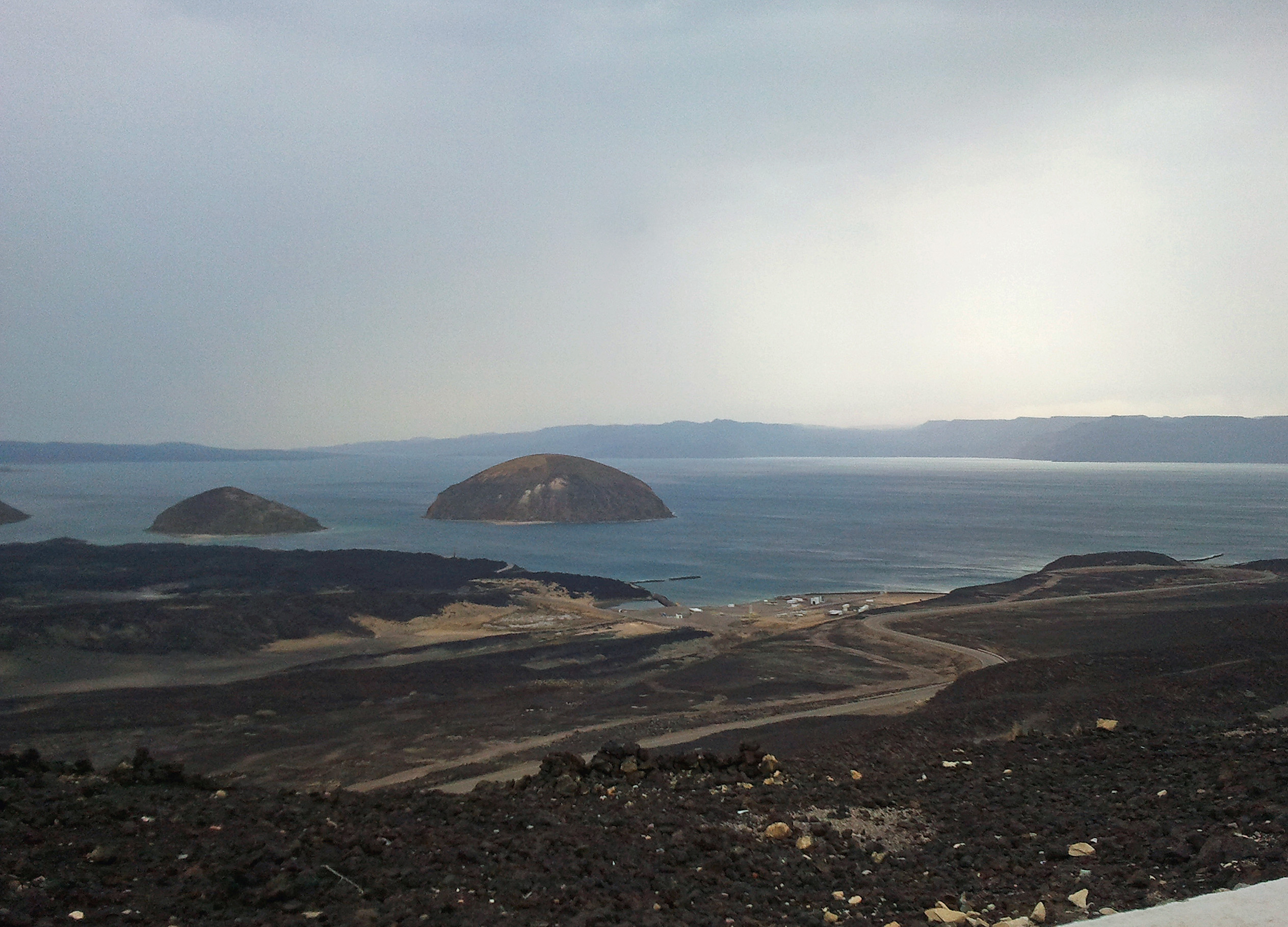
Ghoubbet Bay (Ghoubbet al-Kharab, 'the abyss of demons') lies at the far western end of the Gulf of Tadjoura, linked to the rest of the gulf by a narrow passage with strong currents. It is a deep, dark basin ringed by lava cliffs up to 600 metres high and by the Ardoukoba volcano, right in the rift where the African and Arabian plates pull apart. Every winter its waters draw juvenile whale sharks, and its volcanic landscape and legends make it one of the most striking places in the country.
📌Best time to go
November to January to swim with the whale sharks, which gather in the bay to feed on plankton; this is the main season. For the rest of the year, October to April has the most bearable weather for exploring the area and its volcanic landscape (summer is extreme, at 40-45 °C). The bay is almost always visited as part of the route to Lake Assal.
📌Suggested days
It's visited on a day trip from Djibouti City, usually combined with Lake Assal and the Ardoukoba volcano, or as a base for swimming with whale sharks in season. For the whale sharks, set aside a full day on the boat; to take in the landscape, a one- or two-hour stop on the way to Assal is enough.
📌Getting there
By 4x4 from Djibouti City along the southwestern road that skirts the gulf, passing through Arta; it takes 1 to 1.5 hours to reach the shore of Ghoubbet. To swim with the whale sharks, a boat heads out into the bay from the coast. Everything is arranged from the capital, either with a vehicle and driver or on a tour.
📌Geology
Ghoubbet sits at the heart of the Asal-Ghoubbet rift, where the floor is opening up and Africa is drifting away from Arabia by a few millimetres a year. It is surrounded by lava flows, cliffs and the Ardoukoba volcano, which erupted in 1978. It is one of the planet's great geological settings, a 'laboratory' of plate tectonics that draws scientists from all over the world.
📌Legends
The name 'abyss of demons' comes from local beliefs: for centuries, Afar fishermen feared these dark, deep waters, convinced that demons could drag anyone who ventured in down to the bottom. The mix of currents, depth and lunar landscape fed its sinister reputation, which today has become part of its appeal.
💱 DJF exchange rate
Loading rate…
🌤️ Weather in Ghoubbet Bay
Loading weather…

Few places have a name as evocative as Ghoubbet al-Kharab bay: 'the abyss of demons'. It is a basin of dark, deep water at the end of the Gulf of Tadjoura, hemmed in by lava cliffs hundreds of metres high and dominated by the Ardoukoba volcano. A narrow passage of rough currents connects it to the rest of the gulf, and for centuries Afar fishermen avoided going in, certain that demons lived in its depths.

Behind the legend lies a geologically astonishing place: Ghoubbet sits exactly where the great rift separating Africa from Arabia meets the sea. It is an ocean in the making, a spot where the Earth's crust is splitting open and volcanism shapes the landscape. Every winter it is also one of the best places in the world to swim with whale sharks, which gather in its plankton-rich waters between November and January.

This guide explains how to visit Ghoubbet, on its own or on the big route to Lake Assal, when to go to see the whale sharks, what makes its geology so special and where its demonic reputation comes from. It is one of Djibouti's most dramatic and evocative landscapes: dark sea, black cliffs, a young volcano and the echo of the gulf's old legends.

📖 History of Ghoubbet Bay

Ghoubbet al-Kharab bay, 'the abyss of demons', owes its name to the age-old fear of Afar fishermen, who avoided its dark waters, convinced they hid evil forces. Modern science revealed the origin of this unsettling landscape: Ghoubbet lies on the axis of the Asal rift, where the African and Arabian plates are pulling apart and volcanic activity is intense, as the 1978 eruption of the nearby Ardoukoba volcano showed. Its natural history and legends are covered on our history page.

Read the full history ↓

🗺️ What to see

1
The 'abyss of demons' and its cliffs
The deep basin of dark water hemmed in by lava cliffs up to 600 metres high, one of the most dramatic landscapes in the country.
Leer más ↓
The sight of Ghoubbet is striking: a bay of dark, still water boxed in by black lava cliffs that rise to around 600 metres, with the Ardoukoba volcano towering over it all. The contrast with the turquoise sea of the rest of the gulf is total. Here the water looks deeper and gloomier, shut in behind a narrow passage of strong currents that links it to the Gulf of Tadjoura. The almost lunar, bare landscape adds to its reputation as an unsettling place. From the road to Lake Assal there are natural viewpoints over the bay, ideal for taking in the whole scene and taking photos. Part of the appeal is the feeling of standing before a forgotten corner of the world, with the old demon legends still hanging in the air. It's a place to stop, look and be awed by the power of geology. Getting there: on the southwestern route, on the way to Assal (1-1.5 h from the capital). Best time: October-April; spectacular light in mid-afternoon. Tips: a must-stop on the route to Assal; bring water and sun protection, there's no shade.
2
Swimming with whale sharks (Nov-Jan)
Together with Arta, the hub for swimming with juvenile whale sharks, which gather in the bay to feed on plankton.
Leer más ↓
Along with Arta, Ghoubbet is the main setting for swimming with whale sharks in Djibouti. Between November and January, the bay and its surroundings draw large numbers of juveniles of this species, the largest fish in the world and harmless because it only eats plankton, attracted by the season's plankton blooms. The concentration of young sharks suggests the area works as a 'nursery' for the species. The experience is done with a snorkel: you head out by boat into the bay, the animals are located, and you get into the water to swim alongside them while keeping your distance. Watching the huge spotted back of a whale shark glide through these legend-laden waters is doubly special. It's one of the most accessible and memorable marine wildlife encounters on the planet. Getting there: boat trip into the bay, arranged from the capital. Best time: November-January. Tips: don't touch or chase the animals, keep your distance; choose operators that follow the viewing rules.
3
Ardoukoba volcano
The young volcano born in the 1978 eruption, between Ghoubbet and Lake Assal, where you can walk along the rift's fissure.
Leer más ↓
Above the shore of Ghoubbet rises Ardoukoba, a very young volcano born in the November 1978 eruption after thousands of years of quiet. That eruption, preceded by earthquakes, opened a fissure several kilometres long and left basalt lava flows and scoria cones that you can now explore on foot. It's one of the few places in the world where you can literally walk along the crack where a continent is splitting apart: here Africa is separating from Arabia. The landscape is spectacularly arid: fields of black lava, fissures, scoria and, in the background, the dark bay of Ghoubbet and the salt flats of Assal. For geology lovers it's a pilgrimage site; for any traveller, an overwhelming landscape that helps you understand the force that has shaped all of Djibouti. It's usually visited on the same route as the bay and Lake Assal. Getting there: between Ghoubbet and Lake Assal, on the southwestern route. Best time: October-April. Tips: sturdy footwear for walking on the lava; plenty of water, a hat and sun protection; ideally with a guide who can explain the geology.
4
The Asal-Ghoubbet rift
The axis of the great rift where the African and Arabian plates pull apart, a natural laboratory of plate tectonics.
Leer más ↓
Ghoubbet isn't just a pretty landscape: it's one of the most important places in the world for understanding how the Earth works. The bay marks the point where the Gulf of Aden rift enters the continent, in what's called the Asal-Ghoubbet rift. Here, between the bay and Lake Assal, the Earth's crust is pulling apart by a few millimetres a year, with Africa moving away from Arabia. It's the birth of a future ocean, live and on dry land. That's why the area is a magnet for geologists and volcanologists, who set up instruments here to measure plate movement and study how new ocean floor forms. For travellers, understanding this adds real meaning to the visit: the cliffs, lava flows, fissures and the dark bay itself are the visible scars of this continental fracture. Together, Ghoubbet and Assal form one of the planet's great geological settings. Getting there: the whole area between Ghoubbet and Assal is the rift. Best time: October-April. Tips: a guide with geological knowledge transforms the visit; combine Ghoubbet, Ardoukoba and Assal in one day.
📶I have never landed without internet. I arrive and my phone connects to the strongest network in the country I am visiting: I can say I landed, sort out transport, book tours and keep posting, at a seriously good price. I always use the Maya eSIM — check their plans by clicking the banner.See plans →Maya Mobile eSIM — turn travel mode on
What nobody tells you

💵 Prices

Tickets

TypePrice
Acceso / miradores de la bahíaFree; visited on the route to Assal (verified July 2026)
Nado con tiburón ballena (día completo, con barco y equipo)From about USD 80-170 per person depending on operator and group (Nov-Jan season, verified July 2026)
Excursión combinada Ghoubbet + Ardoukoba + lago Assal (4x4)From about USD 100-180 per person depending on group (verified July 2026)
🔄 updated monthlyOfficial / reference values · double-check when buying

Activities and tours

ActivityPriceDurationOperator
Swimming with whale sharks in the bay (snorkelling)From about USD 80-170 per person (Nov-Jan, verified July 2026)Full dayDive centres in the capital
Hike on the Ardoukoba volcano and lava fieldsIncluded in the combined tour; guide recommended (verified July 2026)1-2 hAgencies / guides
Ghoubbet + Assal day trip by 4x4From about USD 100-180 per person depending on group (verified July 2026)Full day (10-12 h)4x4 agencies
Diving in the bay (for experienced divers)Varies by centre; strong currents, only with a reputable operator (verified July 2026)Half dayDive centres
🔄 updated monthlyOfficial / reference values · double-check when buying

🚌 How to get there and distances

Getting around

ModePriceDurationNotes
4x4 with driver from the capitalFrom about 25,000-45,000 FDJ (USD 140-250) per day for the vehicle (verified July 2026)1-1.5 h to GhoubbetEssential for the route; price per vehicle, split among passengers
Boat for whale shark viewingIncluded in the trip (verified July 2026)Trips of several hoursProvided by the operator; the currents in the passage call for an experienced boat and skipper
🔄 updated monthlyOfficial / reference values · double-check when buying

How to get there

RouteAirlines / operatorsAvg. priceDuration
Djibouti City → Ghoubbet Bay (via Arta)4x4 with driver, toursDepends on tour or rental (see activities, verified July 2026)1-1.5 h (about 60-80 km)
Ghoubbet → Lake Assal4x4 with driverUsually part of the same combined tour (verified July 2026)About 30-45 min more to Assal
🔄 updated monthlyOfficial / reference values · double-check when buying

🏨 Where to stay

No exact prices: a scale from $ (budget) to $$$$$ (luxury), with 2-3 options per category.

Base in Djibouti City (luxury)
Price$$$$$
Recommended options
From USD 250-350 a night; the Djibouti Palace Kempinski and high-end hotels in the capital, where trips to Ghoubbet and Assal depart from
Camps and lodges on the route to Assal
Price$$$$$
Recommended options
From about USD 40-90 per person; simple camps near Assal for anyone who wants to sleep in the rift area and watch the sunrise over the salt flats
Base in the capital (mid-range / budget)
Price$$$$$
Recommended options
From USD 40-180 a night; central hotels in Djibouti City to stay before or after the trip

🍴 Where to eat

TypePriceOptions / signature dish
Comida en la ruta (picnic / campamento)$$$$$Tours usually include lunch or a picnic; bring plenty of water, there are no services at the bay
Pescado y mariscos en la capital$$$$$From USD 20-45 per person; lobster and fish from the gulf at restaurants in Djibouti City after the trip

📖 History of Ghoubbet Bay

Origins, formation and what the sources say.

Where a continent splits in two

To understand Ghoubbet Bay, you have to think on the timescale of geology. Djibouti sits on the Afar Triangle, one of the few places in the world where three major fractures in the Earth's crust meet: the Red Sea rift, the Gulf of Aden rift and the great East African Rift Valley. Here the African plate is pulling away from the Arabian plate and, at the same time, starting to tear in two. It is, quite literally, the birth of a future ocean.

Ghoubbet Bay marks the point where the Gulf of Aden rift reaches dry land. The bay's deep, dark basin, hemmed in by lava cliffs up to 600 metres high, is the surface expression of that fracture: the floor sinks because the crust is stretching and thinning. Between Ghoubbet and nearby Lake Assal lies the Asal-Ghoubbet rift, where the plates move apart a few millimetres a year.

That process, extremely slow on a human scale but relentless, comes with volcanism: magma rises to fill the gap the crust leaves as it pulls apart, and every so often it breaks through to the surface. The whole landscape around Ghoubbet —black lava flows, volcanic cones, fissures, basalt cliffs— is the work of the geological machinery that built the country and is still building it.

The 1978 eruption of Ardoukoba

The most spectacular and recent proof that the rift is alive came in November 1978. After thousands of years of apparent calm, a series of earthquakes shook the area between Ghoubbet and Lake Assal, and on 7 November a volcanic fissure several kilometres long opened up and lava poured out. That is how Ardoukoba was born: a very young volcano made up of a chain of cinder cones and two flows of fluid basaltic lava.

The eruption was fairly small in volume but huge in scientific significance: geologists were able to measure how, in just a few days, the two sides of the rift moved about a metre apart and the ground dropped by several decimetres. It was plate tectonics happening live, visible and measurable, something very rarely witnessed. Since then the Asal-Ghoubbet area has become a world-class natural laboratory for studying seafloor spreading and continental rifting.

Today you can walk on the Ardoukoba lava flows and look down into the great rift fissure, one of the few places on the planet where you can literally stand on the crack along which a continent is splitting. For visitors, the 1978 eruption is the key to the whole landscape: it is not an ancient backdrop, but land that is still being born.

The abyss of demons: the Afar legend

Long before science explained the geology of the place, the people who lived here had already given this bay an unsettling name: Ghoubbet al-Kharab, usually translated as 'the abyss of demons' or 'the cursed chasm'. For Afar fishermen, these dark, deep waters with strong currents were a place to fear, home to spirits or demons that could drag boats and anyone who ventured out into the depths.

The fear wasn't unfounded: the narrow passage linking the bay to the Gulf of Tadjoura creates strong currents, the water looks darker and deeper than in the rest of the gulf, and the surrounding landscape —black cliffs, lava flows, not a trace of vegetation— feels lunar and desolate. For generations all of this fed the place's sinister reputation, and even today some fishermen are reluctant to head out into it.

The legend grew in the 20th century through episodes and stories that gave the bay an almost mythical aura, including its appearance in the accounts of adventurers and explorers. Commander Jacques Cousteau, for example, explored these waters and helped spread their mystery. So Ghoubbet has two layers of fascination: the ancestral lore that filled it with demons, and the science that found, beneath its waters, the pulse of the Earth.

Science, whale sharks and exploration

In recent decades Ghoubbet Bay has revealed another side: besides being a geological treasure, it is one of the best places in the world to swim with whale sharks. Every winter, between November and January, its plankton-rich waters draw large numbers of young whale sharks, the biggest fish on the planet and harmless because they feed only by filtering plankton. The abundance of juveniles suggests the area works as a natural 'nursery'.

This phenomenon has attracted marine biologists, who study the whale shark population here, and travellers from all over the world who come to swim with them. The bay thus brings together two very different sciences: geology, fascinated by the rift and the volcanism, and marine biology, focused on the giants that fill its waters each winter. Few places pack in so much natural value.

Underwater exploration of Ghoubbet, with its currents and depths, has also fed its legend. Divers and scientists have gone down into its dark waters looking for answers, and every dive adds a little knowledge and a little more mystery to a place that still keeps its secrets. The 'abyss of demons' turned out to be an abyss full of life and of clues about how the planet works.

Ghoubbet today: geology, legend and adventure

Today Ghoubbet Bay is one of the must-see stops on the great route through south-western Djibouti, which runs from the capital to Lake Assal by way of Arta and the Ardoukoba volcano. Travellers stop at its viewpoints to take in the dark basin between lava cliffs, walk on the Ardoukoba lava flows and, in season, swim with whale sharks. It impresses geology lovers, marine wildlife fans and landscape seekers alike.

Its mix of ingredients is hard to match: a newborn ocean, a recent volcano, waters steeped in legend and one of the greatest marine wildlife spectacles in the world, all in a remote corner of the Horn of Africa. Ghoubbet sums up the essence of Djibouti as a destination: small in size, but with extraordinary geological and natural intensity.

For visitors, the 'abyss of demons' is no longer frightening, but it has lost none of its power to overwhelm. Between the dark sea, the black cliffs, the crack of the rift and the echo of old fishermen's tales, Ghoubbet offers one of the most memorable and evocative experiences in the whole country.

📚 Bibliography

  • Wikipedia (EN) — «Ghoubbet-el-Kharab»: https://en.wikipedia.org/wiki/Ghoubbet-el-Kharab
  • Wikipedia (EN) — «Ardoukoba»: https://en.wikipedia.org/wiki/Ardoukoba
  • Wikipedia (EN) — «Afar Triangle»: https://en.wikipedia.org/wiki/Afar_Triangle
  • Wikipedia (EN) — «Lake Assal (Djibouti)»: https://en.wikipedia.org/wiki/Lake_Assal_(Djibouti)
  • Djibouti Guidebook — Ghoubbet al-Kharab: https://djiboutiguidebook.wordpress.com/2014/08/28/ghoubbet-al-kharab/
  • The Culture Trip — The Island of the Devil: https://theculturetrip.com/africa/djibouti/articles/what-and-where-is-the-island-of-the-devil
  • Africorne Travel — 5 unique geological sites in Djibouti: https://africa-horn-travel.com/en/djibouti-5-geological-sites-unique/
  • Dolphin Excursions / Dive Djibouti — Whale sharks: https://www.divedjibouti.com/whalesharks
  • Face2Face Africa — The mysterious Devil's Island in Djibouti: https://face2faceafrica.com/article/the-mysterious-devils-island-in-djibouti-everyone-is-curious-to-visit-before-they-die

❓ Frequently asked questions

Why is it called 'the abyss of demons'?+
The name 'Ghoubbet al-Kharab' translates as 'the abyss of demons' or 'the cursed chasm'. It comes from the age-old fear of Afar fishermen, who avoided these dark, deep waters with their strong currents, convinced that demons could drag anyone who ventured in down to the bottom. The gloomy, almost lunar landscape and the currents in the narrow passage linking it to the gulf fed its sinister reputation for centuries.
Can you swim with whale sharks at Ghoubbet?+
Yes, it's one of the two main places to do it in Djibouti, along with Arta. Between November and January, the bay draws many juvenile whale sharks that come to feed on plankton. They're seen close to the surface and you swim with them using a snorkel, from a boat. They're completely harmless. You need to go with an operator, keep your distance and not touch or chase the animals.
What makes Ghoubbet's geology special?+
Ghoubbet lies on the axis of the Asal-Ghoubbet rift, the point where the great rift separating the African and Arabian plates meets the sea: it is literally an ocean being born. Here the Earth's crust is pulling apart by a few millimetres a year, and volcanic activity is intense, as the 1978 eruption of the Ardoukoba volcano proved. It's one of the best places in the world to 'see' plate tectonics in action.
How do you visit it and what can you combine it with?+
You get there by 4x4 from the capital along the southwestern road, passing through Arta (1-1.5 hours). It's almost always combined with the Ardoukoba volcano and Lake Assal, the lowest point in Africa, on a day trip that brings together sea, lava and salt. In whale shark season, the bay is also the base for boat trips to see them. It's best to set off early and hire a good 4x4 with a driver.
What should I bring and what precautions should I take?+
There are no services at the bay, so bring plenty of water, food, a hat, sun protection and sturdy footwear if you're going to walk on the Ardoukoba lava. The sun and heat are intense and there's no shade. When swimming with whale sharks, follow the guide's instructions. And if you dive in the bay, only do it with reputable operators: the currents in the passage are strong and the area isn't for beginners.

More places in Djibouti

Bosque de Day (Parque Nacional Forêt du Day)Ciudad de YibutiDesierto del Grand BaraDikhilDorraIslas Musha y Maskali
See every place in Djibouti →The history of Djibouti →
Sources consulted (7)
Still planning?
Explore more destinations in Djibouti
See all destinations →
Image credits
Photos from Wikimedia Commons, each under its own licence (CC BY, CC BY-SA or public domain). Open each file to see its author and licence.
Goubet