Pisac (also written Písac or Pisaq) is the gateway to the Sacred Valley from Cusco and packs two very different attractions: one of the largest and most spectacular Inca archaeological sites in the region, perched high on the mountain, and a famous craft market in the town at the foot of the hill. It's about 33 km from Cusco, a little under an hour away.
The archaeological site spreads along a ridge, with fan-shaped farming terraces dropping down the slope, ceremonial sectors with temples to the Sun, control towers, dwellings, water channels and an enormous pre-Hispanic cemetery cut into the hillside. From up top, the views over the Urubamba river valley and the terraces are among the most photographed in Peru. It was also a major maize producer for the empire.
Down in the town, the Pisac market is one of the best known in the Andes for buying textiles, ceramics, silverwork and souvenirs; on market days (Tuesday, Thursday and Sunday) it fills with producers from the communities. To enter the archaeological site you use the Boleto Turístico del Cusco. Go early, bring water, a hat and sunscreen, and comfortable shoes: walking the terraces involves a fair bit of climbing.
The site of Pisac was built in the time of the Inca Pachacútec, in the 15th century, and some historians think it worked as one of his estates or royal residences. It combined a large farming center -with dozens of maize-producing terraces- with ceremonial and military sectors and an important cemetery. It watched over the entrance to the Sacred Valley and the access route toward the jungle. More detail on the history page.
Read the full history ↓The 'navel of the world': capital of the Inca empire and today the archaeological capital of the Americas, gateway to Machu Picchu, the Sacred Valley and the Vilcanota range.
Read the history of Cusco →If you book from here we earn a commission and you pay no more. Prices and availability come from Civitatis.
No exact prices: a scale from $ (budget) to $$$$$ (luxury), with 2-3 options per category.
Origins, formation and what the sources say.
Pisac (Písac or Pisaq, in Quechua) stands at the eastern end of the Sacred Valley, where the road from Cusco drops into the Urubamba river valley. According to an explanation put forward by the Cusco historian Víctor Angles Vargas, the name would come from 'pisaqa', an Andean partridge now scarce in the area. The archaeological site crowning the mountain was largely built during the 15th century, in the time of the Inca Pachacútec, the ruler who drove the great expansion of the Tahuantinsuyo.
For several historians, Pisac would have worked as one of Pachacútec's estates or royal residences, as well as being an important maize-producing center. Its location was no accident: from up high it controlled the entrance to the Sacred Valley and watched over one of the routes toward the jungle, so it combined a farming, religious, administrative and defensive role.
More than a set of ruins, Pisac is a complete system: fan-shaped farming terraces, ceremonial sectors, dwellings, control towers, water channels and a large cemetery on the hillside. All of it built into the geography of the mountain, in that harmony between landscape and architecture that marks Inca engineering.
The most famous image of Pisac is its terraces: dozens of farming platforms fanning down the hillside, held up by stone walls and watered by a system of channels. With this engineering, the Incas turned steep slopes into productive land and made use of different ecological levels for their crops, with maize as the star product, of great ritual and nutritional value.
In the upper part of the complex is the ceremonial sector of Intihuatana, the religious heart of Pisac. There, walls of finely worked and tightly fitted stone -the highest quality masonry, reserved for sacred spaces- surround temples and enclosures linked to the solar cult. The 'intihuatana' itself (sometimes translated as 'where the sun is tied') would be an element tied to astronomical observation and to marking the farming and festive cycles.
The complex is rounded off by lookout towers spread along the ridges, which controlled the access roads, and by residential sectors such as Pisaqa and Q'allaqasa. Walking it from top to bottom, following the terraces, lets you read the site the way the Incas understood it: production, worship, government and defense woven into a single landscape.
One of the most striking features of Pisac is its cemetery, Tankanamarka, cut into the hillside facing the site. There, hundreds of hollows held pre-Hispanic tombs, which makes it one of the largest known Inca cemeteries. The choice of place -high, exposed, looking out over the valley- speaks of the care with which the Andean world treated its dead and of the ritual importance of the mountain. Over the centuries many tombs were looted, but the scale of it is still impressive.
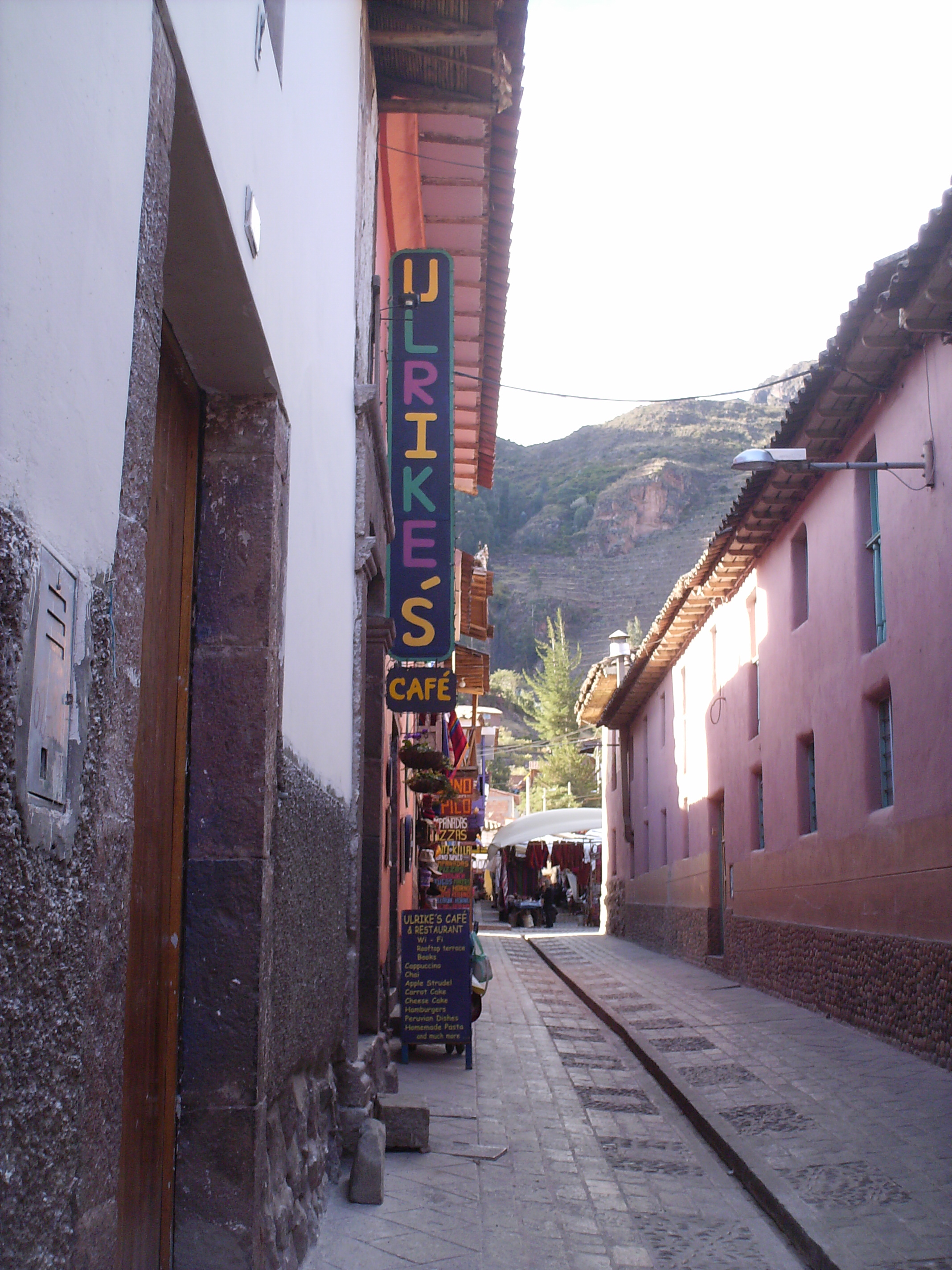
After the Spanish conquest, life in the area shifted largely from the high site to today's town, on the flat ground by the river. Colonial and republican Pisac grew around its plaza and church, and in time it became famous for its craft market, today one of the best known in the Andes. That continuity -from Inca center to living town and market- is part of its charm.
Visiting Pisac therefore means walking through two eras at once: up top, the great Inca center with its terraces, temples and cemetery; down below, a bustling Andean town where the communities still come down to sell textiles, ceramics and produce from the land, keeping alive a tradition that connects the present with the pre-Hispanic world.
Behind the beauty of the Pisac terraces lies one of the most impressive engineering feats of the Andean world. The Incas did not simply stack platforms: they designed a complete system combining stone retaining walls, inner layers of gravel and soil to drain the water, and channels that carried it down the slope in a controlled way from the high springs. Each terrace level also created a slightly different microclimate through its orientation and altitude, which made it possible to grow different varieties of maize, potato and other crops on the same hill. Pisac is reckoned to have been one of the great maize granaries around Cusco, a crop loaded with ritual value because it was used to make the chicha drunk at ceremonies.
That production was not cut off from the sky. In a farming civilization without writing, knowing when to sow and when to harvest was a matter of survival, and for that the Incas watched the movement of the sun closely. The ceremonial sector of the Intihuatana, with its carved stone and its curved-plan Temple of the Sun, worked as an instrument for marking solstices and equinoxes, linking the farming calendar with the religious one. Production, astronomy and worship formed a single mechanism: the sun ruled the harvests, and the harvests fed the rituals dedicated to the sun.
Understanding this changes the way you look at Pisac. It is not a pile of decorative terraces nor an isolated temple, but the physical form of knowledge built up over centuries about soils, waters, climates and stars. That is why, along with Machu Picchu and Ollantaytambo, it is considered one of the great works that explain how the Tahuantinsuyo managed to sustain millions of people in the extreme geography of the Andes.
The town of Pisac you visit today, on the banks of the Vilcanota-Urubamba river, is not a spontaneous continuation of the Inca settlement on the mountain: it is the result of a deliberate colonial policy. In 1570, viceroy Francisco de Toledo -the great administrative organizer of the viceroyalty of Peru between 1569 and 1581- ordered the creation of the 'reducción' of San Pedro de Pisac, within the broad program of the Toledan reducciones that regrouped scattered indigenous people into towns laid out Spanish-style, with a plaza, a church and streets on a grid, to make evangelization, tribute collection and administrative control easier.
With that measure, the people living in and around the archaeological site on the mountain were moved to the new town by the river, which took its name from the apostle Saint Peter and from the pre-existing Quechua place name. The old Inca center, stripped of its population, was gradually left empty and covered by vegetation, until archaeology rediscovered and restored it in the 20th century.
The church of San Pedro Apóstol, on the plaza of today's town, is a direct heir of that founding moment: the traditional mass in Quechua held there every Sunday, attended by the community authorities (the varayocs) of the villages around, may well have roots going back to that same colonial period, in a continuity that mixes Spanish imposition with the persistence of Andean forms of organization.