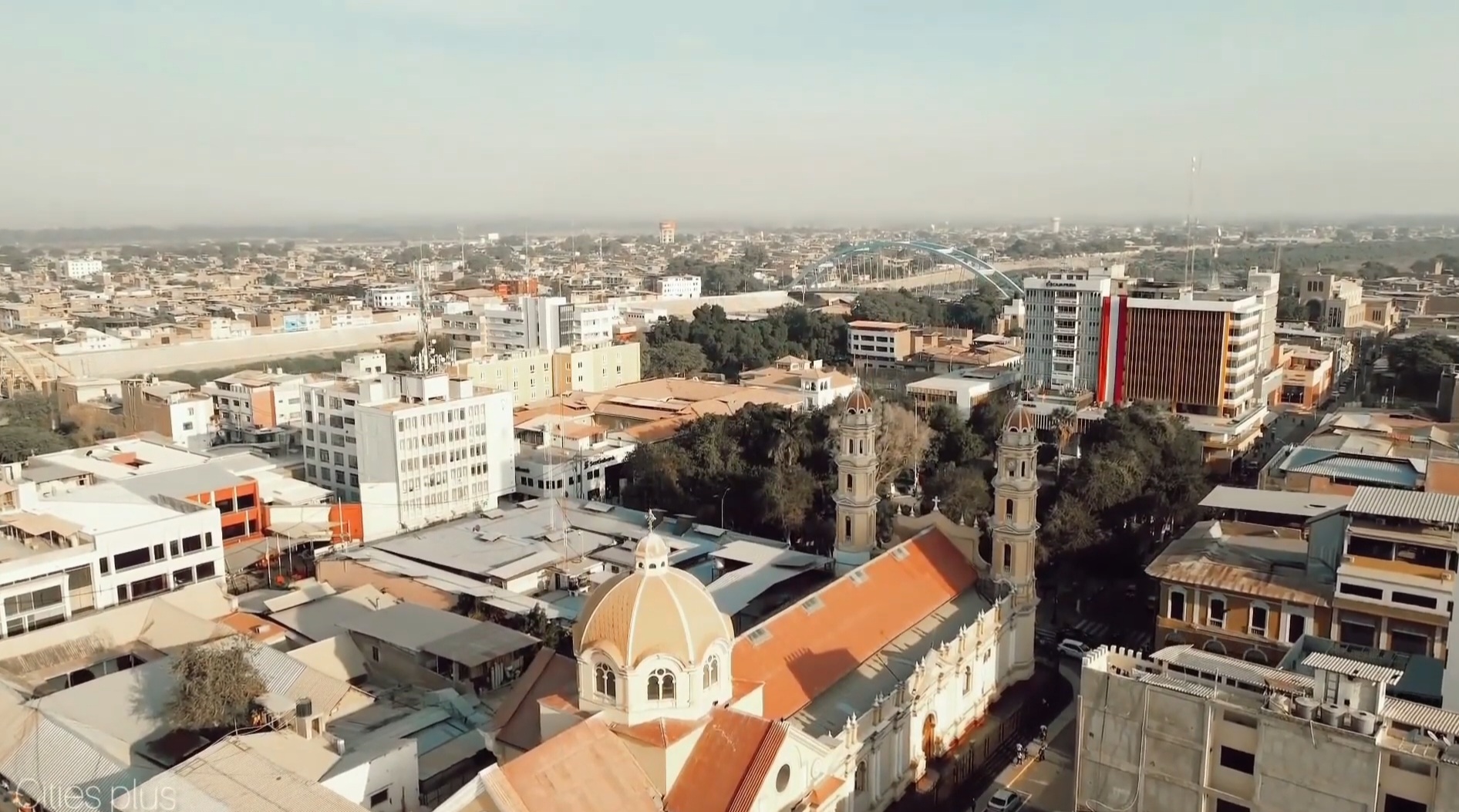
Piura is the big city of northern Peru and the capital of the region of the same name. It also carries enormous historical weight: here, in 1532, the Spanish founded San Miguel, the first city they established in Peru and one of the first in all of South America. Known as 'the city of eternal heat', Piura greets travelers with its Plaza de Armas, its cathedral, old mansions and a warm atmosphere in every sense.
The city works as a base and starting point for a very varied region. A few kilometers away is Catacaos, famous for its silver filigree craft, its straw hats and its traditional northern cooking, one of the great food outings in the country. Toward the coast you find beaches like Colán -golden sunsets and the church of San Lucas, considered one of the oldest in Peru- and, further north, the famous beach towns of Máncora, Vichayito, Los Órganos and Cabo Blanco. Inland stretches the Sechura desert.
Piura has an airport with daily flights from Lima (around 1 hour 35) and very good bus connections. It's ideal for combining city, culture and beach: you can give a day to the city and Catacaos, and use Piura as a springboard to the coast. Bring light clothes and sunscreen: heat is the norm almost all year. Its food -ceviche, seco de chabelo, malarrabia, natilla, the local King Kong sweet- is a reason to travel here on its own.
Piura was the first city the Spanish founded in Peru: San Miguel, established by Francisco Pizarro in 1532, in the territory of the Tallán people. After several relocations it ended up on its current site. Today it is the capital of the Piura region, the economic center of the north and the gateway to its beaches, villages and deserts. More detail on the history page.
Read the full history ↓If you book from here we earn a commission and you pay no more. Prices and availability come from Civitatis.
No exact prices: a scale from $ (budget) to $$$$$ (luxury), with 2-3 options per category.
Origins, formation and what the sources say.
Long before the Spanish arrived, the Piura region was inhabited by the Tallán, a people of farmers and fishers on the north coast. They lived in chiefdoms spread across the valleys of the Chira and Piura rivers, using the water to farm land marked by heat and the closeness of the desert. Towns such as Catacaos have their roots in that pre-Hispanic tradition, which left a strong cultural mark on the area.
The Tallán were part of the mosaic of north coast cultures that over time fell under the influence of larger states and, finally, of the Inca empire, which extended its rule to this region in the decades before the Spanish conquest. So when the Europeans arrived, they found a territory that was already organized, with settlements, local authorities and a long history of its own.
That Tallán heritage is still alive in the identity of Piura: in the crafts of Catacaos -with its famous silver filigree and its hats-, in the food and in the character of its towns. Today's Piura is largely the product of the encounter between that native culture and the one that arrived with the conquistadors.
Piura holds a unique place in history: the first city the Spanish founded in Peru was born here. In 1532, Francisco Pizarro established San Miguel -San Miguel de la Nueva Castilla- in Tallán territory, in the Tangarará area, on the banks of the Chira river, not far from its mouth. It was one of the first Spanish urban foundations in all of South America and it even predated the founding of Lima.
The founding came at a decisive moment: shortly afterwards Pizarro would push on to Cajamarca, where he captured the Inca Atahualpa, an episode that changed the fate of Peru forever. San Miguel served as the conquistadors' foothold and first base as they pushed into Andean territory.
The city, however, did not stay put. Over time it moved several times -looking for better conditions of climate, health or defense-, passing through places such as what is known as Piura la Vieja, before finally settling on its present site, on the banks of the Piura river. That is why people say Piura is a city that 'walked' before it found its definitive spot.
Through the colonial and republican centuries, Piura built itself up as an important center of northern Peru. From this land came one of the best-loved figures in the country's history: admiral Miguel Grau, Peru's naval hero during the War of the Pacific, born in Piura in 1834. The house where he was born is now a museum and a point of pride for the city, which honors the man they call the 'Gentleman of the Seas'.
In time Piura grew into the capital of one of the country's most dynamic regions, strong in farming, fishing and trade. Its almost permanently warm climate earned it the nickname 'city of eternal heat', and its position turned it into a crossroads: the gateway to the beaches of the north coast -Colán, Paita, Máncora, Cabo Blanco- and to the Sechura desert, as well as the base for getting to know Catacaos and its culture.
The Iglesia San Francisco in the historic center also has its own place in the country's political history: in 1821, before Lima proclaimed independence, Piura was one of the first cities in Peru to come out for the cause of emancipation, a precedent the city remembers with pride.
No history of Piura is complete without Catacaos, the town barely twelve kilometers from the city that holds much of the region's cultural identity. Its roots are deeply Tallán: Catacaos was one of the great indigenous chiefdoms of the north coast before the arrival of the Incas and the Spanish, and that continuity still shows today in its language, its food and its trades. When the conquistadors reorganized the area, Catacaos kept its population and its craft tradition, which in time would make it famous throughout Peru.
The trade that made Catacaos famous is filigree, working gold and above all silver into the finest threads, which the silversmiths twist and solder into jewelry of astonishing delicacy: earrings, pendants, rosaries and ornaments that look like metal lace. It is a technique with pre-Hispanic roots, perfected during the colonial period and passed down from generation to generation in the town's family workshops. Buying a piece of filigree in Catacaos is not just taking home a souvenir: it is keeping centuries of craft knowledge alive.
To that heritage add the table. For many, Catacaos is the culinary capital of northern Peru: its picanterías -the 'chicherías'- serve dishes that are living history of the region's Andean, coastal and African fusion, such as seco de chabelo, copús cooked underground, plantain malarrabia and majado de yuca, washed down with chicha de jora served in a poto. That combination of craft, cooking and Tallán tradition makes Catacaos the best summary of what the cultural heritage of Piura means.
In the 20th century, Piura found itself at the center of one of the tensest episodes in Peruvian history: the 1941 war with Ecuador. As the departmental capital closest to the disputed border, the city became the logistical and military base of the Peruvian effort during the conflict, which broke out on 5 July 1941 after years of border friction. The war ended with the Rio de Janeiro Protocol of Peace, Friendship and Boundaries, signed on 29 January 1942, which defined much of the current border between the two countries.
In the decades that followed, especially from the 1960s on, Piura went through strong urban expansion driven by major infrastructure works such as the Panamericana Norte, and by migration from rural and Andean areas into the city. That growth, shared with other north coast capitals like Chiclayo and Trujillo, brought new neighborhoods and also the usual challenges of rapid urbanization.
Today Piura combines that historical weight -from the Tallán to the war of '41- with a lively urban life and food celebrated across Peru. Strolling its Plaza de Armas, visiting the cathedral and Grau's house, eating a good ceviche or a seco de chabelo and slipping off to Catacaos or the beach sums up what it offers: the mix of history, heat and flavor that defines northern Peru.