Viajá con Gus
HomeMexicoSan Miguel de Allende
San Miguel de Allende
🇲🇽 Mexico · Central Mexico

San Miguel de Allende

Jump to what you need
📌State
Guanajuato, in the heart of the Mexican Bajío, at around 1,900 meters of altitude on a valley slope. San Miguel de Allende is the seat of the municipality of the same name and one of the most beautiful colonial cities in Mexico, with about 70,000 people in the city and around 170,000 in the municipality. Its historic center, of cobbled streets and quarry stone mansions, was declared a UNESCO World Heritage Site in 2008 along with the nearby Santuario de Atotonilco
📌Gateway city
San Miguel de Allende itself has boutique hotels, restaurants, galleries, ATMs and tour operators, but no airport of its own. The main way in is Querétaro International Airport (QRO), a little over an hour away, and Bajío International Airport (BJX), near León/Silao, about an hour and a half away. The city of Querétaro, some 70 km away, works as the big bus and connection hub; frequent services run from its terminal to San Miguel. It is an ideal base for escapes to Atotonilco, the Querétaro vineyards, Dolores Hidalgo and the city of Guanajuato
📌Best time
The best window runs from November to April: the dry season, with clear skies, mild days (highs around 24-26 °C) and cool nights, ideal for walking the historic center. Bear in mind that San Miguel sits at nearly 1,900 meters, so winter nights can be cold: bring a jacket. Summer (June to September) is the rainy season, with stormy afternoons but green countryside and festivals. September (the independence holidays and the commotion of San Miguel Arcángel) and Holy Week are very lively but also the busiest times
📌Suggested days
2 to 3 days is enough to take in the historic center without rushing (the Parroquia, El Jardín, the churches, the galleries at Fábrica La Aurora), climb to a lookout and make an escape to the Santuario de Atotonilco and some hot springs. With 4 to 5 days you can add the Querétaro vineyards, a day at El Charco del Ingenio, art or cooking workshops, and a trip to Dolores Hidalgo or the city of Guanajuato. It is a destination to live slowly, between cafés, art and sunsets
💱 MXN exchange rate
Loading rate…
🌤️ Weather in San Miguel de Allende
Loading weather…

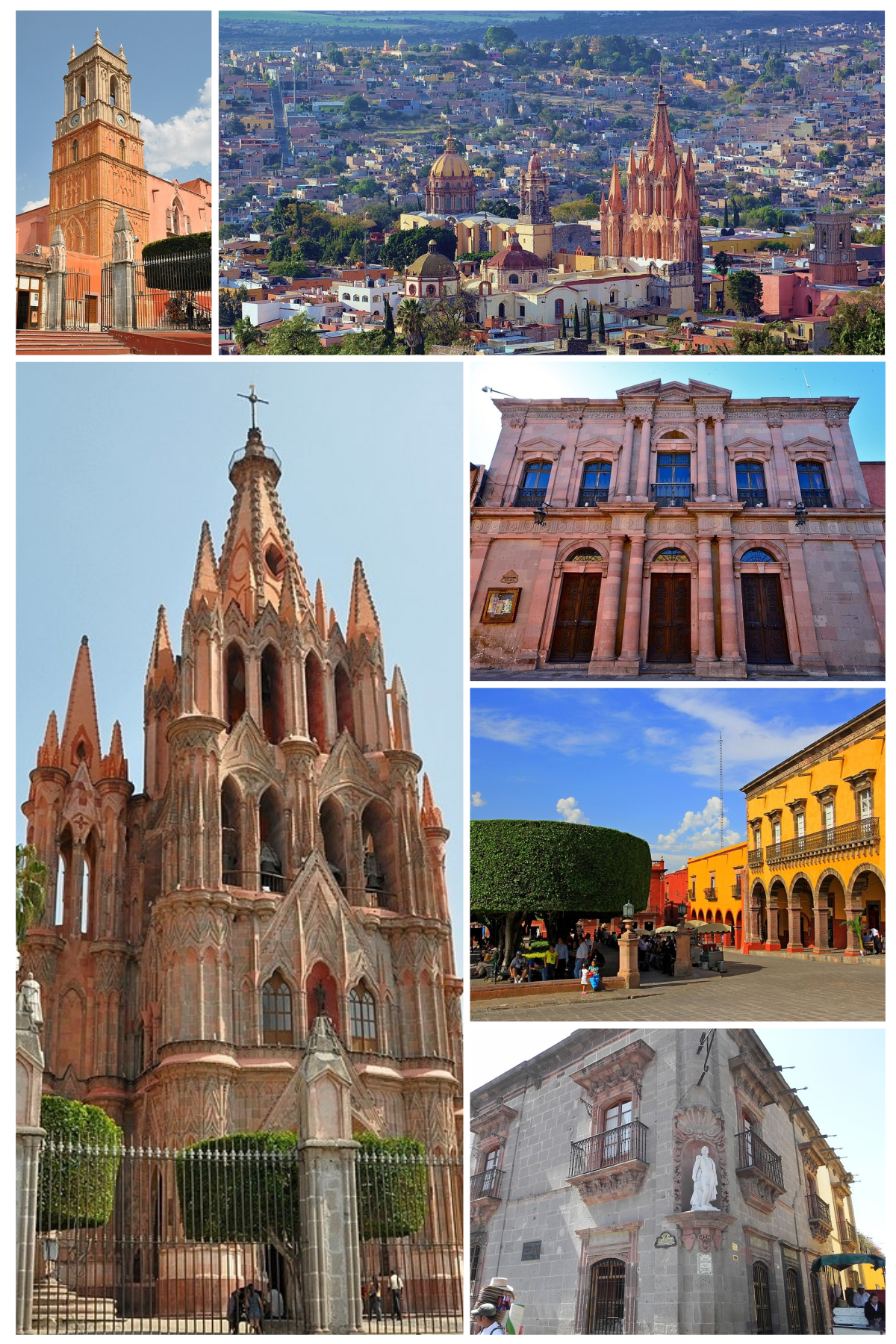
San Miguel de Allende is, for many people, the most beautiful colonial city in Mexico: a maze of cobbled streets climbing the hillside, pink quarry stone mansions with wrought-iron balconies, flowering courtyards, church domes and, towering over it all, the neo-Gothic fantasy silhouette of the Parroquia de San Miguel Arcángel. Set in the Guanajuato Bajío, at nearly 1,900 meters of altitude, this 'protective town' was a cradle of Mexican independence and today is a magnet for artists, travelers and lovers of the good life, awarded again and again as one of the best destinations in the world.

Its magic is in the detail and in the pace: you walk without hurrying, finding art galleries on every corner, artisan workshops, terraces with a view, design shops and a food scene that is surprising for a city this size. The heart of it all is El Jardín, the main square in the shade of the laurel trees, where locals and visitors sit to watch life go by, listen to mariachis, watch the mojigangas (papier-mâché giants) dance and look up at the Parroquia changing color with the light of the day.

Beyond the historic center, San Miguel is a base for a Bajío full of treasures: the Santuario de Atotonilco, the 'Mexican Sistine Chapel', a few kilometers away; the hot springs hidden out in the countryside; the Querétaro vineyards producing sparkling wine by the traditional method; and Dolores Hidalgo, the birthplace of the Grito de Independencia. Declared a UNESCO World Heritage Site in 2008, San Miguel de Allende combines history, art and pleasure like few places in Mexico.

📖 History of San Miguel de Allende

San Miguel de Allende was founded in 1542 by the Franciscan friar Juan de San Miguel, under the name San Miguel el Grande, as a mission and a strategic point on the Camino Real de Tierra Adentro, the great silver route that linked the mines of Zacatecas and Guanajuato with Mexico City. Thanks to its location, the town prospered as a cattle, craft and trade center through the viceregal period, filling up with churches, convents and stately quarry stone mansions that still define its look. Its great historical moment came at the start of the 19th century: Ignacio Allende was born here in 1769, a criollo officer who became one of the main conspirators and leaders of the independence movement. When the insurrection broke out in 1810, after the Grito de Dolores by the priest Miguel Hidalgo, San Miguel was one of the first towns taken by the insurgents; that is why it is known as the 'cradle' or 'forge' of Mexican independence. In honor of its most illustrious son, in 1826 the town was raised to city status and renamed San Miguel de Allende. After the colonial boom came a long decline through the 19th century and the start of the 20th, which paradoxically kept its heritage intact. In the mid-20th century, the arrival of artists and intellectuals —Mexican and foreign, drawn by art schools such as the Instituto Allende— brought the city back to life and turned it into a famous artists' colony. That revival peaked in 2008, when UNESCO declared the protective town of San Miguel and the Santuario de Atotonilco a World Heritage Site. The full history is on our history page.

Read the full history ↓

🏛️ San Miguel de Allende is in Guanajuato

The colonial and mining heart of the Bajío: birthplace of Independence with the Grito de Dolores and the Alhóndiga de Granaditas, a city of alleyways, tunnels and mummies, home of the Festival Cervantino and of San Miguel de Allende.

Read the history of Guanajuato →

🗺️ What to see

1
Parroquia de San Miguel Arcángel
The absolute symbol of San Miguel de Allende and one of the most photographed churches in Mexico. Its dazzling neo-Gothic facade of pink quarry stone, with pointed towers that look like a fairy-tale castle, was designed at the end of the 19th century by the indigenous master mason Zeferino Gutiérrez, taking his cue from postcards of European Gothic cathedrals. It presides over El Jardín and can be seen from almost anywhere in the city, especially magical at dusk and lit up at night.
The Parroquia de San Miguel Arcángel is the undisputed icon of San Miguel de Allende, that silhouette of pink pointed towers that shows up on every postcard and rises, like a fantasy castle, over El Jardín and the historic center. Its story has a charming twist: although there has been a church on the site since the end of the 17th century, the neo-Gothic facade that makes it unique today was built between 1880 and 1890 to a design by Zeferino Gutiérrez, a self-taught indigenous master mason who, tradition says, drew on drawings and postcards of European Gothic cathedrals to reinvent the front of the church in local pink quarry stone. The result is a one-off mixture: an exterior that evokes European Gothic combined with the hands and materials of the Mexican Bajío. The towers are visible from almost every corner of the city and change tone with the light of the day, from pale pink in the morning to deep pink at dusk, until they glow gold when the floodlights come on at night. The interior, more restrained than the facade, holds altarpieces, images and a much-venerated crucifix (the Señor de la Conquista), along with the quiet feel of a working church. The Parroquia is the spiritual and visual heart of San Miguel. The big celebrations happen in front of it: the San Miguel Arcángel festivities at the end of September, with the famous 'alborada' of fireworks at dawn, the Holy Week processions and the parades that set off from its doors. It is not unusual to run into a wedding and its procession of mojigangas coming out of the forecourt. It is right downtown, on the south side of El Jardín, so you walk there from anywhere in the old quarter. Entry to the church is free (respect mass times and the silence). Recommendations: see it at different hours (dusk and night are spectacular), find the lookouts and café terraces to photograph it from above, go inside respectfully, and, if your trip lines up with it, don't miss a religious celebration or 29 September. This is the image of San Miguel you will carry with you.
ℹ️ What it is: The city's icon church, with a neo-Gothic facade in pink quarry stone · History: Facade from 1880-1890, designed by the mason Zeferino Gutiérrez · Location: On El Jardín (the main square); free entry · Tip: See it at dusk and lit up at night; go up to a terrace for the photo
2
El Jardín (the main square / Jardín Allende)
The social heart of San Miguel de Allende: the main square in the shade of laurel trees clipped into cubes, ringed by colonial arcades and presided over by the Parroquia. This is where the life of the city beats: people on the iron benches, musicians, mariachis, sellers of balloons and corn, mojigangas dancing and weddings spilling out of the church. It is the meeting point and the best place to feel the pulse of San Miguel.
El Jardín —officially Jardín Allende or Plaza Principal— is the social heart and meeting point of San Miguel de Allende, the square everyone ends up crossing sooner or later. It is a square space shaded by big Indian laurel trees, clipped into that characteristic cube shape that gives it the air of a tidy garden, ringed by the arches of the colonial arcades, the Antiguo Palacio Municipal to the north and, dominating everything to the south, the pink towers of the Parroquia. The best of El Jardín is sitting on one of its wrought-iron benches and simply watching: locals talking, kids running around, shoeshiners, sellers of balloons, corn and cotton candy, tourists with cameras, and almost always music in the air. At different moments mariachis turn up offering songs, barrel-organ players, and the unmistakable mojigangas, those papier-mâché giants that dance at weddings and celebrations. It is not unusual to see a wedding procession come out of the Parroquia with its mojiganga, its band and its fireworks. More than a monument, El Jardín is an experience: the place to take the city's pulse, to start or end the day, to eat something from a street stall, or to settle onto one of the terraces and cafés in the arcades and surrounding buildings (several with privileged views of the Parroquia). By day it is lively and sunny; at dusk and at night, with the church lit up, it hits its most magical moment. It is at the exact center of the old quarter, so you walk there from any hotel downtown. Access is free (what you spend in cafés and restaurants is separate). Recommendations: go at different hours to watch it change, sit a while to observe local life, go up to one of the nearby terraces for the best view of the Parroquia, and let yourself be surprised by mariachis, mojigangas or a parade. It is the soul of San Miguel.
ℹ️ What it is: The main square, the social heart of the city, facing the Parroquia · Atmosphere: Clipped laurel trees, colonial arcades, musicians, mariachis and mojigangas · Access: Free (what you spend in cafés and on terraces is separate) · Tip: Go at dusk; head up to a terrace in the arcades for the view
3
Santuario de Atotonilco (the 'Mexican Sistine Chapel')
About 14 km from the city, this 18th-century Baroque sanctuary is a World Heritage Site along with San Miguel. They call it the 'Mexican Sistine Chapel' for the extraordinary murals covering ceilings and walls, the work of the artist Miguel Antonio Martínez de Pocasangre over some thirty years. It is one of the most impressive ensembles of folk Baroque in the Americas and an important pilgrimage center.
The Santuario de Jesús Nazareno de Atotonilco, about 14 km north of San Miguel de Allende, is one of the most impressive Baroque gems in Mexico and, together with the protective town of San Miguel, was declared a UNESCO World Heritage Site in 2008. It is known as the 'Mexican Sistine Chapel' for the overwhelming mural decoration that completely covers the ceilings, vaults and walls of its church and chapels, a universe of images that wraps entirely around the visitor. These extraordinary murals are the work of the criollo artist Miguel Antonio Martínez de Pocasangre, who painted them over some thirty years (from the mid-18th century onwards), working only with natural light. They tell the Passion of Christ and a complete religious program through a Stations of the Cross, with scenes, texts and figures covering every available centimeter in a folk Baroque style loaded with fervor. The whole thing was conceived by the priest Luis Felipe Neri de Alfaro as a center for spiritual exercises, and it is still an active place of pilgrimage and retreat today. Atotonilco also carries historical weight: it was here that Ignacio Allende took, in 1810, the banner of the Virgin of Guadalupe that became the flag of the insurgent army at the start of the independence struggle. So the visit combines art, spirituality and national history in one place. It is about 14 km from San Miguel, on the road to Dolores Hidalgo; you get there by taxi, car, tour or local transport, and it is usually combined with a stop at the nearby hot springs. Access to the sanctuary is usually free or by donation (check the hours, especially if there is a service or restoration work). Recommendations: allow time to take in the detail of the murals, respect the sacred character of the place (it is an active church and pilgrimage site), combine the visit with a soak in the local hot springs (La Gruta, Escondido Place) and, if you can, add a guide to understand the symbolism. It is an unmissable visit.
ℹ️ What it is: 18th-century Baroque sanctuary, World Heritage Site (UNESCO, 2008) · Don't miss: Murals covering the entire interior (Martínez de Pocasangre, ~30 years) · Distance: About 14 km from San Miguel; combined with the hot springs · Access: Free or by donation (check the hours; it is an active church)
4
Fábrica La Aurora (art and design center)
A former 1902 textile mill converted into San Miguel's main complex of galleries, studios and design shops. Dozens of artists' studios, art galleries, antique dealers, decor shops and cafés share its recycled industrial halls. You can watch the artists at work, buy original pieces and wander a setting with a lot of charm. Free entry.
Fábrica La Aurora is San Miguel de Allende's big art and design center, and an essential visit for anyone who enjoys art, decor and spaces with a past. It occupies a former spinning and weaving mill from 1902 which, after closing as an industry, was converted in the early 2000s into a cultural complex where the old halls, columns and machinery share space with contemporary galleries and studios. Today it houses dozens of art galleries, artists' studios (many of them open, where you can watch them work), antique dealers, shops for design, decor, jewelry and furniture, plus cafés and restaurants. It is a place to wander without hurrying, drifting in and out of the spaces, discovering work by local and international artists, talking to the makers and, if you like, taking home an original piece. The building itself, with its restored industrial look and its courtyards, is part of the appeal. La Fábrica sums up very well the artistic spirit that was reborn in San Miguel in the mid-20th century and turned it into a famous artists' colony. It is a good place to understand why the city draws so many makers, and to buy quality art and craft away from the bustle of the center. It is a little way from El Jardín (a few minutes by taxi or a longer walk), in the north of the city. Access to the complex and the galleries is free (purchases and food are separate). It is usually open during the day, with many spaces closing on Sundays or Mondays (check). Recommendations: allow time to go through the galleries, chat with the artists in their studios, combine it with a coffee or lunch inside the complex, and check whether there is an opening or an event on. This is artistic San Miguel in its purest form.
ℹ️ What it is: A former 1902 textile mill converted into an art and design center · What it has: Galleries, artists' studios, antique dealers, design shops and cafés · Access: Free (purchases and food separate) · Tip: Watch the artists at work; combine it with a coffee inside the complex
5
El Charco del Ingenio (botanical garden and reserve)
A botanical garden and ecological reserve of some 70 hectares on the northern edge of the city, devoted to the flora of the Mexican semi-desert. It holds one of the largest cactus collections in the country (hundreds of species, many endangered), plus a canyon, a dam, wetlands and trails with panoramic views. It was consecrated a 'Zone of Peace' by the Dalai Lama. Ideal for walking, birdwatching and connecting with nature.
El Charco del Ingenio is San Miguel de Allende's great green lung and its natural attraction par excellence: a botanical garden and ecological reserve of some 70 hectares on the northeastern edge of the city, dedicated to conserving semi-desert flora and the ecosystems of the Bajío. It is a perfect contrast with the old quarter, a place to breathe, walk and reconnect with the Guanajuato landscape. Its jewel is the collection of cacti and succulents, one of the most important in Mexico, with thousands of specimens from hundreds of species, many of them threatened or endangered, including a greenhouse and conservation areas for Mexican plants. But El Charco is much more: a canyon with a historic dam, wetlands and a body of water that draws rich birdlife (dozens upon dozens of bird species have been recorded), trails running through the reserve and lookouts with panoramic views of the city and the Parroquia in the distance. The place was consecrated as a 'Zone of Peace' by the Dalai Lama, and it keeps a serene, almost sacred feel. Walking it is a calm experience, very different from the bustle downtown: hikes along the trails, watching birds and plants, and the chance to join guided visits, workshops or events the reserve organizes (including equinox ceremonies). It is ideal for anyone who enjoys nature, photography and the outdoors. It is on the northern edge of the city, a few minutes by taxi from downtown (or a longer, uphill walk). There is a modest admission fee (check it; it goes towards conservation). Recommendations: go early or in the mid-afternoon to avoid the heat, bring water, a cap, sunscreen and comfortable shoes (there is little shade and the trails are dirt), take the time to walk out to the lookouts, and check the schedule of guided visits or events. This is the natural, serene face of San Miguel.
ℹ️ What it is: Botanical garden and ecological reserve of ~70 ha of semi-desert · Don't miss: A big cactus collection, a canyon, a dam, wetland and lookouts · Curiosity: Consecrated a 'Zone of Peace' by the Dalai Lama · Tip: Go early, bring water and a cap (little shade); comfortable shoes
6
Templo de San Francisco and the churches downtown
A block from El Jardín, the Templo de San Francisco shows off an imposing Churrigueresque facade (Mexican Baroque) and a neoclassical tower. The historic center is scattered with remarkable churches: the Templo de la Concepción (Las Monjas) with its great dome, the Oratorio de San Felipe Neri, the Santa Casa de Loreto and the Santa Escuela de Cristo. A walk through the city's viceregal religious wealth.
Beyond the Parroquia, San Miguel de Allende is a city scattered with valuable viceregal churches, and walking them means finding layers of history, art and devotion on every block of the historic center. The most striking, a block from El Jardín, is the Templo de San Francisco, which combines an imposing, heavily worked Churrigueresque facade (the peak of Mexican Baroque, carved in quarry stone) with a neoclassical tower, a contrast that sums up the city's architectural evolution. Inside it keeps altarpieces and works of sacred art. Very close by is the Templo de la Inmaculada Concepción, known as 'Las Monjas' because it was once part of a convent, famous for its great dome, one of the tallest and most beautiful in the city, inspired —according to tradition— by Les Invalides in Paris. Next to it ran the art school that helped bring San Miguel back to life as an artists' colony. Another unmissable ensemble is the Oratorio de San Felipe Neri, with its pink facade of indigenous feel and, adjoining it, the Santa Casa de Loreto, a richly decorated chapel that replicates the one in Loreto, Italy. Facing El Jardín, the small Santa Escuela de Cristo and, spread around the center, other churches, chapels and former convents complete a religious mosaic that is impressive for a city this size. Each has its altarpiece, its story and its atmosphere, and together they explain the enormous wealth of colonial San Miguel, built on the prosperity of the silver route. They are all in the old quarter, a few blocks from one another, so you cover them on foot. Entry to the churches is usually free (respect mass times and the silence). Recommendations: make a walking circuit of the churches (San Francisco, Las Monjas, the Oratorio and the Santa Casa de Loreto), go in to take in the altarpieces and the domes, and combine it with the lookouts and the cobbled lanes downtown. It is the best way to read the city's viceregal history.
ℹ️ What it is: Viceregal churches downtown: San Francisco, Las Monjas, the Oratorio · San Francisco: Churrigueresque (Baroque) facade and neoclassical tower, a block from El Jardín · Las Monjas: A great dome inspired by Les Invalides in Paris · Access: Free (respect mass times)
7
Lookouts and sunsets (El Chorro and the terraces)
San Miguel, stepped up a hillside, hands you spectacular views. El Mirador, on the street of the same name, gives you the classic postcard of the city with the Parroquia and the domes cut out against the hill. The El Chorro area (where the city began, with its old washing basins) and the many hotel and bar rooftop terraces round out the best spots for a sunset.
One of the great experiences in San Miguel de Allende is looking at it from above: the city, stepped up the side of a valley, offers panoramic views that become unforgettable at dusk, when the sun turns the domes, the pink towers of the Parroquia and the roofs of the historic center to gold. The classic spot is El Mirador, a natural balcony over the city (on the street of the same name, to the east) that gives you the most complete postcard: the old quarter spread out at your feet with the Parroquia as the lead. It is unmissable for the photo, especially late in the afternoon, though for that same reason it tends to draw crowds and vendors. Very close by is the El Chorro area, the spring where, tradition says, the city began, with its picturesque old public washing basins (Lavaderos del Chorro) and charming corners, part of the walk that drops down to Parque Juárez. But the lookouts don't end there: San Miguel is famous for its rooftops, hotel, bar and restaurant terraces with a view of the Parroquia, perfect for a sunset with a drink in hand. Several of the best cocktails in town are drunk watching the church light up as night comes on. Going up to one of these terraces is almost a San Miguel ritual. El Mirador and El Chorro are a few minutes on foot or by taxi from downtown (uphill); the terraces are spread all over the old quarter. Access to the public lookouts is free; on the rooftops you order something (prices vary by place). Recommendations: get to El Mirador well before sunset to grab a spot, combine it with a walk through El Chorro and Parque Juárez, and book a table on the most sought-after rooftops for the golden hour. Watch your belongings at the busiest spots. It is the best way to see out the day in San Miguel.
ℹ️ What it is: Panoramic views of the city stepped up the hillside · El Mirador: The classic postcard with the Parroquia; best at dusk · Also: El Chorro (where the city began, the old washing basins) and rooftops with a view · Tip: Arrive before sunset; book a terrace for the golden hour
8
Mercado de Artesanías and Mercado Ignacio Ramírez
Behind the churches downtown, the Mercado de Artesanías is a covered passage full of stalls with textiles, talavera, tinwork, jewelry, leather goods and souvenirs, reckoned one of the best places to buy crafts for both variety and price. Next to it is the traditional Mercado Ignacio Ramírez (El Nigromante), with flowers, local food, fruit and the bustle of a lifelong neighborhood market.
For buying crafts and seeing the most everyday San Miguel, the downtown markets are a compulsory stop. The Mercado de Artesanías is a long covered passage that snakes behind the churches in the center (near the Oratorio and Loreto/Colegio streets), packed with stalls selling goods from all over Mexico: embroidered textiles, talavera and ceramics, tin and brass pieces, silver jewelry, leather goods, ojos de Dios, catrinas, souvenirs and a thousand curiosities. It is reckoned one of the best places in the city to buy souvenirs for its variety and for prices friendlier than the boutiques on El Jardín, with room for good-natured haggling. Right next door, and completely different in spirit, is the Mercado Ignacio Ramírez 'El Nigromante', the city's traditional market: where the people of San Miguel shop, with its stalls of fruit and vegetables, flowers, spices, butchers, herbs, and eateries serving traditional home cooking at good prices. It is the authentic, down-to-earth face of downtown, with its smells, colors and noise, ideal for trying antojitos, a juice or a set lunch away from tourist prices. Walking both markets, one right next to the other, lets you combine craft shopping with a taste of local life and home cooking. It is a sensory experience and a good way to support producers and traders in the area. They are right in the historic center, a few blocks from El Jardín, so you walk there. Access is free (purchases and food are separate; bring some cash). Recommendations: walk the whole craft passage comparing prices, haggle respectfully, be brave and eat at one of the eateries in the Mercado Ignacio Ramírez (antojitos, set lunch), watch your belongings in the narrow, crowded aisles, and bring your own bag. It is shopping and local life in their purest form.
ℹ️ Mercado de Artesanías: Covered passage with textiles, talavera, tinwork, silver and souvenirs · Mercado Ignacio Ramírez: The traditional market: fruit, flowers, local food and eateries · Access: Free (purchases and food separate; bring cash) · Tip: Haggle good-naturedly; eat at an eatery in the local market
9
Hot springs in the area (La Gruta, Escondido Place)
The countryside around San Miguel is dotted with natural hot spring resorts, perfect for relaxing. The best known are La Gruta, famous for its pool inside a grotto reached through a tunnel, and Escondido Place, with its pools in a wooded setting. They are 10-20 minutes from the city, on the road to Atotonilco, and are usually combined with the visit to the sanctuary.
Few people know, before they arrive, that San Miguel de Allende is surrounded by natural hot springs, and that a soak in these warm mineral pools is one of the great pleasures of the area. The ground beneath the Guanajuato Bajío feeds several thermal resorts and spas in the nearby countryside, perfect for a morning or afternoon of relaxing, especially after several days of walking the historic center. The most famous is La Gruta, known for its unique experience: a series of open-air thermal pools and, above all, a pool inside a vaulted grotto reached by swimming through a dimly lit tunnel, where a jet of hot water falls; the atmosphere, between the stone walls and the steam, is something special. Another classic is Escondido Place, with several pools and tunnels among wooded gardens, quieter and more family-friendly. There are also other resorts and clubs in the area, with different facilities, restaurants and green areas. These thermal baths are best enjoyed early in the morning, when there are fewer people and the contrast between the warm water and the cool Bajío air is delicious. They are ideal for relaxing the body, and many visitors combine them with the visit to the Santuario de Atotonilco, since they sit on the same road north of the city. The resorts are 10-20 minutes by car from San Miguel, on the road to Dolores Hidalgo/Atotonilco; you get there by taxi, car or tour (sort out the return trip in advance). They charge admission, which varies by place and by day (check; it usually includes use of the pools; some charge more at weekends). Recommendations: go early to avoid the crowds, bring a swimsuit, towel, sandals and sunscreen, combine it with Atotonilco to make the most of the trip, and check hours and prices before you go. It is the perfect relaxing plan in San Miguel.
ℹ️ What it is: Natural hot spring resorts in the nearby countryside · The classics: La Gruta (a pool inside a grotto) and Escondido Place · Distance: 10-20 min away, on the road to Atotonilco; combined with the sanctuary · Tip: Go early; bring a swimsuit, towel and sandals; sort out the return trip
10
Art galleries, workshops and creative life
San Miguel came back to life in the mid-20th century as an artists' colony, and that identity is still very much alive. The city is full of art galleries, studios, schools (such as the historic Instituto Allende) and workshops where you can learn painting, ceramics, jewelry, textiles or Mexican cooking. Doing the galleries, taking a class or an art tour is one of the most San Miguel things you can do.
If anything defines San Miguel de Allende beyond its colonial beauty, it is its artistic soul. In the mid-20th century, the arrival of artists and intellectuals —Mexican and foreign, many drawn by schools such as the Instituto Allende and the old art school at Las Monjas— rescued the city from oblivion and turned it into a famous colony of makers. That spirit still beats on every corner. The city is scattered with art galleries, from those in the Fábrica La Aurora complex to the ones spread around the historic center, with work by painters, sculptors, photographers and artisans, local and international. But the special part is that San Miguel invites you to make, not just to look: there are plenty of workshops and classes for travelers, where in a few hours you can learn painting or watercolor, ceramics and talavera, silver jewelry, textiles and loom work, tinwork, or sign up for Mexican cooking and mixology classes. The historic Instituto Allende, housed in an old mansion, is still a reference point for this educational and artistic tradition. Beyond the classes there are art tours, visits to artists' studios, events, fairs and festivals (the city has an intense cultural calendar all year round). Diving into this scene —buying an original piece, talking with a maker or getting your hands dirty in a workshop— is one of the most authentic and memorable ways to experience San Miguel. The galleries and workshops are spread around the center and Fábrica La Aurora; many of the classes need booking in advance. Prices vary a lot with the activity and the length (check with each operator or school). Recommendations: book the most sought-after classes ahead (cooking, jewelry, ceramics), combine a gallery walk with Fábrica La Aurora, check the cultural calendar for your dates, and be brave enough to take at least one workshop so you go home with something you made. This is the creative San Miguel people fall for.
ℹ️ What it is: San Miguel's identity as an artists' colony, still very much alive · What it offers: Galleries, studios, the Instituto Allende and workshops (painting, ceramics, jewelry, cooking) · How to experience it: Gallery walks, classes and workshops; book in advance · Tip: Take at least one workshop so you go home with a piece of your own
11
Querétaro vineyards (the Bajío Wine Route)
About an hour from San Miguel, the high valleys of Querétaro make up one of Mexico's main wine regions, part of the Wine, Cheese and Art Route. More than fifty vineyards produce still wines and, above all, sparkling wines by the traditional method (the same one used in Champagne). You visit them on tours and tastings, a perfect escape combining landscape, wine and good food.
One escape that surprises a lot of travelers is the Querétaro vineyards, about an hour from San Miguel de Allende: one of the most important and dynamic wine regions in Mexico, sitting in high semi-arid valleys of the Bajío. It forms part of what is called the Wine, Cheese and Art Route, linking wineries, cheese makers and craft workshops across the states of Querétaro and Guanajuato. The region is known for its big bet on sparkling wines made by the traditional method —the same process as French Champagne, with a second fermentation in the bottle— as well as reds, whites and rosés that are gaining recognition. There are more than fifty vineyards in the area, several with facilities built for wine tourism: tours of the vines and cellars, guided tastings, pairings with cheese and regional food, restaurants overlooking the vines, and events. Some wineries are large and well set up for visitors, others are boutique and family-run. Visiting the vineyards means combining the pleasure of wine with vineyard landscapes, enormous skies and good food, an experience very different from the colonial city but a perfect complement to it. It is ideal for a relaxed day, especially during the harvest (around August-September, when many wineries hold parties and events). The vineyards are about an hour from San Miguel, towards Querétaro/Tequisquiapan/Ezequiel Montes; you get there by car, taxi or, most practically, on an organized tour (which saves you worrying about driving after tasting). Visits and tastings cost money, and the amount varies a lot with the winery and what is included (check and book). Recommendations: book the visits in advance (especially at weekends and during the harvest), go for a tour with transport if you plan to taste, combine two or three wineries with lunch in the area, and check the harvest events calendar. It is a delicious escape from San Miguel.
ℹ️ What it is: The Querétaro wine region, part of the Wine, Cheese and Art Route · Specialty: Sparkling wines by the traditional method (more than 50 vineyards) · Distance: About 1 hour away; better on a tour if you plan to taste · Tip: Book in advance; go during the harvest (Aug-Sep) for the events
Advertisements
What nobody tells you

💵 Prices

Tickets

TypePrice
El Jardín, the churches and the historic centerFree access (food, purchases and workshops separate)
Parroquia de San Miguel ArcángelFree access (respect mass times)
Santuario de AtotonilcoFree access or a voluntary donation (2025; an active church, with no fixed admission rate)
El Charco del Ingenio (botanical garden)$100 MXN general admission; $50 MXN students, teachers and seniors with an ID; under-10s free; 2 h guided visit $200 MXN (Tuesdays and Thursdays at 10 a.m.). Open every day 9 a.m. to 5 p.m. (source: elcharco.org.mx, verified July 2026)
Fábrica La Aurora (art center)Free access (purchases and food separate)
La Gruta (hot springs)$300–350 MXN per person (2025); temazcal extra $500 MXN; under-3s free
Escondido Place (hot springs)Approx. $250–320 MXN per person (2025); check when you visit
Querétaro vineyards (visit and tasting)US$ 20–50 per person depending on the winery (tour + tasting of 3-4 wines, 2025)
Workshops and classes (art, cooking, jewelry)US$ 30–90 per person depending on the activity and its length (2025)
🔄 updated monthlyOfficial / reference values · double-check when buying

Activities and tours

ActivityPriceDurationOperator
Walking city tour of the historic centerFree tour on tips (suggested US$ 5-10); private tours from US$ 202 to 3 hLocal operators and free walking tours
Trip to the Santuario de Atotonilco + hot springsUS$ 35–55 per person (transport, guide and admission to the springs)Half a dayLocal tour operators
Querétaro vineyard tour with tastingsUS$ 60–120 per person (full day, 2-3 wineries with transport and tastings)Full dayWineries and wine tourism operators (BajioGo and others)
Visit to El Charco del Ingenio (botanical garden)$100 MXN general admission ($50 with an ID; under-10s free); $200 MXN for the 2 h guided visit (Tuesdays and Thursdays at 10 a.m.) (verified July 2026)1 to 3 hEl Charco del Ingenio (self-guided or guided visit)
Mexican cooking, ceramics or jewelry classUS$ 40–100 per person depending on the workshop and its length2 to 4 hArt and cooking schools and workshops downtown
Gallery and art walk (Fábrica La Aurora and the center)Free on your own; guided tour from US$ 252 to 3 hSelf-guided / art tour operators
Sunset on a rooftop and bars with a view of the ParroquiaMinimum spend or cocktails from $180-280 MXN depending on the place1 to 2 hBars and hotels with a terrace
Trip to Dolores Hidalgo or the city of GuanajuatoUS$ 40–70 per person (full day with transport and guide)Half a day to a full dayLocal tour operators
🔄 updated monthlyOfficial / reference values · double-check when buying
Advertisements

🚌 How to get there and distances

Getting around

ModePriceDurationNotes
On footFreeThe historic center is compact and covered on foot, which is the best way to enjoy it. Watch out for the cobbles and the slopes: comfortable shoes with a firm sole are a good idea, especially at night. The altitude (~1,900 m) can make the climbs a little tiring at first.
Taxi$40–80 MXN for a short ride within the center (2025); agree the fare before getting inShort rides around the cityThere are taxis for getting to areas further out (Fábrica La Aurora, El Charco, the hot springs, Atotonilco) or for moving around at night. You pick them up at taxi ranks or call one; they don't always use a meter. For Atotonilco and the springs, arrange the return trip as well.
Ride apps (Uber, DiDi)$50–100 MXN for a ride within the city; from Querétaro (QRO) or Bajío (BJX) airport an Uber usually runs ~US$ 60–70, cheaper than a taxi (US$ 90–100) (verified July 2026)Depends on the rideUber and DiDi work in San Miguel and are practical and cheap for getting around the city and to nearby spots. Availability can be more limited than in big cities and drops after 8 p.m.; have a plan B (a taxi) for outlying areas or for late at night.
Local city busesUrban fare approx. $8–12 MXN per ride, in cash (verified July 2026)VariableSan Miguel has small city buses/combis linking the bus terminal, the neighborhoods and some outlying areas with downtown. How you pay: cash to the driver; there is NO top-up card and no QR payment, and no real-time app tracks these vehicles. For a traveler, almost all of the historic center is done on foot; the city buses are barely used except for the terminal or distant neighborhoods. To plan bus routes and times, people use Google Maps and Moovit.
Tours and transport to nearby attractionsUS$ 25–120 per person depending on the trip (see the activities section)Depends on the destinationFor Atotonilco, the hot springs, the Querétaro vineyards or Dolores Hidalgo/Guanajuato, the most comfortable option is usually a tour or hired private transport, which saves you the hassle of timetables and getting back. There are operators downtown and agencies in the hotels.
Rental carUS$ 35–60 a day + fuel and parking (2025)Useful for exploring the surroundings (hot springs, vineyards, Bajío towns) freely. In the historic center a car is more nuisance than help: narrow, cobbled, one-way streets and little parking; leave it at the hotel or in a car park and walk.
🔄 updated monthlyOfficial / reference values · double-check when buying

How to get there

RouteAirlines / operatorsAvg. priceDuration
Querétaro International Airport (QRO) → San Miguel de AllendeShared shuttles (BajioGo), private taxis (Heros) and appsShared shuttle US$ 30–68 per person; private taxi US$ 90–120 (2025)~1 h to 1 h 30 (a little over 70 km)
Bajío International Airport (BJX, León/Silao) → San Miguel de AllendeShuttles and private transfers, taxis; or a bus connection via León/GuanajuatoPrivate transfer approx. US$ 90–140 (2025)~1 h 30 to 2 h
Querétaro bus terminal → San Miguel de AllendeETN, Primera Plus, Flecha Amarilla, with frequent departures to the San Miguel terminal$150–250 MXN (2025)~1 h 15
From Mexico City → San Miguel de AllendeDirect ETN and Primera Plus buses (from the Central del Norte)$400–500 MXN on a direct bus (2025)~3 h 30 to 4 h on a direct bus
🔄 updated monthlyOfficial / reference values · double-check when buying

🏨 Where to stay

No exact prices: a scale from $ (budget) to $$$$$ (luxury), with 2-3 options per category.

CategoryPriceRecommended options
Luxury boutique hotels and historic mansions$$$$$US$ 200–450 a night; high-end boutique hotels set in restored colonial mansions, with courtyards, rooftops overlooking the Parroquia, a spa and chef-driven restaurants, many right in the historic center. Book in advance, especially in high season
Boutique and upper-mid-range hotels$$$$$US$ 100–190 a night; charming hotels and well-restored houses downtown and in nearby neighborhoods, with an excellent balance of location and quality, terraces and carefully done breakfasts
Mid-range hotels and guesthouses$$$$$US$ 55–95 a night; guesthouses, three-star hotels and B&Bs downtown and around it, a comfortable option with character, many a few blocks from El Jardín
Hostels and budget accommodation$$$$$US$ 15–40 a night for a private room; dorm beds from US$ 12–20. Hostels and guesthouses downtown and in nearby neighborhoods, ideal for backpackers; book ahead in high season and during festivals
Specific establishments (verified names)$$$$$From INEGI's DENUE (cut-off 20/05/2026), the largest in the old quarter: Live Aqua San Miguel de Allende, on the Calzada de la Presa; Rosewood San Miguel de Allende, at Nemesio Diez 11; Hotel Numu, at Nemesio Diez 20; Hotel María Bonita, at Zacateros 12; Hacienda Los Arcángeles, at Portal Allende 8; and Selina, at Cuna de Allende 11 (https://www.selina.com), all six in the historic center except the Rosewood. link out of service: the domains the register publishes for Casa Florida (casafloridasma.com) and Dream House (dreamhousesma.com) have no DNS record as of 08/08/2026, neither on the apex nor on www.

🍴 Where to eat

TypePriceOptions / signature dish
Fine dining and chef-driven restaurants$$$$$For its size, San Miguel has a surprising food scene, with chef-driven restaurants and well-regarded kitchens, many on rooftops and in courtyards overlooking the Parroquia. Ideal for a special dinner; book ahead.
Contemporary and regional Mexican cooking$$$$$Restaurants that rework Mexican and Bajío cooking with local produce, plus good international options. A city very much given over to eating well, with something for every taste.
Antojitos, eateries and markets$$$$$For eating well and cheaply, the eateries in the Mercado Ignacio Ramírez and the stalls downtown serve antojitos, set lunches and traditional Bajío flavors. The authentic, down-to-earth side of the San Miguel table.
Specialty coffee and bakeries$$$$$San Miguel has a strong specialty coffee culture, with bakeries and pastry shops and terraces perfect for breakfast or an afternoon break. Part of the city's unhurried pleasure.
Rooftops, bars and mezcal bars$$$$$The rooftops overlooking the Parroquia, the cocktail bars and the mezcal bars are an institution, especially at dusk and after dark. The nightlife, elegant and relaxed, is part of the experience.
Specific places (verified names)$$$$$Named in the DENUE and with a live website of their own: Cumpanio, at Correo 29 (https://cumpanio.com), one of the few that publishes a menu with prices —breakfasts and dishes from $125 to $190 MXN, read on 08/08/2026—; Prime Steak Club, at Calzada de la Presa 85 (https://primesteakclub.com.mx); Restaurante Atrio, at Cuna de Allende 3; Boca Ciega, at Quebrada 18; and Los Milagros, at Relox 17. Which one to choose is a recommendation from blogs and forums; what is verified is that they exist and where they are.
Advertisements

📖 History of San Miguel de Allende

Origins, formation and what the sources say.

The founding of San Miguel el Grande (1542)

One of the most elegant cities in Mexico started out as an outpost in a war zone. In 1542, the Franciscan friar Juan de San Miguel planted a humble mission on these hills of the Bajío —tradition dates it to 3 October— to evangelize Chichimecas and Otomíes on a still untamed frontier of New Spain. Nothing suggested that this lost spot would become a cradle of independence and a World Heritage Site; its luck changed completely with what turned up underground a few years later: silver.

The town was known as San Miguel el Grande, and its growth was tied to one decisive fact: shortly after it was founded, the great silver veins of Zacatecas and, closer by, of Guanajuato were discovered. San Miguel sat on the Camino Real de Tierra Adentro, the great route that carried silver from the northern mines towards Mexico City and, from there, on to Spain. That strategic position turned the modest mission into a prosperous stop for trade, rest and resupply for the caravans.

Through the 16th, 17th and 18th centuries, San Miguel el Grande flourished as a cattle, craft and trade center. Its well-off families, enriched by commerce and by the workshops (textiles, ironwork, saddlery), raised churches, convents and stately quarry stone mansions that still give the city its unmistakable viceregal look. Much of the heritage that would earn it UNESCO recognition centuries later comes from that colonial boom.

es.wikipedia.org · San Miguel de Allendesma.mx · Brief history of san miguel de allendecentralmunicipal.mx · Celebra san miguel de allende 479 anos de…

The Camino Real de Tierra Adentro and the colonial boom

San Miguel el Grande's prosperity was inseparable from the Camino Real de Tierra Adentro, the 'silver route' that linked the mines of the north of New Spain with the capital of the viceroyalty. The town worked as a logistics hub: mule trains were resupplied here, carts repaired, animals shod, and cloth, leather and tools traded. The economy turned on cattle, textile workshops and crafts, which gave the population work and wealth.

That economic energy translated into architectural splendor. The wealthiest criollo families —such as the Counts of La Canal, whose mansion still presides over a corner downtown— funded churches, chapels and palaces. Up went the Oratorio de San Felipe Neri, the Santa Casa de Loreto, the Templo de San Francisco with its Churrigueresque facade, the Concepción convent ('Las Monjas') and numerous quarry stone mansions with courtyards and carved doorways. San Miguel became one of the most cultured and wealthy towns in the Bajío.

The Camino Real de Tierra Adentro was declared a UNESCO World Heritage Site in 2010 as a cultural itinerary, recognizing the historical role of cities like San Miguel in holding New Spain together. That past of caravans, silver and trade explains how a relatively small town could afford so much monumental heritage, the base on which its colonial identity was built.

es.wikipedia.org · San Miguel de Allendewhc.unesco.orgmuseovirtualug.org · Sanmigueldeallende

Ignacio Allende and the cradle of independence (1810)

The most glorious chapter in San Miguel's history was written at the start of the 19th century. Ignacio Allende had been born in the town in 1769, a criollo officer of the Queen's dragoon regiment who would become one of the main conspirators and leaders of Mexico's independence movement. Allende took part in the secret meetings that, along with figures such as Josefa Ortiz de Domínguez in Querétaro and the priest Miguel Hidalgo in Dolores, gradually wove the conspiracy against Spanish rule.

When the plot was discovered and Hidalgo launched the Grito de Dolores in the early hours of 16 September 1810, the uprising spread quickly across the Bajío. San Miguel el Grande was one of the first towns taken by the insurgent army; Allende himself, as military commander, played a central role in those first dizzying days of the war. Because of that prominence, San Miguel is remembered as the 'cradle' or 'forge' of Mexican independence.

The episode ended tragically for its leaders: after some early victories, the main insurgent chiefs —among them Allende and Hidalgo— were captured in 1811 and executed by firing squad. But the seed had been planted, and independence would be completed a decade later, in 1821. Allende's sacrifice stayed forever tied to his home city, which in time would carry his surname as a badge of honor.

es.wikipedia.org · San Miguel de Allendesma.mx · Brief history of san miguel de allendefallinginlovewithsanmiguel.com · San miguel de allende colonial roots to…

From San Miguel el Grande to San Miguel de Allende

Once independence was complete, Mexico wanted to honor the heroes who had made it possible, and San Miguel paid tribute to its most illustrious son. On 8 March 1826, the old town of San Miguel el Grande was raised to city status and renamed with the name it still carries: San Miguel de Allende. The new name fused two legacies: that of the patron saint, San Miguel Arcángel, inherited from the founding friar, and that of the national hero Ignacio Allende, a symbol of the fight for freedom.

The shine of the 18th century, however, did not carry into the 19th. With the decline of the old trade routes, the conflicts of independent Mexico and, above all, a railway layout that left the city somewhat off the main axes, San Miguel entered a long period of economic stagnation. The population fell and activity languished for decades.

Paradoxically, that decline turned out to be providential for its heritage. With no money and no pressure to tear down the old and build the new, the old quarter was left almost frozen in time: the quarry stone mansions, the Baroque churches, the cobbled streets and the colonial layout survived intact while other cities modernized and lost their old faces. Without knowing it, San Miguel kept the treasure that would make it famous in the following century.

es.hispanopedia.com · San Miguel de Allendees.wikipedia.org · San Miguel de Allendeprogramadestinosmexico.com · Historia de san miguel de allende

Rebirth as an artists' colony and UNESCO status (2008)

San Miguel de Allende's rebirth came in the mid-20th century, and it came through art. From the 1930s and 1940s onwards, the city's intact beauty and its light began to draw artists, writers and intellectuals, Mexican and foreign. The founding of art schools —especially the Instituto Allende and the school in the former Concepción convent— consolidated that calling: after the Second World War, many American veterans studied art in San Miguel on scholarships, and a cosmopolitan colony took shape that gave the city new life.

Out of that momentum came the San Miguel we know today: a city of galleries, workshops, studios, festivals and intense cultural life, where local artisans live alongside makers who arrived from all over the world. Without losing its Mexican soul or its viceregal heritage, San Miguel became one of the most sought-after destinations in the country, repeatedly ranked among the best cities in the world to visit.

The biggest recognition came in 2008, when UNESCO inscribed the 'Protective town of San Miguel and the Sanctuary of Jesús Nazareno de Atotonilco' on the World Heritage List. The listing valued both its contribution to Mexican Baroque and the exceptional preservation of its architecture, and its role in the fight for independence. So the city that neglect had preserved and art had revived was consecrated as one of the great cultural treasures of Mexico and of humanity.

whc.unesco.orgfallinginlovewithsanmiguel.com · San miguel de allende colonial roots to…es.wikipedia.org · San Miguel de Allende

📚 Bibliography

  • Wikipedia — «San Miguel de Allende»: https://es.wikipedia.org/wiki/San_Miguel_de_Allende
  • SMA.mx — «San Miguel de Allende: A Brief History from Its Beginnings as San Miguel el Grande»: https://sma.mx/brief-history-of-san-miguel-de-allende/
  • Falling in Love with San Miguel — «The History of San Miguel de Allende: From Colonial Roots to UNESCO Status»: https://fallinginlovewithsanmiguel.com/san-miguel-de-allende-colonial-roots-to-unesco/
  • UNESCO World Heritage Centre — «Protective town of San Miguel and the Sanctuary of Jesús Nazareno de Atotonilco»: https://whc.unesco.org/en/list/1274/
  • UNESCO World Heritage Centre — «Camino Real de Tierra Adentro»: https://whc.unesco.org/en/list/1351/
  • Hispanopedia — «San Miguel de Allende»: https://es.hispanopedia.com/wiki/San_Miguel_de_Allende
  • Central Municipal — «Celebra San Miguel de Allende 479 años de fundación»: https://centralmunicipal.mx/municipios/2021/10/03/celebra-san-miguel-de-allende-479-anos-de-fundacion/
  • INAH — «San Miguel de Allende visto desde lo alto»: https://www.inah.gob.mx/foto-del-dia/foto-del-dia-san-miguel-de-allende-visto-desde-lo-alto
  • Programa Destinos México — «Historia de San Miguel de Allende»: https://programadestinosmexico.com/en/historia-de-san-miguel-de-allende/
  • Infobae — «Murales, devoción y herencia barroca: el Santuario de Atotonilco, la Capilla Sixtina mexicana»: https://www.infobae.com/historias/2025/08/11/murales-devocion-y-herencia-barroca-asi-es-el-impresionante-santuario-de-atotonilco-la-capilla-sixtina-mexicana/

❓ Frequently asked questions

How many days is it worth staying in San Miguel de Allende?+
For a first visit, 2 to 3 days is enough to take in the historic center without rushing (the Parroquia, El Jardín, the churches, the galleries and Fábrica La Aurora), climb to a lookout at sunset and make an escape to the Santuario de Atotonilco with some hot springs. With 4 to 5 days you can add the Querétaro vineyards, a day at El Charco del Ingenio, art or cooking workshops and trips to Dolores Hidalgo or the city of Guanajuato.
How do I get to San Miguel de Allende?+
San Miguel has no airport of its own. The most common route is to fly into Querétaro International Airport (QRO), a little over an hour away, or Bajío (BJX, near León), about an hour and a half away, and take a shuttle, private transfer, taxi or app from there. Another option is to arrive at the Querétaro bus terminal and take a direct bus to San Miguel (~1 h 15). From Mexico City there are direct buses of about 3 h 30 to 4 h.
How do I get around the city?+
The historic center is covered on foot, which is the best way to enjoy it, though you have to reckon with the cobbles and the slopes (comfortable shoes). For areas further out (Fábrica La Aurora, El Charco, the hot springs, Atotonilco) or at night, there are taxis (cash, agree the fare before getting in) and apps like Uber and DiDi, which work well although availability drops after 8 p.m. There are also small city buses paid in cash (about $8–12 MXN), with no card and no QR, used mostly for the bus terminal and the neighborhoods; there is no real-time app for them, you plan with Google Maps or Moovit. For trips to the hot springs, the vineyards or nearby towns, the most comfortable option is usually a tour or hired transport (verified July 2026).
When is the best time to visit?+
The best window runs from November to April, the dry season, with mild days, clear skies and little rain, ideal for walking the center. Since the city sits at nearly 1,900 meters, winter nights are cold: bring a jacket. Summer (June to September) is the rainy season, with stormy afternoons but green countryside and festivals. September (the independence holidays and the San Miguel Arcángel festivities) and Holy Week are very lively, but also the busiest moments.
Is the Santuario de Atotonilco worth the trip?+
Yes, absolutely. About 14 km from the city, the Santuario de Jesús Nazareno de Atotonilco is a World Heritage Site along with San Miguel and is known as the 'Mexican Sistine Chapel' for the extraordinary murals covering its entire interior. It is one of the most impressive folk Baroque ensembles in Mexico and an important pilgrimage center. It is usually combined with a soak in the nearby hot springs, on the same road.
What is there to buy, and where?+
San Miguel is excellent for crafts, art and design. The Mercado de Artesanías (behind the churches downtown) has textiles, talavera, tinwork, silver and souvenirs at good prices, with room to haggle. Fábrica La Aurora concentrates higher-end art and decor galleries and shops. And all over the center there are design, jewelry and fashion boutiques. For more everyday crafts, Dolores Hidalgo (talavera), near the city, is also worth it.
Is San Miguel de Allende expensive?+
San Miguel has a reputation as one of Mexico's more 'premium' destinations, with plenty of boutique hotels, chef-driven restaurants and design shops at high prices. But there are options for every wallet: guesthouses and hostels, eateries and markets with cheap food, free attractions (El Jardín, the churches, the lookouts) and inexpensive admissions (El Charco, museums). With a bit of planning you can enjoy it on any budget; prices in pesos are worth checking on the spot.
Sources consulted (24)
Still planning?
Explore more destinations in Mexico
See all destinations →
Advertisements
Image credits
Photos from Wikimedia Commons, each under its own licence (CC BY, CC BY-SA or public domain). Open each file to see its author and licence.
San Miguel de Allende Collage