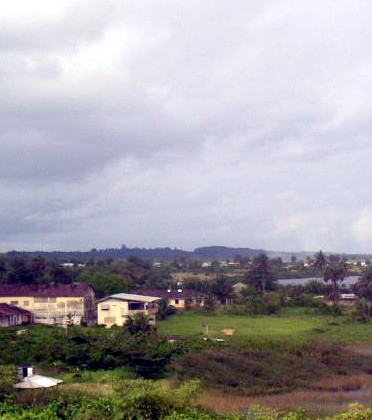
Harper is one of the most fascinating and melancholy places in all of West Africa: a city in the far south of Liberia, next to Cape Palmas, where time seems to have stopped among crumbling stately mansions. It was the capital of the Republic of Maryland, an independent state founded by free African American settlers that existed on its own between 1834 and 1857, before joining Liberia. That elite left an astonishing architectural legacy: large wooden houses in the American Southern style, now eaten away by the tropics, facing the Atlantic.
Exploring Harper is like peering into a 'ghost American South': antebellum mansions with columns and verandas, churches, a Masonic lodge, all built by descendants of enslaved people who recreated on the African coast the world they had come from. William Tubman, Liberia's longest-serving president, was born here in 1895, and his ruined mansion is one of the must-see sights. The decay of these buildings, worsened by the civil wars, gives them a haunting beauty that draws travellers, photographers and historians.
This practical guide explains how to get to this remote corner of the country, which mansions and historic sites to see, how Americo-Liberian history blends with the culture of the Grebo people and with Cape Palmas and its lighthouse, and what to expect from a destination as far-flung as it is extraordinary. Harper isn't easy to reach, but for anyone who truly wants to understand Liberia's history, it is probably the most telling place in the country.
Harper was founded in 1834-1835 by the Maryland State Colonization Society as the capital of the colony of 'Maryland in Africa', centred on Cape Palmas. It is named after Robert Goodloe Harper, the American politician who had proposed the name 'Liberia'. In 1854 the colony declared itself the independent Republic of Maryland, one of the few cases of a sovereign state of African American settlers, until 1857 when, after a conflict with local peoples, it joined the Republic of Liberia as Maryland County. The Americo-Liberian elite built large Southern-style mansions in Harper; William V. S. Tubman, president of Liberia from 1944 to 1971, was born here in 1895. The civil wars and neglect left that heritage in evocative ruins.
Read the full history ↓The other end of Liberia, where a separate republic —Maryland in Africa— had its own capital: Harper and its Southern-style mansions, now in ruins facing the Atlantic, next to Cape Palmas and the Ivorian border.
Read the history of Maryland and the far south →No exact prices: a scale from $ (budget) to $$$$$ (luxury), with 2-3 options per category.
Origins, formation and what the sources say.
The far south-east of present-day Liberia, around Cape Palmas, has been home to the Grebo people since time immemorial. They are a group within the large Kru language family. The Grebo lived from fishing, farming and trade along this coast and the banks of the Cavalla River. They were organised into communities with their own institutions, societies and hierarchies.
The headland that dominates the area was named by Portuguese navigators who sailed this coast in the 15th century in search of routes and goods. They called it Cabo das Palmas, 'Cape of the Palms', after the palm trees that grew there. From then on, the cape was a landmark for ships sailing along the West African coast and a place of contact, and of slave trading, between local peoples and Europeans.
This coast was part of the stretch of African shoreline that Europeans knew by its products: the 'Grain Coast' or 'Malagueta Coast', after the grains of paradise traded in the area. In the 19th century, a very unusual colonial project was set up on top of this Grebo world, with its seafaring culture and trade networks. It was different even from the rest of Liberia: the colony of Maryland.
The modern history of Harper begins with a colonisation project of its own, separate from the original core of Liberia. The Maryland State Colonization Society was an American branch devoted to resettling free African Americans in Africa. It decided to found its own colony, independent of the one the colonisation societies had established further north-west, around Monrovia.
On 12 February 1834, the society established the colony of 'Maryland in Africa', centred on Cape Palmas. The following year the town of Harper was founded. It was named after Robert Goodloe Harper, an influential American politician from Maryland and a member of the American Colonization Society, who is credited with proposing the name 'Liberia' for the colonisation project. The settlers, free African Americans mostly from the state of Maryland, settled on Grebo land.
The colony grew into a distinctive community with its own administration, and in time it took a bold step. In 1854 it declared itself the Republic of Maryland, a sovereign and independent state. It is one of the few republics in history founded by African American settlers. For a few years, Maryland was formally a separate country with Harper as its capital, lying between the Republic of Liberia to the west and the territories to the east.
The small Republic of Maryland was not independent for long. In 1856-1857, an armed conflict with Grebo and Kru peoples of the region put the young republic in serious trouble. The conflict was partly tied to tensions over control of trade and land. Maryland asked neighbouring Liberia for military help, and with Liberian support the conflict was settled. The price was the loss of sovereignty: in 1857, Maryland joined the Republic of Liberia as Maryland County.
Once it was part of Liberia, Harper entered its most splendid period. The county's Americo-Liberian elite were settler families who dominated politics, trade and administration. Over the second half of the 19th century and the first decades of the 20th, they built the great mansions that define the town today. These were wooden houses in the Southern antebellum style, with columns, verandas and spacious halls. They recreated the plantation world of the American South that the settlers came from.
That grand architecture reflected both the prosperity and the inequality of Americo-Liberian society. While the elite put up mansions and monuments, the Indigenous Grebo communities were largely sidelined and kept in a subordinate position. Harper became a symbol of the power of that ruling class, which would give the country leading figures, including its most famous president.
Harper's tie to power reached its peak with William Vacanarat Shadrach Tubman. He was born in the town in 1895 into an Americo-Liberian family of humble origins. Tubman built a political career and became president of Liberia in 1944. He held the office until his death in 1971, making him the longest-serving president in the country's history, with almost twenty-seven years in power.
Known as the 'father of modern Liberia', Tubman pushed an 'open door' policy towards foreign investment, above all in rubber and iron ore. He also pursued a 'unification policy' that aimed, at least on paper, to bring Indigenous peoples into national life. At the same time, he kept a dominant-party system and tight personal control of power. Under his rule, Liberia enjoyed decades of economic growth and a strong international profile.
As Harper's favourite son, Tubman lavished attention and public works on his home town and strengthened its symbolic role as the cradle of the Americo-Liberian elite. That heyday can still be seen in the mansions, the Morning Star Masonic Lodge linked to Tubman and the public buildings of the period. But the splendour stood on feet of clay. Tubman never resolved the deep inequality between the Americo-Liberian elite and the Indigenous majority. A few years after his death it would explode, dragging the country, and Harper, into the abyss.
In 1980 a coup overthrew and killed President William Tolbert, Tubman's successor, and ended more than a century of Americo-Liberian rule. It marked the beginning of the end of the old order. The following decade brought the civil wars (1989-2003), which devastated the whole country and hit the remote south-east especially hard. Isolated and impoverished, Harper suffered neglect, looting and decay.
The great mansions symbolised an elite and a world that history had left behind. With no upkeep, they were exposed to tropical damp, vegetation and the passing years. Many fell into ruin: majestic, melancholy shells with crumbling columns and verandas, open to the Atlantic wind. Paradoxically, this decay gave Harper a haunting beauty that now draws travellers, photographers and historians from around the world.
Today Harper is a quiet, remote town, home mostly to the Grebo people, who live alongside the imposing ruined legacy of the Americo-Liberian era. Its ghost mansions, the Tubman house, the Masonic lodge, the churches and Cape Palmas with its lighthouse make up one of the most unusual heritage sites in Africa. For anyone who reaches this far corner of the country, Harper tells Liberia's history more eloquently than anywhere else: the rise and fall of an elite, written in wood by the sea.