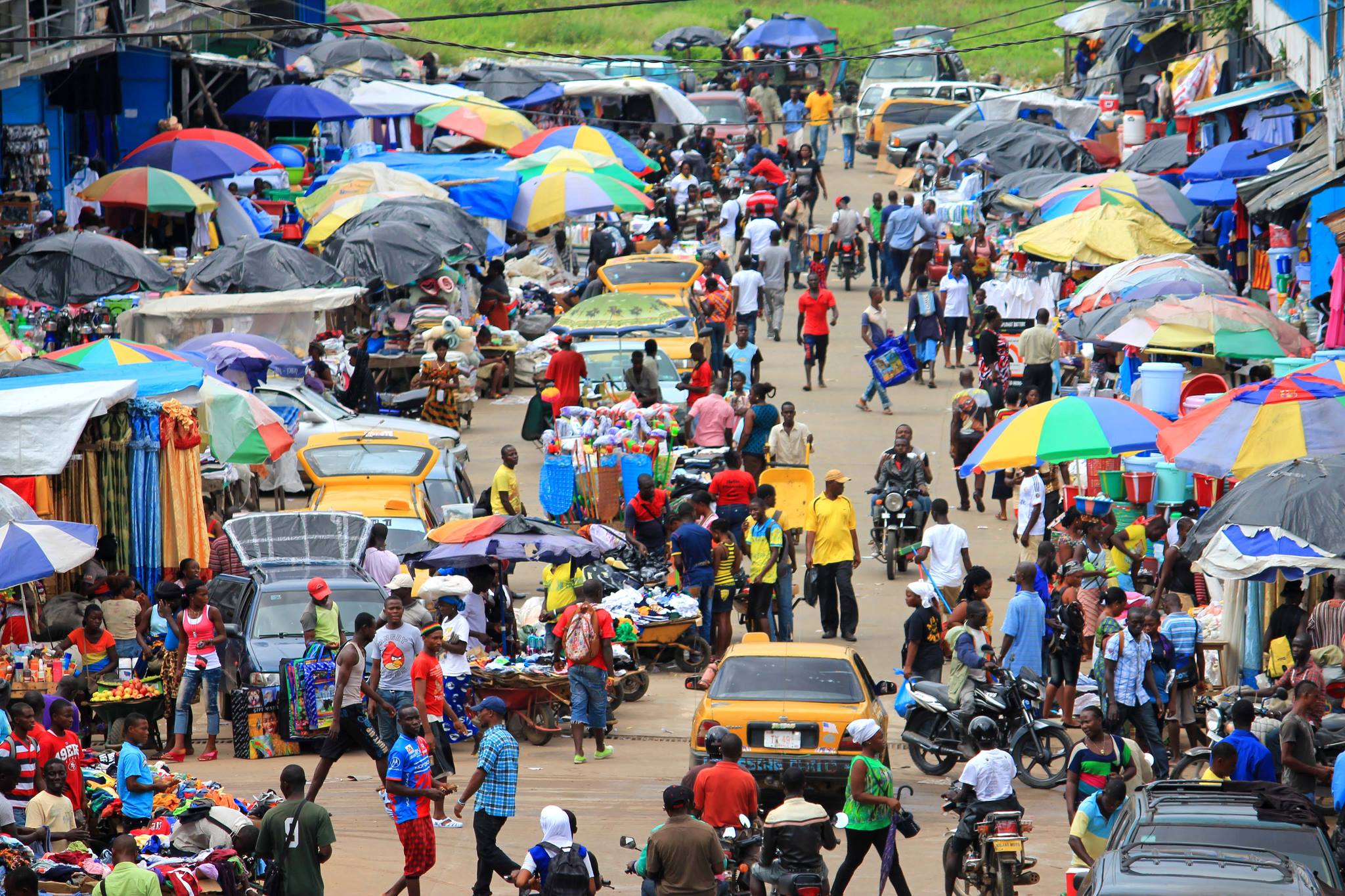
Monrovia is a capital like few others in Africa: chaotic, warm, full of music and with a history unlike any other. It was born in 1822 as a refuge for freed African Americans who crossed the Atlantic to found a nation of free people. It is named after a US president, it has streets called Broad Street and Ashmun Street, and its wooden houses with verandas recall the American South. All of that, mixed with the energy of West Africa, makes for a one-of-a-kind city.
This is not a polished postcard capital. The long civil war (1989-2003) and the Ebola outbreak of 2014-2016 hit Monrovia hard, and the scars are still visible: ruined buildings like the legendary Ducor Hotel, shaky infrastructure, overflowing markets. But the energy of its people, its music scene (hipco and Afrobeat play everywhere), its city beaches and its warm welcome make Monrovia a destination that wins over anyone looking for the real Africa, unfiltered and without crowds of tourists.
This guide takes a practical look at Monrovia: what to see in the historic centre and on Providence Island, how to visit the National Museum and the Waterside Market, where to soak up the sun on the city's beaches, how to get around safely in a place where transport is informal, and how to use the capital as a base for exploring the rest of the country. With two or three well-planned days, Monrovia stops being a stopover and becomes a memorable experience.
Monrovia was born in 1822, when the American Colonization Society landed a group of freed African Americans on Providence Island, at the mouth of the Mesurado River, with the aim of founding a colony of free people in Africa. The settlement was named Monrovia in honour of US President James Monroe, and in 1847 it became the capital of Africa's first independent republic, the Republic of Liberia. For more than a century the Americo-Liberian elite ruled from here, until the 1980 coup and the devastating civil wars of 1989 to 2003, which left the city in ruins. Today Monrovia is slowly rebuilding, proud of its unique history as the cradle of African freedom. The full story is on our dedicated page.
Read the full history ↓The heart of the nation: the first African American settlers landed on an island in the Mesurado River in 1822, and from there grew Monrovia, the capital named after a US president.
Read the history of Monrovia and the central coast →No exact prices: a scale from $ (budget) to $$$$$ (luxury), with 2-3 options per category.
Origins, formation and what the sources say.
Curiously enough, the story of Monrovia begins not in Africa but in the United States of the early 19th century. In 1816 the American Colonization Society was founded in Washington. It brought together philanthropists, churchmen and also slaveholders, with very different motives, ranging from abolitionist idealism to the wish to remove free Black people from the country, since they were seen as a threat to the slaveholding order. What they shared was a plan to send free African Americans to found a colony on the west coast of Africa.
Thousands of free and freed Black people in the United States were caught between legal slavery and a second-class freedom shaped by segregation. For them, the idea of crossing the Atlantic and founding a society of their own, where they would be full citizens, was a powerful one. The first ship, the 'Elizabeth', sailed in 1820. After several failed attempts and deaths from disease on Sherbro Island (in present-day Sierra Leone), the Society looked for firmer ground further to the southeast.
In 1821 a US naval officer, Robert Stockton, secured the cession of Cape Mesurado from the local King Peter and other chiefs. Several accounts say he did it under pressure, pistol in hand. The following year, in April 1822, the settlers moved onto a small island at the mouth of the Mesurado River, which they named Providence Island. That landing is the founding act of Monrovia and of Liberia.
The early years were extremely hard. The settlers came from a temperate country and faced a relentless tropical climate, malaria and yellow fever, which killed a very high share of the newcomers. Food was scarce, and the local peoples, who did not welcome strangers settling on their land, put up armed resistance. In 1822, led by the agent Jehudi Ashmun, the settlers held off the attacks and consolidated the settlement on the mainland, on the Cape Mesurado peninsula.
In 1824 the Society officially named the settlement Monrovia, after James Monroe, the US president who had backed the colonisation project with public funds. It called the whole colony Liberia, from the Latin 'liber', free: the land of the free. Monrovia is one of only two capitals in the world named after a US president. Streets were laid out with names such as Broad Street and Ashmun Street, and the architecture copied the verandah houses of the American South.
Monrovia grew as the capital of an unusual society: that of the 'Americo-Liberians', descendants of the settlers, who recreated in Africa many of the cultural, religious (Methodist, Baptist, Episcopalian) and social forms they had known in North America. They dressed in Victorian style, built churches and Masonic lodges, and saw themselves as bearers of 'civilisation'. From the very start, the vast Indigenous majority of the interior was placed in a subordinate position beneath them.
On 26 July 1847 the settlers of Liberia declared independence and adopted a constitution modelled on that of the United States, with Monrovia as the capital. This was the birth of the Republic of Liberia, the first independent republic on the African continent. Together with Ethiopia, it is one of only two African nations that were not colonised by the European powers in the 19th-century scramble for Africa. Joseph Jenkins Roberts, a prosperous free Black merchant born in Virginia, was its first president.
For more than a century Monrovia was the centre of a state governed almost exclusively by the Americo-Liberian elite through the True Whig Party, which held power from 1878 to 1980. The Americo-Liberians never made up more than 5% of the population, yet they controlled politics, the economy and the administration, while the Indigenous majority was shut out of full citizenship. In practice it was a colony of Black settlers ruling over other Africans, with its own version of a caste system.
The city boomed in the mid-20th century, above all under President William Tubman (1944-1971). His 'open door' policy brought in foreign investment, such as Firestone rubber and iron ore from the mountains, and his 'unification' policy reached out to the interior. During those years the Free Port of Monrovia, Roberts airport and landmark hotels such as the Ducor (1960) were built, and Monrovia became one of the most prosperous and cosmopolitan capitals in West Africa.
Americo-Liberian rule came to an abrupt end in the early hours of 12 April 1980. A group of army non-commissioned officers led by Sergeant Samuel Doe, a Krahn from the interior, stormed the Executive Mansion, killed President William Tolbert and seized power. A few days later, thirteen senior officials of the toppled government were publicly executed on a Monrovia beach in front of the cameras. It was the end of 133 years of rule by the founding elite and the start of an era of violence.
Doe's authoritarian and increasingly sectarian regime ended in catastrophe. In December 1989 Charles Taylor launched a rebellion from the border with Côte d'Ivoire that sparked the First Liberian Civil War (1989-1997). It was a brutal conflict with many factions, widespread use of child soldiers and ethnic massacres. Monrovia was besieged and devastated, and Doe was captured and executed in 1990. After a fragile interlude, the Second Civil War (1999-2003) broke out and put the capital under fire again, including the notorious sieges of 2003.
The wars left Monrovia in ruins and Liberia with some 250,000 dead and hundreds of thousands displaced. Landmark buildings such as the Ducor Hotel and the Executive Mansion, along with much of the infrastructure, were destroyed or looted, and the National Museum lost most of its collection. Displaced people crowded into any building still standing. In 2003, international pressure and the rebels forced Charles Taylor into exile and brought in a UN peacekeeping mission, UNMIL, which opened the way to reconstruction.
The peace of 2003 opened a long and difficult period of reconstruction. In 2005 Liberia elected Ellen Johnson Sirleaf, the first woman to lead an African country and winner of the 2011 Nobel Peace Prize. She governed from Monrovia until 2018 and drove the recovery of the economy, the institutions and basic infrastructure. The city slowly began to piece itself back together: services were restored, streets were repaired and normal urban life returned, although poverty, unemployment and insecurity remained huge problems.
In 2014, while Monrovia was still recovering from the war, a new blow struck: the Ebola epidemic that swept West Africa hit Liberia especially hard. The capital lived through months of fear, with whole neighbourhoods placed under quarantine (such as the sealing-off of the West Point district), hospitals overwhelmed and thousands of deaths across the country before the epidemic was brought under control in 2016. Community action and international solidarity finally defeated the virus, in one of the hardest chapters of the city's recent history.
Today Monrovia is a capital at peace that is still rebuilding. In 2018 the former footballer George Weah, the only African to win the Ballon d'Or, became president, and in 2024 he was succeeded by Joseph Boakai in a democratic transfer of power. The city still bears its scars, but it also has an infectious energy: its 'hipco' music scene, its overflowing markets, its Atlantic beaches and its pride in being the birthplace of Africa's first republic. Providence Island, where it all began in 1822, is now seeking World Heritage status as a symbol of a history unique on the continent.