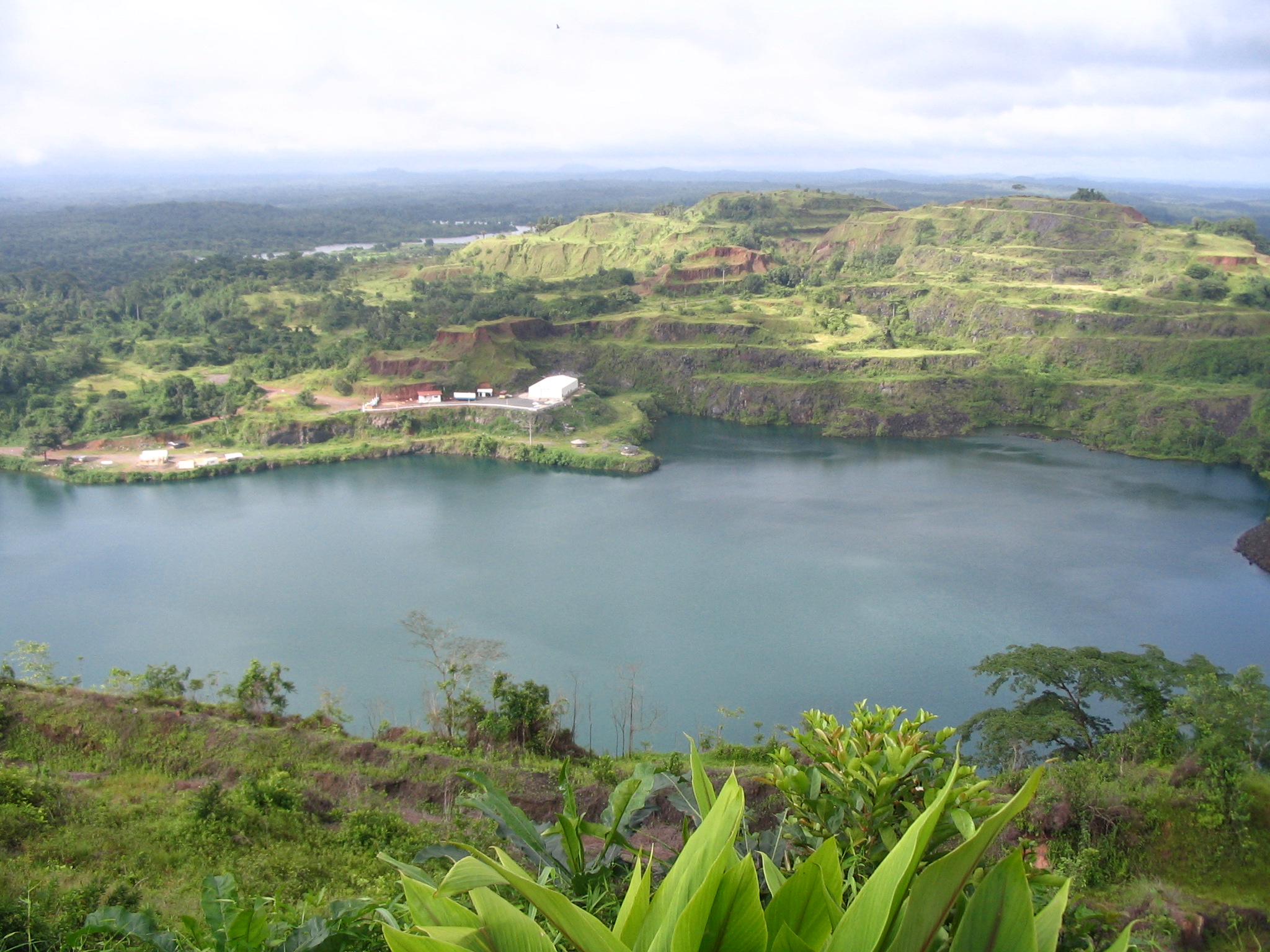
The Blue Lake at Tubmanburg is one of Liberia's most photogenic curiosities: a lake of almost unreal turquoise water, tucked away among the Bomi hills, an hour and a half from Monrovia. The surprising part is its origin, because it isn't a natural lake but the scar of an old iron mine that nature has taken back: when mining ended, the huge pit filled with water and the minerals in the ground tinted it the intense blue that gives it its name.
The result is an unexpected, striking landscape that is very popular with Liberians as a weekend getaway: families picnicking under the gazebos, grilling fish, swimming in the clear water and climbing the surrounding hills to look out over the forest and the rock formations. It is an intriguing stop on the way to the northwest of the country and one of the easiest day trips from the capital.
This guide tells you what to do at the Blue Lake, how to get there from Monrovia or Tubmanburg, what precautions to take when swimming in an old mining pit and how to combine it with the rest of the area. It is a simple destination, without much infrastructure, ideal for a day of nature, swimming and picnicking with a curious industrial history behind it.
The Blue Lake was born from a mine. In the Bomi hills, near Tubmanburg, the Liberia Mining Company ran an open-pit iron mine from the 1950s to the 1970s, when iron ore was the great engine of the Liberian economy. When the reserves ran out and the mine closed in the late 1970s, the deep pit was left below the water table and filled with groundwater, which the minerals in the ground tinted turquoise. And so the scar left by mining became a lake of rare beauty, now a tourist attraction. The full story is on our dedicated page.
Read the full history ↓The Atlantic corner of long waves and lagoons: Robertsport and its point breaks beneath coconut palms, Lake Piso and the old Vai land of Grand Cape Mount, birthplace of an African script.
Read the history of The surf coast and the northwest →No exact prices: a scale from $ (budget) to $$$$$ (luxury), with 2-3 options per category.
Origins, formation and what the sources say.
The story of Blue Lake is, at heart, the story of Liberian iron. The Bomi Hills, in the north-west of the country, held rich deposits of high-grade iron ore, one of the resources that would shape Liberia's economic development in the 20th century. Before mining arrived, the region was home to peoples such as the Gola and the Vai, who farmed and traded in the interior not far from the coast.
In the mid-20th century, when the world economy was hungry for iron and Liberia was looking to modernise under President William Tubman's 'Open Door' policy towards foreign investment, the Bomi Hills became a prime mining target. In the early 1950s, the Liberia Mining Company (LMC) started a large open-pit iron mine there, one of the country's first operations on an industrial scale.
The mine completely transformed the area. Tubmanburg, named in honour of President Tubman, grew up as a mining town, with its own infrastructure, its workers and an economy tied to iron. For decades, ore from the Bomi Hills was one of the pillars of Liberia's exports, which at one point made the country one of the largest iron producers in Africa.
Like every mine, the one in the Bomi Hills had a limited life. Open-pit mining dug ever deeper pits to reach the ore, leaving huge craters in the landscape. By the late 1970s, the area's iron reserves were considered exhausted or no longer viable, and the Liberia Mining Company shut down its operations, ending almost three decades of intensive mining.
Once the pumping and the work at the mine stopped, nature took its course. One of the large pits had been dug below the water table, so groundwater slowly seeped in and flooded it until it became a lake. The minerals in the ground and in the water, together with the particular conditions of the site, gave the water its intense turquoise colour.
That is how Blue Lake was born: not an ancient natural lake, but a mining scar reclaimed by water and turned, almost by accident, into a landscape of unexpected beauty. It is a fascinating example of how an abandoned industrial site can, over time, become a place for leisure and even a tourist attraction, while keeping for ever the sheer walls and the depth that come from its mining past.
Like almost all of Liberia, the Bomi region was deeply scarred by the civil wars of 1989 to 2003. Its strategic position in the north-west, on the route between Monrovia and the border with Sierra Leone, and its status as a mining area made it a battleground and a fiercely contested zone during the conflict, especially in the second civil war.
Tubmanburg suffered badly: the town was captured, fought over and damaged, its people endured displacement, hunger and violence, and economic activity ground to a halt. At some of the worst moments of the conflict, the Bomi area became sadly known for sieges and humanitarian crises. The mining and urban infrastructure, already hit by the closure of the mine, deteriorated even further.
With the arrival of peace in 2003 and the rebuilding of the country, Tubmanburg and Bomi County slowly began to recover. Life in the town returned to normal, and the region looked for new sources of income beyond the old mining industry, including making the most of its natural and unusual heritage, such as Blue Lake.
In post-war Liberia, Blue Lake went from industrial curiosity to tourist attraction. Being close to Monrovia, just an hour and a half by road, and having such a striking turquoise colour made it a very popular weekend getaway for Liberians, who come to swim, have picnics and grill fish under the gazebos by the water.
The local authorities in Bomi County have worked to prepare the site for tourism, with swimming areas, picnic shelters and lifeguards, and promote it as one of the country's accessible natural destinations. The contrast between its origin as a mining wound and its beauty today is part of its charm and its story, and it makes the lake a unique case among Liberia's tourist attractions.
Today, visiting Blue Lake means enjoying a beautiful and surprising landscape while also getting a glimpse of the history of Liberian iron, the mining boom of the mid-20th century and nature's ability to reclaim the places people leave behind. It is an unusual and refreshing stop on the way to north-west Liberia, with more history behind it than its calm turquoise surface suggests.