Viajá con Gus
Home › Fiji › Malolo Island and Cloud 9
Malolo Island and Cloud 9
🇫🇯 Fiji · Mamanuca and Yasawa Islands

Malolo Island and Cloud 9

🪪 What do I need to enter Fiji?Pick your citizenship and we tell you the visa, the days and the paperwork, with the official source.

By leaving your email and citizenship you agree to receive the documents you asked for and weekly travel news. You can unsubscribe whenever you want. How we handle your data.
Jump to what you need
📌State
Malolo is the largest island in the Mamanuca archipelago, about 25 km west of Nadi; it has two iTaukei villages (Yaro and Solevu) and several resorts. Cloud 9 is a two-storey floating platform anchored on Ro Ro reef, off Malolo
📌Best time to go
Dry season (May-October): sunshine, calm seas and the best surf season at Cloudbreak. The warm season (Nov-Apr) is more humid and carries a cyclone risk, but it is cheaper
📌Suggested days
Cloud 9 can be done as a day trip from Denarau or from a resort; for Malolo itself, 3 to 5 nights of beach, snorkelling and switching off
📌Getting there
By fast catamaran with South Sea Cruises or on the Malolo Cat from Port Denarau (20 min from Nadi); also by resort boat, seaplane or helicopter. Cloud 9 is reached by boat from Denarau (~45-60 min) or by speedboat from the resorts on Malolo/Malolo Lailai (10-15 min)
📌Getting around
Between islands, catamarans and resort boats; on Malolo you get around on foot or by kayak. There are no roads or public transport: it is an island. Cloud 9 can only be reached by boat
📌Language and currency
English and Fijian (iTaukei); Fijian dollar (FJD, FJ$). The resorts and Cloud 9 take cards; it is worth carrying some cash for tips, the village and small purchases
💱 FJD exchange rate
Loading rate…
🌤️ Weather in Malolo Island and Cloud 9
Loading weather…

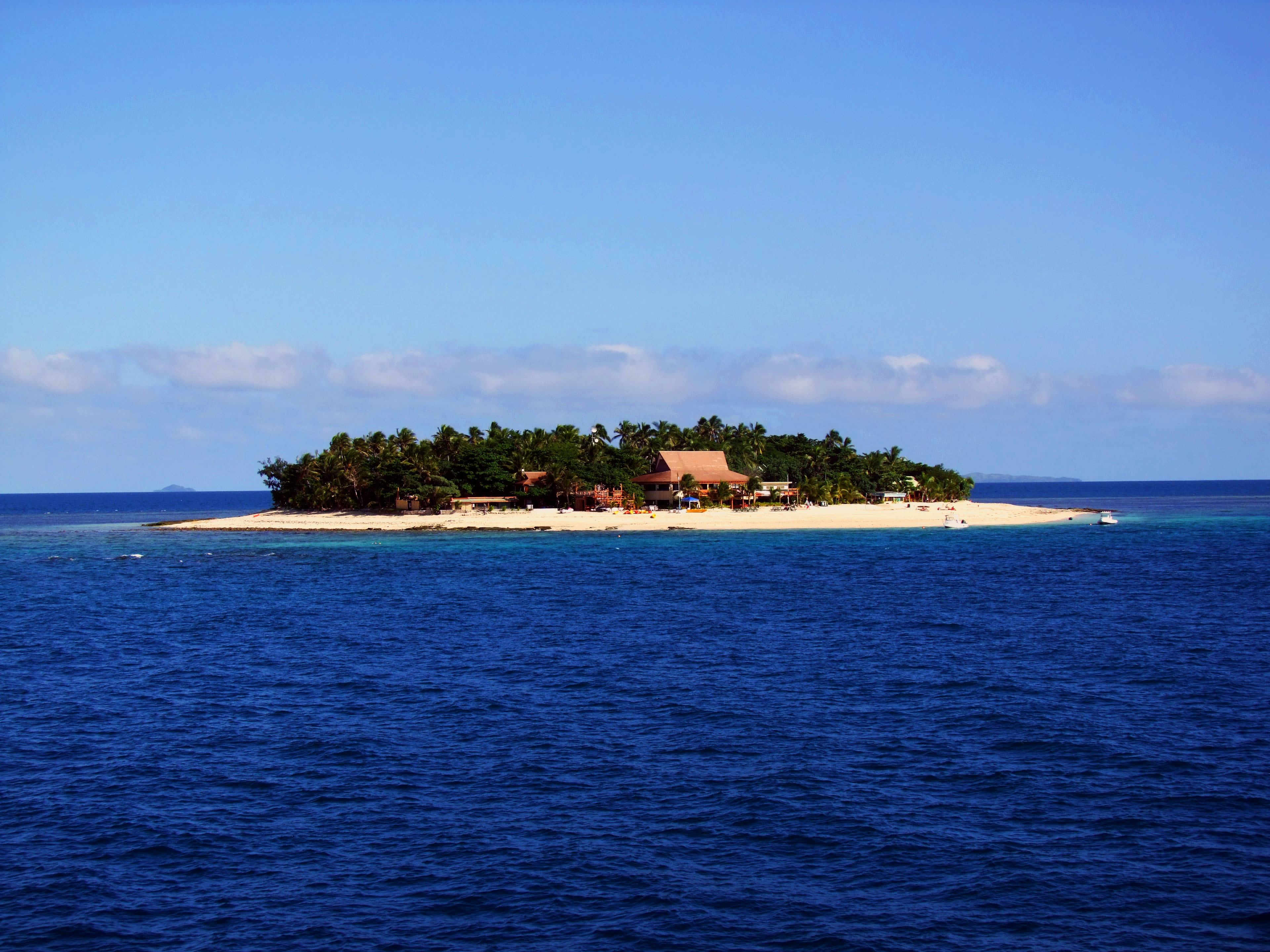
Malolo is the largest island in the Mamanuca group and one of the most complete in Fiji: white-sand beaches, a house reef, two iTaukei villages with centuries of history and a string of resorts ranging from overwater bungalows to luxury hideaways. It is just 25 km from Nadi, close enough to reach in under an hour and big enough to have a small mountain, walking trails and corners to get lost in.

Floating off its coast is the most Instagrammed outing in the country: Cloud 9, a two-storey platform anchored on Ro Ro reef, with a full bar, wood-fired pizzas and 360-degree views of the turquoise sea. You spend the day between snorkelling dips, cocktails, music and pizza, floating in the middle of the South Pacific. You get there by boat from Denarau or by speedboat from the resorts on Malolo and Malolo Lailai.

Malolo is also the gateway to the world-famous waves of the Mamanuca: Cloudbreak breaks over the Malolo barrier reef and is considered one of the best and most demanding waves on the planet. And its neighbouring island, Malolo Lailai, is home to classics such as Musket Cove and Plantation Island. Beach, culture, surf and an iconic floating bar: Malolo packs the best of Fiji a stone's throw from Nadi.

📖 History of Malolo Island and Cloud 9

Malolo is part of the traditional iTaukei vanua of the Mamanuca: its two villages, Yaro and Solevu - the latter the seat of the Paramount Chief of the Mamanuca - retain ancestral rights over the land and sea. In 1840, near here, the American expedition led by Charles Wilkes fought a bloody clash with islanders. Sparsely populated and used for fishing and gardens, Malolo opened up to tourism in the 20th century and today combines resorts, surf and the famous Cloud 9 floating bar. The full story is on the history page.

Read the full history ↓

🏛️ Malolo Island and Cloud 9 is in Mamanuca and Yasawa Islands

Fiji's postcard islands: two volcanic chains off the west coast of Viti Levu, with white sand and turquoise water. The Lapita people settled them three thousand years ago, and today they are home to resorts and snorkelling and were the setting for films such as Cast Away and The Blue Lagoon.

Read the history of Mamanuca and Yasawa Islands →

🗺️ What to see

Tours nearby, in Denarau

They depart from Denarau, 22 km away. If you book from this link we earn a commission and you pay no more.

1
Cloud 9, the floating bar on Ro Ro
The two-storey platform with pizza and cocktails in the middle of the sea
Leer más ↓
Cloud 9 is a two-level floating platform anchored on Ro Ro reef, in Vanua Malolo, with a full bar, a wood-fired pizza oven, sun loungers and 360-degree views. The plan is to spend the day snorkelling the surrounding reef, sipping cocktails, listening to music and eating freshly baked pizza on the water. You get there by boat from Port Denarau (45-60 min depending on the sea, passing Malolo and Castaway) or by a 10-15 min speedboat ride from resorts such as Plantation Island, Musket Cove or Lomani. It is one of the most famous outings in Fiji; booking online in advance is a good idea.
ℹ️ Day at Cloud 9 from Denarau ~FJ$229 per person (includes return transfer and FJ$60 food and drink credit); full-day private tour ~FJ$550 (source: Cloud 9 Fiji / operators, verified July 2026)
2
The villages of Yaro and Solevu
Living iTaukei culture on the island, home to the seat of the Paramount Chief of the Mamanuca
Leer más ↓
Malolo has two traditional villages: Yaro and Solevu. Solevu is also the residence of the Paramount Chief of the Mamanuca, which makes it a cultural centre for the archipelago. The resorts organise visits where the sevusevu (an offering of kava to the chief) is presented, you take part in a kava (yaqona) ceremony, watch weaving workshops and, on Sundays, hear the church singing. It is a genuine window into iTaukei life: dress with shoulders and knees covered, take off your hat and sunglasses when you enter and follow the village guide's instructions.
ℹ️ Village visit from the resort, with demonstrations and ceremony (free or donation / low cost); bring a bundle of kava for the sevusevu (~FJ$20-50) bought in Nadi (range; verified July 2026)
3
Surfing Cloudbreak and the Malolo barrier reef
One of the most famous and challenging waves in the world
Leer más ↓
Cloudbreak breaks over the Malolo barrier reef: a reef wave that rises at a bend in the reef, with the trade winds blowing offshore and a wall that peels for hundreds of metres. It is voted among the ten best and hardest waves on the planet and hosts international competitions. Restaurants, Namotu Left and Wilkes also break nearby. These are waves for experienced surfers, reached by boat from Malolo, Malolo Lailai, Namotu or Tavarua. Even if you don't surf, watching the pros at Cloudbreak is a spectacle. Peak season runs from April to October.
ℹ️ Boat transfer to the breaks from ~FJ$50-120 per person depending on resort and distance (range; Malolo/Malolo Lailai surf operators, verified July 2026)
4
Snorkelling and diving on the house reef
Corals, turtles and colourful fish a few metres from the beach
Leer más ↓
Malolo and its lagoon are an excellent snorkelling and diving destination. Several resorts have a house reef you can walk into from the beach, with hard and soft corals, turtles, rays and schools of fish. The Malolo barrier reef also hides walls, wrecks and swim-throughs for diving. There are PADI centres on the islands offering try dives and courses. The warm water and good visibility in the dry season make it ideal for beginners, and the proximity to Nadi makes day trips easy.
ℹ️ House-reef snorkelling free at most resorts; guided boat trip ~FJ$60-120; try dive ~FJ$250-350 (range; Mamanuca PADI centres, verified July 2026)
5
Malolo beaches and resorts for every style
From overwater bungalows to adults-only hideaways
Leer más ↓
The island is home to some of the best accommodation in Fiji. Likuliku Lagoon Resort has the country's only overwater bungalows and is adults-only; Six Senses Fiji is a sustainable luxury resort with private-pool villas, linked to the village of Solevu; Malolo Island Resort is ideal for families and Tropica Island Resort is an adults-only boutique. All share white-sand beaches, reef and postcard sunsets. Choosing the resort to suit your profile (family, couple, luxury) is the key to enjoying Malolo.
ℹ️ Catamaran transfers from ~FJ$152 per adult/leg (South Sea Cruises); accommodation from mid-range up to FJ$2000+/night at Likuliku or Six Senses (source: Malolo Island Resort / South Sea Cruises, verified July 2026)
6
Getaway to Malolo Lailai: Musket Cove and Plantation Island
The neighbouring island with a marina, golf and Mamanuca classics
Leer más ↓
Right next to Malolo is Malolo Lailai (Malololailai), a flatter island with a marina, an airstrip and two classics: Musket Cove Island Resort & Marina (a base for sailors and surfers, with its famous Island Bar) and Plantation Island Resort (large and family-friendly). It is one of the best starting points for Cloudbreak and for Cloud 9, which is a few minutes away by speedboat. You get there in 50 minutes on the Malolo Cat or South Sea Cruises from Port Denarau, or by light aircraft to the Malolo Lailai airstrip.
ℹ️ Malolo Cat or South Sea Cruises Denarau → Malolo Lailai ~50 min, from ~FJ$152 per adult/leg (source: Malolo Cat / South Sea Cruises, verified July 2026)
📶I have never landed without internet. I arrive and my phone connects to the strongest network in the country I am visiting: I can say I landed, sort out transport, book tours and keep posting, at a seriously good price. I always use the Maya eSIM — check their plans by clicking the banner.See plans →Maya Mobile eSIM — turn travel mode on
What nobody tells you

💵 Prices

Tickets

TypePrice
Cloud 9 (bar flotante), día completo desde Denarau~FJ$229 per person (transfer + FJ$60 food and drink credit) (source: Cloud 9 Fiji, verified July 2026)
Cloud 9, tour privado día completo~FJ$550 (skipper, boat and soft drinks) (source: transfer operators, verified July 2026)
Traslado en catamarán Denarau → Malolo (South Sea Cruises)From ~FJ$152 per adult/leg (+FJ$20 fuel surcharge) (source: Malolo Island Resort / South Sea Cruises, verified July 2026)
Bautismo de buceo (discover scuba)~FJ$250-350 (range; Mamanuca PADI centres, verified July 2026)
🔄 updated monthlyOfficial / reference values · double-check when buying

Activities and tours

ActivityPriceDurationOperator
Day at Cloud 9 (floating bar)~FJ$229 per person (source: Cloud 9 Fiji, verified July 2026)
Transfer to the surf breaks (Cloudbreak, etc.)~FJ$50-120 per person (range; surf operators, verified July 2026)
Guided snorkelling on the Malolo barrier reef~FJ$60-120 per person (range; Malolo resorts, verified July 2026)
Visit to the villages of Yaro or Solevu with kavaFree/donation or low cost; bundle of kava ~FJ$20-50 (range; verified July 2026)
Helicopter transfer Denarau → Malolo~FJ$865 per person one way / ~FJ$1570 return (source: Malolo Island Resort transfers, verified July 2026)
🔄 updated monthlyOfficial / reference values · double-check when buying

🚌 How to get there and distances

Getting around

ModePriceDurationNotes
South Sea Cruises catamaran (Denarau → Malolo)From ~FJ$152 per adult/leg; child 2-15 ~FJ$99 (+ fuel surcharge FJ$20/adult)
Malolo Cat (Denarau → Malolo Lailai)Fare per leg (includes Nadi/hotels ↔ Denarau shuttle)
Speedboat to Cloud 9 / seaplane / helicopterCloud 9 day ~FJ$229; helicopter ~FJ$865 pp one way
On foot / kayak on the islandFree or included at the resort
🔄 updated monthlyOfficial / reference values · double-check when buying

How to get there

RouteAirlines / operatorsAvg. priceDuration
Nadi Airport → Port Denarau MarinaTaxi, hotel transfer, Malolo Cat shuttleTaxi ~FJ$25-40; shuttle included with some tickets~20-25 min (12 km)
Port Denarau → Malolo IslandSouth Sea Cruises, Malolo CatFrom ~FJ$152 per adult/leg50 min direct to 2 h with stops
Port Denarau → Cloud 9 (day)Cloud 9 Fiji / transfer operators~FJ$229 per person (full day)~45-60 min by boat
Nadi/Denarau → Malolo by airTurtle Airways (seaplane), Island Hoppers (helicopter)~FJ$865 per person (helicopter, one way)10-15 min flight
🔄 updated monthlyOfficial / reference values · double-check when buying

🏨 Where to stay

No exact prices: a scale from $ (budget) to $$$$$ (luxury), with 2-3 options per category.

Luxury
Price$$$$$
Recommended options
Likuliku Lagoon Resort (Fiji's only overwater bungalows, adults-only), Six Senses Fiji (private-pool villas); approx. FJ$1500-3500+/night
Mid-range
Price$$$$$
Recommended options
Malolo Island Resort (family-friendly), Tropica Island Resort (adults-only), Plantation Island and Musket Cove (on Malolo Lailai); approx. FJ$400-1000/night
Budget
Price$$$$$
Recommended options
Simpler options and dorms at neighbouring Mamanuca resorts (Funky Fish, Ratu Kini on Mana); from ~FJ$100-200/night

🍴 Where to eat

TypePriceOptions / signature dish
Alta cocina de resort (frente al mar)$$$$$Restaurants at Likuliku and Six Senses; menus ~FJ$60-120 per dish, often included in the resort meal plan
Restaurante de isla-resort casual$$$$$Restaurants at Malolo Island Resort, Tropica, Plantation; buffets and à la carte ~FJ$25-55
Bar flotante y comida de isla$$$$$Cloud 9 (wood-fired pizzas ~FJ$30-45 and cocktails), Musket Cove's Island Bar; beach kiosks

📖 History of Malolo Island and Cloud 9

Origins, formation and what the sources say.

1840: the battle that put Malolo on the map

Today Malolo is synonymous with floating pizza and overwater bungalows, but in July 1840 it was the scene of one of the bloodiest episodes in the contact between Fiji and the West. That year the United States Exploring Expedition reached the Mamanuca. It was the great American scientific expedition, commanded by Lieutenant Charles Wilkes and tasked with charting the Pacific. During a negotiation for food in the village of Sualib, on Malolo, something went badly wrong. The local chief's son, held as a hostage, jumped from the boat and escaped, and the Americans opened fire. In the skirmish Lieutenant Joseph Underwood and Midshipman Wilkes Henry, the commander's own nephew, were killed, along with several islanders.

The revenge was brutal. The next day, Wilkes launched a punitive attack that razed the villages of Sualib and Arro and much of the surrounding area. According to an account from an elder of Malolo recorded some time later, around eighty Fijians died. The episode, known as the Battle or the Massacre of Malolo, ended with Wilkes accused of illegally attacking the natives. That charting work even left its mark on the names of the waves: the Wilkes break, near Cloudbreak, recalls the commander.

That clash was not the beginning of Malolo's story, just one violent moment on an island that had already been inhabited for millennia. To understand why there were villages, chiefs and hostages there, you have to go much further back.

Lapita, vanua and the villages of Malolo

Like the rest of the Fijian archipelago, Malolo and the Mamanuca were settled more than 3,000 years ago by seafarers of the Lapita culture. They crossed the Pacific in double-hulled canoes, bringing pigs, crop plants and their unmistakable stamped pottery. Skilled growers and formidable sailors, they settled in the sheltered bays, farmed the slopes and turned the reefs into a larder. From the Lapita roots and later Melanesian waves came iTaukei society, the Indigenous Fijians.

On Malolo, that heritage lives on in two villages: Yaro and Solevu. Life is organised around the vanua, the inseparable union of land, people, ancestors and spiritual identity. It also revolves around the mataqali, the clans that inherit collective rights over land and sea. Solevu carries special weight as the residence of the Paramount Chief of the Mamanuca, which makes Malolo a centre of traditional authority in the archipelago. That structure explains why, even today, the land is communally owned. It also explains the sevusevu, the ritual offering of kava (yaqona) to the chief that is still made before entering a village.

For centuries, life in the Mamanuca meant fishing, yam and taro gardens, and wars and alliances between chiefdoms. The great Fijian canoes sailed these waters long before the first tourist catamaran appeared. The islands are small and short of fresh water, so they were never heavily populated, but they were firmly part of the iTaukei political and spiritual world of western Viti Levu.

Cakobau, the cession and colonial Fiji

While Malolo went about its village routine, a struggle for power in the heart of Fiji would end up changing everything. In the 19th century, the chief Seru Epenisa Cakobau, from the island of Bau, took advantage of the arrival of muskets, whalers and sandalwood and bêche-de-mer traders. He extended his influence until he proclaimed himself Tui Viti, 'king of Fiji'. But debts to foreign powers, above all an old American claim, backed him into a corner.

On 10 October 1874, in Levuka, Cakobau, the Tongan chief Ma'afu and other chiefs signed the Deed of Cession that handed Fiji to Queen Victoria. This created the Colony of Fiji, which stayed British for 96 years. The first governor, Arthur Gordon, banned the sale of native land. That froze the iTaukei communal ownership that today covers almost the whole country, Malolo included. From 1879 he also brought in tens of thousands of indentured labourers from India for the sugar cane plantations, the origin of the large Indo-Fijian community.

For outlying islands like Malolo, the cession mostly meant continuity. With no plantations or ports, they remained iTaukei villages under indirect colonial rule, which left a lot of power in the hands of the chiefs. Fiji became independent from the United Kingdom on 10 October 1970, exactly 96 years after the cession, and later declared itself a republic. National politics were turbulent, with several coups (1987, 2000, 2006) shaped by tensions between the iTaukei and Indo-Fijian communities.

From barrier reef to floating bar

The Mamanuca were among the first parts of Fiji to open up to tourism, long before the remote Yasawa. Lying just 25 km across the water from Nadi, they became the natural playground for travellers arriving at the international airport. From the mid-20th century, resorts were built on islands such as Malolo Lailai, Malolo's flat neighbour. Classics like Plantation Island and Musket Cove started there; Musket Cove was founded by New Zealander Dick Smith and is famous for its marina and sailing culture. Malolo itself gained several resorts over the years. There's the family-friendly Malolo Island Resort and the boutique Tropica. There's also the exclusive Likuliku Lagoon Resort, which has Fiji's only overwater bungalows. Most recently came the luxurious and sustainable Six Senses Fiji, linked to the village of Solevu.

The reef around Malolo also made the area world-famous for another reason: surfing. Cloudbreak breaks on the barrier reef and has been voted one of the best and toughest waves on the planet. Nearby are Restaurants, Namotu Left and the Wilkes break mentioned earlier. Since the 80s and 90s, surfers from all over the world have made the pilgrimage to these waters, and Cloudbreak went on to host the world professional tour.

The most recent chapter literally floats on the sea. Cloud 9 is anchored on the Ro Ro reef, off Malolo. It is a two-storey platform with a bar, a wood-fired pizza oven and 360-degree views. It has become one of Fiji's tourist icons and a photo machine for social media. It's the latest twist for an island that went from Lapita pottery and chiefly wars to cocktails and pizza in the middle of the Pacific. Behind the postcard, the villages of Yaro and Solevu are still there, along with the vanua and the Paramount Chief of the Mamanuca. The best way to honour that long and sometimes painful history is to explore Malolo with respect: ask permission before entering the villages, look after the reef and support the communities.

📚 Bibliography

  • Battle of Malolo — Wikipedia — https://en.wikipedia.org/wiki/Battle_of_Malolo
  • United States Exploring Expedition — Wikipedia — https://en.wikipedia.org/wiki/United_States_Exploring_Expedition
  • Malolo — Wikipedia — https://en.wikipedia.org/wiki/Malolo
  • History of Fiji — Wikipedia — https://en.wikipedia.org/wiki/History_of_Fiji
  • Fiji: Melanesian, Colonialism, Independence — Encyclopaedia Britannica — https://www.britannica.com/place/Fiji-republic-Pacific-Ocean/History
  • Cession to Britain, 1874: The Birth of Colonial Fiji — Indo-Fijian Heritage — https://indofijian.org/heritage/cession-to-britain-1874-the-birth-of-colonial-fiji/
  • Six Senses Fiji, Malolo Island — Six Senses — https://www.sixsenses.com/en/hotels-resorts/asia-the-pacific/fiji/fiji/
  • Surfing in the Mamanuca Islands: Top Waves — Fiji Journal — https://www.fijijournal.com/fiji/places/mamanuca/surfing/
  • Cloud 9 Fiji — Floating Bar Day Trip — Plantation Island Resort — https://www.plantationisland.com/activity/cloud-9/
  • Fijian traditions and ceremonies — Wikipedia — https://en.wikipedia.org/wiki/Fijian_traditions_and_ceremonies
  • A Traveller's Guide to Drinking Kava in Fiji — Tourism Fiji — https://www.fiji.travel/things-to-do/arts/a-travellers-guide-to-drinking-kava-in-fiji

❓ Frequently asked questions

What is Cloud 9 and how much does it cost to go?+
Cloud 9 is a two-storey floating platform anchored on Ro Ro reef, off Malolo, with a bar, wood-fired pizzas and snorkelling all around. A full day from Port Denarau costs ~FJ$229 per person and includes the boat transfer (45-60 min) and FJ$60 food and drink credit; there are also private tours (~FJ$550). If you are staying at Plantation, Musket Cove or Lomani, you get there by speedboat in 10-15 minutes (verified July 2026).
How do I get to Malolo Island?+
By fast catamaran with South Sea Cruises or on the Malolo Cat from Port Denarau (20 min from Nadi). The trip takes from 50 min direct to 2 h with stops, from ~FJ$152 per adult per leg. There are also resort boats, seaplanes (Turtle Airways) and helicopters (~FJ$865 pp one way). Malolo is an island: there are no rental cars or public transport.
Can you visit Cloud 9 as a day trip from Nadi?+
Yes, it is the most popular day trip in the area. Transfers leave Port Denarau and drop you at the platform in 45-60 min, where you spend the day snorkelling, eating pizza and drinking cocktails, and head back in the afternoon (~FJ$229 per person with food and drink credit included). You don't need to stay on the islands to do it.
Can you surf Cloudbreak from Malolo?+
Yes. Cloudbreak breaks over the Malolo barrier reef and is one of the best waves in the world, but it is a reef break for experienced surfers. You reach it by boat (~FJ$50-120 per person) from Malolo, Malolo Lailai (Musket Cove, Plantation), Namotu or Tavarua. Peak season runs from April to October. Even if you don't surf, watching it is a spectacle.
When is the best time for Malolo and Cloud 9?+
The dry season, from May to October: sunshine, calm seas, good visibility for snorkelling and the best surf season at Cloudbreak. The warm season (November to April) is more humid, with more rain and a cyclone risk, although prices are often better. Cloud 9 operates year-round depending on the weather; in very rough seas it may be cancelled.

More places in Fiji

Islas MamanucaIslas YasawaKadavuLevukaMeridiano 180 (Taveuni)Nadi
See every place in Fiji →The history of Fiji →
Sources consulted (11)
Still planning?
Explore more destinations in Fiji
See all destinations →