Viajá con Gus
Home › Fiji › Mamanuca Islands
Mamanuca Islands
🇫🇯 Fiji · Mamanuca and Yasawa Islands

Mamanuca Islands

🪪 What do I need to enter Fiji?Pick your citizenship and we tell you the visa, the days and the paperwork, with the official source.

By leaving your email and citizenship you agree to receive the documents you asked for and weekly travel news. You can unsubscribe whenever you want. How we handle your data.
Jump to what you need
📌State
Archipelago of some 20 volcanic and coral islands off the west coast of Viti Levu, between Nadi/Denarau and the Yasawas
📌Best time to go
Dry season (May-October): sunny days, calm seas and less rain. The warm season (Nov-Apr) is wetter and carries a cyclone risk, but it's also cheaper
📌Suggested days
1 day if you're doing a day trip from Denarau; 3 to 5 nights if you're staying on a resort island to switch off
📌Getting there
From Port Denarau Marina (~20 min from Nadi) on a South Sea Cruises fast catamaran or the Awesome Adventures Yasawa Flyer; also by seaplane or speedboat to the more distant islands
📌Getting around
Between islands, South Sea Cruises catamarans and resort boats; on each little island you get around on foot or by kayak. There's no public transport: these are small islands
📌Language and currency
English and Fijian (iTaukei); Fijian dollar (FJD, FJ$). Resorts take cards; it's worth carrying some cash for tips and small purchases
💱 FJD exchange rate
Loading rate…
🌤️ Weather in Mamanuca Islands
Loading weather…

The Mamanuca Islands are Fiji's instant postcard: a string of small volcanic and coral islands with dazzling white sand and turquoise water, scattered off the west coast of Viti Levu. They're so close to Nadi and Denarau that you can visit them in a day, but they're so beautiful that most people stay the night at one of their resorts, from backpacker hostels to luxury hideaways on the reef.

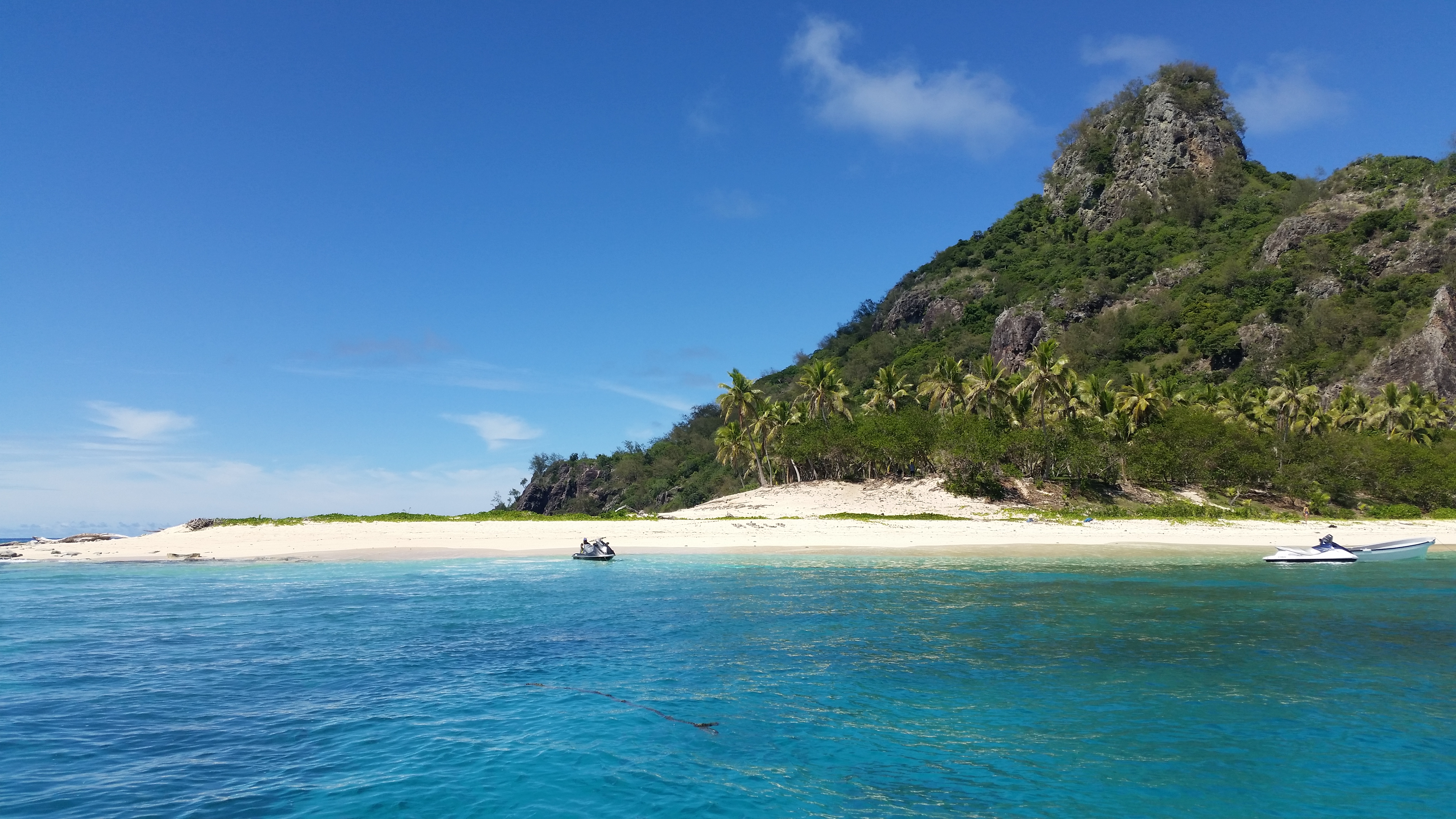
This archipelago is Fiji's water playground: snorkelling over coral gardens, diving, surfing world-famous waves like Cloudbreak, kayaking and whole days in a hammock. It's also movie territory: the uninhabited island of Monuriki (or 'Modriki') was the beach where Tom Hanks survived in Cast Away, and today it's one of the most requested excursions.

The big advantage of the Mamanucas is how close and varied they are. From Port Denarau Marina, fast catamarans leave several times a day for around twenty destinations: family islands with water slides, party islands for young travellers, romantic hideaways with overwater bungalows. It's textbook Fiji, easy to reach and perfect for a first taste of the South Pacific, whether for a day or a week.

📖 History of Mamanuca Islands

The Mamanucas are volcanic and coral islands that form part of the traditional iTaukei vanua of Viti Levu's west coast; the villages on the mainland and on islands such as Yanuya hold ancestral rights (qoliqoli) over these waters and are the custodians of islets like Monuriki. Sparsely populated and historically used for fishing and gardens, they opened up to tourism in the mid-20th century and shot to worldwide fame with films such as Cast Away (2000). The full story -from Lapita settlement to movie islands- is on the history page.

Read the full history ↓

🏛️ Mamanuca Islands is in Mamanuca and Yasawa Islands

Fiji's postcard islands: two volcanic chains off the west coast of Viti Levu, with white sand and turquoise water. The Lapita people settled them three thousand years ago, and today they are home to resorts and snorkelling and were the setting for films such as Cast Away and The Blue Lagoon.

Read the history of Mamanuca and Yasawa Islands →

🗺️ What to see

Tours nearby, in Denarau

They depart from Denarau, 32 km away. If you book from this link we earn a commission and you pay no more.

1
Monuriki, the Cast Away island
The uninhabited islet where Tom Hanks survived in the film
Leer más ↓
Monuriki -popularly called 'Modriki' or 'Cast Away Island'- is an uninhabited volcanic islet just over a kilometre long, ringed by reef, where much of Cast Away with Tom Hanks was filmed in 2000. Today it's a star excursion: you get there by catamaran or boat from Denarau or from nearby resorts, walk its white-sand beach, snorkel the reef and take the classic photo. It's looked after by the village of Yanuya, which helped restore its vegetation and its iguana population. There are no facilities: it's pure nature.
ℹ️ Day trips to Monuriki from Denarau/Mamanuca approx. FJ$150-250 per person with snorkelling and lunch (range; local operators, verified July 2026)
2
South Sea Island and the day-trip islands
Nearby islets that are ideal for a day out
Leer más ↓
Several of the Mamanuca islands are designed to be visited in a day from Denarau. South Sea Island is a speck of sand 30-40 min away by catamaran, with a shallow lagoon perfect for splashing about, snorkelling, kayaking, an inflatable slide and a buffet lunch. Other day options are Bounty Island, Treasure Island or Beachcomber. South Sea Cruises runs the Mamanuca Island Explorer catamaran, which combines several stops. It's the easiest and cheapest way to try a Fijian island without staying the night.
ℹ️ A day on South Sea Island with South Sea Cruises: Full Day Pass FJ$255 per adult and FJ$135 per child aged 5 to 15; half day FJ$225 and FJ$125; under-4s free (South Sea Cruises, rate 01/04/2026-31/03/2027, checked 08/08/2026)
3
Snorkelling and diving on the reefs
Coral gardens, turtles and colourful fish in calm water
Leer más ↓
The Mamanucas are a snorkelling and diving paradise. Many resorts have a house reef you can walk into straight from the beach; boats also head out to shoals such as those at Malolo, Mana or Namotu. You'll see hard and soft corals, turtles, rays, whitetip reef sharks and schools of fish. The visibility and warm water are ideal for beginners. There are PADI dive centres on the larger islands (Mana, Malolo, Plantation) offering try dives and courses.
ℹ️ House-reef snorkelling free at most resorts; guided boat trip ~FJ$60-120; try dive ~FJ$250-350 (range; island PADI centres, verified July 2026)
4
Surfing Cloudbreak and the world-class waves
One of the best breaks on the planet, off Namotu and Tavarua
Leer más ↓
Off the Mamanucas, on the Malolo Barrier Reef, breaks Cloudbreak, considered one of the best and most dangerous waves in the world and host to international competitions. Next to it are Restaurants, Namotu Left, Wilkes and others. These are reef waves for experienced surfers, reached by boat from islands such as Namotu, Tavarua or Malolo. Even if you don't surf, watching the pros at Cloudbreak is a spectacle. The peak season runs from April to October.
ℹ️ Boat transfer to the surf breaks from ~FJ$50-100 per person; surf stays on Namotu/Tavarua are premium packages (range; local operators, verified July 2026)
5
Resort islands for every style
From backpacker hostel to luxury overwater bungalow
Leer más ↓
The great charm of the Mamanucas is that there's an island for every traveller. Mana Island and Malolo have family and mid-range resorts; Beachcomber is the classic party island for young travellers; Matamanoa, Tokoriki, Likuliku Lagoon (with Fiji's only overwater bungalows) and Vomo are luxury hideaways, some adults-only. Almost all can be reached by catamaran from Denarau in 45 min to 1.5 h. Picking the right island for your profile (family, couple, backpacker) is key to enjoying them.
ℹ️ Catamaran transfers ~FJ$80-160 per leg depending on the island; accommodation from ~FJ$100 (dorm) up to FJ$2000+/night (luxury) (range; South Sea Cruises and resorts, verified July 2026)
6
Cloud 9 and floating-bar days
The iconic floating bar on the Ro Ro reef
Leer más ↓
Right on the Mamanuca reef floats Cloud 9, a two-storey platform with a bar, wood-fired pizzas, sun loungers and music, surrounded by turquoise water for snorkelling. You get there by boat from Denarau (about 45-60 min) or from resorts such as Malolo, Castaway or Plantation. It's one of the most famous things to do in Fiji: spending the day between dips, cocktails and pizza over the sea. (It has its own detailed page: Malolo Island and Cloud 9).
ℹ️ A day at Cloud 9 from Denarau ~FJ$229 per person (includes transfer and FJ$60 food and drink credit) (source: Cloud 9 Fiji, verified July 2026)
📶I have never landed without internet. I arrive and my phone connects to the strongest network in the country I am visiting: I can say I landed, sort out transport, book tours and keep posting, at a seriously good price. I always use the Maya eSIM — check their plans by clicking the banner.See plans →Maya Mobile eSIM — turn travel mode on
What nobody tells you

💵 Prices

Tickets

TypePrice
Excursión de día a Monuriki (isla Náufrago)FJ$150-250 per person (range; local operators, verified July 2026)
Día en South Sea Island (South Sea Cruises)Full Day Pass FJ$255 per adult, FJ$135 per child aged 5 to 15 (family pass FJ$719 for 2+2 and FJ$849 for 2+3); half day FJ$225 and FJ$125; under-4s free. Prices include taxes; paying by card adds a non-refundable 2.5-3% (South Sea Cruises, rate valid from 01/04/2026 to 31/03/2027, checked 08/08/2026)
Cloud 9 (bar flotante), día completo~FJ$229 per person (source: Cloud 9 Fiji, verified July 2026)
Bautismo de buceo (discover scuba)~FJ$250-350 (range; island PADI centres, verified July 2026)
🔄 updated monthlyOfficial / reference values · double-check when buying

Activities and tours

ActivityPriceDurationOperator
Mamanuca Island Explorer day cruise (South Sea Cruises)~FJ$150-220 per person (range; South Sea Cruises, verified July 2026)
Guided snorkelling on the barrier reef~FJ$60-120 per person (range; island resorts, verified July 2026)
Monuriki (Cast Away) excursion with snorkelling~FJ$150-250 per person (range; local operators, verified July 2026)
Transfer to the surf breaks (Cloudbreak, etc.)~FJ$50-100 per person (range; surf operators, verified July 2026)
Scenic seaplane flight over the islands~FJ$300-500 per person (range; Turtle Airways/Pacific Island Air, verified July 2026)
🔄 updated monthlyOfficial / reference values · double-check when buying

🚌 How to get there and distances

Getting around

ModePriceDurationNotes
Fast catamaran (South Sea Cruises)~FJ$80-160 per leg depending on the island
Yasawa Flyer (Awesome Adventures)Short legs to the Mamanucas from ~FJ$55-75 (one way)
Speedboat / seaplane to distant islandsSpeedboat from ~FJ$100; seaplane ~FJ$300+
On foot / kayak on the islandFree or included at the resort
🔄 updated monthlyOfficial / reference values · double-check when buying

How to get there

RouteAirlines / operatorsAvg. priceDuration
Nadi Airport → Port Denarau MarinaTaxi, hotel transfer, busTaxi ~FJ$25-40; shared transfer cheaper~20-25 min (12 km)
Port Denarau → Mamanuca IslandsSouth Sea Cruises, Awesome Adventures (Yasawa Flyer)~FJ$80-160 per leg depending on the island45 min to 1.5 h
Nadi/Denarau → islands by airTurtle Airways (seaplane), Pacific Island Air (helicopter)~FJ$300-600 per person10-20 min flight
Denarau → Monuriki (full day)Excursion operators (catamaran/boat)~FJ$150-250 per person~1-1.5 h by boat
🔄 updated monthlyOfficial / reference values · double-check when buying

🏨 Where to stay

No exact prices: a scale from $ (budget) to $$$$$ (luxury), with 2-3 options per category.

Luxury
Price$$$$$
Recommended options
Likuliku Lagoon Resort (overwater bungalows), Tokoriki Island Resort, Matamanoa, Vomo Island; approx. FJ$1200-2800+/night
Mid-range
Price$$$$$
Recommended options
Mana Island Resort, Malolo Island Resort, Plantation Island, Castaway Island; approx. FJ$400-900/night
Budget
Price$$$$$
Recommended options
Beachcomber Island Resort, Bounty Island, South Sea Island, Ratu Kini (Mana); dorm from ~FJ$90-180/night

🍴 Where to eat

TypePriceOptions / signature dish
Alta cocina de resort (frente al mar)$$$$$Dining rooms at Likuliku, Tokoriki, Vomo; menus ~FJ$60-120 per dish
Restaurantes de isla-resort casual$$$$$Buffets and à la carte at Mana, Malolo, Plantation; ~FJ$25-55
Bares y comida rápida de isla$$$$$Beachcomber bar, Cloud 9 (pizzas), day-island kiosks; pizza ~FJ$30-45

📖 History of Mamanuca Islands

Origins, formation and what the sources say.

Islands of fire and coral

Long before they became the perfect backdrop for a thousand honeymoon photos, the Mamanucas were the work of fire. This archipelago of about twenty islands off the west coast of Viti Levu was born from the volcanic activity that raised much of Fiji millions of years ago. On those cones and ridges, coral slowly built barrier reefs that today enclose shallow turquoise lagoons. Some islands, like the rugged Monuriki, still show their volcanic origin in their dark rock. Others are little more than banks of sand and coral topped with coconut palms.

The name 'Mamanuca' comes from the Fijian language and the traditional geography of the area: these are the 'outer' islands, in sight of the mainland but separated from it by the sea. For centuries they were part of the iTaukei world of the west coast and belonged to the vanua system (the web of land, kinship and chiefly authority) of the villages of Viti Levu and of larger islands such as Malolo. Communities on the coast and on inhabited islands such as Yanuya held ancestral fishing rights over these waters, known as qoliqoli. Inherited rules set who could fish a particular reef or gather shellfish on a particular shoal.

The first Fijians had reached the archipelago thousands of years earlier. They descended from the Lapita seafarers who settled the western Pacific some 3,000 years ago, bringing their decorated pottery, pigs and taro, along with an extraordinary command of the canoe and the stars. To them, islands like the Mamanucas were not exotic destinations but a larder and a road: places to fish and to gather turtle and shell, and stopovers on the sea routes that linked the Fijian world.

Malolo, the seafarers and the shadow of war

Malolo, the largest of the Mamanucas, and its neighbours played a part in the turbulent history of 19th-century Fiji. It was an era of wars between chiefly confederacies, of trade with European and American ships in sandalwood and bêche-de-mer (sea cucumber), and of growing tensions. The western islands saw whalers, traders and explorers come and go.

In 1840, the United States Exploring Expedition under Lieutenant Charles Wilkes stopped in the Mamanucas. On the island of Malolo, two American officers were killed in a clash with the islanders, and the incident set off a brutal reprisal: Wilkes's men attacked the villages of Malolo and killed many people. Remembered as the 'Battle of Malolo', the episode left a bitter mark. It shows how deeply these picture-postcard islands were scarred by the violence of colonial contact.

Like the rest of Fiji, the Mamanucas came under British rule after the 1874 cession, when the paramount chief Cakobau and other leaders handed the archipelago over to Queen Victoria. Under colonial rule, iTaukei land, including most of these islands, was protected as the inalienable communal property of the mataqali. That principle still defines who owns what in Fiji today. While the interior of Viti Levu filled with sugar cane plantations worked by Indian girmitiyas, the Mamanucas remained a world of fishing, coconut palms and villages, far from the bustle.

The islands Hollywood discovered

The Mamanucas began to take shape as a tourist destination in the mid-20th century. Their closeness to Nadi, home of the big international airport, made them the obvious getaway for the first travellers to the South Pacific. Beachcomber, one of the pioneers, became famous as a 'party island', and little by little, island after island, resorts sprang up for every budget.

But what fixed the Mamanucas in the global imagination was film. Their impossibly white beaches and unreal turquoise water were perfect for playing the deserted paradise. The breakthrough came in 2000 with Cast Away: small, uninhabited Monuriki, which almost everyone calls 'Modriki', was the island where Tom Hanks's character survived alone for years, talking to a volleyball. After the film came out, Monuriki became a place of tourist pilgrimage. The village of Yanuya, its traditional custodian, later led projects to restore the island's vegetation and its population of endangered Fijian crested iguanas.

Monuriki was not the only star. Other islands in the area served as locations for films and advertisements, and the whole region was sold as 'postcard Fiji'. That power of image (turquoise sea, leaning palm, white sand) transformed the local economy. The iTaukei villages, which own the land and the qoliqoli, partnered with tour operators and contributed labour, culture and reef protection. The Mamanucas went from fishing islands to the country's most accessible tourism engine.

The Mamanucas today: between tourism and the reef

Today, for millions of people, the Mamanucas are the gateway to Fiji. Their closeness to Nadi and Denarau, the range of resorts (from backpacker dorms to Likuliku's luxury overwater bungalows) and the easy catamaran trip have made them the most visited archipelago in the country. Every day, dozens of boats leave Port Denarau for South Sea Island, Mana, Malolo, Castaway or Cloud 9, the floating bar that became a social media sensation.

Behind the postcard, though, the vanua and the sea still rule. Most of the islands are communal iTaukei land. The resorts operate on leases over land that belongs to the mataqali, and the villages, on the islands or on the nearby mainland, own the waters where tourists snorkel. Many projects combine tourism with protection: reef reserves, the restoration of Monuriki, and care for world-famous surf breaks such as Cloudbreak. Access to Cloudbreak even became the subject of a legal dispute over who may use the reef.

That balance is the great modern challenge of the Mamanucas: showing paradise without destroying it, and earning from tourism without losing the land or the culture. Coral, threatened by bleaching and warming seas, is both the natural capital and the whole reason for the destination. Anyone sailing between these white-sand islands today sees the result of a long history. A volcanic archipelago was settled by Lapita seafarers, scarred by colonial violence and discovered by Hollywood. Without ever ceasing to be iTaukei land, it became the most famous face of Fiji.

📚 Bibliography

  • Mamanuca Islands — Wikipedia — https://en.wikipedia.org/wiki/Mamanuca_Islands
  • Monuriki — Wikipedia — https://en.wikipedia.org/wiki/Monuriki
  • Cast Away — Wikipedia — https://en.wikipedia.org/wiki/Cast_Away
  • A Guide to the Mamanuca Islands, Fiji — Fiji Travel — https://www.fijitravel.org/posts/guide-to-mamanuca-islands/
  • History of Fiji — Wikipedia — https://en.wikipedia.org/wiki/History_of_Fiji
  • United States Exploring Expedition (Wilkes) / Battle of Malolo — https://en.wikipedia.org/wiki/United_States_Exploring_Expedition
  • Deed of Cession (1874) — https://en.wikipedia.org/wiki/Fiji_during_the_time_of_Cakobau
  • Lapita culture — Wikipedia — https://en.wikipedia.org/wiki/Lapita_culture
  • Fiji crested iguana / Monuriki restoration — https://en.wikipedia.org/wiki/Fijian_crested_iguana
  • Fiji — Melanesian, Colonialism, Independence — Britannica — https://www.britannica.com/place/Fiji-republic-Pacific-Ocean/History

❓ Frequently asked questions

Can you visit the Mamanucas in a single day from Nadi?+
Yes, it's one of their big advantages. From Port Denarau Marina (20 min from Nadi), catamarans take you in 30-60 min to day-trip islands such as South Sea Island, Bounty or Beachcomber, with lunch and snorkelling included, and you're back in the afternoon. There are also day trips to Monuriki (the Cast Away island) and to Cloud 9. To really experience them, though, it's worth staying at least one or two nights.
How do I get to the Mamanuca Islands?+
The standard way is the fast catamaran from Port Denarau Marina, run mainly by South Sea Cruises, with scheduled departures to almost every resort (legs of FJ$80-160 depending on the island). The Awesome Adventures Yasawa Flyer also stops at several Mamanuca islands. For distant islands or express transfers there are seaplanes (Turtle Airways) and helicopters from Nadi/Denarau.
Which Mamanuca island should I choose?+
It depends on who you are. For families: Mana, Malolo or Plantation, with slides and activities for kids. For backpackers and a young party crowd: Beachcomber or Bounty. For couples and luxury: Likuliku (Fiji's only overwater bungalows), Tokoriki, Matamanoa or Vomo, several of them adults-only. Choosing according to what you're after is the key to getting it right.
How much does it cost to go to the Cast Away island (Monuriki)?+
Day trips to Monuriki -where Cast Away with Tom Hanks was filmed- run at around FJ$150 to 250 per person from Denarau or from nearby resorts, and include the boat ride, time on the beach, snorkelling on the reef and usually lunch. The island is uninhabited and has no facilities; it's pure nature looked after by the village of Yanuya (verified July 2026).
When is the best time to visit the Mamanucas?+
The dry season, from May to October, is best: sunshine, calm seas, good visibility for snorkelling and the peak surf season at Cloudbreak. The warm season (November to April) is wetter, with more rain and a cyclone risk, although prices are usually better. At any time of year the water is warm enough for swimming.

More places in Fiji

Islas YasawaKadavuLevukaMeridiano 180 (Taveuni)NadiNananu-i-Ra
See every place in Fiji →The history of Fiji →
Sources consulted (9)
Still planning?
Explore more destinations in Fiji
See all destinations →