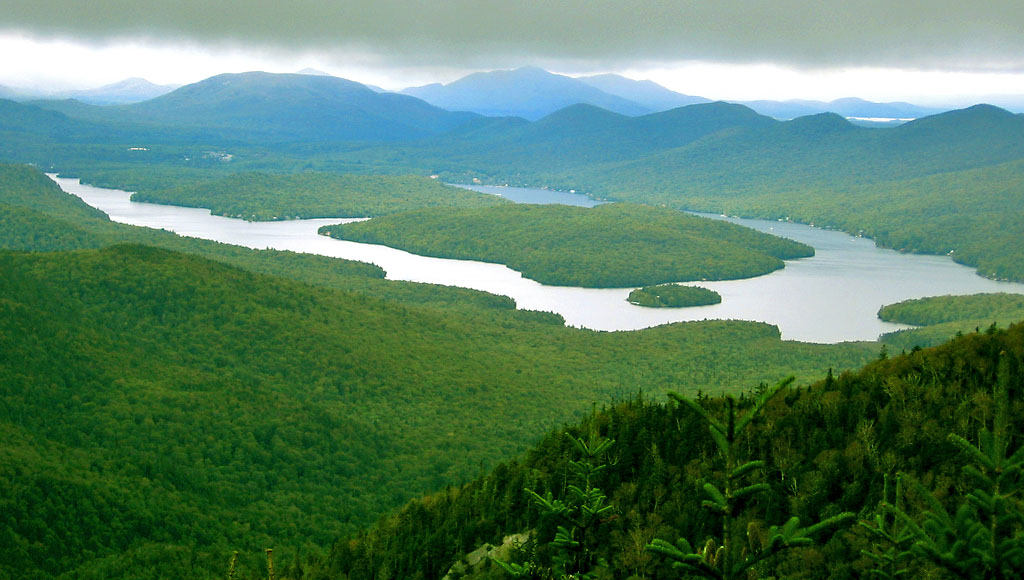
Lake Placid is a small mountain village with a huge name in sporting history: it hosted the Winter Olympic Games in 1932 and in 1980, a feat very few places in the world can claim. Set in the heart of the Adirondack Mountains, in the north of New York State, it is surrounded by crystalline lakes, endless forests and the highest summits in the state, the famous High Peaks. It is one of the great mountain and winter-sports destinations in the American Northeast.
Its Main Street, looking out over peaceful Mirror Lake, keeps the charm of a mountain village, with shops, cafés and restaurants, while the Olympic venues —the imposing ski jump, the skating center where the United States starred in the legendary 'Miracle on Ice' of 1980, the bobsled track— keep the spirit of those Games alive and are still in use for training and competitions. In winter, everything is covered in snow and the village becomes a paradise for skiers, skaters and lovers of the cold.
But Lake Placid shines all year. In summer, the Adirondacks offer hiking among the High Peaks, kayaking, cycling and the calm of its lakes; in fall, the foliage sets the mountains on fire in red and gold. This guide covers the village with a practical eye: the Olympic venues, the lakes, the mountains, how to get there and get around, where to stay and how to make the most of each season in one of the most beautiful natural corners of New York State.
The Lake Placid region, in the Adirondack Mountains, was for centuries within the territory of Algonquian- and Iroquoian-speaking Indigenous peoples, who used it as a hunting and transit area rather than for permanent settlement, given the harshness of the mountain climate. The village developed in the 19th century, first linked to iron mining and then to tourism: by the middle of that century, Lake Placid had become a summer and health-cure destination, drawing visitors from the cities in search of pure mountain air. A notable milestone was the founding of the Lake Placid Club in the late 19th century, which drove winter sports in the area. But what changed its destiny forever was the Winter Olympic Games: Lake Placid was the host in 1932 —the third Winter Games in history— and again in 1980, when the famous 'Miracle on Ice' took place, the unexpected victory of the United States hockey team over the mighty Soviet Union at the height of the Cold War. Those Games established Lake Placid as the winter-sports capital of the United States, home to elite training centers. All of this happens inside the Adirondack Park, the largest protected park in the country's contiguous states. The full story is on our history page.
Read the full history ↓The 'Empire State': heart of the Iroquois Confederacy, a Dutch colony before it was an English one, the great gateway for millions of immigrants through Ellis Island, home to the largest city in the country and to natural wonders such as Niagara Falls.
Read the history of New York →A local guide tells you in half an hour what no sign at the site will ever explain. We look ours up on Civitatis: guided in Spanish and booked online with no fuss. They have 7 activities in Quebec. And there are free tours here: you book without paying and tip the guide whatever you think at the end, so trying one costs you nothing. Have a look below: tap any of them to see them all.
They depart from Quebec, 109 km away. If you book from this link we earn a commission and you pay no more.
No exact prices: a scale from $ (budget) to $$$$$ (luxury), with 2-3 options per category.
Origins, formation and what the sources say.
The region where Lake Placid stands today is part of the Adirondack Mountains, a massif of summits, forests and lakes in the north of what is now New York State. Before European colonization, this area of harsh climate and rugged geography was traveled by Indigenous peoples speaking Algonquian and Iroquoian languages, who used it above all as a territory for hunting, fishing and passage, rather than for permanent settlement, given the severity of the mountain winters.
The name 'Adirondack' itself has an Indigenous root and is usually explained as a term that some peoples applied to others, in the context of the relations among the region's nations. The mountains marked a frontier and transit zone between different groups, and their lakes and rivers served as natural routes of communication through the forest.
With the arrival of the European settlers and, later, of the United States, the Adirondacks remained for a long time a remote and sparsely populated region, seen as wild territory. That condition of rough, barely touched nature would in time be the basis of its value: first as an area of resources and then as a great nature reserve and tourist destination.
Stable settlement in the Lake Placid area developed in the 19th century. In its beginnings, economic activity revolved around mining and ironwork, making use of the mountains' resources, in small settler communities established in this remote corner of the north of the state.
As the century went on, however, the Adirondacks began to attract a different kind of visitor. The pure mountain air, the crystalline lakes and the forests turned the region into a summer and 'health cure' destination: at a time when the mountain climate was believed to heal illnesses like tuberculosis, visitors came from the cities in search of rest and recovery. Lake Placid and its surroundings gradually filled with hotels, inns and summer houses.
An important milestone was the founding, in the late 19th century, of the Lake Placid Club, an exclusive seasonal club that drove outdoor activities and, decisively, winter sports in the area, staying open through the cold. That early bet on winter —skiing, skating, sledding— sowed the seed of what would later make Lake Placid a capital of winter sports.
Lake Placid's great leap to worldwide fame came in 1932, when the village hosted the III Winter Olympic Games, the third in history after Chamonix (1924) and St. Moritz (1928). It was the first time Winter Games were held in the United States, a remarkable fact for a place as small and remote as Lake Placid.
Organizing Games in the middle of the Great Depression was an enormous logistical and economic challenge. The village built venues for the various disciplines —skating rinks, a bobsled track, the ice stadium— and welcomed athletes and spectators from several countries. Those 1932 Games put Lake Placid on the international sporting map and left behind infrastructure and an Olympic calling that would shape the village's future.
The experience of 1932 showed that this small Adirondack village, with its winter-sports tradition inherited from the Lake Placid Club, was capable of organizing an event on a world scale. That reputation would prove decisive decades later, when Lake Placid put itself forward again to host the Games, something very few venues have managed to repeat.
Almost half a century later, in 1980, Lake Placid made history again by hosting the Winter Olympic Games for a second time (the XIII Winter Games), a rarity that very few places in the world can claim. For the occasion, the village modernized and expanded its venues, many of which are still in use today.
These Games are etched in memory for one of the most famous sporting events of the 20th century: the 'Miracle on Ice'. In the ice hockey competition, the United States team —made up of young college players and amateurs, coached by Herb Brooks— unexpectedly beat the Soviet Union team, considered the best in the world and practically unbeatable. The game, played at the height of the Cold War, took on an enormous symbolic charge and became a landmark of American culture; the team would go on to win the gold medal.
The 1980 Games were also the stage for feats like those of the speed skater Eric Heiden, who won five gold medals. After those Games, Lake Placid definitively cemented its identity as the winter-sports capital of the United States, keeping its Olympic venues in operation as elite training and competition centers.
Today's Lake Placid lives to a good extent off its double Olympic legacy. The venues of the 1932 and 1980 Games —the ski jumping complex, the Olympic Center with the Herb Brooks Arena, the bobsled and sliding track at Mount Van Hoevenberg, the Whiteface ski mountain— remain in use for elite athlete training and for international competitions, and are at the same time offered as tourist attractions that let the public get close to the Olympic world.
That inheritance turned the village into a genuine winter-sports capital of the United States, home to training centers and world-class events. The management of the venues by the regional Olympic development authority has kept the infrastructure alive, and it is periodically renewed so it can keep hosting competitions.
But Lake Placid is not only sport and Olympic nostalgia: it is, above all, a mountain village in the heart of the Adirondack Park, the largest protected park in the country's contiguous states. Its lakes, its forests and its High Peaks —with Mount Marcy, the highest summit in New York State— make the region a first-order nature destination, for hiking, skiing and outdoor life in every season. That combination of Olympic legacy and wild nature is what defines its unique identity.